The Vocabulary Problem
Ask ten logistics professionals what a transportation management solution does and you will get ten different answers. That is not because they are uninformed. It is because the category genuinely covers a wide range of distinct functions, and the market has never settled on consistent definitions.
A freight broker who needs to automate carrier tendering across hundreds of lanes is looking for something fundamentally different from a distribution company that needs to dispatch its own drivers and see them on a live map. Both will be told they need a TMS. Both will end up evaluating software built for completely different problems.
The result is a common failure mode in TMS evaluations: buyers build a feature checklist, vendors check boxes against it, and the organisation ends up with a platform that handles the problem it already had a workaround for while leaving the actual operational gap unaddressed.
The more useful question before evaluating any transportation management solution is not what features does this have, but which of these five distinct problems is my operation actually trying to solve.
The Five Problems Transportation Management Solutions Actually Address
Every platform in this guide solves one or more of these problems. Identifying which gap exists in your operation before starting an evaluation narrows the field from dozens of vendors to a short list of genuinely relevant options.
1. Freight Cost and Carrier Management
The original purpose of the TMS: controlling how much you pay to move freight and which carriers you use to move it. This covers rate shopping, carrier selection, load tendering, freight audit, invoice reconciliation, and contract management. Organisations with fragmented carrier relationships and no systematic rate comparison are the primary buyers here. The problem is almost entirely upstream of the actual delivery.
2. Transportation Planning and Execution
Building load plans, optimising consolidation, scheduling pickups, and managing the movement of freight from origin to destination. This is where enterprise freight planning platforms focus. The problem is matching freight volume to available capacity and mode at the right cost, which requires modelling complex networks of lanes, carriers, and shipment types simultaneously.
3. Real-Time Visibility and Tracking
Knowing where freight is in transit, across carriers and modes, and being able to share that information with operations teams and customers. Visibility platforms solve the problem of organisations whose freight is invisible after it leaves the loading dock. They typically sit on top of existing TMS infrastructure rather than replacing it.
4. Last-Mile Delivery Execution
Managing the physical handoff at the end of the chain: dispatching drivers, building and optimising multi-stop routes, tracking vehicles in real time, capturing proof of delivery at the door, and returning confirmed delivery status to source systems. Most freight planning TMS platforms do not cover this layer. It requires a different architecture because the problem is fundamentally different — stop-by-stop optimisation, live driver communication, and customer-facing confirmation, all happening in real time across a fleet.
5. Cross-Border Compliance and Documentation
Managing the regulatory requirements of international freight: customs documentation, trade compliance, denied party screening, and the administrative overhead of moving goods across borders. This is typically a specialist layer required by freight forwarders, importers, exporters, and enterprises with complex international supply chains.
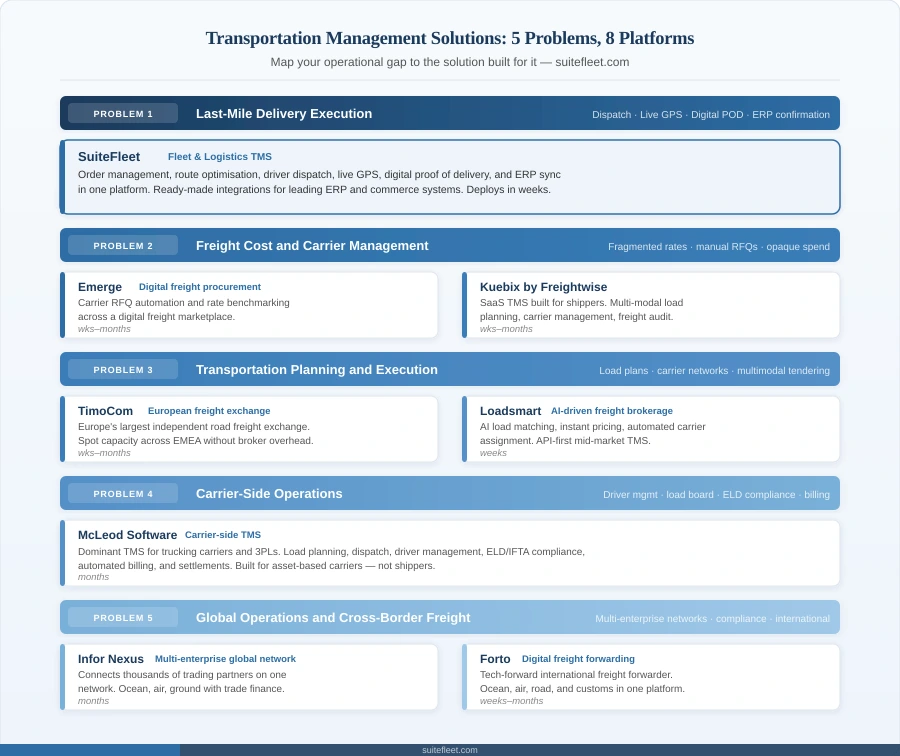
Eight Transportation Management Solution Providers: What Each One Actually Solves
The platforms below are mapped to the specific problem each one is designed for. No rankings, no scores. The right choice depends entirely on which problem your operation is trying to close.
LAST-MILE DELIVERY EXECUTION
SuiteFleet Fleet and Logistics TMS
SuiteFleet is a fleet and logistics TMS that manages the complete delivery operation from the moment an order is created to confirmed delivery and performance reporting. The platform covers order management, route optimisation, driver dispatch, live GPS tracking, digital proof of delivery, and customer notifications as a unified workflow.
Where most freight planning platforms end at load tendering, SuiteFleet picks up. Dispatchers get a single interface for assigning drivers, optimising routes dynamically, and tracking every vehicle on a live map. Drivers work from a mobile app with turn-by-turn navigation and capture proof of delivery at each stop — signature, photo, and notes — without paper or phone calls back to dispatch. Operations managers see every vehicle in real time and catch exceptions during the shift, not the next morning.
SuiteFleet connects to leading ERP, order management, and commerce platforms through ready-made integration connectors, so orders flow in automatically and confirmed delivery status returns to source systems the same day. No middleware project, no custom integration build, no manual reconciliation at end of shift.
The platform is used by fleet operators, retailers, distributors, and service businesses managing their own delivery vehicles or contracted drivers, across the Middle East and beyond. Deployment is weeks.
Core capabilities: Order management, route optimisation, dispatch, live GPS, digital POD, customer notifications, performance reporting
Integration: Ready-made connectors for ERP and commerce platforms — no custom build required
Deployment: Weeks
FREIGHT COST AND CARRIER MANAGEMENT
Emerge Digital Freight Procurement Marketplace
Emerge is a digital freight procurement marketplace built to replace the manual, email-driven carrier RFQ process that still defines how many shippers negotiate freight rates. Rather than managing carrier requests through spreadsheets and inboxes, Emerge gives shippers a structured platform for running automated RFQ cycles, comparing carrier bids side by side, and awarding freight based on price and performance data rather than relationships and guesswork.
The platform enables shippers to manage both spot and contract freight procurement in one place. Carriers access inbound load opportunities without cold outreach, and shippers build a competitive, data-backed carrier programme without the overhead of a managed freight brokerage. The result is a procurement process that takes days rather than weeks and produces verifiable market-rate benchmarks on every lane.
Emerge is used primarily by mid-to-large shippers with significant truckload and LTL volume whose freight procurement is still running through manual processes that do not scale. The ROI case is direct: better rates through genuine carrier competition, less time spent on RFQ coordination, and a defensible audit trail on every award.
Core problem: Manual carrier RFQ, fragmented rate comparison, lack of procurement structure and lane benchmarking
Best fit: Shippers with meaningful truckload and LTL volume who want to run structured, competitive freight procurement
Deployment: Weeks
TRANSPORTATION PLANNING AND EXECUTION
TimoCom European Road Freight Exchange
TimoCom is Europe's largest independent road freight exchange, connecting shippers and carriers across more than 50 countries on a single digital platform. It operates as a neutral marketplace: shippers post available freight, carriers post available truck capacity, and the matching happens through the platform rather than through bilateral contracts or broker intermediaries. With over 45,000 verified companies active on the network, TimoCom gives shippers access to spot road freight capacity across EMEA without building individual carrier relationships for every lane.
What makes TimoCom distinct from other European freight networks is its independence. It is not owned by a TMS vendor or a logistics conglomerate, which means it does not push users toward a proprietary TMS or carrier programme. Shippers use it as a procurement layer on top of whatever planning system they already run, accessing competitive capacity when contracted carriers cannot cover a lane or when spot rates are more favourable than contract rates.
TimoCom also offers a transport management module that handles order management, route planning, and shipment tracking for companies that want to manage road freight execution through the same platform they use to source capacity. For organisations whose freight is concentrated in European road lanes, it addresses both the procurement and execution layers without requiring a full enterprise TMS deployment.
Core problem: Limited spot capacity access, fragmented European carrier relationships, manual road freight procurement
Best fit: European shippers and logistics providers managing road freight across EMEA who need spot capacity and carrier network access
Deployment: Weeks
Kuebix by Freightwise Mid-Market Shipper TMS
Kuebix, now part of Freightwise, is a SaaS TMS built for shippers managing their own freight rather than freight forwarders or carriers. Its coverage spans the core shipper TMS functions: multi-modal load planning, carrier rate shopping, load tendering, shipment tracking, freight audit, and analytics, in a package that scales from small logistics teams to enterprise operations.
The platform's distinctive position in the market is its scalability model. Smaller shippers access a simplified version for basic freight management, while mid-market and enterprise users add modules, users, API access, and dedicated support as their requirements grow. This avoids the common failure mode of buying far more systems than the organisation can use, and paying for features that never get adopted.
Freightwise also offers managed transportation services alongside the software, which means shippers who want operational support rather than just a platform have the option to combine both. The managed services component is particularly useful for shippers who need faster time-to-value than a standalone implementation would deliver.
Core problem: Manual freight planning, disconnected carrier management, lack of freight spend visibility
Best fit: Mid-market shippers managing their own freight who need a scalable TMS without enterprise complexity
Deployment: Weeks to months
CARRIER-SIDE OPERATIONS AND DIGITAL FREIGHT BROKERAGE
Loadsmart AI-Powered Digital Freight Brokerage
Loadsmart is a digital freight brokerage and TMS platform built on AI-driven load matching. Its core value is speed: where traditional freight brokerage involves phone calls, manual matching, and hours of back-and-forth, Loadsmart uses machine learning to match loads to carriers instantly, confirm bookings automatically, and price freight based on real-time market signals rather than broker intuition. For shippers managing high spot freight volume, that speed translates directly into reduced booking time and more competitive rates.
The platform has expanded beyond brokerage into a full TMS layer, covering shipment visibility, carrier management, freight audit, and analytics alongside the core booking capability. Its API-first architecture connects to existing ERP and WMS systems, giving mid-market shippers a way to modernise freight operations without replacing the systems they already run. The integration approach is designed to be fast — weeks rather than months — which makes it a practical choice for companies whose IT capacity for integration projects is limited.
Loadsmart's growing suite of autonomous freight tools, including automated load building, predictive pricing, and carrier capacity prediction, positions it ahead of most traditional brokerage platforms on the AI curve. For shippers who want both the transactional efficiency of digital brokerage and the operational coverage of a TMS, the combination is increasingly difficult to replicate through separate vendors.
Core problem: Slow carrier matching, manual freight booking, lack of real-time market pricing for spot loads
Best fit: Mid-market shippers managing significant spot freight volume who want AI-driven booking speed and TMS functionality in one platform
Deployment: Weeks
McLeod Software Carrier-Side TMS
McLeod Software is the dominant TMS for the carrier side of the freight industry. Where most platforms on this list serve shippers — organisations that tender freight to carriers — McLeod serves the carrier: the trucking company, the asset-based 3PL, or the private fleet operator managing its own drivers and equipment. Its PowerBroker and LoadMaster products cover the full carrier operation, from load planning and dispatch through driver management, ELD and IFTA compliance, freight settlement, and business intelligence.
The platform's depth in carrier operations is unmatched in its segment. Driver pay, fuel tax reporting, owner-operator settlements, load board integrations, and compliance management are built into the core system rather than bolted on as afterthoughts. For a trucking company managing hundreds of drivers and thousands of loads per month, McLeod eliminates the need to patch together separate systems for dispatch, compliance, and back-office settlement.
McLeod is not a shipper TMS, and it is not designed to be evaluated alongside platforms that manage freight procurement or last-mile delivery. The distinction determines whether it belongs in an evaluation at all. For carriers and 3PLs running their own fleet, it is purpose-built for exactly the operational complexity they face. For shippers, it is the wrong tool regardless of how it performs on a feature matrix.
Core problem: Fragmented carrier operations: load planning, driver management, compliance, and settlement running on disconnected systems
Best fit: Trucking carriers, asset-based 3PLs, and private fleet operators managing their own drivers and equipment
Deployment: Months
GLOBAL OPERATIONS AND CROSS-BORDER COMPLIANCE
Infor Nexus Multi-Enterprise Global TMS
Infor Nexus operates as a multi-enterprise network platform for global supply chains. Its architecture connects thousands of trading partners — suppliers, manufacturers, carriers, freight forwarders, customs brokers, and financial institutions — on a shared data network, so shipment information flows between parties without bilateral integrations. Instead of each company building point-to-point connections to every partner, they connect once to the network.
The platform covers global order management, multi-modal transportation execution, real-time visibility across ocean, air, and ground, and trade finance capabilities. It is used primarily by large enterprises managing complex international supply chains with significant supplier and carrier diversity. The network effect is its core differentiator: the more trading partners already connected, the less integration work each new participant needs to do.
Infor Nexus is not a fit for organisations whose freight is primarily domestic or whose supply chain complexity does not justify the overhead of a multi-enterprise network platform. For organisations managing global supply chains with dozens of suppliers and carriers across multiple regions and modes, however, it addresses a category of coordination problem that bilateral integrations cannot scale to solve.
Core problem: Fragmented global supply chain visibility, bilateral integration complexity, trade finance coordination
Best fit: Large enterprises managing complex international supply chains across multiple regions and trading partners
Deployment: Months
Forto Digital Freight Forwarding Platform
Forto is a tech-forward freight forwarder that operates as both a digital platform and a full logistics service. Its architecture covers ocean, air, road, and customs in a single interface — not through integrations with third-party forwarders, but through Forto's own operations and carrier network. For importers and exporters who want the visibility and control of a TMS alongside the execution of a managed forwarding service, the combination addresses a gap that software-only platforms cannot fill.
The platform is built for the transparency problem that has historically defined international freight: shipments that disappear into the forwarding chain and surface again only when something goes wrong. Forto gives customers a live view of every shipment across all modes, with proactive exception management that flags issues before they become delays rather than after. That combination of real-time data and operational accountability is what differentiates it from traditional freight forwarders who operate largely as black boxes.
Forto is headquartered in Berlin with operations across Europe, the Middle East, and Asia. Its focus on mid-to-large enterprises managing significant international freight volume makes it most relevant for organisations where cross-border complexity, documentation overhead, and global supply chain visibility are the primary problems rather than domestic last-mile execution.
Core problem: Fragmented international freight visibility, documentation overhead, lack of accountability in cross-border shipments
Best fit: Importers and exporters managing international freight across ocean, air, and road who want a single platform with full operational accountability
Deployment: Weeks to months
The Question Most TMS Evaluations Skip
Most transportation management solution evaluations start with a feature list. The procurement team assembles requirements, vendors respond with capability matrices, and the organisation picks the platform with the highest score. The problem is that feature lists rarely identify which specific operational gap the organisation is trying to close.
The more useful starting question is: at what point in our supply chain does the problem occur?
If freight is moving but costs are uncontrolled and carrier management is fragmented, the problem is upstream. Emerge, Kuebix, TimoCom, and Loadsmart are designed for it.
If freight is moving through a complex global network with compliance and documentation overhead, the problem is international. Infor Nexus and Forto are designed for it.
If freight is moving but nobody, not operations, not customer service, not the customer, can see where it is, the problem is visibility. Loadsmart's tracking layer, TimoCom's real-time network, and standalone visibility platforms address it.
If freight planning is working but what happens after dispatch is invisible, unpredictable, and disconnected from the ERP, the problem is last-mile execution. That is a different category entirely, and most freight planning platforms leave it open by design.
The Last-Mile Execution Gap
Enterprise freight planning platforms were designed to manage the procurement and planning of freight at scale. They model carrier networks, optimise load consolidation, manage rate contracts, and produce outbound shipment plans with precision. What happens after the load is tendered is outside the design specification of most of them.
For organisations running their own delivery fleet or contracted drivers, that gap is where the operation actually lives. Drivers make stops. Customers are not home. Deliveries are refused. Routes run over time. None of that is visible in a freight planning TMS. None of it flows back to the ERP automatically.
The plan and the execution exist in separate worlds, and the reconciliation between them happens through phone calls, messaging apps, and end-of-day driver reports. The operations manager finds out what went wrong the next morning. The customer finds out after they call in.
This is the structural gap that last-mile TMS platforms are built to close. They pick up where freight planning ends: dispatching drivers, optimising routes stop by stop, tracking every vehicle in real time, capturing proof of delivery at the door, notifying customers automatically, and returning confirmed delivery status to the ERP the same day.
SuiteFleet covers this execution layer. It connects to the ERP and order management systems businesses already run, so orders arrive automatically and confirmed delivery data returns without anyone touching it. The complete delivery operation, from dispatch to doorstep confirmation, runs through one system rather than across WhatsApp threads, spreadsheets, and a dispatcher staring at Google Maps.
For organisations already running a freight planning TMS, SuiteFleet completes the loop. For organisations where last-mile execution is the primary operational challenge and freight procurement is not, it addresses the problem directly without the overhead of an enterprise freight platform.
Finding the Right Transportation Management Solution for Your Operation
The table below maps operational situations to the solution built for each one. It is not a ranking. The right choice depends on which problem your operation is trying to solve.
See SuiteFleet for Last-Mile Execution
SuiteFleet closes the execution gap that freight planning platforms leave open. Dispatch, live tracking, digital proof of delivery, and ERP sync in one platform, deployed in weeks. Book a demo at suitefleet.com/demo.