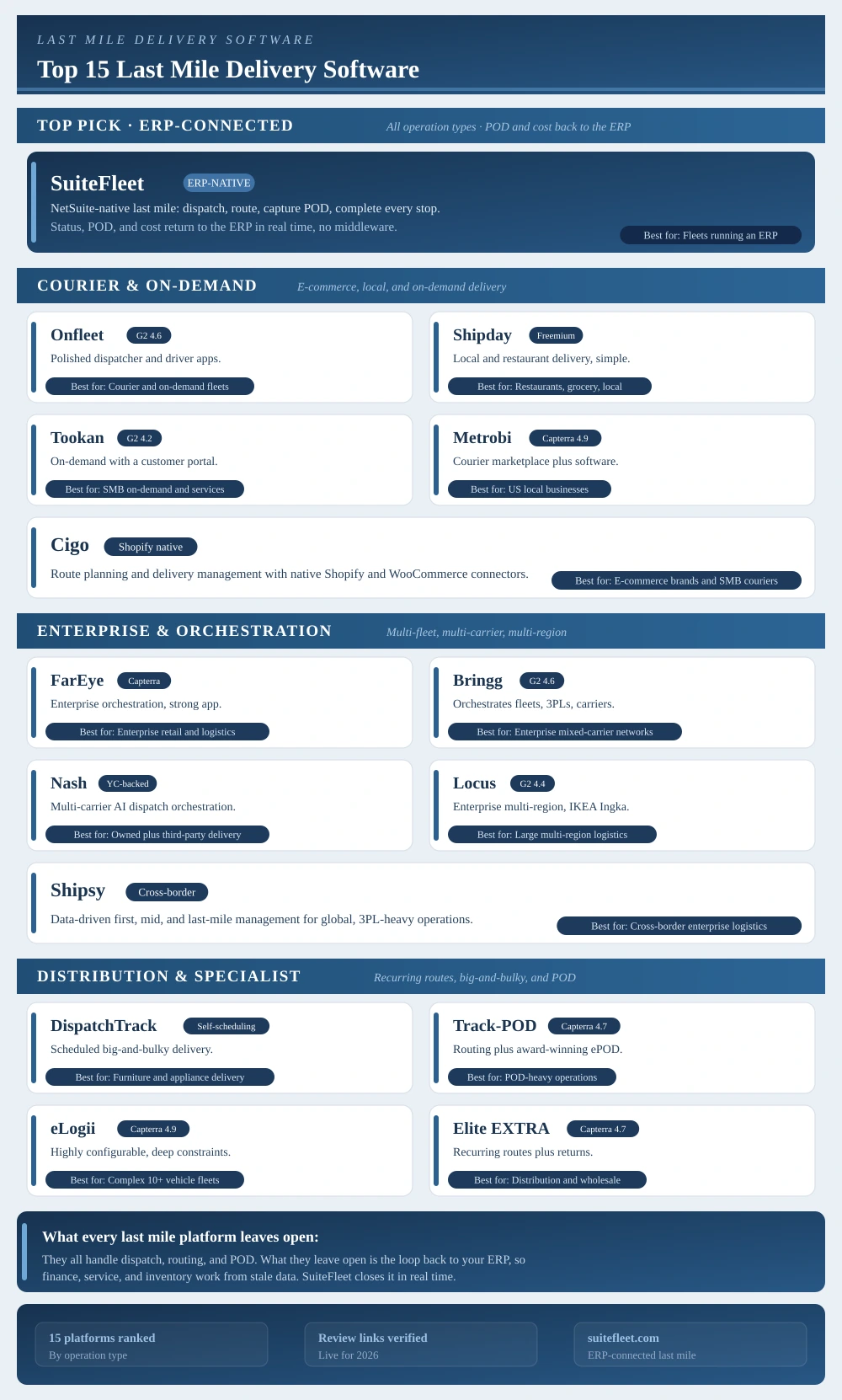
Every category comparison for final mile delivery software looks the same. A ranked list. Feature checkboxes. A pricing table. A winner announced.
The problem is not that these comparisons are inaccurate. The problem is that they answer the wrong question. The right question is not which platform has the most features. The right question is which platform is the right fit for the specific operation you run, the ERP you already depend on, and the failure modes you cannot afford.
This guide does not rank platforms. It gives operations teams the framework to evaluate any platform against what actually matters: the cost of getting the selection wrong, the five operation types that need fundamentally different things, the seven criteria that separate good implementations from expensive mistakes, and the red flags that tell you a platform will underperform before you sign a contract.
What Final Mile Delivery Actually Costs
Final mile delivery accounts for between thirty and fifty-five percent of total shipping cost depending on the sector. For most operations, it is the most expensive leg of the supply chain and the one with the most direct impact on customer experience. A failed delivery in a warehouse costs money. A failed delivery to a customer costs money and trust simultaneously.
Software selection mistakes in this category are expensive in ways that are not always obvious at the point of purchase. The visible costs are implementation fees, training time, and migration work. The invisible costs are harder to quantify but often larger: manual reconciliation between systems that do not talk to each other, dispatchers spending hours rescheduling failed attempts that a well-configured platform would handle automatically, and reporting that requires exporting data to spreadsheets because the tool does not connect to the ERP where financial decisions are actually made.
The other cost is switching. Final mile delivery software is operationally embedded. Drivers are trained on the app. Dispatchers build workflows around the interface. Integrations are configured. A platform that works adequately for two years but fails to scale with the business, or that turns out to have a shallow ERP integration that was never surfaced in the sales process, costs significantly more to replace than it cost to implement.
The framework principle: Evaluate platforms against the total cost of a wrong decision, not against the feature list on a sales deck. The question is not what the software can do in a demo. The question is what it does when a delivery fails at 4pm and your dispatcher is unavailable.
Five Operation Types That Need Different Things
Final mile delivery software is often marketed as a universal category. In practice, the operational requirements of an e-commerce courier business share very little with the requirements of a temperature-sensitive pharmaceutical distributor. Matching the platform to the operation type is the first and most important step in any evaluation.
1. E-Commerce Courier
E-commerce courier operations are defined by volume variability, thin margins, and customer expectation for self-service visibility. Orders spike without warning. Customers expect a real-time tracking link, not a phone call from a dispatcher. Returns are frequent and must be handled through the same platform to avoid creating a separate operational silo.
The primary software requirements for this operation type are: native integration with the storefront platform (Shopify, WooCommerce, or equivalent), automated dispatch that can handle surge volume without manual intervention, a customer-facing tracking portal that updates in real time, and a returns dispatch workflow that runs alongside outbound delivery rather than separately.
2. Distribution Fleet
Distribution fleets typically run recurring routes with established customer accounts. The routing problem is less about dynamic optimization and more about consistent territory management, reliable ETA communication to trade accounts, and accurate proof of delivery that feeds back into invoicing. The ERP integration requirement here is high: delivery status needs to update the order record, and proof of delivery needs to trigger invoice workflows without manual intervention.
Returns are also significant in distribution. When a driver completes a route that includes both outbound deliveries and return pickups from previous orders, the platform needs to handle both workflows within the same dispatch job rather than requiring the driver to switch between systems.
3. Enterprise Mixed-Carrier
Enterprise operations that route deliveries across a mix of internal fleet, regional couriers, and national carriers face an orchestration problem that single-fleet tools cannot solve. The dispatcher does not just need to know where the internal drivers are. They need a unified view of every delivery regardless of which carrier is executing it, with consistent customer communication and SLA monitoring across all partners.
Software requirements for this type include carrier orchestration (routing orders to the appropriate delivery partner based on cost, capacity, and service level rules), a single reporting layer that aggregates performance across internal and third-party carriers, and enterprise-grade ERP and TMS integration.
4. Field Service Delivery
Field service delivery involves delivering and often installing goods, requiring coordination between delivery timing and technician availability. The dispatch problem is more complex than a standard parcel route: jobs have skills requirements (the driver delivering and installing a piece of industrial equipment needs different capabilities than a standard courier), time windows are often customer-selected and non-negotiable, and proof of delivery includes more than a signature.
The driver app requirements are higher in this type: job checklists, photo documentation at each stage of an installation, and the ability to capture customer sign-off against a specific service record rather than just a delivery confirmation.
5. Temperature-Sensitive and Perishables
Temperature-sensitive operations add compliance requirements to every layer of the dispatch stack. Time windows are not preferences; they are operational constraints with direct health and safety implications. Proof of delivery must capture chain-of-custody information alongside the standard confirmation. Driver apps need to support temperature logging at delivery points in some regulated categories.
The ERP integration requirement is also elevated because inventory positioning for perishable stock depends on accurate, real-time delivery status. A delivery that completes an hour late has implications for the next stock replenishment cycle, not just for the individual customer.
The Seven Evaluation Criteria That Actually Matter
Most platform comparisons focus on features: does it have route optimization, real-time tracking, a driver app, customer notifications. By 2026, every credible platform in this category has all of those things. The question is not whether those capabilities exist. The question is how deeply they are implemented, whether they connect to the rest of your stack, and whether they hold up under operational pressure.
These seven criteria are what separate platforms that perform reliably in production from platforms that look strong in a demo and underperform in the field.

1. ERP Integration Depth
ERP integration is the most commonly overstated capability in this category. Every platform claims to integrate with major ERPs. What that claim means in practice varies enormously.
A shallow integration syncs orders one way, from the ERP to the delivery tool. A deep integration syncs bidirectionally: orders flow in, delivery status updates flow back, and proof of delivery attaches to the order record automatically. A deep integration means a completed delivery triggers invoice workflows in the ERP without a human exporting a report and importing it into a different system.
The test: ask the vendor to show you a completed delivery updating the order record in your ERP in real time during the demo. If that demonstration requires manual steps, the integration is not deep enough.
2. Failed Delivery Logic
Every operation experiences failed delivery attempts. The question is not whether failures happen. The question is what the platform does automatically when one occurs.
A well-configured platform captures the failure reason (customer absent, address inaccessible, refused, damaged), sends an automated notification to the customer with a rescheduling option, creates a new delivery job in the queue without dispatcher intervention, and logs the failure against the driver and route for pattern analysis.
A platform that treats a failed attempt as a closed event with no automatic downstream action is creating manual work that compounds with volume. At ten failures a day, that work is manageable. At a hundred, it becomes a bottleneck.
3. Driver App Adoption Rate
Driver app quality is the most underweighted criterion in most evaluations and the one that causes the most operational failures after go-live. A dispatch system that optimizes routes and assigns jobs efficiently at the planning layer delivers none of that value if drivers do not use the app as intended.
Poor adoption manifests as drivers calling dispatchers for information that should be in the app, proof of delivery being captured on personal phones and texted rather than logged in the system, and exception handling happening through WhatsApp rather than through structured in-app communication.
The test is simple: give the app to a driver who has never seen it and time how long before they can navigate to a job, mark it in progress, and capture proof of delivery. Any platform that requires more than ten minutes of onboarding for that workflow will have adoption problems in a fleet with driver turnover.
4. POD Data Loop Closure
Proof of delivery is only valuable if it is accessible to the teams that need it. In too many implementations, POD lives inside the delivery tool and stays there. The customer service team cannot access it to resolve a dispute. The finance team cannot access it to validate an invoice query. The ERP does not know it exists.
Evaluate where POD data goes after capture. Does it write to the order record in the ERP automatically? Is it accessible in the customer account without logging into the delivery platform? Does it trigger any downstream workflow (invoice approval, customer notification, driver performance record) automatically or does it sit inert until someone exports it?
5. Reverse Logistics Integration
Returns handling is frequently treated as an afterthought in final mile software evaluations and frequently becomes a significant operational problem after implementation. For any operation with meaningful return volumes, the platform needs to handle reverse logistics inside the same dispatch workflow as outbound delivery, not in a separate system.
The practical test: can a driver's route for Tuesday include both outbound deliveries and scheduled return pickups from Monday's failed deliveries, dispatched and tracked inside the same interface? If returns require a different login, a different app, or a phone call to schedule, the reverse logistics capability is insufficient.
6. Scalability Under Volume Pressure
Most platforms perform well under average load. The relevant test is performance under peak conditions: the distribution operation running twice its normal daily volume in the week before a holiday, the e-commerce brand managing a spike from a promotional campaign, the enterprise operation handling an unexpected carrier failure that requires rapid reallocation.
Questions to ask: what is the platform's documented uptime SLA and what happens to deliveries in progress during an outage? How does route optimization performance change when order volume doubles? What is the maximum number of simultaneous active deliveries the system has handled for a customer similar to your operation?
7. Reporting Without Manual Assembly
Reporting quality is consistently underestimated in platform evaluations. The question is not whether the platform has a reporting module. The question is whether the metrics that matter to your operation are available in real time without requiring anyone to export data and rebuild it in a spreadsheet.
On-time delivery rate, cost per delivery, failed attempt rate by route and driver, and return processing time should all be available from a single dashboard that pulls live data. If producing a weekly operational report requires an analyst to export three files and combine them, the reporting layer is not connected to the operational layer. That gap grows more expensive as the business scales.
What a Demo Should Prove
A software demo is a controlled environment designed to show the platform at its best. The scenarios that expose capability gaps are rarely the ones the vendor chooses to demonstrate. Run these eight tests in every final mile delivery software evaluation.
- Live ERP writeback: Ask the vendor to complete a test delivery during the demo and show you where the order status updates in your ERP (or a comparable ERP environment) within thirty seconds of the driver marking it complete.
- Failed attempt simulation: Have the vendor simulate a failed first delivery attempt. Watch what happens automatically: does the customer receive a notification, does a rescheduled job appear in the queue, is the failure reason logged? Count the manual steps required.
- Driver app cold start: Give the driver app to someone in the room who has not used it before. Ask them to accept a job, navigate to the delivery point, and capture proof of delivery. Note how long it takes and how many steps are required.
- Route disruption mid-day: Ask the vendor to simulate a driver dropping out mid-route and show how the platform reassigns their remaining stops. Evaluate how long the process takes and what the dispatcher is required to do manually.
- Return pickup on an outbound route: Ask the vendor to schedule a return pickup on the same route as outbound deliveries and show the driver's app view. Confirm the return job flows through the same interface without requiring a separate login or system.
- Peak volume test: Ask what the platform's largest single-day customer volume is and request a reference from an operation of comparable scale. Ask specifically about performance during peak periods.
- POD access outside the platform: After capturing a proof of delivery in the demo, show where that POD is accessible in the ERP order record, in the customer account, and in the finance workflow. Count the steps required to find it from the finance team's perspective.
- Live operational dashboard: Ask to see the on-time delivery rate, cost per delivery, and failed attempt rate for today's operations without any export or data preparation. If the vendor cannot show that live, the reporting layer is not connected to the operational layer.
Five Red Flags That Indicate a Platform Will Underperform
These patterns appear consistently in implementations that underperform. None of them are visible from a feature list. All of them are discoverable in a thorough evaluation.
A sixth pattern worth noting: vendors who struggle to answer direct questions about ERP writeback, POD data flow, or failed delivery automation during the sales process will not have better answers during implementation. Ambiguity at the evaluation stage is a reliable indicator of capability gaps.
How to Build Your Shortlist: A Decision Matrix by Operation Type
The table below maps the five operation types to the criteria that carry the most weight for each. Use it to prioritise your evaluation criteria before beginning vendor conversations, not after.
The matrix is a starting point, not a formula. An e-commerce courier operating at enterprise scale will have higher ERP integration requirements than the matrix suggests. A distribution fleet expanding into e-commerce fulfillment will need to weight the customer-facing tracking layer more heavily. Adjust the priority weightings to match the specific shape of your operation.
The most reliable approach: take the three criteria that are highest priority for your operation type, define what a strong answer looks like for each one (using the demo tests above), and eliminate any platform that cannot demonstrate those three capabilities in the evaluation process. The remaining shortlist will be small enough to evaluate in depth against secondary criteria.
When the Evaluation Is Done, the Integration Question Remains
The evaluation framework above will help you identify the platform that handles final mile execution well for your operation type. What it will not resolve on its own is whether that platform closes the data loop to the ERP systems your broader operation depends on.
Delivery execution and ERP data are the two halves of a single operational picture. When they connect, dispatchers, finance teams, and customer service teams all work from the same current reality. When they do not, every team compensates with manual effort that grows with volume and shrinks the margin that good final mile software was meant to create.
SuiteFleet connects final mile delivery execution to the ERP layer so delivery status, proof of delivery, and return records update the systems your business already runs on, automatically and in real time. Request a demo to see how it fits the stack you already have.