TL;DR: The 7 best quick commerce delivery management software platforms are SuiteFleet (ERP-connected last-mile for Q-commerce operators on NetSuite, SAP, Dynamics, and Odoo), Shipsy (AI-native enterprise platform for high-volume food and grocery networks), FarEye (enterprise grocery retailer last-mile with strong carrier orchestration), Bringg (multi-carrier Q-commerce delivery orchestration for enterprise brands), Onfleet (SMB and mid-market on-demand delivery with a clean interface), Hyperzod (full-stack Q-commerce storefront and delivery platform for operators building their own dark store network), and Tookan (white-label dispatch platform for multi-vertical Q-commerce). Mapped below by use case, ERP integration depth, and operational scale.
The Q-commerce delivery problem is not a shortage of software. It is a shortage of the right software for the right operation. A grocery startup running three dark stores in Dubai needs fundamentally different tools than an enterprise FMCG brand managing fifty micro-fulfillment centers across the GCC. A Q-commerce operator on Oracle NetSuite needs a platform that closes the ERP loop. A multi-carrier 3PL running Q-commerce deliveries for retail brands needs orchestration capabilities, not a single-fleet dispatch tool.
The seven platforms below cover the full range of Q-commerce delivery management needs. Each entry maps what the platform does, who it fits, and where its limitations sit. SuiteFleet leads the list for ERP-connected operators. The others are positioned based on the operational problems they actually solve.
The 7 Quick Commerce Delivery Management Software Platforms at a Glance
1. SuiteFleet
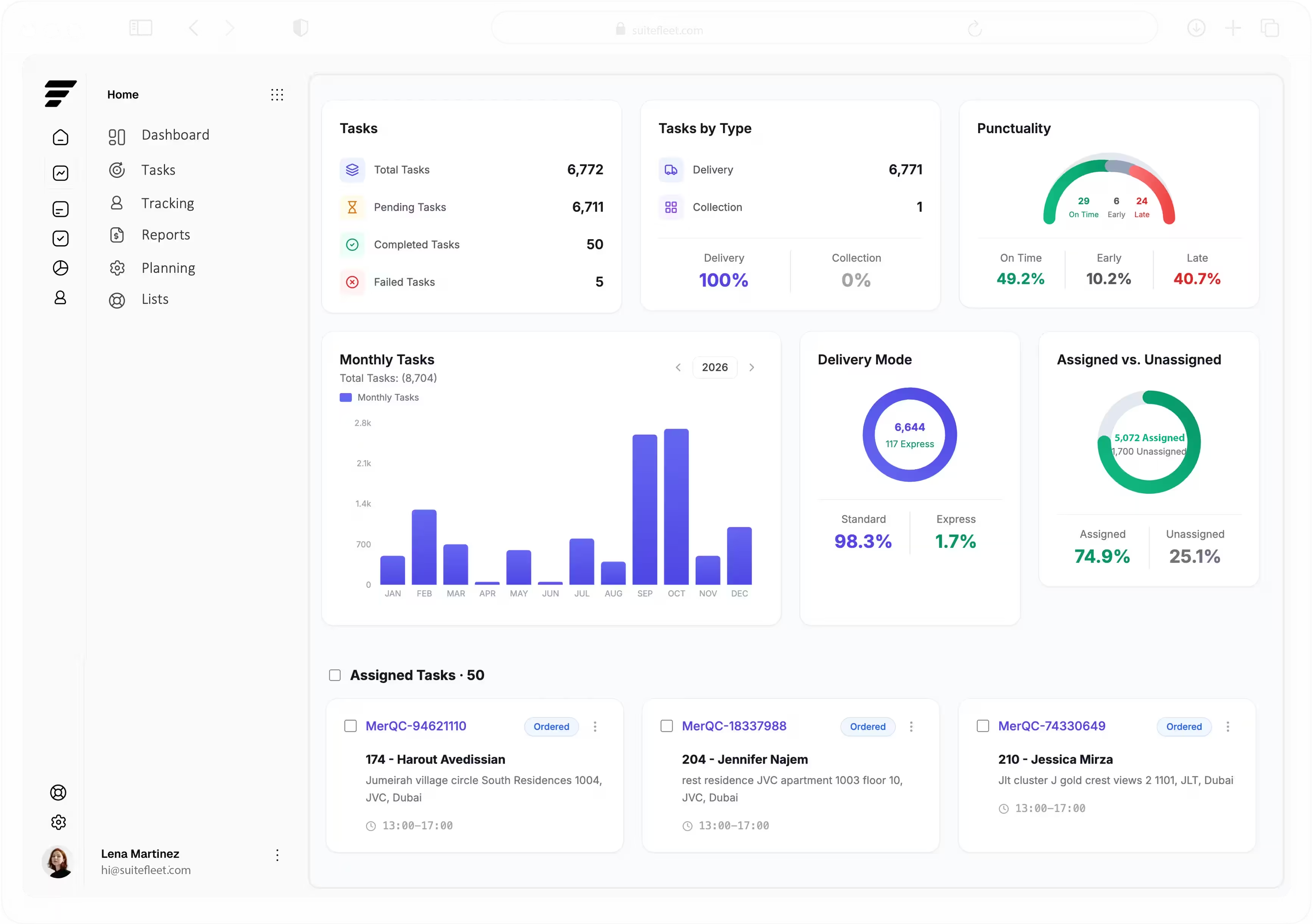
Best for: Q-commerce operators running Oracle NetSuite, SAP, Microsoft Dynamics, or Odoo who need last-mile delivery execution connected directly to their ERP
SuiteFleet is the only last-mile delivery platform in this list with native, certified ERP connectivity across the major platforms used by Q-commerce operators in the Middle East, MENA, and globally. Built by Azdan, a certified Oracle NetSuite Solutions Provider, SuiteFleet was purpose-built to close the gap between the ERP order record and the physical delivery event — without middleware, without nightly batch syncs, and without manual reconciliation.
For Q-commerce specifically, SuiteFleet handles the complete delivery execution layer that sits between the dark store and the customer door: on-demand dispatch, dynamic route optimization, real-time fleet tracking, digital proof of delivery, and ERP data return — all from a single platform.
Key strengths
- Native SuiteApp for Oracle NetSuite — orders flow from NetSuite to dispatch automatically, POD writes back to NetSuite records at delivery completion
- Direct connectors for SAP Business One, SAP S/4HANA, Microsoft Dynamics 365, and Odoo without middleware
- On-demand dispatch with real-time route optimization calibrated for hyperlocal Q-commerce delivery windows
- Arabic-first driver mobile app — essential for Q-commerce fleets in MENA and GCC markets where driver workforces are primarily Arabic, Urdu, or South Asian language speakers
- Agentic AI for logistics — autonomous dispatch decisions without dispatcher manual approval, scaling Q-commerce operations without proportional headcount growth
- Customer delivery tracking portal with live driver GPS and dynamic ETAs
- WhatsApp-native customer notifications — critical for MENA Q-commerce markets where WhatsApp is the primary consumer communication channel
- COD (cash on delivery) workflow management — built for Q-commerce operators in Egypt, Saudi Arabia, Jordan, and Lebanon where COD rates run 30 to 70 percent
Why it stands out
Most Q-commerce delivery platforms treat ERP integration as an add-on. SuiteFleet treats it as the product foundation. Every delivery event — dispatch, en-route status, completion, proof of delivery, return — writes back to the ERP in real time, not overnight. For operators whose financial reconciliation, invoice triggering, and inventory management depend on delivery data being accurate and current, this is not a preference — it is an operational requirement.
SuiteFleet is also the only platform in this list with regional specificity for the Middle East Q-commerce market: Arabic-language driver apps, COD workflow management, WhatsApp notification integration, and route optimization calibrated for Cairo, Riyadh, Dubai, Doha, and other dense MENA urban environments where Q-commerce is growing fastest.
See: Quick Commerce Operations | On-Demand Delivery Management | Dark Store Delivery Management | Agentic AI for Logistics
2. Shipsy

Best for: Large enterprise Q-commerce operators with high-volume food, grocery, and multi-vertical delivery networks
Shipsy is an AI-native logistics platform positioned for enterprise food delivery, grocery, and quick commerce at scale. Its Q-commerce offering covers intelligent dispatch, route optimization, driver gamification, and AI-driven customer experience across hyperlocal delivery networks. The platform has shipped significant R&D investment into what it calls "AI agents" for logistics automation, marketed under its AgentFlow and AgentFleet products.
Shipsy targets the large end of the Q-commerce market — operators running thousands of orders per day across complex networks, typically in South Asia and the Middle East. Its customer base includes enterprise brands across India, UAE, Saudi Arabia, and Southeast Asia.
Key strengths
- AI-native dispatch with intelligent order allocation across driver fleets
- Driver gamification tools — performance scoring and incentive management to reduce turnover in high-churn Q-commerce driver workforces
- Multi-vertical coverage: food delivery, grocery, and general Q-commerce under a single platform
- Geocoding microservice for improving address match rates in informal address environments
- Real-time tracking and customer notification automation
- AgentFlow AI agents for autonomous logistics decisions at scale
Why it stands out
Shipsy's driver gamification capability is a genuine differentiator — high driver turnover is a significant cost and operational quality issue in Q-commerce markets, and platforms that address retention at the software level rather than purely at the compensation level solve a real problem. The AI agent investment is also meaningful for operators looking to reduce dispatcher headcount dependency at scale.
Limitation: Shipsy's ERP integration requires custom API work — it does not offer the pre-built, certified ERP connectors that operators on NetSuite, SAP, or Dynamics need for clean bidirectional data sync without an integration project.
3. FarEye

Best for: Established grocery and retail brands expanding to quick commerce with existing last-mile operations
FarEye is an enterprise last-mile delivery platform with a specific positioning for grocery, retail, and now quick commerce. It covers route planning, dynamic routing, EV routing, customer experience management, and returns management. FarEye has a strong presence in enterprise retail and grocery accounts and has positioned itself for the Q-commerce transition that brick-and-mortar grocery chains are making.
FarEye's grocery platform emphasizes customer experience features — delivery scheduling, branded tracking pages, and post-delivery feedback loops — alongside route optimization and carrier management.
Key strengths
- Purpose-built grocery and quick commerce industry vertical
- EV routing capability — useful for Q-commerce operators transitioning to electric delivery fleets under green logistics mandates
- Returns management integrated with the delivery platform
- Carrier orchestration across owned fleet and third-party carriers
- Sustainability reporting — carbon footprint tracking per delivery for enterprise sustainability commitments
- Territory planning tools for Q-commerce zone management
Why it stands out
FarEye is one of the few platforms in this category with built-in EV routing and sustainability reporting — relevant for Q-commerce operators in markets with active fleet electrification mandates (Singapore, UK, Western Europe) or ESG reporting requirements. Its grocery industry vertical focus also means the platform was designed for the product category and operational model that defines most Q-commerce operations, rather than adapted from a general logistics platform.
Limitation: FarEye is enterprise-targeted and enterprise-priced. For Q-commerce operators below a certain volume threshold, the implementation overhead and platform cost relative to operational scale makes it a difficult ROI case. ERP integration requires custom connector work.
4. Bringg

Best for: Enterprise brand operators running Q-commerce through a mix of owned fleet, 3PL carriers, and crowdsourced drivers
Bringg is a delivery orchestration platform built for enterprise brands managing complex multi-channel delivery operations. In the Q-commerce context, Bringg is used by brands that need to route deliveries across their own dark store fleet, partner couriers, and on-demand crowdsourced drivers — all from a single dispatch view.
Bringg's strength is orchestration logic: the ability to apply business rules that determine which delivery type (owned, 3PL, crowdsourced) handles which order based on zone, time, cost, and SLA. This is valuable for Q-commerce operators scaling beyond a single-fleet model.
Key strengths
- Multi-carrier and multi-fleet delivery orchestration from a single platform
- Delivery-as-a-service marketplace integration — connecting to third-party carrier networks for overflow capacity
- White-label customer experience with branded tracking and notifications
- Delivery windows and slot management for scheduled Q-commerce delivery
- Real-time operations view across all carrier types simultaneously
- Enterprise-grade APIs for custom integration
Why it stands out
For Q-commerce operators who have outgrown single-fleet dispatch and need to coordinate owned drivers, 3PL partners, and crowdsourced capacity dynamically, Bringg's orchestration model is genuinely differentiated. The ability to apply cost and SLA rules to automatically route to the optimal carrier per order — rather than manually managing carrier allocation — is operationally valuable at scale.
Limitation: Bringg's platform depth comes at enterprise pricing and implementation complexity. It does not offer pre-built ERP connectors for NetSuite, SAP, or Dynamics — integration requires API development. The multi-carrier orchestration model also assumes the operator has multiple carrier relationships to manage, which is less relevant for single-fleet Q-commerce operators.
5. Onfleet
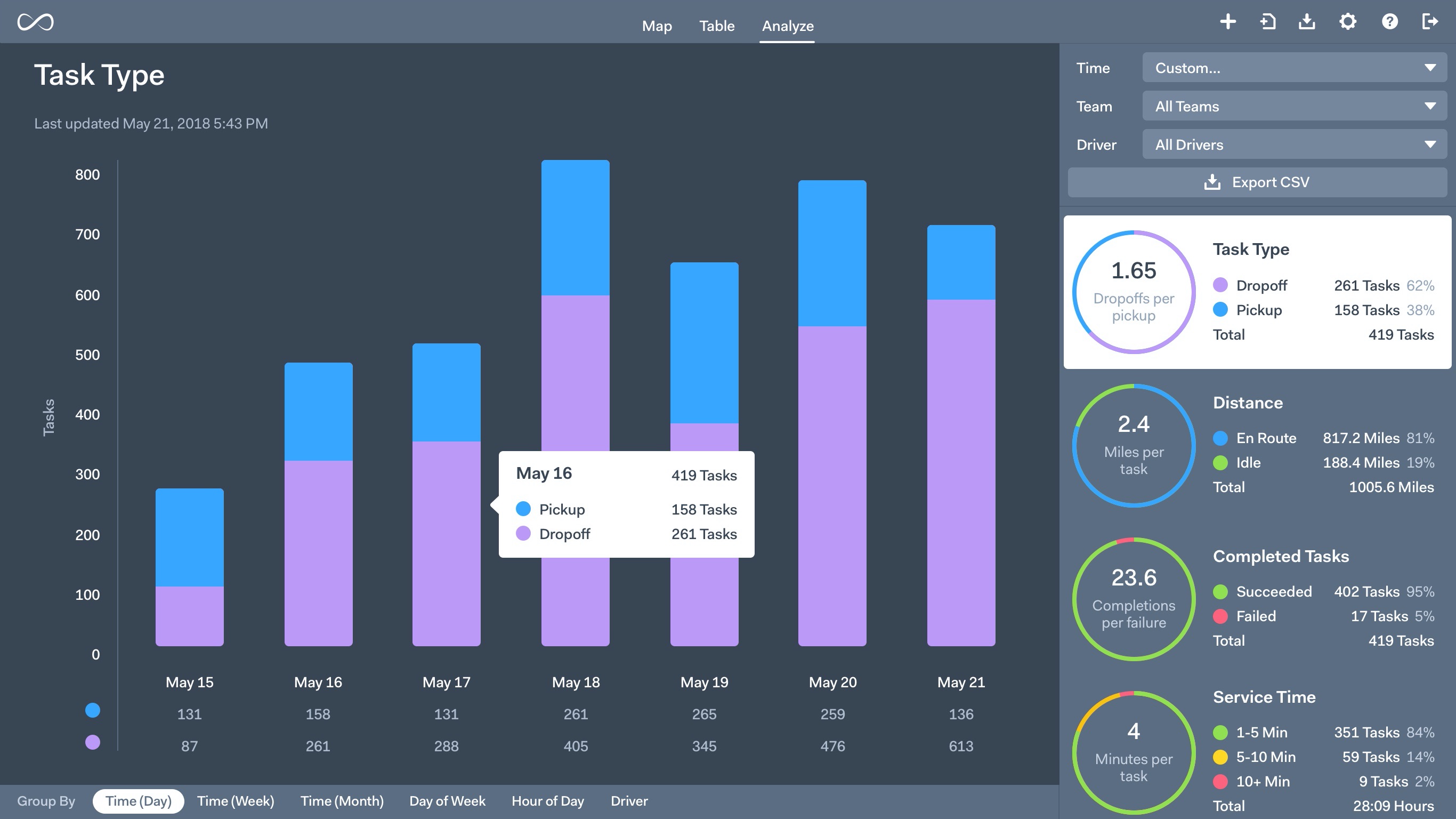
Best for: Small to mid-market Q-commerce operators who need clean on-demand dispatch and routing without enterprise complexity
Onfleet is one of the most widely used last-mile delivery management platforms globally, particularly among SMB and mid-market operators in e-commerce, food delivery, grocery, and healthcare. It covers dispatch, route optimization, real-time tracking, proof of delivery, and customer notifications with a notably clean interface that supports rapid onboarding.
In the Q-commerce context, Onfleet is used by dark store operators, grocery delivery startups, and on-demand delivery companies managing fleets up to a few hundred drivers. Its per-task pricing model makes it accessible for growing operations without upfront enterprise commitment.
Key strengths
- Clean, intuitive dispatcher interface with a shallow learning curve
- Dynamic route optimization with real-time traffic integration
- Digital proof of delivery with photo and signature capture
- Automated customer SMS notifications with live tracking links
- Driver iOS and Android app with turn-by-turn navigation
- Webhooks and REST API for custom integrations
- Per-task pricing accessible to growing operations
Why it stands out
Onfleet's interface quality is consistently cited as a differentiator in user reviews. For Q-commerce operators whose dispatchers are not logistics technology specialists, the platform's usability reduces training time and adoption friction. Its per-task pricing also makes it financially accessible for operators in the growth phase before volume justifies enterprise platform investment.
Limitation: Onfleet does not offer pre-built ERP connectors — integration with NetSuite, SAP, or Dynamics requires custom API work or third-party middleware. It was designed for single-fleet operations; multi-client and multi-fleet Q-commerce orchestration is not a native capability. As operations scale, custom integration and operational complexity can drive total cost of ownership above enterprise platform alternatives.
6. Hyperzod

Best for: Q-commerce startups and operators building a vertically integrated dark store business with a branded storefront and owned delivery fleet
Hyperzod takes a different positioning from the other platforms in this list. Where Shipsy, FarEye, Bringg, and SuiteFleet focus on the delivery execution layer, Hyperzod provides the complete Q-commerce technology stack: branded consumer ordering app, merchant app, driver app, and an admin panel — under a single white-label product.
Hyperzod's target customer is the Q-commerce operator who does not yet have a storefront technology layer and needs to build one alongside their delivery infrastructure. This is common in emerging Q-commerce markets where operators are building the customer-facing and operational layers simultaneously rather than layering delivery on top of existing e-commerce platforms.
Key strengths
- Complete white-label Q-commerce technology stack — ordering app, merchant app, driver app, and admin panel
- Autozod automated delivery management within the platform
- Multi-vendor marketplace capability for operators aggregating multiple dark store merchants
- Branded consumer iOS and Android ordering apps included
- Real-time driver tracking visible to consumers through the ordering app
- Industry verticals: grocery, food, pharmacy, fashion, accessories, and pet supplies
Why it stands out
For a Q-commerce operator building from scratch — particularly in a market where they cannot rely on Shopify or WooCommerce storefronts for the consumer-facing layer — Hyperzod's all-in-one stack removes the integration work between the ordering platform and the delivery platform. The consumer experience, merchant management, and driver dispatch are on the same system from day one.
Limitation: Hyperzod is a full-stack product designed for operators building new businesses, not for integrating into an existing ERP or e-commerce infrastructure. It does not offer native connectivity to NetSuite, SAP, Dynamics, or other enterprise ERPs. Operators who already have a storefront (Shopify, WooCommerce, Salla) and an ERP (NetSuite, SAP) and need a delivery execution layer will find Hyperzod over-built in some areas and under-built in the ERP integration layer.
7. Tookan
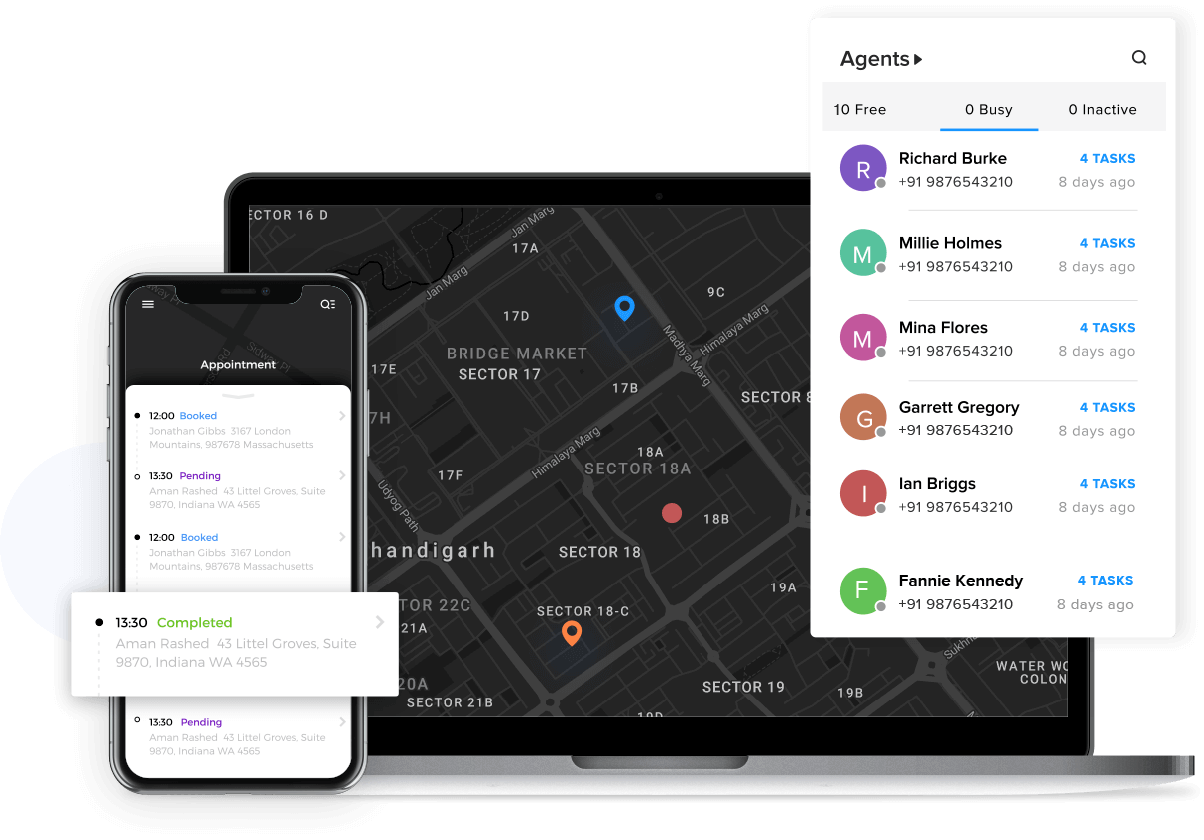
Best for: Multi-vertical Q-commerce operators who need a flexible white-label dispatch platform with a wide app marketplace and moderate technical customization
Tookan by Jungleworks is a white-label on-demand delivery management platform positioned across multiple service verticals — food delivery, grocery, Q-commerce, cannabis delivery, laundry, and services. It covers task assignment, live tracking, driver dispatch, customer notifications, and a marketplace of add-on extensions.
Tookan's approach is modular: operators build their dispatch infrastructure from a base platform and add capabilities through the Tookan marketplace, including extensions for third-party integrations, specialized workflows, and vertical-specific features.
Key strengths
- White-label platform with branded customer notifications and tracking
- Marketplace of 50+ extensions for expanded functionality
- Multi-vertical coverage — useful for operators running Q-commerce alongside other service delivery verticals
- Live tracking and automated customer notification
- Driver performance analytics
- Affordable pricing accessible for early-stage Q-commerce operations
- REST API for custom integration
Why it stands out
Tookan's extension marketplace gives operators a degree of configurability that pure-SaaS platforms do not. For multi-vertical operators running Q-commerce alongside food delivery, services, or other verticals from a single platform, Tookan's unified dispatch view reduces tool fragmentation. The white-label capability is also useful for operators who need a fully branded consumer experience without building custom technology.
Limitation: Tookan's modular approach means that building out full functionality requires assembling multiple extensions, which adds operational complexity and cost. ERP integration requires custom development — no pre-built connectors for NetSuite, SAP, or Dynamics. At higher volumes or greater operational complexity, the platform's SMB-oriented architecture can show its limits.
How to Choose the Right Quick Commerce Delivery Management Software
The seven platforms above serve meaningfully different operator profiles. The selection decision comes down to three questions:
1. What is your existing technology stack?
If your business runs on Oracle NetSuite, SAP Business One, SAP S/4HANA, Microsoft Dynamics 365, or Odoo, the ERP integration question is not a secondary concern — it is the primary selection criterion. SuiteFleet is the only platform in this list with pre-built, certified bidirectional connectors for all five. Every other platform requires custom API development to achieve the same integration depth, which translates into a multi-month integration project and ongoing maintenance overhead.
If your business runs on Shopify, WooCommerce, or Salla, multiple platforms connect directly to these storefronts. SuiteFleet, Onfleet, and Tookan all offer storefront connectivity.
2. What is your operational scale and complexity?
For single-fleet Q-commerce operations under 500 daily orders, Onfleet and Tookan are both viable with lower implementation overhead and more accessible pricing. For operations above that threshold, or for operators with multi-carrier or multi-client complexity, the enterprise platforms — SuiteFleet, Shipsy, FarEye, and Bringg — offer the operational depth to match the complexity.
3. Are you building a new Q-commerce business or integrating into an existing operation?
If you are building from scratch and need a consumer-facing ordering platform alongside delivery management, Hyperzod's full-stack approach eliminates the need to separately procure and integrate a storefront technology. If you already have a storefront and an ERP, Hyperzod adds unnecessary complexity where a focused delivery execution layer is what you need.
Frequently Asked Questions
What is quick commerce delivery management software?
Quick commerce delivery management software handles the last-mile execution layer for Q-commerce operations — dispatch, route optimization, driver management, real-time tracking, proof of delivery capture, and ERP data return. It connects the dark store fulfillment event to the customer door and closes the delivery data loop back to the financial and operational systems the business depends on. Unlike standard delivery management software, Q-commerce platforms must support on-demand dispatch (not pre-planned batch routing), dynamic real-time route optimization, and click-to-door times measured in minutes rather than days.
Which quick commerce delivery management software integrates with NetSuite?
SuiteFleet is the only quick commerce delivery management platform with a native, certified SuiteApp for Oracle NetSuite — orders flow from NetSuite to SuiteFleet automatically without middleware, and confirmed delivery data, proof of delivery, and return records write back to NetSuite records at job completion. Shipsy, FarEye, Bringg, Onfleet, and Tookan all require custom API development to integrate with NetSuite.
What is the difference between Shipsy and SuiteFleet for Q-commerce?
Shipsy is an AI-native enterprise platform designed for very high-volume food, grocery, and Q-commerce networks in South Asia and MENA. SuiteFleet is an ERP-connected last-mile delivery platform designed for Q-commerce operators who need delivery execution to close the data loop back to their ERP (NetSuite, SAP, Dynamics, Odoo) in real time without middleware. For operators whose primary selection criterion is ERP integration depth, SuiteFleet is purpose-built. For operators whose primary need is AI-driven dispatch automation at enterprise scale without ERP integration as a priority, Shipsy addresses that use case.
Is Onfleet suitable for Q-commerce operations?
Onfleet works well for small-to-mid Q-commerce operations — dark store operators, grocery delivery startups, and on-demand delivery companies managing fleets up to a few hundred drivers. Its clean interface, per-task pricing, and quick onboarding make it accessible for growing operations. Its limitations in the Q-commerce context are ERP integration (requires custom API work for NetSuite, SAP, or Dynamics) and multi-client orchestration, which is not a native capability.
What should I look for in quick commerce delivery management software?
Key evaluation criteria for Q-commerce delivery management software: on-demand dispatch capability (not just pre-planned batch routing), real-time route optimization that recalculates throughout the shift as orders arrive, ERP bidirectional integration without middleware for operators on enterprise systems, digital proof of delivery with photo and GPS confirmation, customer real-time tracking portal and WhatsApp or SMS notification, driver mobile app with multilingual support for diverse driver workforces, and COD workflow management for Q-commerce markets where cash-on-delivery is significant. See the full operational requirements in our Complete Guide to Quick Commerce Operations.
Which quick commerce software is best for the Middle East?
For Q-commerce operators in the UAE, Saudi Arabia, Egypt, Qatar, or across MENA, SuiteFleet is the platform built specifically for regional requirements: Arabic-first driver mobile app, WhatsApp-native customer notifications, COD workflow management for high-COD markets (Egypt 65-70%, Saudi Arabia 30-40%), route optimization calibrated for MENA urban environments, and bidirectional integration with the ERP systems most commonly deployed in Middle East enterprises (NetSuite, SAP, Dynamics, Odoo). Shipsy also has significant presence in the MENA Q-commerce market at the enterprise scale.
Running Q-Commerce Deliveries?
SuiteFleet connects your Q-commerce operation to the ERP you already run — NetSuite, SAP, Dynamics, Odoo, or a custom integration — and handles the last-mile execution layer from dark store dispatch to digital proof of delivery, without middleware and without manual reconciliation.
Explore the Quick Commerce solution or request a demo today.