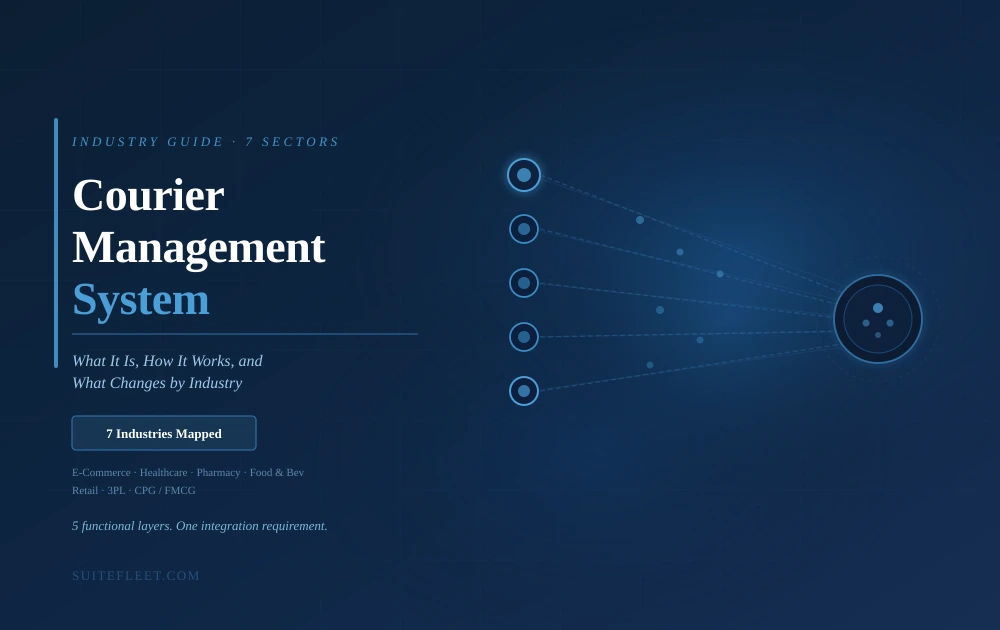
A courier management system is the operational layer between a confirmed order and a closed delivery. It takes a job that exists in a record system and turns it into a dispatched driver, a tracked vehicle, a captured proof of delivery, and a confirmed status that flows back to where the order began.
What it is not: a shipping label generator, a freight procurement tool, or a marketplace for gig workers. Those tools solve different problems. A courier management system is for operations running their own drivers or contracted fleets, managing daily route volumes, and needing delivery execution to connect cleanly to the business systems that depend on it.
The core functions every serious courier management system covers are consistent across operations: order intake and dispatch, route optimization, real-time driver tracking, driver app and communication, proof of delivery capture, and customer notifications. What differs significantly is how each of those functions needs to work when the operation is a cold-chain pharmaceutical distributor versus an e-commerce brand versus a 3PL running routes for multiple clients simultaneously.
This guide covers both layers. First, the five functional layers of a courier management system and what good looks like at each one. Then, seven industries and what each one requires from the system beyond the standard feature set, with a recommended system for each. Finally, the top 10 courier management systems for 2026.
What a Courier Management System Is
Courier management sits at the intersection of logistics planning and field execution. It is downstream of the ERP, the order management system, and the warehouse management system, and upstream of the customer. Its job is to take what those systems know about a delivery and make it happen reliably in the field, then return confirmation that it did.
The distinction between a courier management system and a transportation management system (TMS) is worth drawing clearly. A TMS handles strategic freight planning, carrier selection, contract management, and multi-modal logistics at a network level. A courier management system handles the execution layer: which driver takes which job today, in what order, and what proof exists that each stop was completed. The two are complementary, not interchangeable.
The distinction between a courier management system and a basic GPS tracker is equally important. A GPS tracker tells you where a vehicle is. A courier management system tells you where every vehicle should be, dispatches routes to driver apps, captures structured delivery confirmation, handles failures, and closes the loop back to the ERP. GPS tracking is one component inside a courier management system, not a substitute for one.
The integration test: The cleanest way to evaluate whether a tool is genuinely a courier management system is to ask what happens after a delivery is completed. If the answer is that the driver marks it done in the app and the data stays there until someone exports it, it is a dispatch and tracking tool. A courier management system closes the loop automatically.
The Five Functional Layers
Thinking about courier management as a stack of five connected layers clarifies both what to look for in a platform and where the common failure points are.

Layer 1: Order Intake and Dispatch
The dispatch layer receives order data and converts it into driver assignments. In a well-configured courier management system, orders flow in automatically from the ERP, storefront, or order management platform without manual data entry. The dispatch logic then evaluates available drivers against job requirements: location, vehicle type, shift hours, current workload, and any special handling needs.
Manual dispatch is the baseline for most operations before a courier management system is implemented. It is also the primary source of errors: missed assignments, uneven workload distribution across drivers, and last-minute changes that require phone calls to confirm. Automated dispatch eliminates most of those friction points and produces consistent assignment decisions that do not degrade at high volume or at the end of a long shift.
The quality of the dispatch layer depends almost entirely on the quality of the order data flowing into it. An order that arrives without a verified address, a clear time window, or the correct vehicle requirement will produce a poor dispatch decision regardless of how sophisticated the assignment logic is.
Layer 2: Route Optimization
Route optimization answers the sequencing question: given a set of stops assigned to a driver, what is the most efficient order to complete them while satisfying all constraints? Those constraints typically include delivery time windows, vehicle capacity, driver hours, traffic conditions, and customer-specific access requirements.
Static optimization runs at the start of the day and produces a planned route. Dynamic optimization runs continuously throughout the day, adjusting sequences as conditions change: a driver running behind schedule, a new urgent job added to the queue, a road closure, or a failed delivery attempt that needs to be rescheduled. The difference between the two is significant at scale. A static route that was optimal at 7am can become operationally damaging by midday if no adjustment is made.
Modern courier management systems use machine learning to improve optimization quality over time. Route segments that consistently take longer than the algorithm predicts, customers who are reliably unavailable during certain windows, and driver patterns that correlate with higher on-time rates all feed back into future planning cycles, producing a system that improves with use.
Layer 3: Real-Time Tracking
Real-time tracking gives dispatchers a live view of every vehicle and gives customers a live view of their delivery. For the dispatcher, it enables proactive exception handling: when a driver falls behind schedule, the courier management system flags the at-risk delivery and surfaces options before it becomes a failure. For the customer, it replaces inbound status calls with self-service visibility.
The value of tracking is not the position data itself. It is what the system does with that data: updating ETAs dynamically, triggering customer notifications at defined milestones, alerting dispatchers to deviations from planned routes, and building a timestamped record of every vehicle movement that can be referenced in the event of a dispute.
Layer 4: Proof of Delivery
Proof of delivery is the moment the courier management system generates a verifiable record that a delivery was completed. The standard capture is a customer signature, a photo of the delivered item, a geo-stamp confirming the location, and a timestamp. Most platforms handle all four.
Where the layer breaks is in what happens to that data after capture. In a disconnected system, POD lives inside the delivery app. Finance cannot access it to resolve invoice disputes. Customer service cannot access it to handle claims. The ERP does not know the delivery happened until someone runs a manual export. That gap is not a minor inconvenience. It compounds with every delivery, creating a reconciliation overhead that grows with volume and narrows the operational margin that good courier management is supposed to create.
The measure of a POD layer is not the quality of capture. It is whether the captured data writes automatically to the order record in the system the business depends on.
Layer 5: ERP Integration
ERP integration is the layer that determines whether a courier management system is an operational tool or an operational island. A courier management system that receives orders from the ERP but does not return delivery status, proof of delivery, and cost data automatically is solving only half the problem.
Bidirectional integration means orders flow in as they are created and delivery confirmation flows back the moment a job is closed. Invoice workflows trigger automatically. Inventory positions update. Customer-facing order status reflects reality. The finance team has what it needs without waiting for a nightly sync or a manual data pull.
The practical distinction that matters in evaluation is between a prebuilt ERP connector and an API-based integration that requires configuration. A prebuilt connector is maintained by the platform vendor and updates when either system updates. An API integration requires someone to build, test, and maintain the connection, and introduces a failure point every time either platform changes. For enterprise operations, that difference in integration architecture has a meaningful impact on total cost of ownership.
Seven Industries, Seven Different Sets of Requirements
The five functional layers above are consistent across industries. What varies is how each layer needs to be configured, what additional data it must capture, what compliance obligations it must satisfy, and what downstream systems it must feed. The sections below cover what generic courier management misses for each industry and what the courier management system needs to handle instead.
1. E-Commerce — Storefront-native dispatch, surge volume, customer self-tracking
E-commerce courier management begins at the order intake layer. When a customer completes a checkout, that order needs to appear in the routing queue without anyone manually moving it. Native connectors to Shopify, WooCommerce, or the order management platform create delivery jobs automatically, making them available for the next dispatch cycle without dispatcher intervention.
The surge problem is specific to e-commerce and rarely handled well by generic courier management tools. A promotional campaign or seasonal spike can double order volume in hours. The dispatch and routing layers need to absorb that additional volume across available fleet capacity without the planner manually rebuilding routes. Systems that cannot handle volume variability gracefully create the exact bottleneck they were supposed to eliminate.
The customer-facing layer matters more in e-commerce than in most other sectors. Customers do not call a dispatcher to track their order. They expect a link that updates in real time, a notification when the driver is close, and a structured resolution if the delivery fails. When a delivery is left unattended, the courier management system needs to capture a GPS-stamped photo with a location description, and send a confirmation that the customer can reference if the parcel is not where it was left.
- Order intake: native storefront connector — no CSV export, no manual upload
- Surge dispatch: route optimization absorbs volume spikes without manual intervention
- Customer tracking: branded portal with live ETA, milestone notifications, safe-location proof
- Returns: return pickup dispatched in the same workflow as outbound delivery
ERP requirement: Order status must update the storefront and the back-office ERP simultaneously on delivery completion. A customer whose storefront shows delivered but whose ERP order is still open creates a customer service and finance reconciliation problem.
Recommended systems: Onfleet and Cigo Tracker for storefront-native dispatch and a strong customer-tracking experience, or Shippit for multi-carrier e-commerce shipping. SuiteFleet is the pick when order status has to update both the storefront and the ERP at the same moment.
2. Healthcare and Medical — Chain-of-custody, specimen integrity, zero failure tolerance
Healthcare courier operations have a failure cost that is categorically different from other industries. A failed retail delivery is rescheduled. A failed specimen delivery can invalidate a diagnostic result. A failed medication delivery can interrupt patient care. The courier management system needs to reflect that asymmetry in how it handles dispatch, tracking, and exception management.
Chain-of-custody is the defining requirement. Every transfer of custody must be documented: who collected the specimen or item, at what time, in what condition, and who received it at the destination. That record needs to be preserved in a format that can withstand regulatory scrutiny and be produced quickly when a clinical team needs to verify that a sample was handled correctly.
Time windows in healthcare are not preferences. A diagnostic lab has a cut-off time for sample processing. A clinical procedure has a scheduled start. The courier management system needs to treat those windows as hard constraints, flag at-risk deliveries proactively, and give dispatchers meaningful options when a driver is running late rather than simply recording the failure after it happens.
- Chain-of-custody record: named recipient with role and facility, timestamped at each transfer point
- Specimen integrity logging: temperature, handling conditions, and packaging state documented at collection and delivery
- Hard time window enforcement: at-risk deliveries flagged and escalated before failure, not after
- Regulatory POD: delivery records formatted for HIPAA compliance and clinical audit requirements
Recommended systems: SuiteFleet for configurable chain-of-custody capture enforced in the driver workflow and routed to the clinical system or ERP automatically. Most generic tools require customization to enforce these fields, so prioritize a platform where the capture is structured and mandatory rather than optional.
3. Pharmacy — Controlled substances, patient identity verification, cold chain
Pharmacy courier management carries regulatory obligations that most courier management systems are not configured to handle without specific customization. Controlled substance deliveries require documented chain-of-custody, patient identity verification at the point of handover, and confirmation that the medication was received by the authorized recipient rather than a household member or a neighbor.
The cold chain requirement applies to an expanding category of medications including biologics, insulin, and certain vaccines. The courier management system needs to log the temperature conditions the medication was transported in, flag any excursion from the required range, and record the temperature at the point of handover. Without that log, a cold-chain breach during delivery is undetectable until a patient reports an adverse outcome.
Privacy is an additional dimension. The customer-facing notifications for a pharmacy delivery need to be structured differently from a retail order. The delivery confirmation should not expose medication details in a tracking link that a third party might see. The POD capture should not include information beyond what is required for compliance.
- Patient identity verification: structured ID check at handover, confirmation by authorized recipient only
- Cold chain logging: temperature at collection and delivery, excursion flagging
- Controlled substance documentation: chain-of-custody record meeting regulatory requirements
- Privacy-compliant notifications: customer communications that do not expose prescription details
Recommended systems: SuiteFleet for cold-chain logging, structured ID verification at handover, and privacy-controlled notifications tied back to dispensing and billing records. Onfleet can cover the delivery and notification layer where an operation pairs it with its own compliance process.
4. Food and Beverage — Time windows, temperature compliance, short delivery handling
Food and beverage distribution runs on windows that are tight by necessity. A restaurant or foodservice customer cannot receive a delivery during service. A retailer has a loading bay window that may be thirty minutes wide. The courier management system needs to treat those windows as operational constraints and plan routes accordingly, not as preferences that the driver can work around.
Short deliveries are a routine occurrence in food and beverage. Stock availability changes between order confirmation and vehicle loading. A driver arriving with eighteen of twenty ordered cases needs to document the short delivery at the point of handover so the credit note is generated immediately. A POD system that only records that a delivery was made, without capturing the delivered quantity per line, leaves a financial discrepancy that requires manual reconciliation later.
Traceability requirements mean that the batch identity of delivered stock matters. A product recall requires the ability to identify which customers received which batch. That traceability only exists if the courier management system captures batch references at the point of delivery and links them to the customer record.
- Time window precision: delivery windows treated as hard constraints in route planning
- Quantity variance capture: delivered quantity per line recorded against ordered quantity with reason code
- Temperature log: for chilled and frozen products, at handover point
- Batch traceability: batch references linked to delivery record for recall readiness
ERP requirement: Short delivery data needs to trigger a credit note in the ERP on the same day. An operation that reconciles short deliveries weekly through a manual review process is funding a cash flow gap that prompt ERP integration would eliminate.
Recommended systems: Track-POD for its depth on quantity variance and short-delivery capture at the point of handover. SuiteFleet is the pick when that short-delivery data has to trigger a same-day credit note in the ERP rather than a weekly manual reconciliation.
5. Retail and Distribution — Recurring routes, SKU-level confirmation, ERP-linked invoicing
Retail and distribution courier management is defined by volume consistency and account relationships. Unlike e-commerce, which deals with variable consumer demand, a distribution operation typically serves recurring business accounts with established delivery schedules. The courier management system needs to support that structure: regular routes, familiar stops, and driver territory ownership that builds efficiency over time.
SKU-level delivery confirmation is the critical POD requirement. A retail store receiving a delivery will check it against their purchase order. If there is a shortage or a damaged product, that discrepancy needs to be documented per line at the point of delivery, not through a phone call to the supplier the following day. Barcode scanning at the stop confirms the identity and quantity of each delivered item and creates a record that both the supplier's ERP and the retailer's inventory system can use.
Direct store delivery (DSD) operations have the additional complexity of drivers placing product directly onto shelving. The POD needs to confirm not just that goods were delivered to the store but that they were stocked in the correct location, particularly for space-managed categories where slot compliance matters.
- Territory management: consistent zone assignments that build driver familiarity and route efficiency over time
- Barcode scanning at stop: SKU-level confirmation against purchase order
- Discrepancy logging: structured reason codes for shortage or damage, triggering credit workflow
- Store sign-off: authorized recipient identified, linked to the delivery record
Recommended systems: DispatchTrack for appointment-driven, high-touch retail delivery, backed by its Built for NetSuite certification, and Track-POD for SKU-level confirmation against the purchase order. SuiteFleet ties the confirmed POD directly to invoicing and inventory in the ERP.
6. Third-Party Logistics (3PL) — Multi-client dispatch, client-branded POD, separate ERP feeds
Third-party logistics operations introduce a structural complexity that none of the other industries on this list face: the courier management system must serve multiple clients simultaneously from a single operational interface, with each client's requirements, branding, and data flows kept separate while the dispatcher manages everything from one view.
A 3PL driver completing a route that includes deliveries for three different clients needs three different POD configurations: different capture fields, different customer-facing branding on the delivery notification, and different data routing for the completion record. A courier management system that uses a single generic POD template across all clients fails to meet the requirements of any client that has specific documentation needs, and forces the 3PL to manage exceptions manually.
The client visibility requirement is equally distinctive. Each client needs to see their own delivery data, in their own system, without seeing data that belongs to other clients. That means the courier management system needs to route completion records independently to each client's ERP or tracking portal, not aggregate everything into a shared view.
- Per-client POD configuration: different capture fields and required photos per client, applied automatically based on the job's client assignment
- Client-branded notifications: customer-facing delivery confirmation branded for the shipper, not the 3PL
- Independent data routing: each client's delivery records feed their ERP or portal separately
- Consolidated 3PL view: dispatcher sees all clients in one operational dashboard without exposing cross-client data
Returns handling in 3PL requires the same separation. A returned item belongs to a specific client. The collection record, condition grading, and disposition decision all need to route to the correct client's system, not to a shared returns queue.
Recommended systems: SuiteFleet for its multi-client 3PL connectivity, per-client POD configuration, and independent routing of each client's data to their own ERP or portal. VersaFleet is a capable alternative for high-volume multi-client dispatch where an operation does not need the ERP loop.
7. CPG and FMCG — High-volume routes, van sales capture, promotional surge handling
Consumer packaged goods and fast-moving consumer goods distribution runs at a volume and pace that stress-tests courier management systems in ways that lower-volume sectors do not. A route driver serving fifty trade accounts in a day, capturing van sales orders at some stops and completing pre-booked deliveries at others, needs a courier management system that handles both workflows in the same interface without creating two separate data entry processes.
Van sales coordination is the requirement most generic courier management systems do not address. In CPG distribution, a driver visiting a trade account may complete a pre-planned delivery, but also take an order for additional stock that the customer wants on the next run. That order needs to enter the ERP immediately, not be written on paper and transferred at the end of the day.
Promotional surge handling is the volume management challenge. When a promotional campaign drives demand above forecast, the route planning layer needs to accommodate additional stops, adjusted quantities, and in some cases entirely new delivery points without requiring the planner to rebuild routes manually.
- Van sales order capture: in-app order entry at trade accounts, feeding ERP in real time
- Promotional surge handling: route optimization absorbs volume increases without manual route rebuilding
- Territory management: consistent zone assignments for account relationship continuity
- SKU-level delivery confirmation: actual delivered quantity per line feeds ERP sales and inventory records
ERP requirement: Van sales data and delivery confirmation need to feed the ERP simultaneously from the field. A driver who captures both a delivery completion and a new order at the same stop should generate both an invoice close and a new sales order in the ERP without any manual intervention at end of day.
Recommended systems: SuiteFleet for van sales capture and delivery confirmation that feed the ERP from the field in the same workflow. Shipsy suits high-volume, multi-vendor CPG distribution in emerging markets, and Tookan covers lighter on-demand and local distribution routes.
Cross-Industry Comparison
The table below maps all seven industries against five criteria: primary dispatch challenge, POD requirement, compliance need, and ERP integration priority.
Top 10 Courier Management Systems in 2026
The industries above each need something specific, but the shortlist of platforms that can execute courier management well is smaller than the market makes it look. Here are the top 10 courier management systems for 2026, ranked with the ERP loop in mind, with a verified review link and the industries each fits best.
1. SuiteFleet
SuiteFleet is a courier management platform built for operations that need delivery execution wired into the ERP. It covers order intake, route optimization, driver scheduling, live tracking, configurable proof of delivery, and customer notifications, then returns the full delivery record to NetSuite, SAP, Odoo, Salesforce, Dynamics, Shopify, or WooCommerce in real time through native connectors, with no middleware. Its configurable POD and multi-client 3PL connectivity let it flex to healthcare, pharmacy, food and beverage, retail, 3PL, and CPG requirements while keeping the data loop closed.
Best for: Every industry in this guide that needs delivery data in the ERP the same day, especially healthcare, pharmacy, 3PL, distribution, and CPG.
2. Onfleet
Onfleet is a widely used delivery management platform with a polished driver app, multi-stop route optimization, and automated customer notifications. Its clean dispatcher dashboard and strong customer-tracking experience make it a practical fit for storefront-driven delivery.
Best for: E-commerce, grocery, and pharmacy delivery that needs a proven driver app and customer tracking.
3. DispatchTrack
DispatchTrack is a last-mile platform strong in appointment-driven, high-touch delivery, and it holds Built for NetSuite certification. It is built around accurate delivery windows and the customer communication that supports them.
Best for: Big-and-bulky, furniture, appliance, and appointment-based retail and distribution delivery.
4. Track-POD
Track-POD is a single-dashboard delivery platform built around electronic proof of delivery, route optimization, and driver apps. It handles partial delivery, overdelivery, and delivery in full cleanly, which makes it strong where accurate quantity capture matters.
Best for: Food and beverage, wholesale, and distribution operations that need SKU and quantity-level POD.
5. Tookan
Tookan is an on-demand delivery and dispatch platform covering real-time tracking, driver apps, and route dispatch, with flexible connections by webhook or API. Its low starting cost makes it accessible for smaller operations.
Best for: On-demand, local courier, and lighter CPG distribution routes.
6. Cigo Tracker
Cigo is a delivery management and route planning platform with dynamic customer notifications and real-time tracking, and integrations with common commerce systems. Its strength is a polished customer-facing tracking experience.
Best for: E-commerce and retail operations that prioritize the customer tracking experience.
7. Shipsy
Shipsy is a logistics platform covering route planning, carrier allocation, and end-to-end visibility, with strong adoption in emerging markets. It suits multi-vendor operations managing both owned fleets and external transport.
Best for: High-volume CPG and FMCG distribution across emerging markets.
8. Senpex
Senpex is an on-demand courier platform that bundles delivery software, an API, and its own courier network across the US. It fits operations that want same-day capacity and last-mile software together. Best for: Same-day courier operations that want a network plus software.
9. VersaFleet
VersaFleet is a browser-based operations portal with a companion driver app, real-time delivery status, and route optimization that can assign and dispatch large job volumes quickly. It has a strong presence in Southeast Asia logistics.
Best for: 3PL and logistics operations that need high-volume multi-client dispatch.
10. Shippit
Shippit is a multi-carrier shipping and delivery platform for e-commerce and retail, strong in Australia and New Zealand, with automated carrier selection and post-purchase tracking. It helps merchants ship across many carriers from one interface.
Best for: E-commerce and retail operations that need multi-carrier shipping and tracking.
The Integration Requirement Every Industry Shares
Across seven industries with different dispatch challenges, different POD requirements, and different compliance obligations, one requirement is constant: the delivery record needs to reach the systems that downstream workflows depend on, automatically and without manual intervention.
A healthcare delivery whose chain-of-custody record stays inside the courier app is not compliant. A food and beverage operation whose short delivery data never reaches the ERP is funding credit notes it cannot issue. A 3PL whose clients cannot access their own delivery records in their own systems is providing an incomplete service regardless of how well the physical delivery was executed.
The courier management system is the execution layer. The ERP, the inventory system, the compliance record, the client portal — those are the systems of record. The courier management system's job is to capture accurately in the field and push that data where it needs to go the moment the delivery is closed. When that loop is closed, every team downstream works from the same current picture. When it is not, every team compensates with manual work that grows with volume and erodes the operational margin that the system was supposed to protect.
Frequently Asked Questions
What is a courier management system?
A courier management system is software that manages the full execution of delivery operations — from order intake and driver dispatch, through real-time tracking and proof of delivery capture, to ERP data return. It sits downstream of the order management system and ERP, and upstream of the customer. Its job is to take what those systems know about a delivery and execute it reliably in the field, then return confirmed delivery data automatically to the systems the business depends on.
What is the difference between a courier management system and a TMS?
A TMS (Transportation Management System) handles strategic freight planning at the carrier and network level: carrier selection, contract management, load optimization, and multi-modal freight cost management. A courier management system handles the execution layer: dispatching individual drivers, optimizing multi-stop routes, tracking vehicles in real time, capturing proof of delivery, and returning delivery status to the ERP. The two are complementary — a courier management system picks up where most TMS platforms end.
What are the five functional layers of a courier management system?
The five layers are: (1) order intake and dispatch — receiving order data and assigning it to drivers automatically; (2) route optimization — sequencing stops efficiently across constraints; (3) real-time tracking — live GPS visibility for dispatchers and customers; (4) proof of delivery — capturing signature, photo, and GPS confirmation at each stop; and (5) ERP integration — returning delivery status, POD, and cost data back to the source system automatically on job completion.
How does a courier management system integrate with an ERP?
The best courier management systems use prebuilt connectors to popular ERPs — such as Oracle NetSuite, SAP, Salesforce, Odoo, and Microsoft Dynamics — that allow orders to flow in automatically and delivery data to sync back in real time on job completion. This triggers invoice workflows, adjusts inventory, and closes order records without manual entry. Platforms that require custom API builds or middleware to connect to the ERP add implementation time, create maintenance risk, and often default to batch syncing rather than real-time data return.
What is the best courier management system for healthcare?
Healthcare courier management requires chain-of-custody documentation, hard time window enforcement with proactive escalation, specimen integrity logging, and HIPAA-compliant POD records. The best courier management system for healthcare is one that enforces these capture requirements in a structured driver workflow — not an optional field — and routes completed delivery records to the relevant clinical system or asset register automatically on job completion. SuiteFleet covers these requirements with configurable POD capture and real-time ERP integration.
What is the best courier management system for 3PL operations?
3PL courier management requires per-client POD configuration, client-branded customer notifications, independent data routing to each client's ERP or portal, and a consolidated dispatcher view across all clients without cross-client data exposure. The best courier management system for 3PL is one where the multi-client data model is built into the platform architecture — not bolted on through workarounds — so that each client's delivery data flows to the right destination automatically from the moment a job is closed.
Courier Management That Closes the Loop
The seven industries covered above each have specific requirements that generic courier management tools do not address by default. What they share is the same underlying need: delivery execution that connects back to the systems the rest of the business depends on, automatically and in real time.
SuiteFleet connects courier management execution to the ERP layer so every delivery event — dispatch, tracking, proof of delivery, and return — updates the record systems that operations, finance, and compliance depend on.