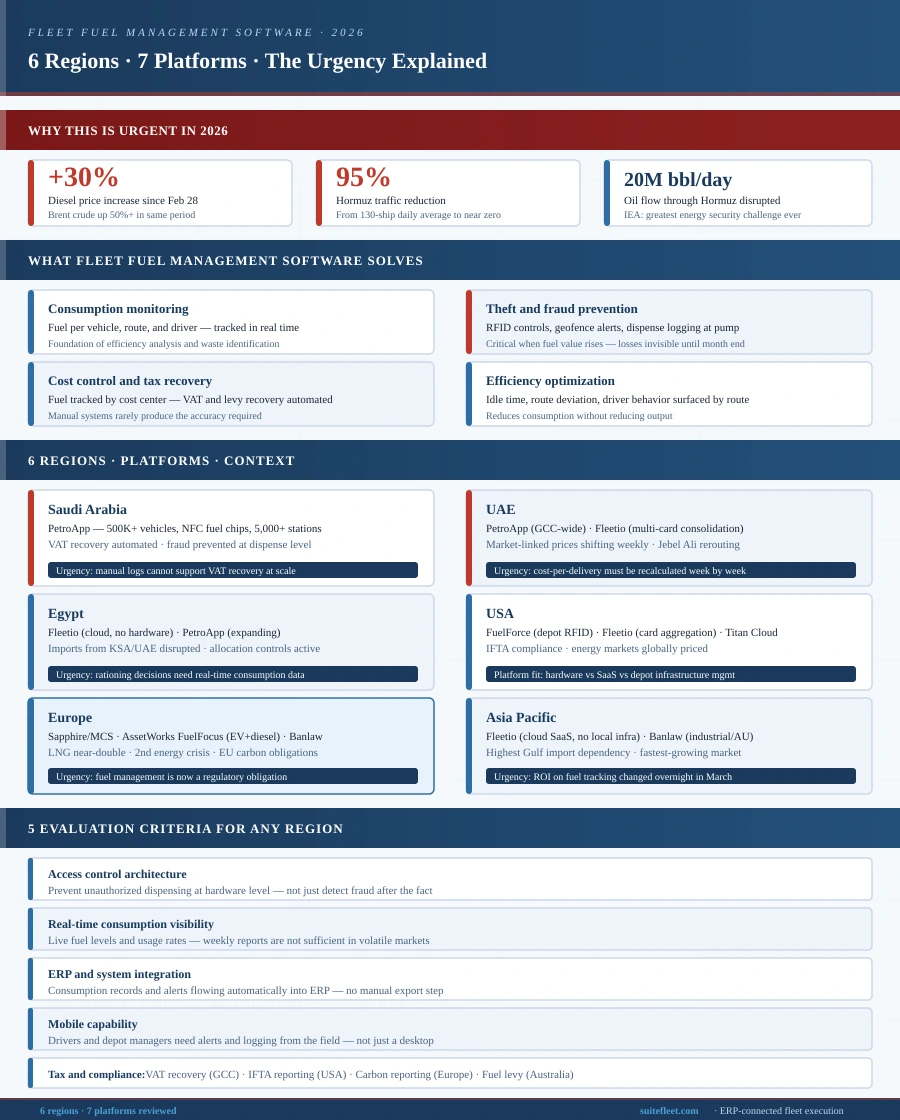
On February 28, 2026, the conflict involving Iran triggered the largest disruption to global energy supply in modern history. Within weeks, Brent crude had surged more than 50 percent. Diesel prices jumped over 30 percent across Europe and the Middle East. The Strait of Hormuz, through which roughly 20 million barrels of oil and petroleum products moved daily, saw traffic collapse by approximately 95 percent from pre-conflict averages.
For fleet operators, this is not an abstract supply chain problem. It is a fuel invoice that arrived 30 percent higher than last month, with no certainty about what next month looks like. Operations that were running at acceptable margins in January are under pressure in March. The question is no longer whether to invest in a fleet fuel management system. It is which platform is the right fit for the region, the fleet size, and the specific problem being solved.
This guide maps the leading fleet fuel management software options by region, explains what each one solves, and provides the operational context that makes these decisions urgent in the current environment.
What a Fleet Fuel Management System Actually Does
Fuel management software covers more ground than the name suggests. The category addresses four distinct operational problems that often sit in separate spreadsheets or separate tools:
Consumption monitoring: tracking how much fuel each vehicle uses per trip, per route, and per driver. This is the foundation of fuel efficiency analysis and the first step toward identifying waste.
Theft and fraud prevention: unauthorized fills, fuel card misuse, and siphoning are material problems in any fleet. RFID access controls, geofence-based alerts, and dispense logging at the pump prevent losses that are otherwise invisible until month-end reconciliation.
Cost control and tax recovery: fuel is typically the second-largest operating cost in a fleet after labor. Software that tracks consumption by vehicle, route, and cost center makes fuel a managed variable rather than a fixed overhead. VAT and tax recovery on eligible consumption requires structured transaction records — manual systems rarely produce them accurately.
Efficiency optimization: idle time, route deviation, driver behavior, and vehicle load all affect fuel economy. Modern platforms surface these patterns at the driver and route level, enabling targeted coaching and operational changes that reduce consumption without reducing output.
The platforms below address these problems in different ways and at different layers of the fleet operation. The right choice depends on the region, the fleet type, and where the biggest exposure sits.
Fuel Management System in Saudi Arabia
Saudi Arabia has among the largest corporate fleet concentrations in the world. Vision 2030's logistics expansion, NEOM, and the Kingdom's position as a regional distribution hub mean fleets are large, routes are long, and fuel costs are significant even at subsidized domestic prices. The conflict has not directly disrupted domestic fuel supply in the Kingdom, but it has created a regional cost and supply chain environment that is making fuel management infrastructure a priority rather than an optimization.
The specific challenge for Saudi fleets is the combination of high vehicle counts, dispersed geography, and a fuel network that has historically relied on manual recording. The shift toward NFC-based cashless fuel systems is accelerating as corporate fleets recognize that paper-based fuel logs cannot produce the accuracy needed for VAT recovery or operational benchmarking. Fleet fuel management in Saudi Arabia is increasingly a compliance and cost-recovery issue, not just an efficiency one.
PetroApp | petroapp.com
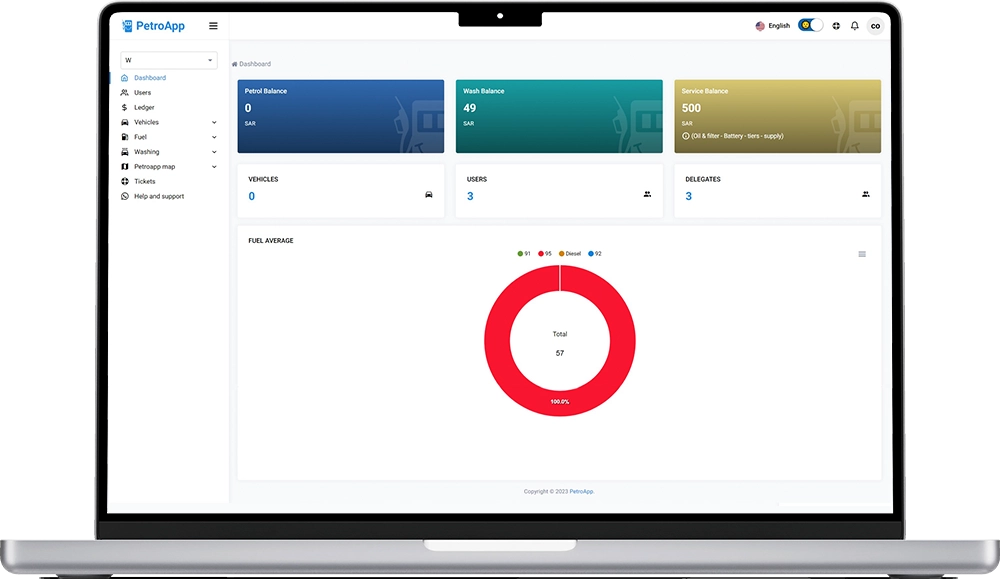
PetroApp is the dominant fleet fuel management platform for corporate fleets in Saudi Arabia, with over 500,000 vehicles and 10,000 corporate clients across a network of more than 5,000 partner stations. The platform provides NFC-based cashless fuel chips for each vehicle, eliminating manual fuel cards and the fraud they enable. Every fuel transaction is authorized at the vehicle level, logged in real time, and reconciled automatically against VAT records for recovery.
Beyond basic transaction logging, PetroApp integrates fleet services including oil change scheduling, vehicle wash, and consumption anomaly alerts. For Saudi fleets navigating the current environment, the fraud prevention layer is particularly relevant: fuel has become a more valuable commodity in the regional market, and operations that cannot verify that every liter dispensed reached an authorized vehicle are carrying a growing exposure.
Best for: Saudi Arabia and GCC corporate fleets, particularly those running high vehicle counts where manual fuel cards and paper logs have become operationally insufficient.
Also relevant for: UAE, Egypt, and other MENA markets where PetroApp is expanding operations.
Fuel Management Software in the UAE
The UAE presents a specific operational context that distinguishes it from the broader GCC market. Dubai and Abu Dhabi are both major logistics hubs with high fleet density, a mix of domestic and international operators, and a regulatory environment that places growing emphasis on documented fuel consumption for corporate sustainability reporting. The conflict has added a layer of urgency: the Jebel Ali Port disruption and rerouting of cargo through land corridors have increased last-mile delivery volumes and extended route distances for fleets operating in and around Dubai.
UAE fleet operators also face the specific challenge of managing fuel costs in a market where prices are market-linked and have moved significantly since the conflict began. A capable fuel management system in UAE operations needs to provide real-time consumption monitoring and route-level cost tracking so that delivery economics can be recalculated as prices shift week to week.
PetroApp | petroapp.com
PetroApp's UAE expansion makes it the most directly relevant platform for GCC-wide fleet operators with operations across both Saudi Arabia and the UAE. The same NFC-based infrastructure that controls fuel access in the Kingdom applies to UAE operations, and the consolidated reporting across both markets is particularly useful for fleet managers overseeing cross-border logistics in the current environment.
Fleetio | fleetio.com
For UAE-based operations running mixed fleets with vehicles from multiple manufacturers and fuel card relationships with different providers, Fleetio's ability to automatically import transactions from a wide range of fuel card networks into a single dashboard makes it a practical choice. The geofence-based fueling alerts are directly applicable to UAE fleet operations where off-route fueling is a known fraud vector, and the mobile receipt capture enables smaller operations to digitize fuel records without replacing their existing fuel card infrastructure.
Best for: mid-market UAE fleets managing multi-vendor fuel cards and needing consolidated reporting without a full infrastructure replacement.
Fleet Fuel Management Software in Egypt
Egypt's fuel management challenge is distinct from the Gulf. The country imports the majority of its refined petroleum from the UAE, Saudi Arabia, and Kuwait. The Strait of Hormuz crisis has disrupted those import chains, driving up domestic fuel costs and creating supply uncertainty that has led to allocation controls at fuel stations. The Suez Canal, which Egypt controls, is also under pressure as vessels reroute away from the Red Sea corridor.
For Egyptian fleet operators, the immediate challenge is cost control under price volatility combined with the risk of supply interruption. Fleet fuel tracking software that provides real-time consumption data and early warning of unusual usage patterns becomes a tool for rationing and prioritization as much as efficiency optimization. Operations that cannot see exactly which vehicles are consuming how much fuel have no reliable basis for making allocation decisions when supply tightens.
Fleetio | fleetio.com
Fleetio's cloud-based model requires no hardware infrastructure beyond the mobile app and fuel card integration, making it accessible to Egyptian fleet operators without a significant upfront investment. The fuel economy reporting at the vehicle level is directly useful for identifying which vehicles are consuming disproportionately in a constrained supply environment, and the integration with telematics data enables route-level consumption analysis.
Best for: mid-market Egyptian fleets needing cost-effective, cloud-based fuel tracking without full hardware deployment.
PetroApp | petroapp.com
PetroApp is actively expanding into Egypt, making it a relevant option for organizations operating across the GCC and North Africa that need consistent fuel management infrastructure across markets. The platform's fraud prevention capabilities are particularly relevant in Egypt's current operating environment, where fuel value has increased significantly and manual controls are insufficient at scale.
Fleet Fuel Management Software in the USA
North America dominates global fuel management software adoption. The US market is characterized by large private fleet operators, municipal and government fleets, and a mature fuel card ecosystem anchored by networks like WEX and Comdata. The Iran conflict's effect on US fleets is primarily through energy price transmission: the US imports a relatively small share of its oil from the Gulf, but energy markets are globally priced, and the crude oil price increase translates directly into diesel prices that US fleet operators pay at the pump.
IFTA (International Fuel Tax Agreement) reporting is a compliance requirement specific to the US and Canadian markets that adds a documentation layer most fuel management platforms in this region address directly. Automated IFTA reporting, which generates jurisdiction-level fuel consumption records from GPS and transaction data, represents significant time savings for commercial fleets crossing state lines.
FuelForce by Multiforce Systems | fuelforce.com
FuelForce is a hardware-plus-software fleet fueling solution with a 40-year track record in North American municipal and commercial fleet operations. Its RFID-based dispenser authorization means fuel can only be dispensed to vehicles with valid credentials, eliminating unauthorized access at the physical pump level rather than detecting fraud after the fact. The system logs every dispense event in real time and supports electric vehicle charging management alongside conventional fuel, positioning it for fleets managing mixed powertrains.
FuelForce is used by municipal fleets, school districts, and commercial operations across the US where the primary concern is physical access control at owned fuel depots. The hardware-first architecture is particularly relevant for operations running private fueling infrastructure where card-based authorization alone has proven insufficient.
Best for: North American municipal, government, and commercial fleets running private fuel depots where physical dispense control is the primary requirement.
Fleetio | fleetio.com
Fleetio is a cloud-first platform that aggregates fuel card transactions from major US networks automatically, without requiring hardware installation. Its fuel economy reporting, driver-level consumption analysis, and IFTA compliance features make it one of the most widely used fuel management software solutions for mid-market US fleets. The geofence-based fueling alerts are effective for detecting off-route fueling, and the maintenance integration means fuel consumption anomalies can be linked to vehicle health data automatically.
Best for: small to mid-market US fleets needing a subscription-based, low-overhead fuel management module integrated with broader fleet operations.
Titan Cloud Software | titancloud.com
Titan Cloud addresses a different layer of the US fuel management problem: the fuel infrastructure itself rather than the vehicles consuming it. Its platform monitors fuel station inventory, detects meter drift and nozzle theft, handles supply chain forecasting for fuel procurement, and provides EMV-compliant point-of-sale integration for fuel retail environments. For large US logistics companies running private fueling depots, Titan Cloud provides the depot-level intelligence that vehicle telematics cannot capture.
Best for: large US fleet operators running private fueling infrastructure where depot inventory management and theft detection at the infrastructure level are material concerns.
Fleet Fuel Management Software in Europe
Europe is facing the most acute fuel management pressure of any region in the current conflict. The Strait of Hormuz disruption has cut Qatar's LNG exports, and European gas storage was already at historically low levels entering the crisis. Dutch TTF gas benchmarks have nearly doubled. The second major energy crisis in three years is forcing European fleet operators to implement fuel cost controls that would previously have been considered discretionary.
European compliance requirements add a layer of complexity absent in other markets. Carbon reporting obligations, emissions zone documentation in cities like London and Amsterdam, and the EU Corporate Sustainability Reporting Directive all place demands on fuel data that go beyond internal cost control. Fleet fuel management in Europe is increasingly a regulatory obligation as well as a cost discipline.
MCS Sapphire by Centaur | mcscardsystems.com
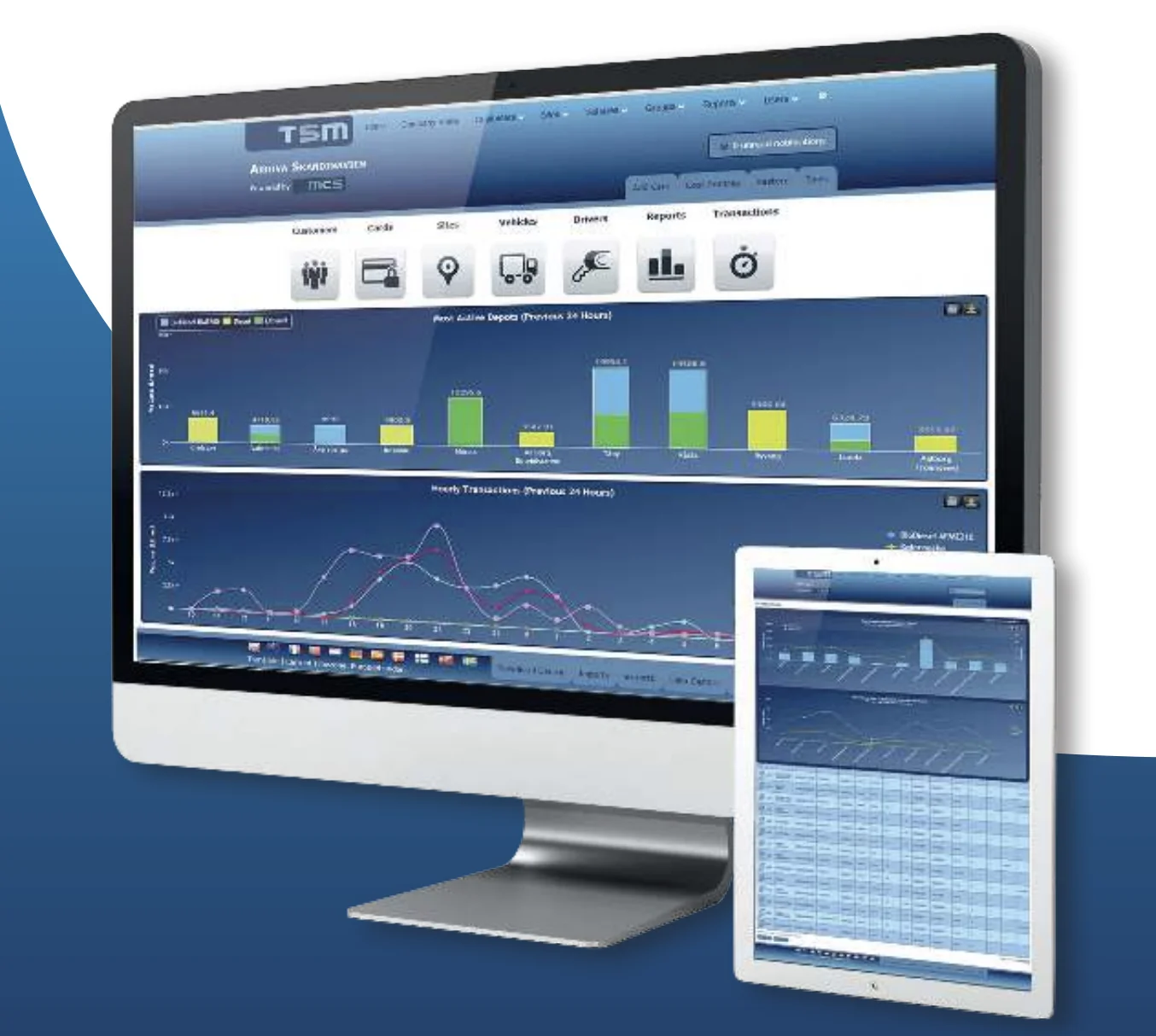
MCS Sapphire is a cloud-connected fuel terminal system deployed across more than 16,500 sites globally, with particularly strong penetration in European transport and logistics depots. Sapphire terminals accept RFID tags, key fobs, cards, and PIN codes, and upload every transaction automatically to the Total Site Manager web portal. The system captures odometer readings at each fill, creating a linked record of fuel consumption against vehicle mileage that enables accurate fuel economy monitoring without requiring telematics integration.
For European logistics businesses with multiple depot sites, the multi-site management capability in Total Site Manager allows a single operations team to monitor fuel consumption and authorization across all locations from one dashboard — directly relevant for sustainability reporting.
Best for: European 3PLs and logistics operators managing multi-site depot fueling infrastructure with sustainability reporting obligations.
AssetWorks FuelFocus | assetworks.co.uk
AssetWorks FuelFocus serves government and transit fleet operators in the UK, EU, and US, combining RFID card reader access, in-cab tank meters, and a cloud platform that logs every fuel transaction at the driver and vehicle level. Its FuelFocusEV module extends the same authorization and logging framework to EV charging, making it the most relevant platform for European fleets managing the transition from diesel to electric, where both fuel types need to be tracked in the same operational dashboard.
Best for: UK and EU public sector and transit fleet operators running depot fueling alongside EV charging infrastructure.
Banlaw | banlaw.com
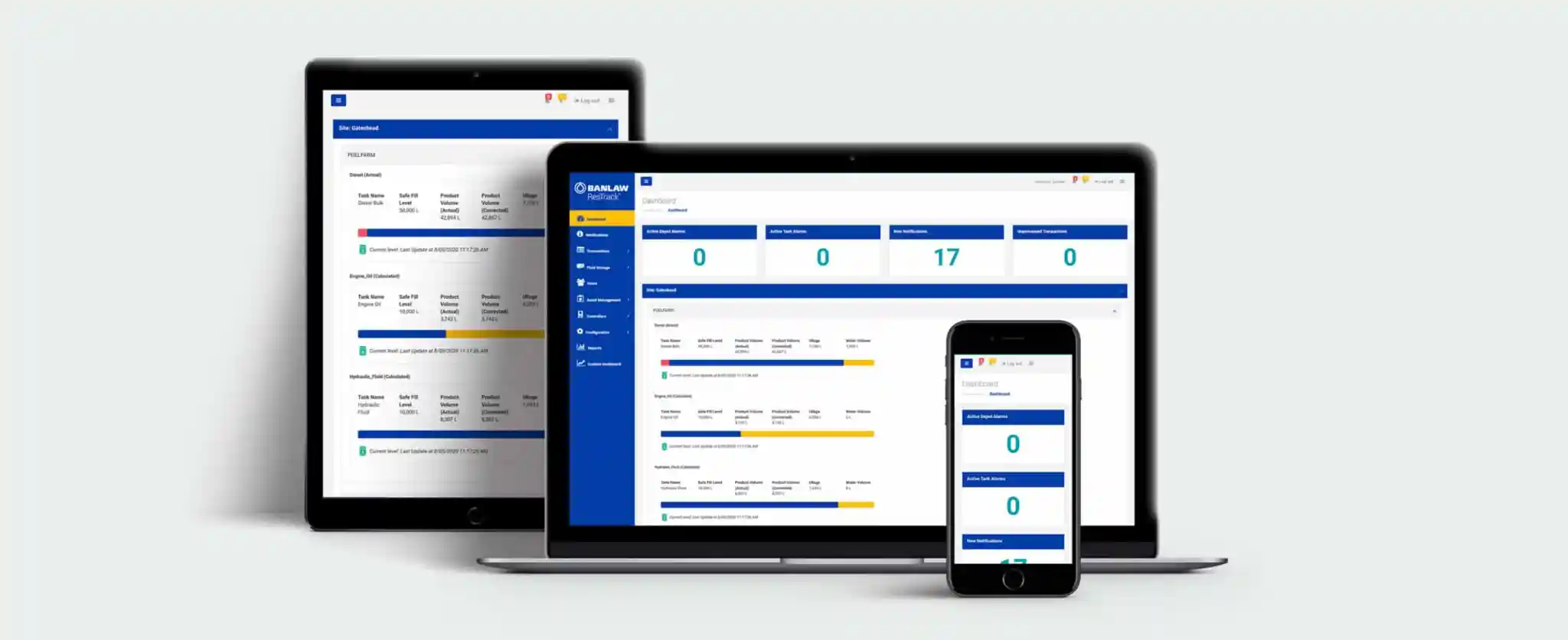
Banlaw builds industrial-grade fuel dispensing systems for large equipment fleets in mining, ports, rail, and heavy construction, with global operations and strong European presence. Its ResTrack software achieves over 99 percent fuel reconciliation accuracy by combining on-board capture units with centralized inventory reconciliation. For European logistics companies running mixed fleets that include heavy equipment alongside delivery vehicles, Banlaw addresses the fuel management problem at both the vehicle and infrastructure layers.
Best for: European logistics and industrial operations with high-volume mixed fleets where conventional fuel card solutions are not designed for the equipment types in use.
Fleet Fuel Management Software in Asia Pacific
Asia Pacific faces the greatest structural vulnerability to the current energy disruption. Major economies in the region are heavily dependent on Gulf crude imports: China holds strategic reserves but faces rising production input costs; India, with thinner reserves, is experiencing direct inflation pressure from fuel price increases. Southeast Asia, which sources a significant share of its fuel from Gulf suppliers, is seeing immediate cost transmission into logistics and distribution operations.
The Asia Pacific fuel management software market is the fastest-growing globally, driven by fleet proliferation in India, China, and Southeast Asia. The conflict has accelerated adoption timelines for organizations that had been evaluating fleet fuel tracking solutions as a future investment. When diesel prices increase 25 to 30 percent in a matter of weeks, the return on investment calculation for consumption monitoring and fraud prevention changes overnight.
Fleetio | fleetio.com
Fleetio's global SaaS architecture makes it deployable in APAC markets without local infrastructure. For fleets in Australia, India, and Southeast Asia operating in markets where established fuel card networks may not have native integrations, Fleetio's mobile receipt capture and manual transaction logging provide a baseline fuel tracking capability that can be deployed quickly and scaled. The platform's fuel economy reporting is equally relevant for fleets in high-diesel-cost markets where route-level consumption benchmarking directly informs planning decisions.
Best for: APAC fleet operators needing a cloud-based, low-overhead fuel tracking solution deployable without local hardware infrastructure.
Banlaw | banlaw.com
Banlaw operates globally with strong presence in the Australian mining and resources sector, where it was originally developed. For APAC industrial fleets in mining, resources, and large-scale logistics, Banlaw's hardware-integrated fuel management is the most operationally appropriate solution: high-flow dispensing, multi-fuel-type tracking, and the accuracy required for cost allocation in capital-intensive operations. The Australian context also includes PAYGQ fuel levy reporting requirements that Banlaw's consumption records directly support.
Best for: Australian and APAC industrial fleet operators in mining, resources, and infrastructure logistics running high-consumption equipment fleets.

What to Look for When Evaluating Fleet Fuel Management Software
The regional mapping above identifies which platforms are most relevant by geography. These evaluation criteria apply across all markets and determine which platform will actually deliver the outcomes the operation needs.
Access control architecture: does the platform prevent unauthorized dispensing at the hardware level, or does it only detect unauthorized transactions after they occur? For operations with owned depot infrastructure, hardware-level control is materially more effective than post-transaction fraud detection.
Real-time consumption visibility: can the operations team see current fuel levels and usage rates, or is reporting retrospective? In a volatile cost environment, weekly reports are not sufficient for operational decision-making.
Integration with existing systems: fuel data has limited value in isolation. The question is whether consumption records, cost data, and exception alerts can flow into the ERP, fleet management platform, or accounting system the business already runs on — automatically, without a manual export step.
Mobile capability: drivers, depot managers, and operations teams in the field need access to fuel data without being tethered to a desktop. Platforms with strong mobile applications for both logging and alert management are operationally more effective than web-only solutions.
Tax and compliance support: VAT recovery in GCC markets, IFTA reporting in North America, carbon reporting in Europe, and fuel levy documentation in Australia are all documentation problems that well-configured fuel management software solves automatically. Verify that the platform generates the specific compliance outputs the operation needs before committing to an implementation.
When Fuel Data Needs to Reach the Rest of the Business
Fleet fuel management software solves the monitoring, control, and efficiency problem at the vehicle and depot level. What it does not solve on its own is the connection between fuel data and the order management, dispatch, and financial systems that the rest of the operation depends on.
For fleet operators running delivery operations alongside fuel management, the cost-per-delivery calculation requires both datasets: what did this route cost in driver time and vehicle depreciation, and what did it cost in fuel? When those numbers exist in separate systems, operational decisions are made from incomplete data.
SuiteFleet connects delivery execution to the ERP layer so every completed route carries its operational context into the systems your finance, planning, and customer service teams work from. To see how it fits your current dispatch and ERP stack, request a demo at suitefleet.com/demo.