Delivery dispatch software is not one category. The platform that solves a trucking carrier's hours-of-service compliance problem is not the same platform that a Shopify merchant needs to dispatch same-day courier routes. And neither of those is the right tool for an enterprise retailer coordinating deliveries across a mixed fleet of owned vehicles and third-party carriers.
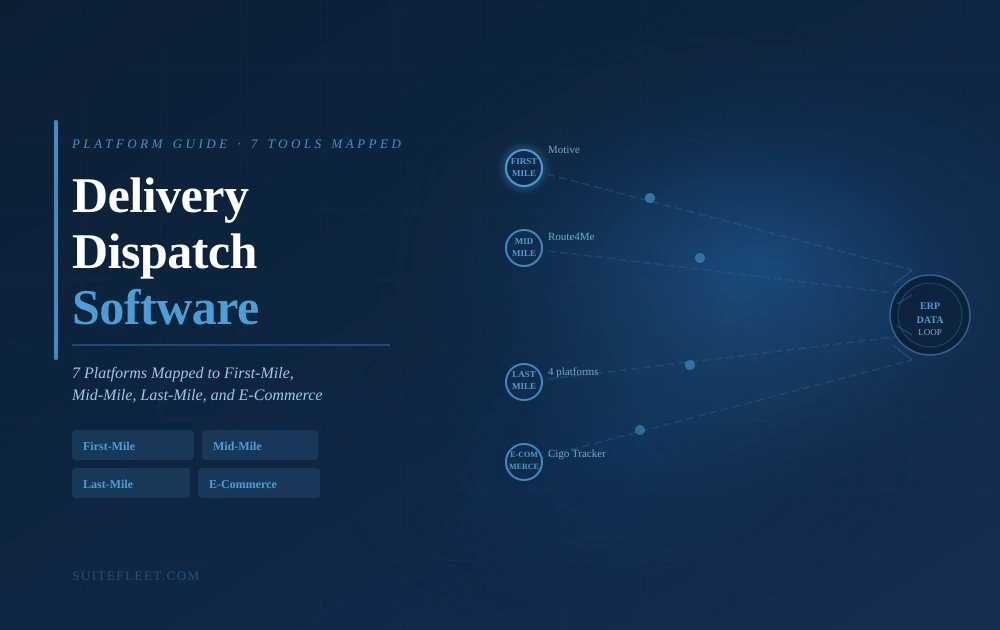
The mistake most buyers make is searching for the best delivery dispatch software and comparing tools that were built for entirely different problems. This guide cuts through that by mapping seven platforms to the specific leg of the delivery journey each one was built to handle: first-mile, mid-mile, last-mile, and e-commerce dispatch.
For each platform, the focus is on what the dispatch capability actually does, who it is built for, and where it fits in the broader technology stack. SuiteFleet is covered separately at the end, as the integration layer that connects dispatch execution back to the ERP systems most enterprise operations already run on.
What Delivery Dispatch Software Actually Does
At its core, delivery dispatch software answers a single operational question: which driver or carrier should handle this job, and when? The more sophisticated the platform, the more variables it factors into that answer.
Basic dispatch tools assign jobs manually or with simple rule-based logic. Modern delivery dispatch software uses AI to optimize across driver availability, vehicle capacity, time windows, traffic conditions, service zones, and cost per delivery simultaneously. The result is not just faster assignment decisions, but decisions that compound across a full day's routes to produce materially lower cost and higher on-time rates.
Beyond assignment, delivery dispatch software typically covers:
- Route optimization, whether static pre-planned routes or dynamic real-time rerouting
- Driver app with job details, navigation, proof of delivery capture, and two-way communication
- Real-time visibility for dispatchers: GPS position, ETA accuracy, exception alerts
- Customer notifications: automated ETAs, tracking links, delivery confirmations
- Reporting: on-time rate, cost per delivery, driver performance, failure analysis
The variable that separates good implementations from expensive frustrations is integration depth: whether the delivery dispatch software can receive order data from upstream systems and push delivery status, proof of delivery, and cost data back to the ERP or order management system downstream. Platforms that cannot close that loop create manual reconciliation work that quietly consumes more time than the dispatch automation saves.

Delivery Dispatch Software for First-Mile Operations
First-mile dispatch covers the movement of goods from origin points to distribution hubs, fulfillment centers, or cross-dock facilities. The operational priorities here are different from last-mile: loads are larger, routes are longer, regulatory compliance (hours of service, weight limits, driver qualifications) is heavier, and the dispatcher is often coordinating with carriers rather than directly employed drivers.
Motive | gomotive.com
Motive is an integrated fleet management and dispatch platform built specifically for the physical economy: trucking, construction, agriculture, oil and gas, and logistics carriers. Its dispatch capability sits within a broader platform that includes electronic logging devices (ELDs), AI dashcams, driver safety scoring, and spend management via a fleet card.
What makes Motive relevant for first-mile delivery dispatch software is the way compliance and operations are unified. When a dispatcher assigns a load, the system already knows the assigned driver's hours-of-service status, vehicle inspection history, and qualification records. Dispatch decisions that would create HOS violations are flagged before the assignment is confirmed rather than after a driver is already on the road.
For fleets operating under DOT regulations, that compliance integration is not a nice-to-have. It is the reason a dedicated trucking and carrier dispatch tool is worth evaluating separately from a generic last-mile platform.
Key dispatch capabilities:
- Driver assignment: factors in HOS availability, vehicle type, load requirements, and proximity
- Real-time tracking: GPS with live ETAs, geofence alerts, and idle monitoring
- Driver app: job details, navigation, document scanning, and in-app messaging
- Compliance integration: ELD data feeds directly into dispatch decisions
- Marketplace integrations: connects to TMS platforms and third-party logistics software via API
Best for: Trucking carriers, owner-operator fleets, and distribution operations where DOT compliance is a primary operational constraint alongside dispatch efficiency.
Delivery Dispatch Software for Mid-Mile Operations
Mid-mile dispatch covers the movement of goods between distribution centers, fulfillment hubs, retail locations, or regional depots. Routes tend to be multi-stop, loads are mixed, and operations often span territories rather than a single city. The primary optimization challenge is not just which driver but how to structure routes across multiple stops, vehicles, and service areas efficiently.
Route4Me | route4me.com
Route4Me is a route optimization and dispatch platform that handles multi-stop planning at scale. It was built to address the specific complexity of mid-mile and distribution dispatch: operations where a single planning cycle might involve hundreds of stops across dozens of vehicles, with constraints including time windows, vehicle capacities, driver territories, and customer-specific service requirements.
The platform's core strength is its optimization engine, which can process large route planning problems faster than most alternatives and surface routes with measurably lower mileage and higher stop density. For dispatchers managing regional fleets, that translates directly to fewer vehicles needed to cover the same volume and lower fuel spend per delivery.
Route4Me also supports territory management, which is useful for mid-mile operations that want to assign consistent geographic zones to drivers rather than re-optimizing territories from scratch each planning cycle. Driver performance data feeds back into the platform to improve future route quality over time.
Key dispatch capabilities:
- Multi-stop optimization: handles hundreds of stops across large vehicle fleets in a single planning cycle
- Territory management: assign and maintain geographic zones for consistent driver routing
- Dynamic dispatch: adjust routes in real time as conditions or orders change mid-day
- Driver app: turn-by-turn navigation, status updates, POD collection
- Reporting: route adherence, cost per delivery, planned versus actual mileage
Best for: Regional distribution fleets, multi-depot operations, and field service companies that need to plan and dispatch large volumes of multi-stop routes across defined service territories.
Delivery Dispatch Software for Last-Mile Operations
Last-mile dispatch is the most operationally complex segment because it involves the highest number of individual delivery points, the tightest time windows, the most direct customer interaction, and the greatest sensitivity to failure. A failed first-mile movement costs money. A failed last-mile delivery costs money and customer trust simultaneously.
Four platforms cover meaningfully different last-mile use cases.
OptimoRoute | optimoroute.com
OptimoRoute is a route planning and dispatch platform that excels at handling operational complexity that simpler tools cannot accommodate: multi-day routing (where drivers carry undelivered stops across days), mixed delivery and pickup runs, return logistics scheduled alongside outbound routes, and skills-based assignment where certain jobs require specific driver certifications or vehicle types.
The platform is particularly useful for fleets where standard last-mile delivery dispatch software produces suboptimal results because the routing problem has unusual constraints. Medical supply delivery with strict temperature and time requirements, appliance installation with skill matching, and parcel operations combining forward deliveries with return collections are all areas where OptimoRoute's constraint handling produces better outcomes than basic optimization.
Key dispatch capabilities:
- Multi-day routing: carry forward undelivered stops without manual rescheduling
- Mixed pickup and delivery: schedule return pickups alongside outbound runs on the same route
- Skills and vehicle matching: assign jobs based on driver certifications and vehicle capabilities
- Real-time tracking: live driver positions with automated customer ETA updates
- Analytics: planned versus actual reporting with cost per delivery breakdown
Best for: Last-mile fleets with complex routing constraints: mixed outbound and return runs, multi-day delivery windows, or jobs requiring specific driver skills or equipment.
Circuit | getcircuit.com
Circuit for Teams is a delivery dispatch software platform built around the driver experience. The platform's driver app consistently ranks among the highest-rated in the category because it was designed to minimize the learning curve for new drivers, reduce the number of steps between receiving a job and completing it, and capture proof of delivery without friction.
For courier companies and small-to-medium delivery fleets, the practical advantage of a driver app that drivers actually use without training is significant. Poor driver app adoption is one of the most common reasons dispatch tools underperform: the optimization runs well at the planning layer but falls apart on the road because drivers revert to phone calls and paper instead of using the app as intended.
Circuit also supports bulk stop import for dispatchers managing high daily volumes, barcode scanning for parcel operations, and real-time ETAs pushed to customers automatically.
Key dispatch capabilities:
- Driver app: highly rated for ease of use; minimal training required for new drivers
- Bulk stop import: upload stops from spreadsheet or connect via API for automated order import
- Live tracking: dynamic ETAs updated throughout the day, with customer-facing tracking link
- POD capture: photo, signature, and notes collected in-app, instantly accessible to dispatcher
- Integrations: Shopify, WooCommerce, and REST API for order management connections
Best for: Courier companies and SMB delivery fleets where driver adoption is a primary concern and the priority is clean, fast execution rather than complex constraint handling.
nuVizz | nuvizz.com
nuVizz is an enterprise last-mile TMS that addresses a specific problem larger retail and distribution operations face: dispatching across a mix of internal fleet, regional 3PLs, and national carriers from a single platform, with consistent visibility and service-level control regardless of which delivery partner handles a given job.
For an enterprise retailer managing deliveries through its own drivers in core markets and outsourcing to third-party carriers in secondary regions, the dispatcher's problem is not route optimization alone. It is carrier selection, load tendering, SLA monitoring across partners, and customer communication that does not break down when a third-party carrier takes over the last mile. nuVizz is built to solve that orchestration problem.
Key dispatch capabilities:
- Carrier orchestration: route orders across internal fleet, regional couriers, and national carriers from one dashboard
- AI dynamic routing: route recalculation based on live data across all active deliveries
- WISMO reduction: automated customer communications reduce inbound status calls
- SLA monitoring: track on-time performance by carrier, region, and delivery type
- Enterprise integrations: TMS, WMS, and ERP connectors for enterprise stack compatibility
Best for: Enterprise retailers and distributors managing mixed internal and third-party carrier networks who need unified dispatch visibility and consistent customer communication across all delivery partners.
Elite EXTRA | eliteextra.com
Elite EXTRA is a last-mile delivery dispatch software platform with a particular focus on distribution, wholesale, and manufacturing delivery operations. Where most last-mile tools are built around the courier or e-commerce use case, Elite EXTRA is designed for the operational reality of a distributor: recurring routes, account-based delivery schedules, mixed load types, and returns automation built into the same workflow rather than bolted on separately.
Key dispatch capabilities:
- Route optimization: handles recurring route schedules alongside dynamic daily dispatch
- Returns automation: schedule, track, and process returns inside the dispatch workflow
- Driver app: job details, POD, returns processing, and in-app communication
- ERP and WMS integration: connects to distribution and warehouse systems for order intake and status sync
- Analytics: cost per delivery, on-time performance, driver efficiency across recurring routes
Best for: Distribution, wholesale, and manufacturing delivery fleets that run recurring route schedules and need returns handling integrated into the same dispatch workflow.
Delivery Dispatch Software for E-Commerce
E-commerce dispatch has a distinct set of requirements. Order volumes can spike sharply without notice. Customers expect self-service tracking rather than proactive outreach. Integration with storefront platforms (Shopify, WooCommerce) must be straightforward enough for small teams to configure without developer resources. And cost per delivery matters more than almost any other metric because e-commerce margins are thin.
Cigo Tracker | cigotracker.com
Cigo Tracker is a cloud delivery dispatch software platform built for e-commerce brands and courier businesses that need to go live fast without a complex implementation. The platform connects to Shopify and WooCommerce natively, pulling orders automatically and creating dispatch jobs without manual data entry.
Where Cigo Tracker earns its place on this list is in the combination of delivery dispatch with returns support within a single, affordable platform. For an e-commerce brand handling both outbound delivery and returns pickups through its own or contracted courier fleet, having dispatch, tracking, and returns workflow in one tool avoids the integration overhead of stitching multiple systems together.
Key dispatch capabilities:
- E-commerce integrations: native Shopify and WooCommerce connectors, REST API for other platforms
- Automated dispatch: route creation and driver assignment from incoming orders without manual entry
- Customer tracking portal: branded, real-time tracking page sent automatically at dispatch
- Returns dispatch: schedule return pickups alongside outbound deliveries in the same workflow
- Reporting: delivery success rate, time-in-transit, driver performance across order cohorts
Best for: E-commerce brands and SMB courier operations that need a fast-to-deploy delivery dispatch software platform with native storefront integrations and a customer-facing tracking experience.
Platform Comparison: Delivery Dispatch Software by Segment
The Integration Layer Most Listings Skip
Every platform on this list handles delivery dispatch software well within its target segment. The gap that most comparisons do not address is what happens after the dispatch event: whether the completion data, proof of delivery, cost records, and return status flow back into the systems the rest of the business depends on.
For operations running on an ERP, that gap is not a minor inconvenience. When delivery status does not update the order record, finance cannot trigger invoices. When POD does not attach to the customer account, customer service cannot resolve disputes without calling the dispatcher. When return data does not reach inventory, stock positions are wrong until someone runs a manual reconciliation.
The platforms above solve the dispatch execution problem. The question for any enterprise operation is whether that execution layer connects cleanly to the ERP or whether it requires middleware, manual exports, or a separate integration project to close the loop.
That is the operational question worth answering before selecting a dispatch tool, not after.
Frequently Asked Questions
What is delivery dispatch software?
Delivery dispatch software is technology that determines which driver or carrier handles a job, when they handle it, and in what sequence — then manages the execution from assignment through to real-time tracking, proof of delivery capture, and data return to the source system. Modern platforms use AI to optimize across driver availability, vehicle capacity, time windows, and traffic conditions simultaneously, and connect that execution back to the ERP so delivery outcomes update order records automatically.
What is the difference between delivery dispatch software and route optimization?
Route optimization calculates the most efficient sequence and path for a set of deliveries. Delivery dispatch software includes route optimization but goes further: it also handles driver assignment, real-time tracking, exception management, proof of delivery capture, customer notifications, and ERP data sync. Route optimization is one function within delivery dispatch software, not a substitute for it.
Which delivery dispatch software works best with an ERP?
SuiteFleet is the most deeply integrated delivery dispatch software for ERP-connected operations. It uses ready-made connectors for Oracle NetSuite, SAP, Salesforce, Odoo, Microsoft Dynamics, Shopify, and WooCommerce, so orders flow in automatically and confirmed delivery data — including proof of delivery and return status — returns to the ERP in real time without middleware. Enterprise platforms like nuVizz also offer ERP and TMS connectors for large mixed-fleet environments.
What is the best delivery dispatch software for last-mile delivery?
The best delivery dispatch software for last-mile delivery depends on the operational model. SuiteFleet is the strongest option for ERP-connected fleets needing real-time dispatch, live tracking, and proof of delivery back in the ERP the same day. OptimoRoute suits fleets with complex routing constraints like mixed pickups and multi-day windows. Circuit is the top choice when driver app adoption is the primary concern. Elite EXTRA fits distribution and wholesale operations running recurring routes with integrated returns.
How does delivery dispatch software integrate with Shopify?
Delivery dispatch software integrates with Shopify either through a native Shopify app connector or via REST API. Platforms like Circuit, Cigo Tracker, and SuiteFleet all offer direct Shopify integration: orders placed on Shopify are pulled into the dispatch system automatically, routes are planned and drivers dispatched, and confirmed delivery status returns to the Shopify order record. For merchants also running a back-office ERP, SuiteFleet can connect to both Shopify and the ERP simultaneously from a single dispatch event.
What delivery dispatch software is best for enterprise fleets?
For enterprise fleets managing mixed internal vehicles and third-party carriers, nuVizz is purpose-built for carrier orchestration and SLA monitoring across delivery partners. SuiteFleet is the strongest option when ERP integration depth is the primary requirement — it connects to major ERPs without middleware and returns the full delivery record in real time. For compliance-heavy first-mile operations, Motive is the enterprise-grade choice for DOT-regulated carrier fleets.
Dispatch Execution That Feeds Back Into Your ERP
Across first-mile, mid-mile, last-mile, and e-commerce operations, the platforms above each solve the dispatch problem within their lane. What they do not fully solve is the upstream and downstream data problem: whether the ERP that runs your business knows what happened after the driver left the depot.
SuiteFleet connects delivery dispatch software execution across all delivery segments to the ERP systems operations teams already run on. Driver assignment, real-time tracking, proof of delivery, and return status feed back to the order record automatically, so every team works from the same current picture without manual reconciliation.