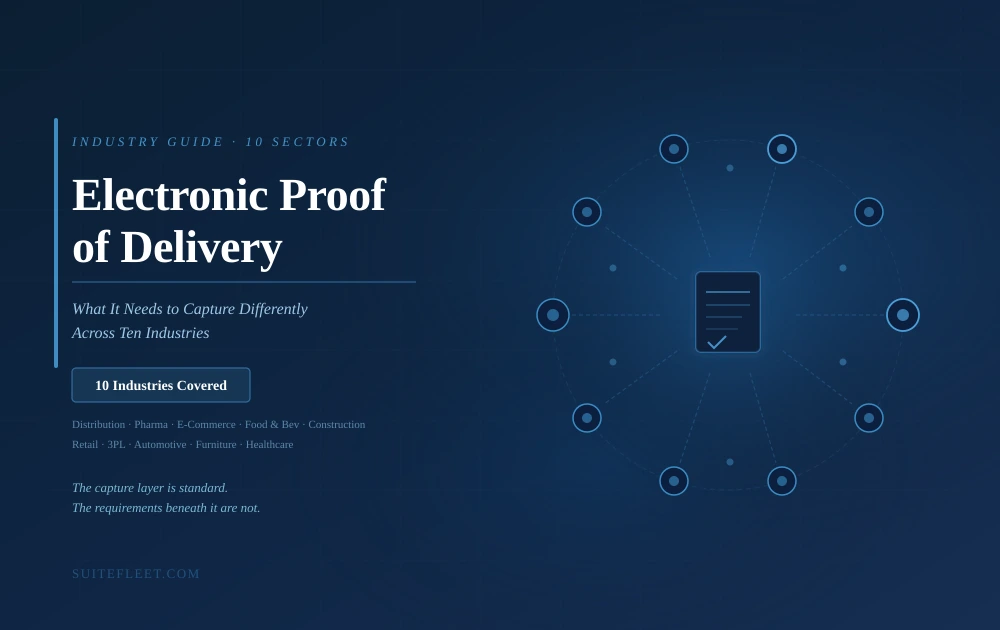
Electronic proof of delivery software captures the moment a delivery is completed. A signature, a photo, a timestamp, a GPS coordinate. Most platforms do all of that. But the requirements that make an electronic proof of delivery record operationally useful vary significantly across industries, and a configuration that works well for a consumer goods distributor can leave a pharmaceutical operation non-compliant and a 3PL unable to serve its clients.
The capture layer is standard. What differs is what needs to be captured, who needs to access it, what compliance record it creates, how it feeds back into the ERP and the inventory system, and how it handles the rejection or return that follows when something goes wrong at the point of delivery.
This guide covers ten industries. For each one, it covers the delivery reality, what standard ePOD typically misses, what the electronic proof of delivery platform needs to capture, and what the downstream data requirements are. The cross-industry comparison table at the end maps all ten against four criteria.

Ten Industries, Ten Different Sets of Requirements
1. Distribution — Recurring accounts, partial acceptance, ERP-linked invoicing
Distribution operations typically serve recurring business accounts with established delivery schedules. The delivery reality is a driver arriving at a warehouse dock or loading bay, handing over a consignment that may include dozens of SKUs across multiple pallets, and waiting for the consignee to confirm receipt.
What standard electronic proof of delivery misses here is the partial acceptance scenario. A consignee who accepts eight of ten pallets because two are damaged, or accepts a delivery but notes a quantity short on one line, needs to be able to document that discrepancy at the point of delivery rather than through a dispute process after the fact. A signature and photo of the delivery do not capture which items were accepted and which were not.
What distribution electronic proof of delivery must capture:
- Item-level confirmation: each line on the delivery order confirmed, short, or rejected individually
- Quantity variance: actual delivered quantity recorded against ordered quantity per line
- Condition documentation: photo evidence for any damaged or disputed items
- Consignee sign-off: signature linked to the specific delivery order, not just the visit
- Returns logging: any items returned on the same trip documented with condition and reason
ERP requirement: Partial acceptance data must update the order record immediately so credit notes and invoice adjustments are triggered automatically. An electronic proof of delivery that records only that the delivery was made, without the quantity variance, leaves finance reconciling discrepancies manually at month end.
Recommended systems: Track-POD for its depth on item-level partial acceptance and quantity variance capture. SuiteFleet is the pick when that variance has to trigger a credit note or invoice adjustment in the ERP automatically.
2. Pharmaceutical and Cold Chain — Temperature logging, chain-of-custody, GDP compliance
Pharmaceutical and cold chain deliveries operate under regulatory frameworks that treat the delivery event itself as a compliance record, not just a logistics event. The goods in transit have defined temperature requirements, often between two and eight degrees Celsius for biologics and vaccines. A delivery that was completed but whose temperature history cannot be documented is not a compliant delivery.
Standard electronic proof of delivery platforms capture a photo and signature. For pharma, those two data points are necessary but insufficient. The chain-of-custody requirement means that every transfer of custody must be documented with the identity of the receiving party, the condition of the goods, the temperature at the point of handover, and the batch or lot number of the delivered product. Without all of those fields, the delivery record cannot serve as a GDP-compliant document.
What pharmaceutical and cold chain electronic proof of delivery must capture:
- Temperature at handover: device-logged or manually entered temperature at the moment of delivery confirmation
- Chain-of-custody record: named recipient with role or designation, not just a signature
- Batch and lot numbers: linked to each item delivered, scannable from packaging barcode
- Condition on arrival: any visible damage, seal integrity, or packaging compromise documented
- Delivery environment: storage condition at destination if relevant to compliance
Rejection handling: A delivery rejected due to a temperature breach is a compliance event. The rejection must be documented with the measured temperature, the specific products affected, and the batch numbers, then fed back to the quality management system and inventory so those units are quarantined and the return is tracked with full custody documentation.
Recommended systems: SuiteFleet for temperature logging, chain-of-custody capture, and batch references enforced in the driver workflow and routed to the quality management and inventory systems automatically. Onfleet can cover the delivery and notification layer where an operation pairs it with its own compliance process.
3. E-Commerce — Customer-visible confirmation, contactless delivery, returns-linked POD
E-commerce electronic proof of delivery has a dual audience that most other industries do not: the operations team that needs delivery confirmation for order management, and the customer who expects to see evidence that their order was delivered. For a business-to-business distributor, the consignee is on site and signs in person. For a consumer e-commerce delivery, the recipient may not be home.
The standard ePOD failure in e-commerce is the safe-location delivery. A driver leaves a parcel at the door, takes a photo, and marks the delivery complete. What is missing is the customer confirmation that the parcel was left in an acceptable location, the GPS stamp proving the photo was taken at the delivery address, and the specific location description that would allow the customer to find their parcel if they were not watching.
What e-commerce electronic proof of delivery must capture:
- Location photo with GPS stamp: proves the delivery was made at the correct address
- Safe-location description: written note or standardized field describing where the parcel was left
- Contactless confirmation: structured flow for unattended deliveries that creates a legally defensible record
- Customer notification trigger: POD completion sends a delivery confirmation to the customer automatically
- Order status update: delivery status writes back to the order record in the storefront and ERP simultaneously
The returns dimension in e-commerce is also POD-linked. When a return pickup is scheduled, the driver collecting the return needs to capture an electronic proof of delivery equivalent on collection: condition of the returned item, packaging integrity, and confirmation that the correct item was collected. That collection record feeds back into the refund workflow.
Recommended systems: Onfleet and Cigo Tracker for customer-visible POD, safe-location proof, and automated notifications. SuiteFleet is the pick when the delivery status has to update the storefront and the back-office ERP at the same moment.
4. Food and Beverage — Quantity variance, temperature, FEFO compliance, short delivery credits
Food and beverage distribution combines the quantity-variance requirements of general distribution with the temperature sensitivity of cold chain and the traceability obligations of food safety regulation. A driver delivering chilled dairy or fresh produce to a retailer or foodservice customer is operating in an environment where the goods may be inspected and partially rejected on the spot, where temperature compliance may be checked at the loading bay, and where the batch identity of delivered stock matters for traceability purposes.
Short deliveries are common in food and beverage because stock availability can change between order confirmation and delivery. A driver arriving with eighteen of twenty ordered cases of a product needs to document the short delivery at the point of handover so the credit note is generated immediately rather than becoming a dispute later.
What food and beverage electronic proof of delivery must capture:
- Delivered quantity per line: against ordered quantity, with short delivery reason code
- Temperature at handover: for chilled and frozen products, device or manual log at the moment of transfer
- Best-before and batch reference: FEFO compliance requires that the batch delivered matches the batch expected
- Rejection reason: structured reason codes for any items rejected at the delivery point
- Consignee identity: authorized recipient confirmed, particularly for alcohol and regulated categories
ERP requirement: Short delivery data must update inventory immediately and trigger a credit note workflow without manual intervention. An electronic proof of delivery that records the short delivery but does not push that data to the ERP leaves the credit note process dependent on a driver handing in paperwork at the end of the day.
Recommended systems: Track-POD for delivered-quantity-per-line capture and batch references at the point of handover. SuiteFleet is the pick when short-delivery data has to update inventory and trigger a same-day credit note in the ERP.
5. Construction and Field Service — Site delivery, materials checklist, project cost closure
Construction site deliveries present a different operational challenge from retail or commercial account delivery. There may not be a fixed receiving function. The person accepting delivery may be a site manager, a foreman, or a subcontractor who has different authority levels. The delivery may be of materials that need to be placed in a specific location on a large site, and the electronic proof of delivery needs to evidence not just that the goods arrived but that they were placed correctly.
For field service operations delivering equipment or parts to service locations, the POD record often needs to close a work order in the ERP, which requires the electronic proof of delivery to reference the work order number and capture the acceptance of the specific items listed on that order.
What construction and field service electronic proof of delivery must capture:
- Site photo with location context: evidence of placement at the correct location on site, not just arrival at the gate
- Materials checklist confirmation: each item on the delivery order confirmed present, with quantity
- Authorized sign-off: identity and role of the accepting party, linked to the work order or project
- Damage on delivery: any transit damage photographed before offloading begins
- Work order reference: POD linked to the project or work order number that closes the delivery in the ERP
Recommended systems: eLogii for its configurable capture flow and API, which lets a field-service operation attach a work-order reference and materials checklist to the POD. SuiteFleet is the pick when that POD needs to close the work order and update project cost in the ERP.
6. Retail — Store-level receipt, SKU-level discrepancy, direct stock update
Retail delivery, particularly direct store delivery (DSD), is one of the highest-volume and most data-intensive electronic proof of delivery environments. A route driver delivering to ten retail stores in a day generates ten separate delivery events, each of which needs to confirm receipt at the store level, document any discrepancies against the delivery order, and feed that data back to the supplier's ERP and the retailer's inventory system.
The discrepancy logging requirement is central. A retail store receiving a delivery will often check it against their purchase order before signing. If there is a shortage or if a product arrives damaged, that discrepancy needs to be documented per SKU at the point of delivery, not through a phone call to the supplier the following day.
What retail electronic proof of delivery must capture:
- SKU-level confirmation: each product line confirmed or discrepancy noted individually
- Barcode scanning: items scanned from the delivery against the purchase order to confirm identity and quantity
- Store-level sign-off: authorized store representative identified, not just a general signature
- Discrepancy reason codes: structured data on shortage, damage, or wrong product for credit and reorder logic
- Shelf or backroom drop confirmation: for DSD routes where the driver places product directly onto shelving
ERP requirement: Discrepancy data at the SKU level should update inventory immediately on both sides. The supplier's ERP adjusts the sale to the confirmed quantity. The retailer's inventory system, if connected, reflects the actual stock received. Manual reconciliation between the two systems is a significant operational cost that direct electronic proof of delivery integration eliminates.
Recommended systems: DispatchTrack for appointment-driven retail delivery and Track-POD for SKU-level barcode confirmation against the purchase order. SuiteFleet ties the confirmed discrepancy directly to invoicing and inventory in the ERP.
7. Third-Party Logistics (3PL) — Multi-client POD, client-branded records, separate ERP feeds
Third-party logistics operations introduce a complexity that no other industry on this list faces: the 3PL is capturing electronic proof of delivery on behalf of multiple clients simultaneously, each of whom has different documentation requirements, different ERP systems, and different expectations of what the POD record will look like.
A 3PL driver delivering orders for three different clients on the same route needs three different POD capture flows, potentially with different required fields, different branding on the customer-facing confirmation, and different downstream integrations for each client. A single generic ePOD template that is the same for all clients either fails to meet the requirements of the most demanding client or forces the least demanding client to capture data they do not need.
What 3PL electronic proof of delivery must capture:
- Client-specific POD configuration: different capture fields, required photos, and confirmation flows per client
- Client-branded customer confirmation: the delivery notification the end customer receives is branded for the shipper, not the 3PL
- Client SLA documentation: time of delivery and delivery window confirmed against the client's service level agreement
- Separate data routing: each client's POD data feeds their ERP or order management system independently
- Consolidated 3PL reporting: the 3PL sees all POD data across all clients in a single operational view
The return handling requirement in 3PL is similarly complex. A returned item belongs to a specific client. The collection event, condition assessment, and restocking or disposal decision all need to be routed to the correct client's system rather than to a single shared returns queue.
Recommended systems: SuiteFleet for per-client POD configuration and independent routing of each client's delivery data to their own ERP or portal. VersaFleet is a capable alternative for high-volume multi-client dispatch where an operation does not need the ERP loop.
8. Automotive and Spare Parts — Part number verification, warranty chain, workshop job closure
Spare parts distribution to automotive dealerships, independent workshops, and fleet maintenance operations has a high dispute rate relative to other distribution sectors. The reason is specificity: a wrong part delivered to a workshop that is mid-repair creates a more significant operational problem than a short-delivered SKU in a retail environment. The technician cannot complete the job, the vehicle remains unrepaired, and the workshop loses revenue for the day.
Electronic proof of delivery in automotive parts distribution needs to confirm not just that a delivery was made, but that the correct parts were delivered. Barcode or QR scanning of the part number against the order is standard in more advanced operations but frequently missing from generic delivery apps. The other distinctive requirement is the job card reference: a workshop receiving parts against a specific vehicle repair job needs the delivery confirmed against that job card number so the parts cost can be allocated correctly in the workshop management system.
What automotive and spare parts electronic proof of delivery must capture:
- Part number scan confirmation: each part scanned and matched to the order line before the driver leaves
- Condition photo on delivery: particularly for sensitive electronics or painted components
- Workshop job card reference: POD linked to the specific job card or VIN that the parts are destined for
- Bin or storage location drop: where in the workshop the parts were placed
- Warranty documentation: chain-of-custody reference for parts subject to manufacturer warranty
Returns handling: A wrong or defective part returned from a workshop needs to travel back to the distribution centre on the same route that delivered it where possible. The return documentation needs to capture the part number, the reason for return, and the job card reference so the credit note is raised against the correct workshop account.
Recommended systems: Elite EXTRA for its strength in automotive parts distribution, combining routing, a delivery network, and returns handling in one platform. SuiteFleet is the pick when the part delivery needs to close the workshop job card and post the parts cost in the ERP.
9. Furniture and White-Glove Delivery — Multi-stage sign-off, installation documentation, dispute evidence
White-glove furniture delivery involves a delivery event that spans multiple stages: the goods arrive, they are inspected for transit damage before being brought into the premises, they are assembled or installed, and the customer accepts the finished result. Each of those stages is a potential dispute point, and the electronic proof of delivery record needs to document all of them.
A furniture delivery claim that a sofa arrived with a scratch is much harder to defend if the only documentation is a final photo and a customer signature. A claim that the installation was incomplete is hard to refute if there is no record of what the installation comprised. White-glove ePOD is fundamentally about creating a layered evidence record that protects both the delivery operation and the customer.
What furniture and white-glove electronic proof of delivery must capture:
- Pre-delivery condition photos: goods photographed in packaging before being brought into the premises
- Unpacking record: photos at the point of unpacking to document any transit damage before installation begins
- Installation checklist: each stage of the assembly or installation confirmed complete
- Post-installation photos: finished installation documented from agreed angles
- Customer sign-off per stage: acceptance at unpacking and again at completion of installation
The dispute rate for high-value furniture deliveries is significantly higher than for standard parcels. The investment in multi-stage electronic proof of delivery documentation pays back in reduced claims processing time and stronger evidence in disputed cases.
Recommended systems: DispatchTrack for appointment-based, high-touch white-glove delivery with multi-stage confirmation and customer communication. SuiteFleet is the pick when the completed installation needs to close the job and trigger the installation invoice in the ERP.
10. Healthcare and Medical Devices — Device serial numbers, clinical sign-off, regulatory traceability
Healthcare delivery combines elements of pharmaceutical compliance, high-value asset management, and installation documentation. A medical device delivered to a hospital department needs to be accepted by a qualified clinical staff member, its serial number recorded and linked to the asset register, its installation or commissioning confirmed, and all of that data preserved in a format that can support regulatory audit.
The distinction from pharmaceutical delivery is that a medical device is an asset with a long service life, not a consumable. The delivery event is the beginning of an asset management record, not just a logistics transaction. The electronic proof of delivery record for a medical device needs to feed the hospital's asset register, the manufacturer's installation record, and any regulatory compliance system that tracks device location and service history.
What healthcare and medical device electronic proof of delivery must capture:
- Device serial number: scanned and confirmed against the order, linked to the asset record
- Clinical staff sign-off: named recipient with role and department confirmed
- Installation or commissioning checklist: for devices requiring setup before use, each step documented
- Department and location: precise placement within the facility recorded for asset management
- Regulatory reference: MDR or equivalent regulation reference linked to the delivery record
ERP and compliance system requirement: Device serial number and delivery confirmation must sync to the asset register and any connected quality management or regulatory compliance system immediately on delivery completion. A device that is delivered but not yet registered in the asset system is both an audit risk and an inventory discrepancy.
Recommended systems: SuiteFleet for device serial-number capture, clinical sign-off, and real-time sync to the asset register and compliance systems. Onfleet can cover the delivery and clinical-recipient notification layer where an operation pairs it with its own asset-management process.
Top 10 Proof of Delivery Software in 2026
The ten industries above each need something specific from the capture layer, but the platforms that handle proof of delivery well, and then get the data where it needs to go, are a shorter list. Here are the top 10 proof of delivery software platforms for 2026, ranked with the ERP and compliance loop in mind, each with a verified review link and the industries it fits best.
1. SuiteFleet
SuiteFleet is a proof of delivery and delivery execution platform built for operations that need POD data wired into the ERP and compliance systems. Its configurable capture supports signatures, photos, GPS stamps, temperature logs, batch and serial numbers, and multi-stage sign-off, then returns the full record to NetSuite, SAP, Odoo, Salesforce, Dynamics, Shopify, or WooCommerce in real time through native connectors, with no middleware. That configurability lets it meet distribution, pharma, retail, 3PL, automotive, and healthcare capture requirements while keeping the data loop closed.
Best for: Any industry that needs POD data in the ERP, inventory, or compliance systems the same day, especially pharma, healthcare, 3PL, distribution, and retail.
2. Track-POD
Track-POD is a single-dashboard delivery platform built around electronic proof of delivery, with strong handling of partial delivery, overdelivery, delivered-quantity-per-line capture, and barcode confirmation. Its POD-first design makes it a natural fit where accurate item and quantity capture drives billing.
Best for: Distribution, food and beverage, and retail operations that need item and quantity-level POD.
3. Onfleet
Onfleet is a widely used delivery platform with a polished driver app, GPS-stamped photo capture, safe-location proof, and automated customer notifications. Its customer-facing POD experience makes it a strong fit where the recipient needs visible confirmation.
Best for: E-commerce, pharmacy, and healthcare delivery that needs customer-visible POD and notifications.
4. DispatchTrack
DispatchTrack is a last-mile platform strong in appointment-driven, high-touch delivery, with multi-stage confirmation and Built for NetSuite certification. It suits deliveries where the POD spans arrival, inspection, and installation.
Best for: Retail and furniture or white-glove delivery that needs appointment-based, multi-stage POD.
5. eLogii
eLogii is a flexible route optimization and delivery management platform with strong proof-of-delivery capture and a well-documented API. Its configurability lets operations attach work-order references, checklists, and custom capture fields to the POD.
Best for: Construction and field service operations that need configurable, work-order-linked POD.
6. Elite EXTRA
Elite EXTRA combines routing and scheduling with a third-party delivery network and returns management, and is strong in automotive parts distribution. Its returns handling makes it a fit where the wrong-part return is part of the POD workflow.
Best for: Automotive and spare parts distribution that needs POD plus returns handling.
7. Cigo Tracker
Cigo is a delivery management and route planning platform with dynamic customer notifications, real-time tracking, and delivery confirmation. Its strength is a polished customer-facing tracking and POD experience.
Best for: E-commerce and retail operations that prioritize the customer-facing POD experience.
8. Tookan
Tookan is an on-demand delivery and dispatch platform with driver apps, real-time tracking, and proof of delivery capture, connecting by webhook or API. Its flexibility and low starting cost suit lighter field-service and on-demand POD needs.
Best for: Field service and on-demand operations that need flexible, low-cost POD.
9. VersaFleet
VersaFleet is a browser-based operations portal with a companion driver app, real-time delivery status, proof of delivery capture, and route optimization that dispatches large job volumes quickly. It has strong adoption in Southeast Asia logistics.
Best for: 3PL and logistics operations that need high-volume multi-client dispatch and POD.
10. Metrobi
Metrobi pairs delivery management software with a courier marketplace, with route planning, real-time tracking, and delivery confirmation. It suits local operations that want POD capture alongside on-demand courier capacity.
Best for: Local courier and SMB delivery that needs POD plus courier capacity.
Cross-Industry Comparison: ePOD Requirements at a Glance
The table below maps all ten industries across four criteria: what the electronic proof of delivery platform must capture beyond signature and photo, the compliance requirement, the ERP integration priority, and how rejection or returns are handled.
The Requirement Every Industry Shares: Closing the ERP Data Loop
Across ten industries with ten different capture requirements, one requirement is constant: the electronic proof of delivery record needs to reach the systems that downstream workflows depend on, automatically and in real time.
A pharmaceutical delivery whose chain-of-custody record stays inside the delivery app is not compliant. A retail delivery whose SKU-level discrepancies are never pushed to the supplier's ERP leaves a credit note unprocessed until someone manually reconciles the data. A 3PL whose clients cannot access their own delivery records in their own ERP is providing a service that is operationally incomplete regardless of how clean the electronic proof of delivery capture is.
The ePOD system is not the system of record. The ERP is. The electronic proof of delivery system's job is to capture accurately at the point of delivery and push that data to the right destination immediately. That destination may be an inventory system, a quality management system, an asset register, a client's ERP, or a financial workflow. In most cases it is several of those simultaneously.
When electronic proof of delivery data reaches those systems automatically, finance teams have the confirmed delivery data they need to process invoices. Customer service teams can resolve disputes from the delivery record without calling the dispatcher. Compliance teams can produce audit documentation without assembling records from multiple sources. The investment in detailed industry-specific capture pays back only when the captured data flows where it needs to go.
Frequently Asked Questions
What is electronic proof of delivery?
Electronic proof of delivery (ePOD) is a digital system that captures and records the moment a delivery is completed — typically through a signature, photograph, GPS coordinates, and timestamp collected on a driver's mobile app. Unlike paper delivery notes, electronic proof of delivery syncs this data back to the ERP or order management system automatically, allowing finance, customer service, and compliance teams to access delivery records in real time without manual data entry.
What is the best electronic proof of delivery software in 2026?
There is no single best platform, because the right choice depends on your industry and what your POD needs to capture. Track-POD leads for item and quantity-level capture in distribution and food and beverage. Onfleet and Cigo lead for customer-visible POD in e-commerce. DispatchTrack leads for multi-stage retail and white-glove delivery. Elite EXTRA leads for automotive parts. SuiteFleet leads for any operation that needs POD data wired natively into an ERP such as NetSuite, SAP, Odoo, Salesforce, or Dynamics. The full top 10 above maps each platform to the industries it fits best.
What does electronic proof of delivery need to capture?
Beyond the baseline of signature, photo, and GPS timestamp, what electronic proof of delivery needs to capture varies by industry. Distribution needs item-level partial acceptance. Pharma needs temperature logs and chain-of-custody records. E-commerce needs safe-location proof and customer notification triggers. Food and beverage needs batch references for FEFO compliance. Healthcare needs device serial numbers linked to asset registers. The minimum configuration is never sufficient for regulated industries.
How does electronic proof of delivery work?
When a driver arrives at a delivery stop, the electronic proof of delivery app guides them through the capture workflow: photograph the goods, obtain the consignee's signature, record any variances or exceptions, and confirm the job complete. The data syncs immediately to the dispatcher dashboard and writes back to the source ERP — updating the order record, triggering invoice or credit note workflows, and making the delivery record accessible to finance and customer service without any manual steps.
What is the difference between electronic and paper proof of delivery?
Paper proof of delivery is a physical delivery note signed by the consignee and returned to the depot at end of shift — typically hours after the delivery occurred. Electronic proof of delivery captures the same confirmation in real time, syncs it to the ERP immediately, attaches photos and GPS data, and makes the record accessible to all relevant teams the moment the driver taps complete. Paper POD requires manual data entry, creates reconciliation delays, and produces no audit trail for partial acceptance or damaged goods.
How does electronic proof of delivery integrate with ERP systems?
The best electronic proof of delivery systems use prebuilt connectors to popular ERPs — such as Oracle NetSuite, SAP, Salesforce, Odoo, and Microsoft Dynamics — that push delivery status, POD records, quantity variances, and exception data back to the order record automatically on job completion. This triggers invoice workflows, adjusts inventory positions, and closes fulfillment records without manual intervention. Platforms that require middleware or batch exports to connect to the ERP create a reconciliation gap that grows with order volume.
What are the compliance requirements for electronic proof of delivery in pharma?
GDP (Good Distribution Practice) and GMP compliance require that pharmaceutical electronic proof of delivery records include temperature at the point of handover, chain-of-custody documentation naming the authorized recipient with their role, batch and lot numbers for each product delivered, and condition of goods on arrival. These records must be accessible for regulatory audit and must feed the quality management system and inventory immediately on delivery completion. A delivery confirmed by signature alone is not GDP-compliant.
ePOD That Captures What Your Industry Requires and Closes the Loop
The ten industries covered in this guide each have specific capture requirements that generic delivery apps do not address by default. The common thread is not the capture layer — it is whether what is captured feeds back to the ERP, the compliance system, and the downstream workflows that depend on it.
SuiteFleet connects electronic proof of delivery to the ERP layer so that what is captured at the point of delivery updates order records, inventory positions, and compliance documentation automatically.