.svg)
.webp)


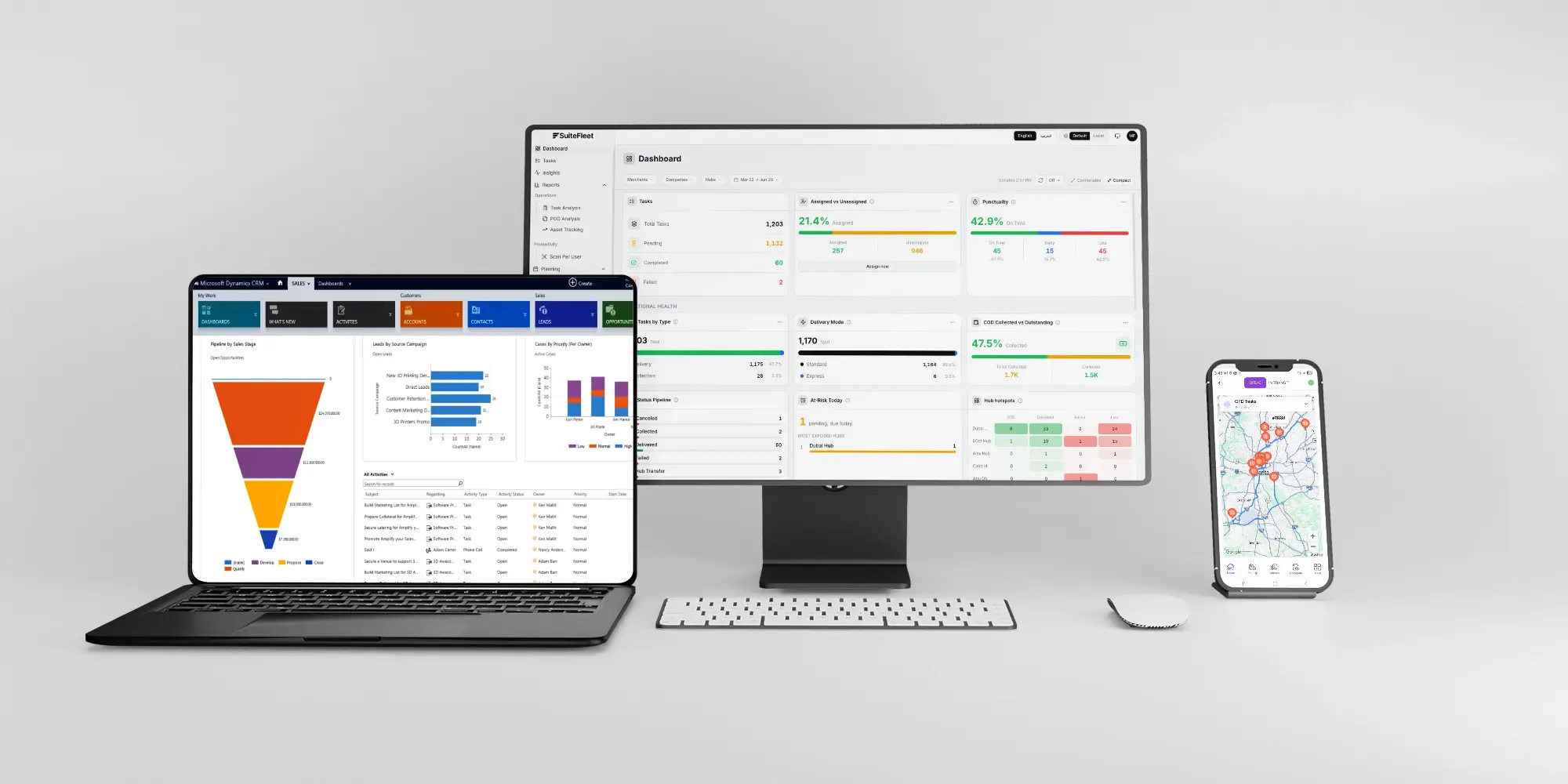
The Business Central–SuiteFleet workflow turns released work from Posted Sales Shipments into stops with a loading point, destination, and receiving window. Dispatchers review drivers, optimization objectives, and unassigned stops before applying a route. Actual completion is reconciled afterward using posted shipment lines.
Connector availability: SuiteFleet plans to publish its Microsoft Dynamics 365 Business Central connector on Microsoft Marketplace, subject to the marketplace review and release process.
1. Start with the Business Central order
Open the source order 101048 for Pinecrest Hospitality and inspect its delivery destination, line quantities, and configured SuiteFleet relationship. The example contains two lines with quantities 4 and 6 in the units shown.
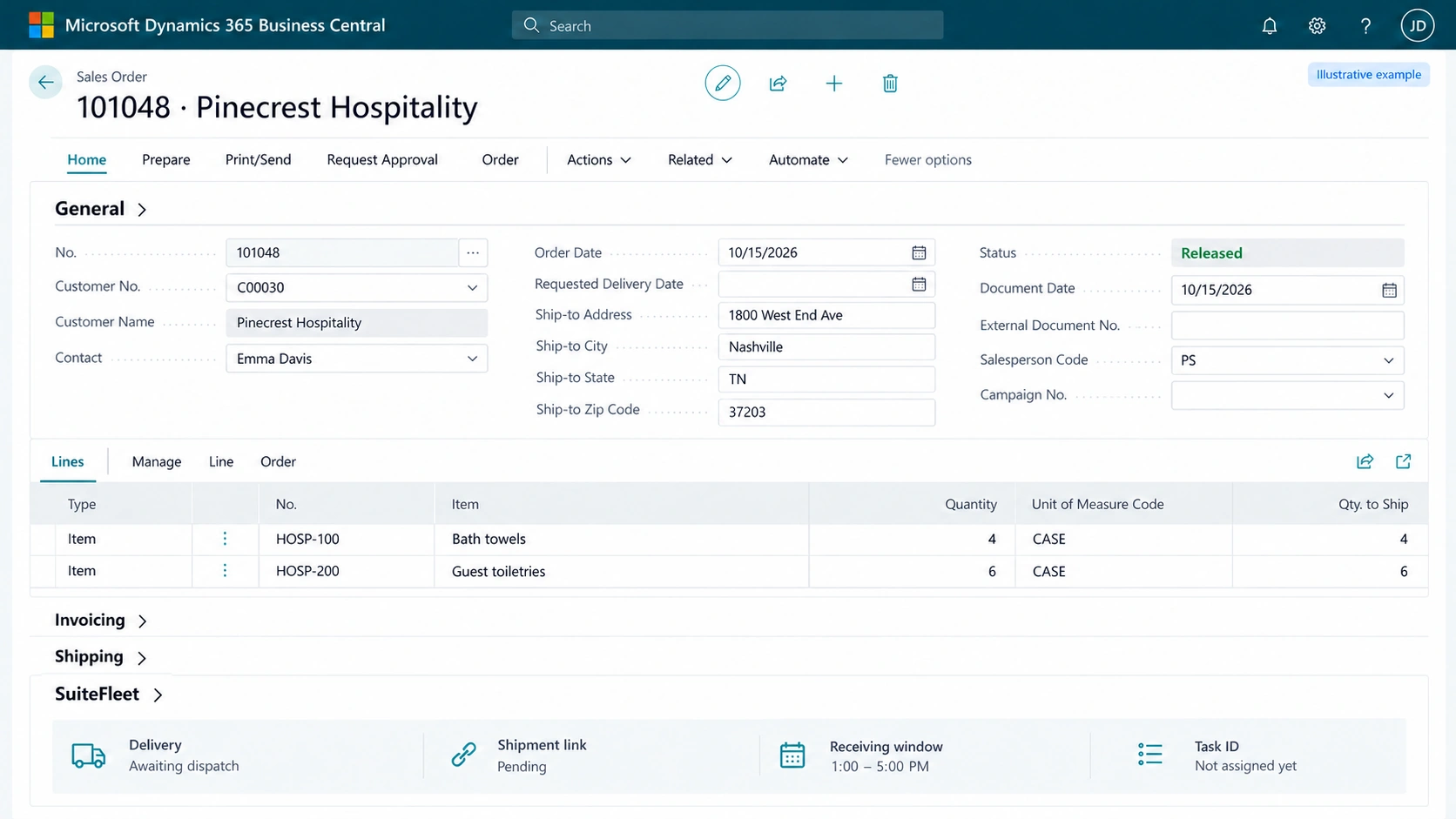
Open a released sales order and confirm its shipping location, ship-to address, and Qty. to Ship values. If the location requires warehouse documents, respect that handling flow before posting shipment. Released alone does not prove stock has been picked or delivered.
Business Central separates shipment posting from invoicing and supports partial quantities through Qty. to Ship. The original order may no longer be the durable display after full posting, so retain the posted shipment relationship rather than requiring the sales order page to survive forever. Microsoft: posting sales.
2. Configure the planning mapping
Preserve this relationship before exporting delivery work:
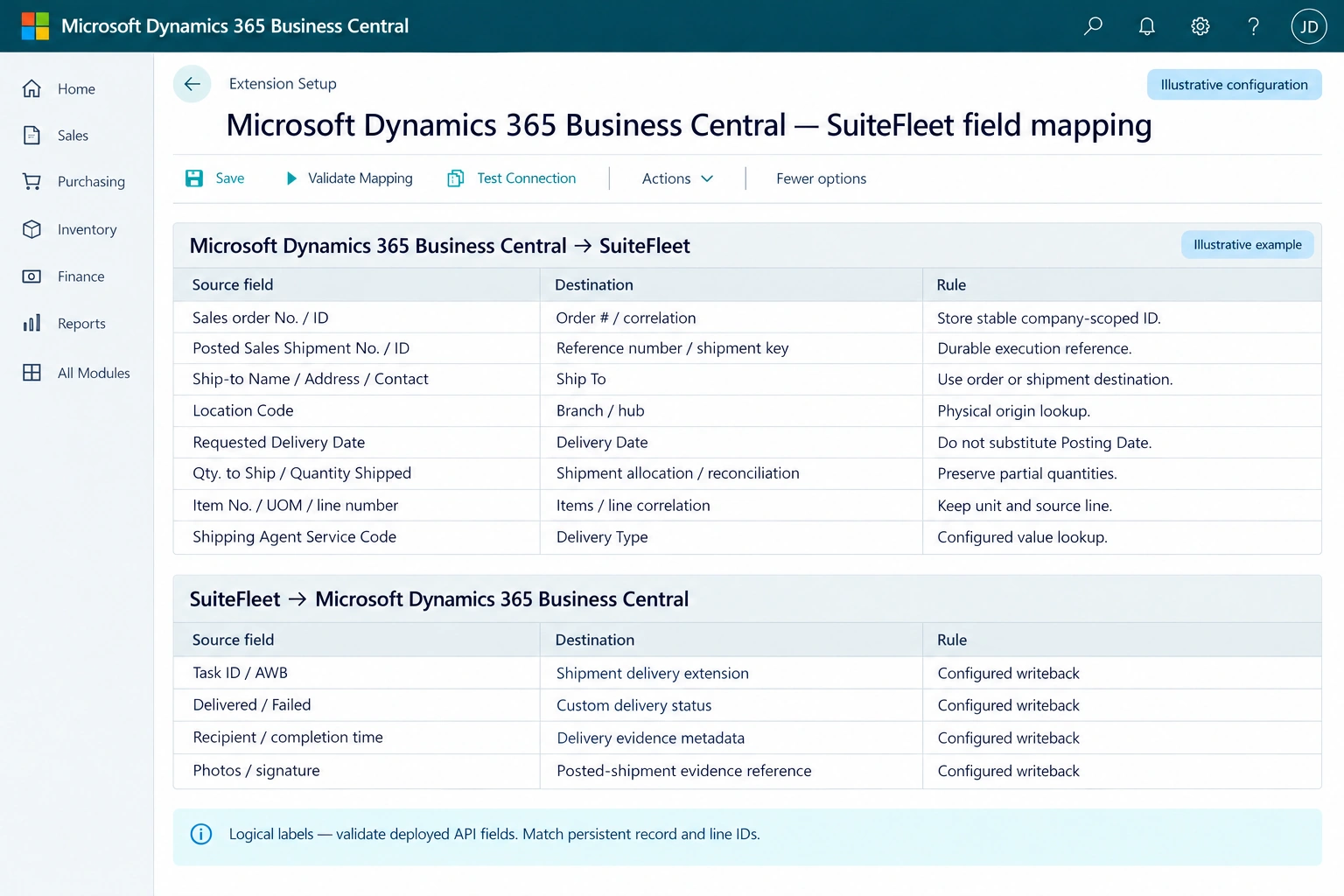
| Microsoft Dynamics 365 Business Central source | SuiteFleet destination | Rule |
|---|---|---|
| Sales order No. / ID | Order # / correlation | Store stable company-scoped ID. |
| Posted Sales Shipment No. / ID | Reference number / shipment key | Durable execution reference. |
| Location Code | Branch / hub | Physical origin lookup. |
| Requested Delivery Date | Delivery Date | Do not substitute Posting Date. |
| Qty. to Ship / Quantity Shipped | Shipment allocation / reconciliation | Preserve partial quantities. |
| Item No. / UOM / line number | Items / line correlation | Keep unit and source line. |
| Shipping Agent Service Code | Delivery Type | Configured value lookup. |
| SuiteFleet result | Microsoft Dynamics 365 Business Central destination | Writeback rule |
|---|---|---|
| Task ID / AWB | Shipment delivery extension | Confirm field access during configuration. |
| Delivered / Failed | Custom delivery status | Confirm field access during configuration. |
| Recipient / completion time | Delivery evidence metadata | Confirm field access during configuration. |
| Photos / signature | Posted-shipment evidence reference | Confirm field access during configuration. |
Resolve Location Code to the loading point. Distinguish Requested Delivery Date from Shipment Date, and keep Shipping Agent Service Code as a mapped service rule rather than assuming it defines a receiving window.
3. Select eligible stops and available drivers
Open Workbench for the intended date and filters. Inspect task, driver, and hub layers; resolve tasks without a location before optimization. Use geographic selection to choose the intended area, then confirm the selected task set contains only released work.
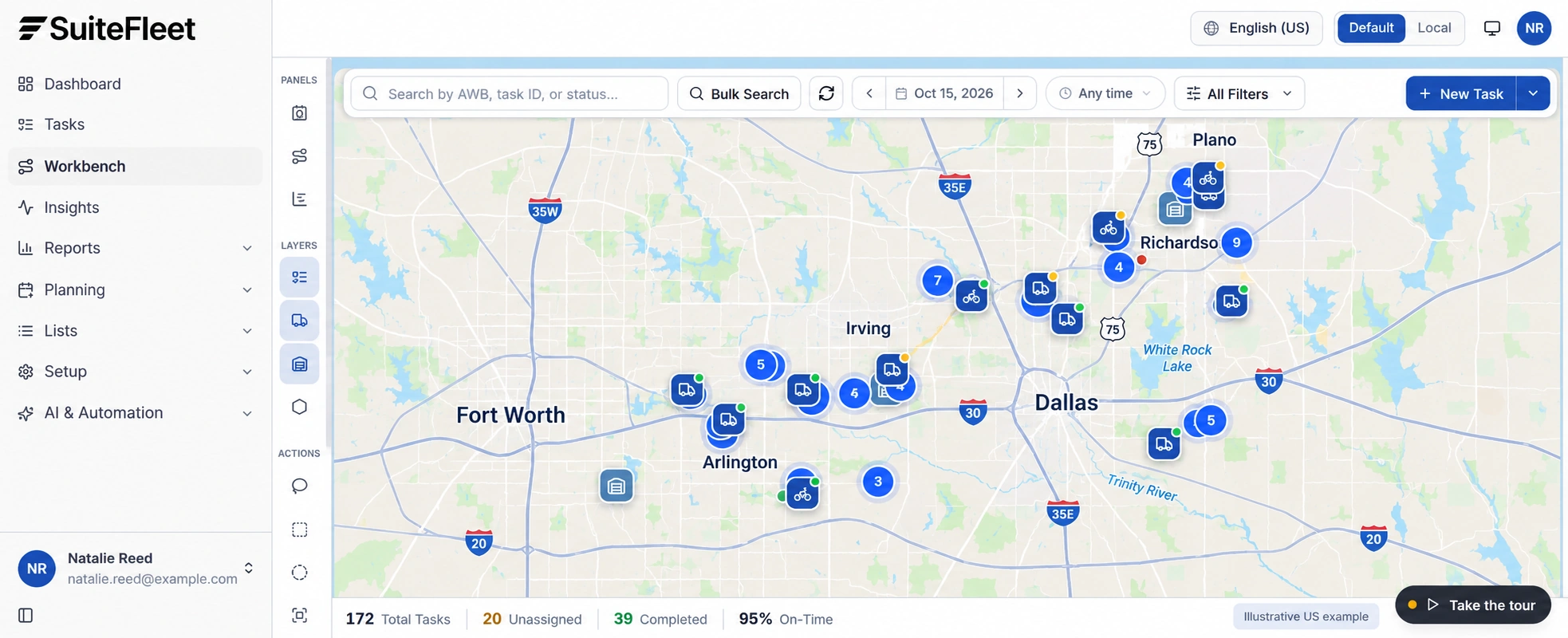
Choose Plan & Optimize when assigning eligible tasks across drivers, or Optimize Existing Routes when retaining assignments and improving stop sequence. Review enabled drivers, shift windows, departure hubs, and the displayed task-capacity limits. Do not assume those limits represent weight or volume.
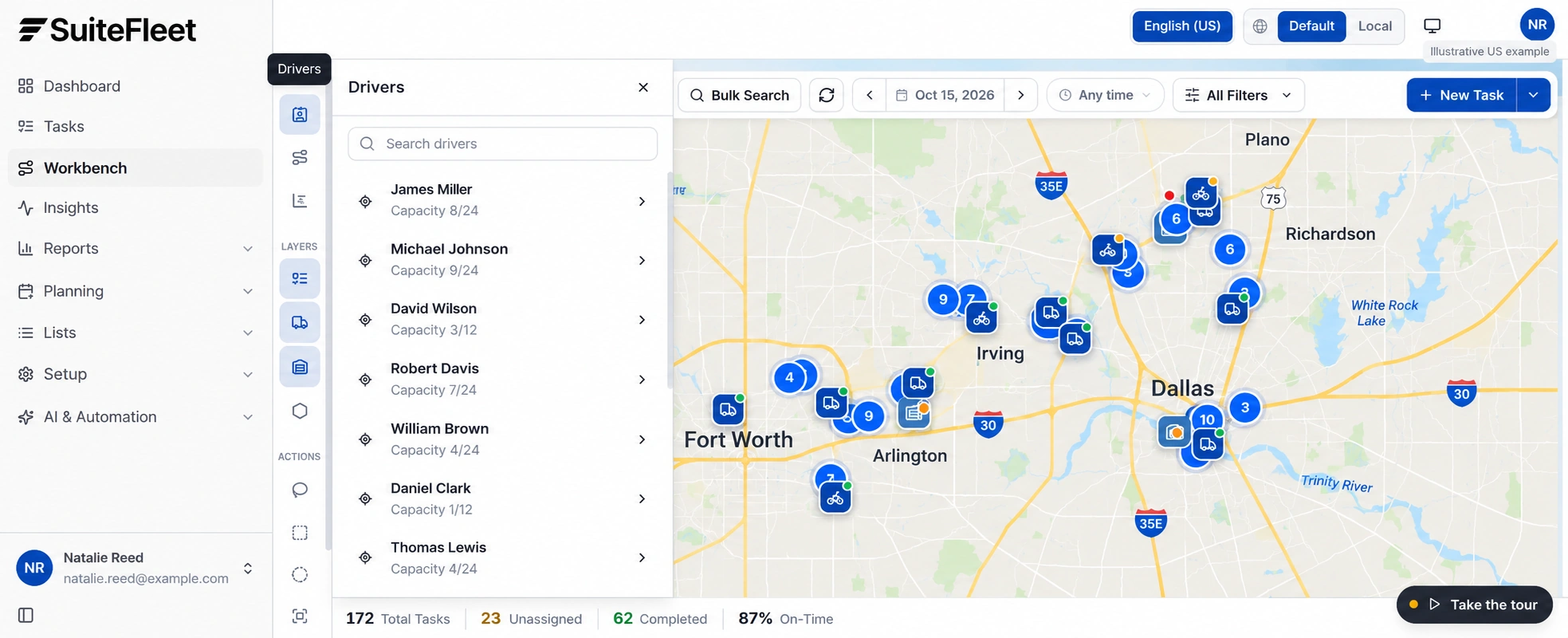
Business Central separates shipment posting from invoicing and supports partial quantities through Qty. to Ship. The original order may no longer be the durable display after full posting, so retain the posted shipment relationship rather than requiring the sales order page to survive forever.
4. Review objectives, constraints, and results
Choose the supported objective: Fastest Completion, Shortest Distance, Fewest Vehicles, or Balanced Workload. Review Respect Time Windows, Reassign Assigned Tasks, and Time Per Stop before running the preview. Select the objective that matches the dispatch plan and confirm which routing constraints are enabled.
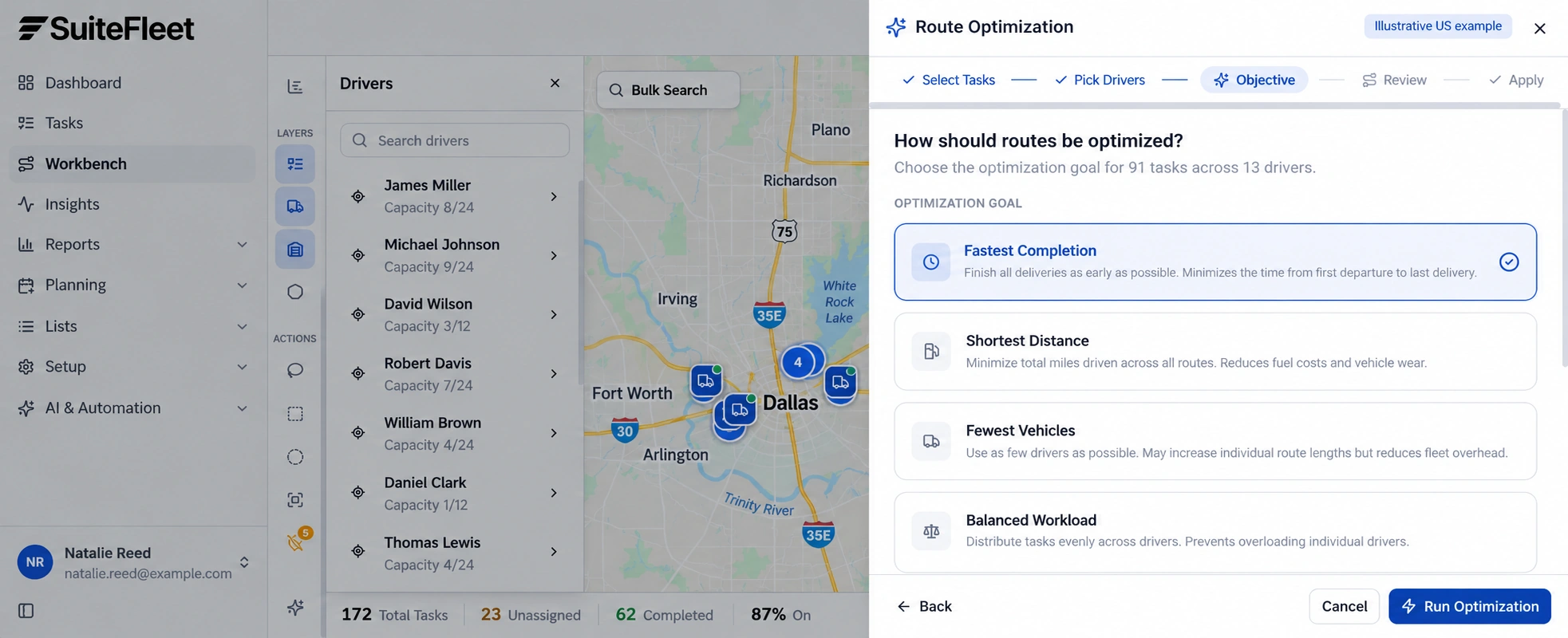
Inspect the returned driver assignments, stop sequence, projected completion, and every unassigned task. Check stop times against driver shifts as well as customer windows; confirm that the proposed schedule is feasible. Missing locations and conflicting requirements need explicit resolution.
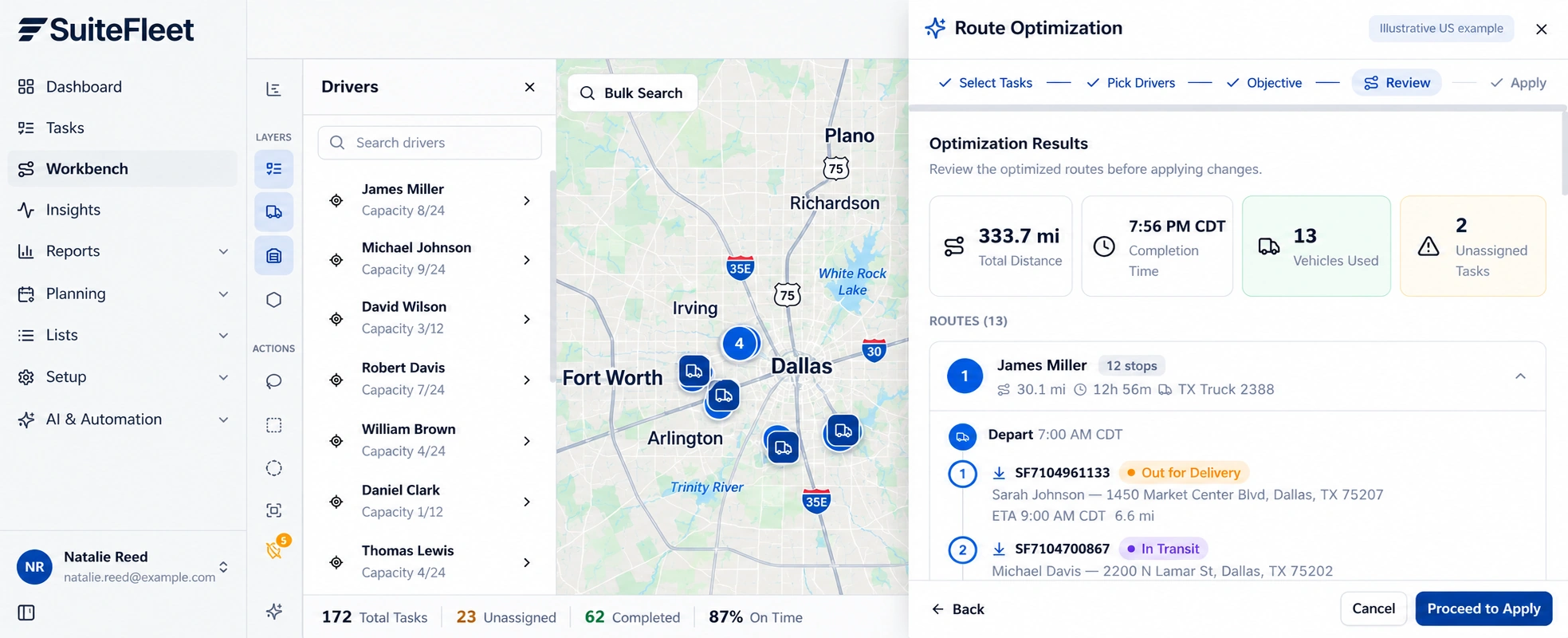
Review the Dallas–Fort Worth planning example, with distances in miles and local receiving times. Dispatchers should check stop sequence, road access, and unresolved work before applying a plan.
5. Execute the route and process actual outcomes
Keep assignment and planned arrival separate from customer delivery. Monitor failed, rescheduled, and completed stops during execution. A route application must not post inventory, close an order, or trigger billing by itself.
If Qty. to Ship is 4 while ordered quantity is 10, the posted shipment and task represent only those 4. Keep the remaining 6 available for a later shipment and do not overwrite posted shipment lines to match an unexpected receipt.
After a stop completes, match its task ID to the source shipment, review required proof, and reconcile accepted quantities. Record actual event time and a separate sync outcome. If the source changes after planning, compare the change with the dispatched allocation before overwriting operational data.
6. Verify the result in Business Central
Use the Posted Sales Shipment as durable shipment evidence and store last-mile details in a related extension record or approved custom fields. Reconcile Quantity Shipped on the original order where it remains available. Do not post Ship and Invoice merely to record customer receipt. Microsoft: posting sales.
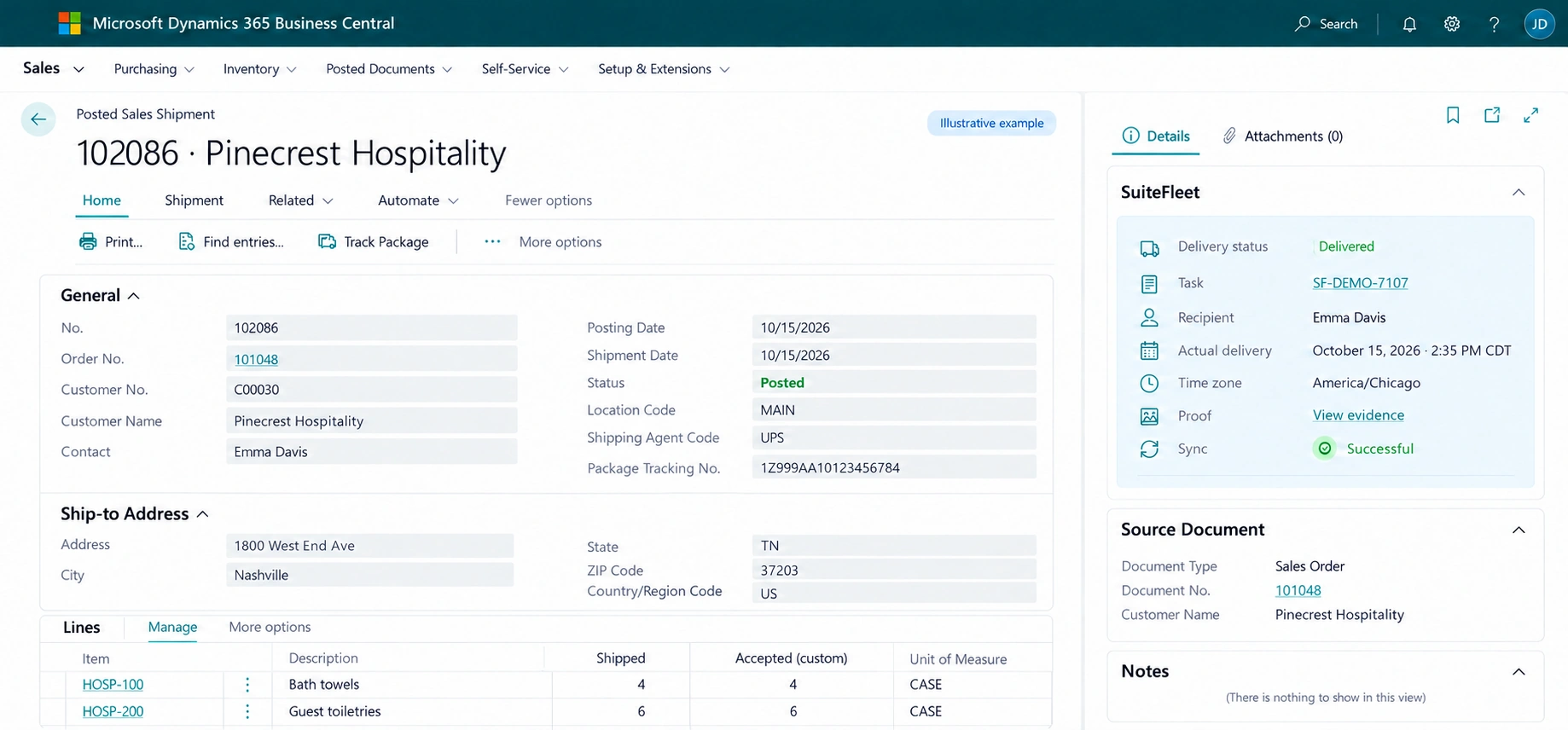
Posted Sales Shipment 102086; task SF-DEMO-7107; recipient Emma Davis; actual handover October 15, 2026 · 2:35 PM CDT (America/Chicago). First line: 4 shipped and 4 accepted. Second line: 6 shipped and 6 accepted.
Read back the linked record and review every outstanding allocation before marking the full order delivered. Test partial shipment, partial acceptance, failed delivery, duplicate completion, and delayed writeback. Keep inventory posting, receipt evidence, and payment reconciliation under their respective configured rules.
Frequently asked questions
Which Business Central details are needed for route planning?
Resolve Location Code to the loading point. Distinguish Requested Delivery Date from Shipment Date, and keep Shipping Agent Service Code as a mapped service rule rather than assuming it defines a receiving window.
How are partial deliveries handled for Business Central?
If Qty. to Ship is 4 while ordered quantity is 10, the posted shipment and task represent only those 4. Keep the remaining 6 available for a later shipment and do not overwrite posted shipment lines to match an unexpected receipt.


.png)

.jpeg)


.png)

.svg)





.svg)


.svg)
.svg)