For growing businesses, NetSuite often becomes the operational backbone. Orders flow in, inventory moves across warehouses, and finance stays aligned. But when third-party logistics providers enter the picture, complexity multiplies — and the question of how to connect 3PL with NetSuite becomes urgent.
Disconnected systems lead to manual updates, delayed tracking, billing errors, and customer frustration. The solution is integration. Modern 3PL connectivity tools bridge NetSuite with fulfillment partners, carriers, and last-mile delivery providers to create a single operational flow.
Below are 10 proven platforms to connect 3PL with NetSuite — what each does, when it fits, and how they compare.
1. SuiteFleet
Best for: End-to-end last-mile and 3PL orchestration
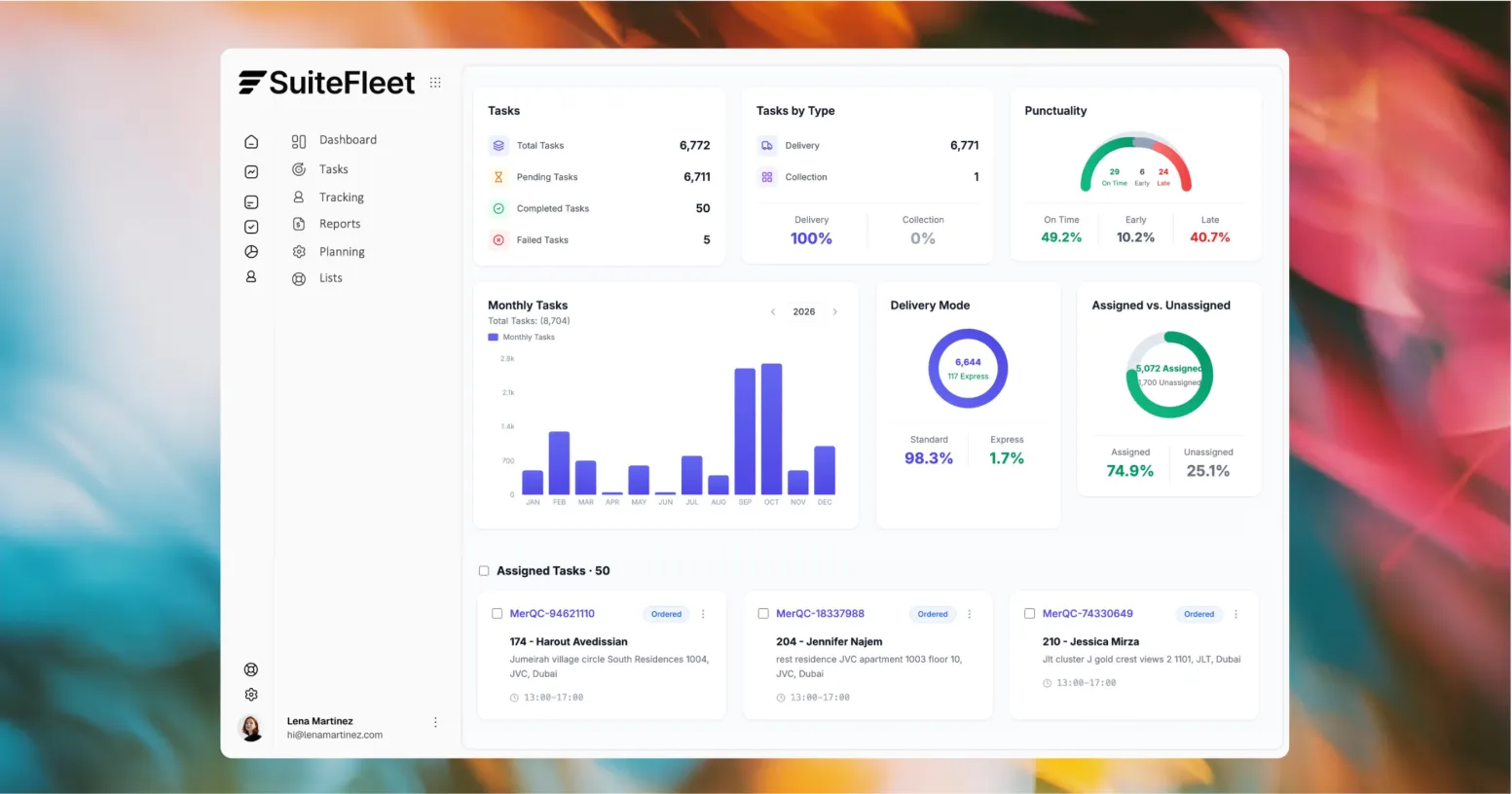
SuiteFleet connects NetSuite with third-party logistics providers, carriers, and last-mile fleets through real-time data exchange. Built by Azdan, a certified Oracle NetSuite Solutions Provider, it is one of the most deeply integrated platforms to connect 3PL with NetSuite natively.
Key strengths
- Order sync and dispatch automation
- Multi-3PL orchestration and dispatch planning
- Real-time tracking and status updates
- Billing, POD, and exception management
Why it stands out
SuiteFleet goes beyond shipping integration. It orchestrates fulfillment, delivery execution inside NetSuite, and visibility across multiple logistics partners — all without middleware.
2. Bringg
Best for: Enterprise delivery orchestration
Bringg enables NetSuite users to coordinate 3PLs, carriers, and internal fleets through a unified delivery management platform.
Key strengths
- Delivery orchestration across providers
- Customer experience tracking and notifications
- Workflow automation and SLA monitoring
Ideal for retailers and enterprise logistics operations needing full delivery visibility when connecting 3PL with NetSuite at scale.
3. OTO
Best for: Middle East logistics ecosystems
OTO connects NetSuite with regional carriers and fulfillment partners, making it a popular choice to connect 3PL with NetSuite in GCC markets.
Key strengths
- Multi-carrier and 3PL connectivity
- Label creation and shipment automation
- Local carrier ecosystem support
Ideal for regional ecommerce brands scaling across GCC markets.
4. ShipHawk
Best for: Warehouse-centric fulfillment operations
ShipHawk integrates NetSuite with warehouses, carriers, and 3PL providers to automate fulfillment and shipping.
Key strengths
- Advanced packing and cartonization logic
- Rate shopping and carrier optimization
- Warehouse workflow automation
Ideal for high-volume fulfillment and distribution centers where warehouse efficiency drives the decision to connect 3PL with NetSuite.
5. Pacejet (Descartes)
Best for: Multi-carrier shipping and compliance
Descartes Pacejet connects NetSuite to parcel, LTL, and international freight providers with strong compliance tooling.
Key strengths
- Global carrier compliance and documentation
- Automated rate shopping
- Freight audit support
Ideal for global shipping operations with complex compliance needs.
6. FreightPOP
Best for: Freight and LTL shipping visibility
FreightPOP integrates NetSuite with freight carriers and 3PL providers to optimize transportation spend and tracking.
Key strengths
- Freight rate comparison and booking
- Real-time shipment tracking
- Cost control and analytics
Ideal for companies shipping pallets, freight, and LTL shipments that need cost visibility when they connect 3PL with NetSuite.
7. ShipStation
Best for: Ecommerce fulfillment and 3PL coordination
ShipStation integrates NetSuite with fulfillment partners and carriers to automate ecommerce shipping workflows.
Key strengths
- Label automation and batch processing
- Multi-warehouse fulfillment coordination
- Marketplace integrations
Ideal for ecommerce brands using outsourced fulfillment partners.
8. ShipEngine / ShipCentral
Best for: API-driven shipping connectivity
ShipEngine provides a developer-friendly platform to connect NetSuite with carriers and fulfillment providers via flexible API.
Key strengths
- Carrier API connectivity
- Real-time rate and tracking data
- Custom shipping workflow automation
Ideal for businesses requiring custom integration workflows and developer control over how they connect 3PL with NetSuite.
9. ReadyCloud / ReadyShipper
Best for: Simplified shipping automation
ReadyShipper connects NetSuite to carriers and fulfillment workflows with automation tools for shipping and tracking.
Key strengths
- Shipping rules automation
- Label generation and tracking sync
- Order fulfillment workflows
Ideal for SMBs seeking a straightforward, low-overhead way to connect 3PL with NetSuite.
10. 2Ship
Best for: Parcel and freight shipping orchestration
2Ship integrates NetSuite with carriers and logistics providers to streamline parcel and freight shipping.
Key strengths
- Carrier rate optimization
- Freight and parcel management
- Centralized shipment tracking
Ideal for hybrid shipping operations managing both parcel and freight volume.
Choosing the Right Way to Connect 3PL with NetSuite
The right platform depends on your operational complexity and delivery model:
Choose SuiteFleet if you need unified orchestration across multiple 3PLs, real-time last-mile visibility, and end-to-end delivery execution inside NetSuite — with no middleware required.
Choose ShipHawk or Pacejet if warehouse and shipping optimization are priorities.
Choose Bringg or FreightPOP if delivery orchestration or freight visibility is critical.
Choose ShipStation or ReadyShipper if ecommerce fulfillment automation is the main goal.
Choose ShipEngine if your team wants API-level control over how you connect 3PL with NetSuite.
Why Connecting 3PL with NetSuite Matters
NetSuite centralizes business operations, but logistics execution often lives outside its core environment. When you connect 3PL with NetSuite through the right platform:
- order status flows automatically from fulfillment partner back to NetSuite records
- billing and proof-of-delivery reconcile without manual re-entry
- customer service teams gain real-time visibility into every active shipment
- operational decisions become data-driven rather than reactive
Disconnected 3PL tools create data silos. The right NetSuite integration creates operational control from warehouse to doorstep.
Frequently Asked Questions
What does it mean to connect 3PL with NetSuite?
Connecting 3PL with NetSuite means integrating your third-party logistics provider's systems with NetSuite so that order data, shipment status, tracking events, and billing information flow automatically between platforms. Without integration, teams manage this data manually — introducing errors, delays, and cost.
Does NetSuite have built-in 3PL integration?
No. NetSuite does not include native connectivity to third-party logistics providers. Businesses need dedicated platforms — such as SuiteFleet, ShipHawk, or FreightPOP — to connect 3PL with NetSuite and automate the data flow between the ERP and fulfillment partners.
What is the best platform to connect 3PL with NetSuite?
The best platform depends on your use case. For end-to-end delivery execution with multi-3PL orchestration and native NetSuite integration, SuiteFleet is the strongest option. For warehouse-centric fulfillment, ShipHawk and Pacejet lead. For freight visibility, FreightPOP is purpose-built. For ecommerce fulfillment, ShipStation is widely used.
How does SuiteFleet connect 3PL with NetSuite?
SuiteFleet connects 3PL with NetSuite natively — without middleware. Orders flow from NetSuite into SuiteFleet automatically. SuiteFleet orchestrates dispatch across owned fleets and 3PL partners, captures proof of delivery, and writes all delivery outcomes back to the originating NetSuite records in real time.
What is the difference between a 3PL connector and a delivery management platform?
A 3PL connector typically handles data transfer — syncing orders, labels, and tracking between NetSuite and a logistics partner. A delivery management platform like SuiteFleet goes further: it actively manages dispatch decisions, driver assignments, route optimization, and customer notifications as part of the delivery execution process itself.
How much does it cost to connect 3PL with NetSuite?
Costs vary significantly. Entry-level tools like ReadyShipper start at a low monthly fee. Mid-market platforms like FreightPOP and ShipStation are typically priced per shipment volume or monthly subscription. Enterprise platforms like Bringg and SuiteFleet are priced based on delivery volume and operational scope. Most vendors offer custom pricing for NetSuite environments.
Looking to Connect 3PL with NetSuite?
NetSuite centralizes your business. SuiteFleet connects it to your logistics partners, carriers, and last-mile fleets — giving you complete control from order to doorstep without a single manual update.
Book a free demo today to see how SuiteFleet connects your 3PL operations with NetSuite in real time.