
It is 1:40 on a Friday afternoon. The morning deliveries are done, the afternoon bags are sealed in bins by the back door, and the phone has not stopped ringing. A refrigerated prescription has to reach a patient in Parma Heights after 4:30, when he is home to take it. A caregiver calls to ask whether her mother's refill can arrive before dinner. Three drivers start their shift at 2:00 p.m. at another store.
Every bag on that shelf carries a promise. Someone has to decide which driver takes it, in what order, and whether the window the patient was given is still realistic.
That is the job of delivery management for retail pharmacies. SuiteFleet brings delivery orders, dispatch planning, route optimization, and proof of delivery into one shared workflow, so the pharmacy can run the afternoon from a plan instead of a pile of tickets.
Let's follow Maria, the delivery coordinator in a worked example of a Cleveland-area pharmacy group with four stores. The screens are pharmacy-themed demo illustrations; names, addresses, maps, and figures are examples.
Start with the promise the patient was given
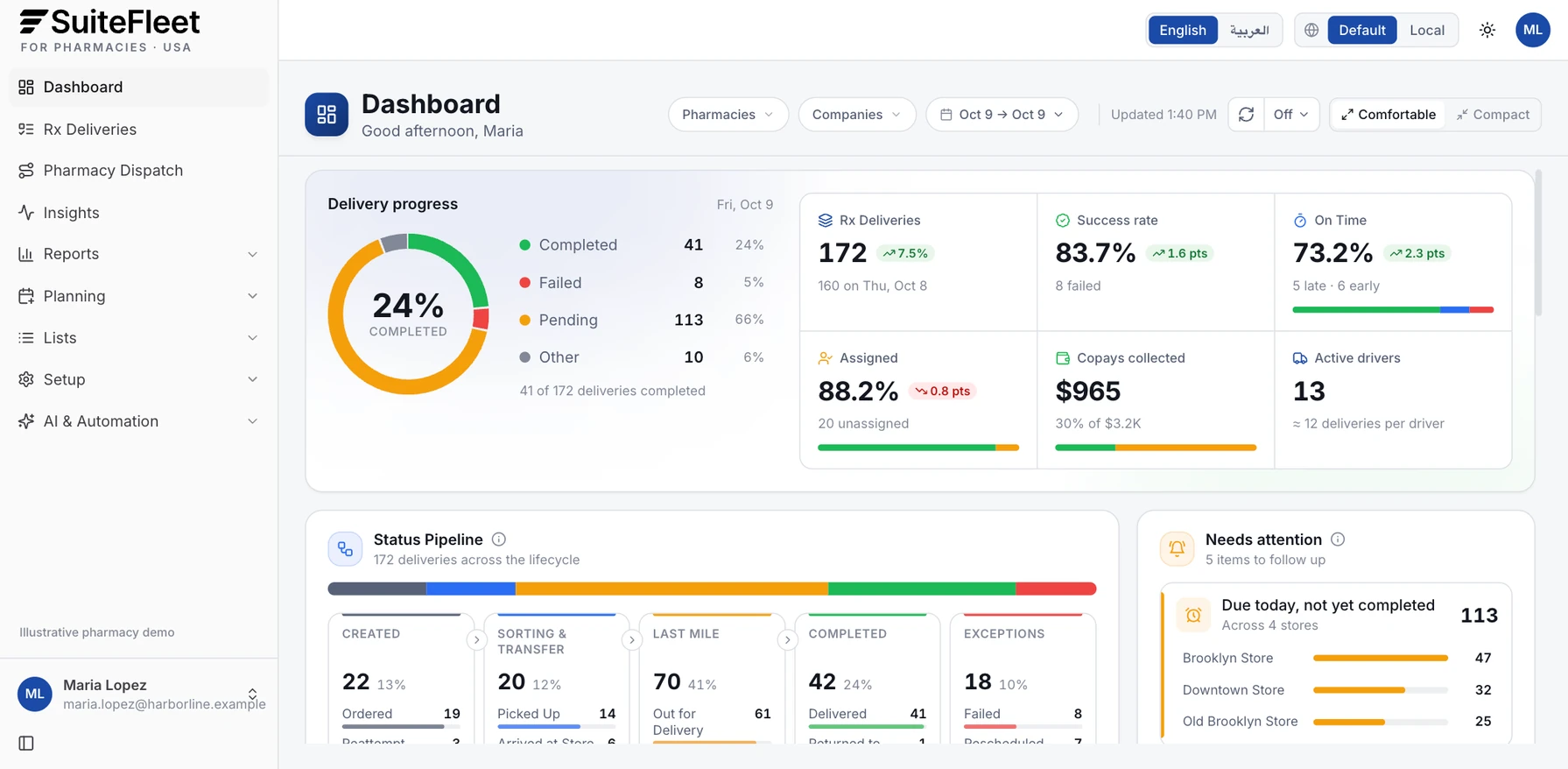
Maria starts with the day as a whole: what has been delivered, what is still open, and what needs a decision. The dashboard shows 41 of 172 deliveries completed, 20 still without a driver, and how much of the day's copay total has been collected.
Good delivery starts at the counter. When staff create the order, they record the patient's phone number, the agreed window, and the details that decide the handoff. "Deliver to York Rd" is far less useful than "Refrigerated item. Patient home after 4:30. Hand to the patient or a caregiver."
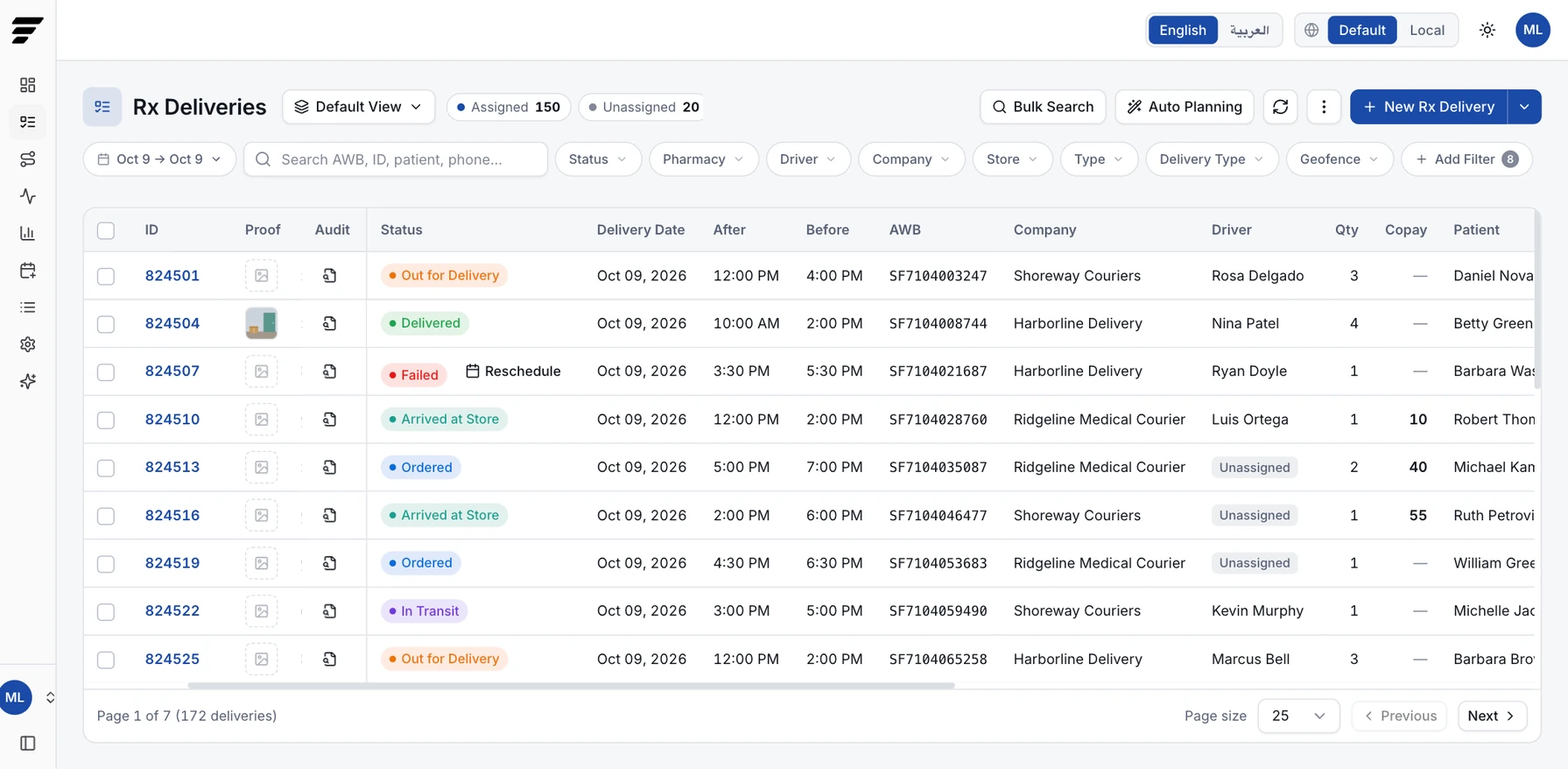
SuiteFleet's delivery list keeps windows, status, driver, and copay in the same view, so Maria can see which promises are covered and which are not.
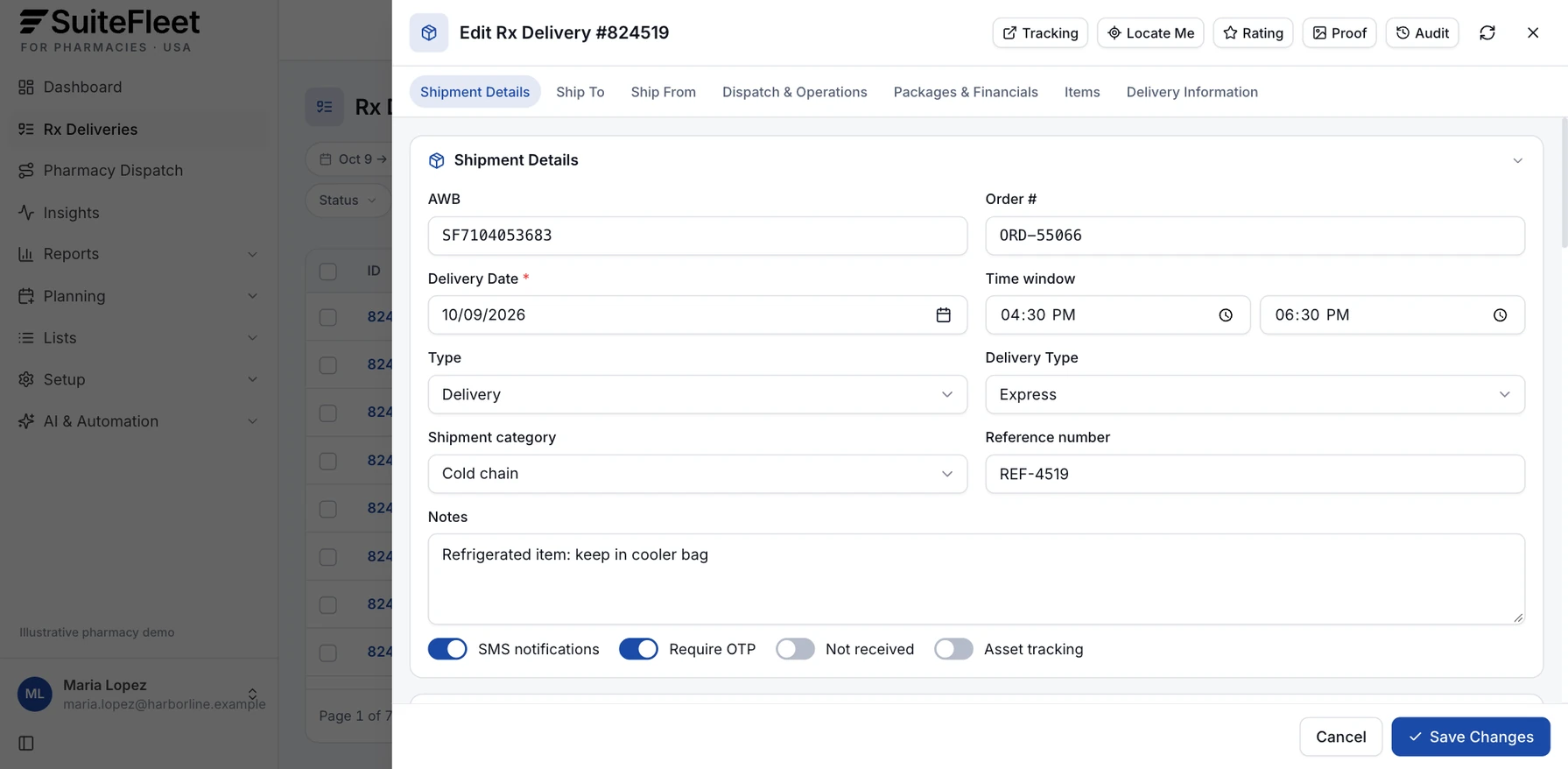
For the refrigerated order, Maria opens the details screen. The window runs from 4:30 to 6:30 p.m., the shipment category is cold chain, the note tells the driver to keep the bag in a cooler, and a one-time code is required at handover. Notice what the note leaves out: the driver needs the handling instruction, not the name of the medication.
Build routes around stores, shifts, and handoffs
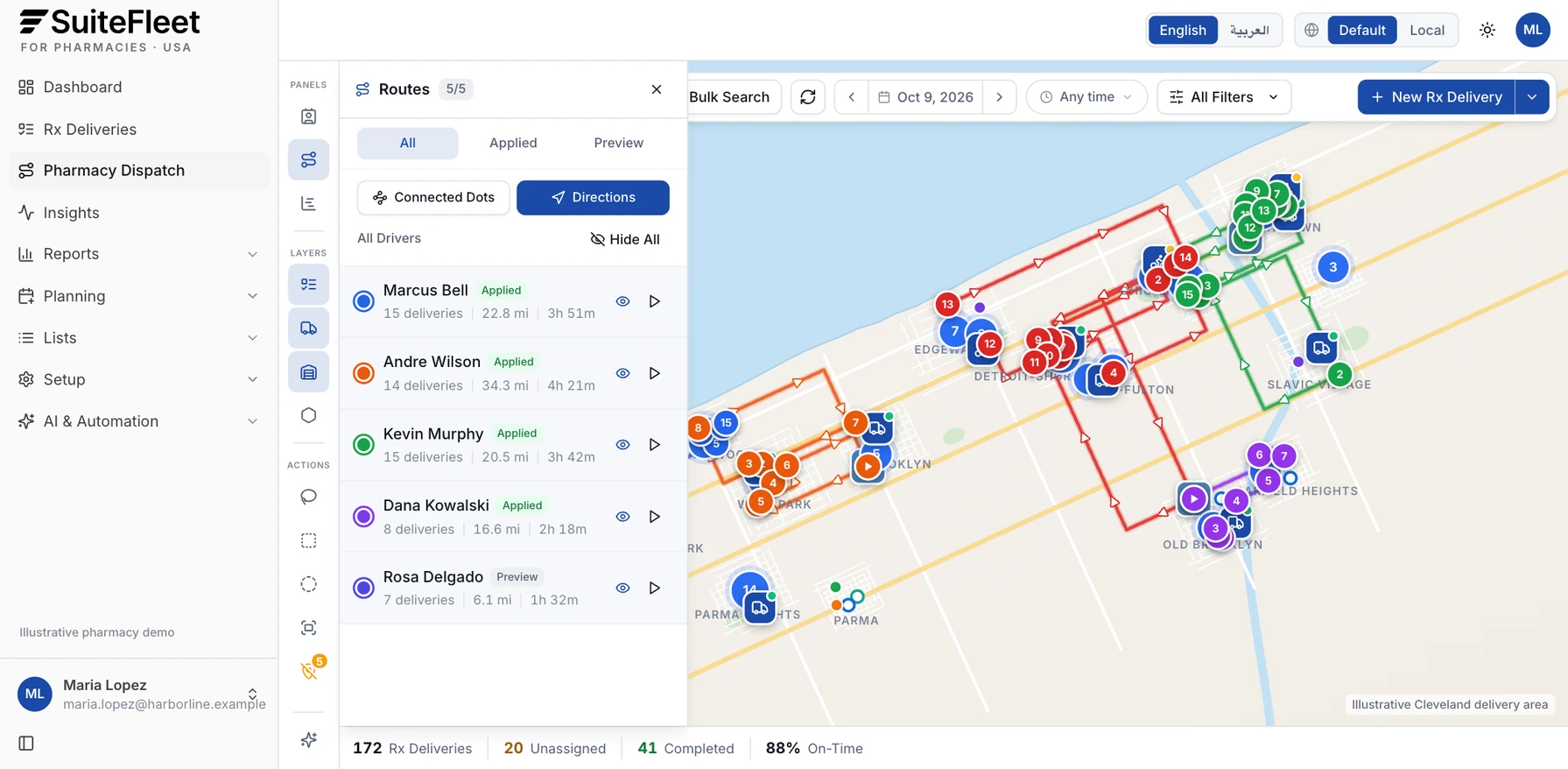
Splitting bags evenly between drivers looks fair, but it rarely is. Fifteen deliveries over 22.8 miles is a different afternoon from fourteen deliveries over 34.3 miles. Drivers start from different stores, and an apartment handoff with a signature takes longer than a porch drop.
In SuiteFleet's dispatch workbench, each driver's route appears with its delivery count, distance, and duration, next to the map. Maria can compare workloads before she adds anything new.
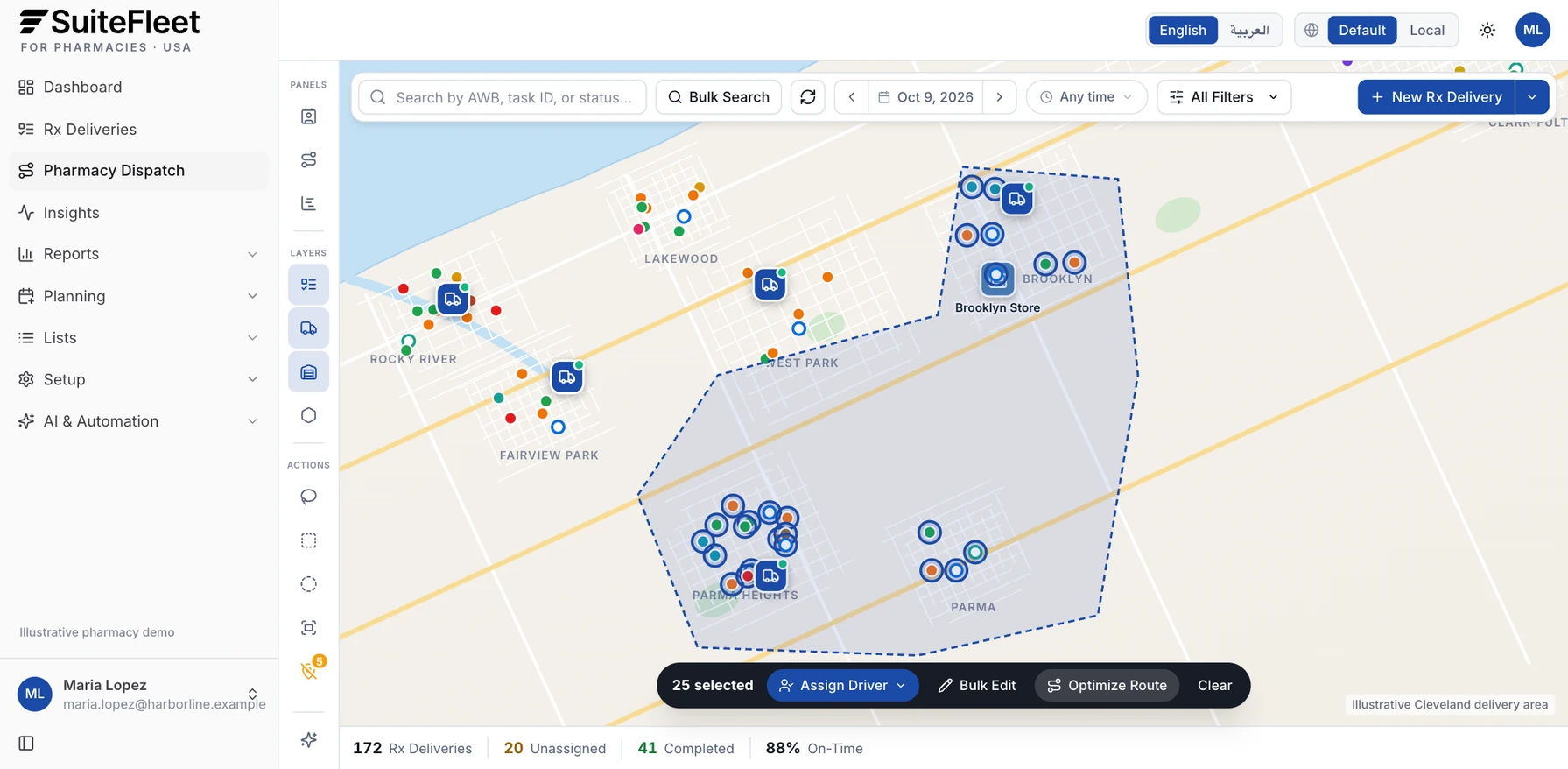
The open work this afternoon is in the southern suburbs. Maria uses the lasso tool to select deliveries across Brooklyn, Parma, and Parma Heights. The selection bar then offers to assign a driver or optimize the route.
Optimize around delivery windows, then check the plan
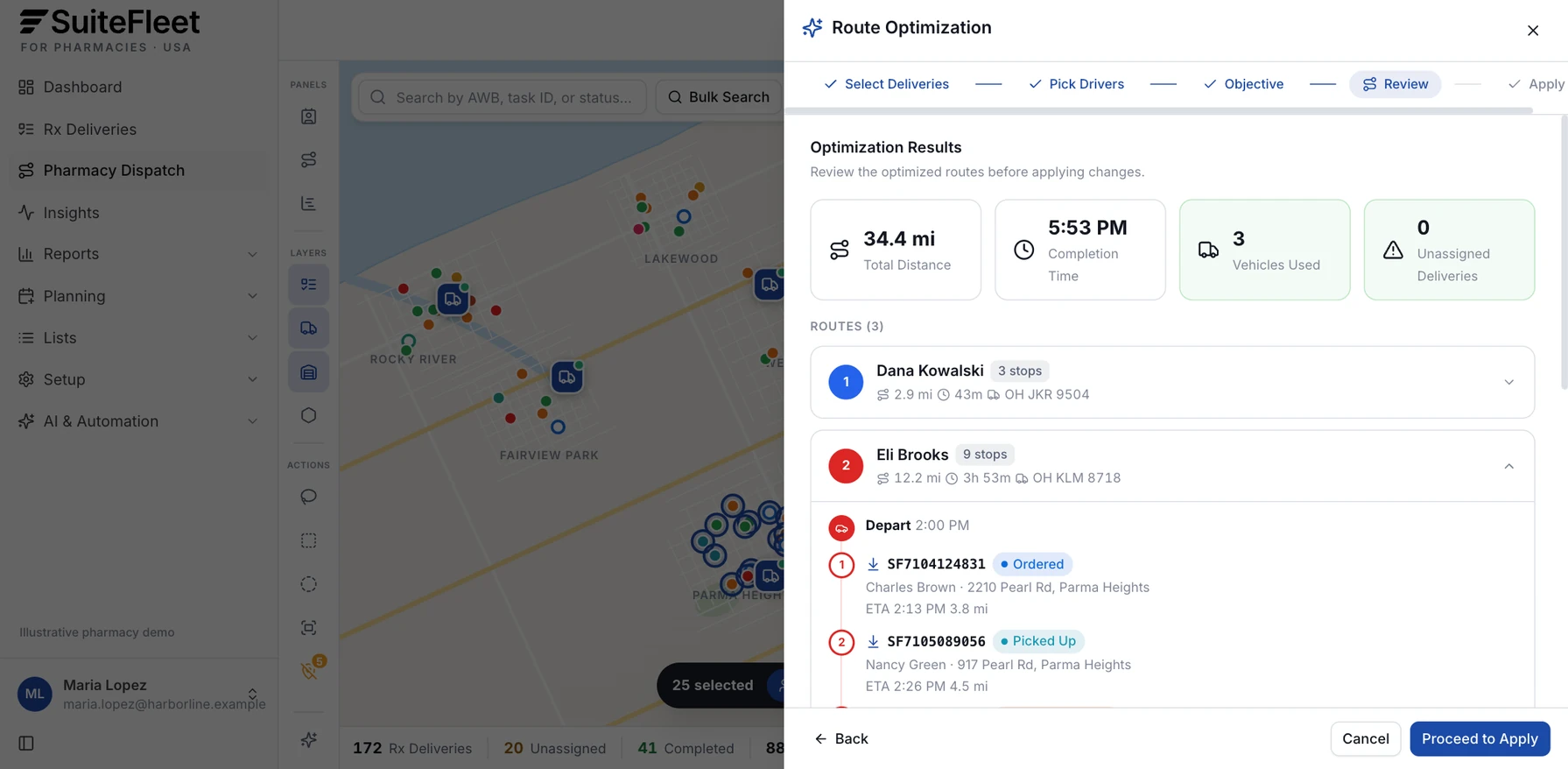
Of the 25 deliveries Maria selected, 18 still need to be delivered. The optimizer leaves out the ones already delivered, failed, or returned. She enables the three drivers on the 2:00 to 9:00 p.m. shift, all starting from the Brooklyn store.
SuiteFleet's optimizer offers four goals: Fastest Completion, Shortest Distance, Fewest Vehicles, and Balanced Workload. Maria keeps Fastest Completion, leaves Respect Time Windows switched on, and keeps the default 10 minutes per stop. For handoffs that need a signature, a code, or a quick question for the pharmacist, a longer time per stop may be more realistic.
The results preview shows three routes, 34.4 miles in total, the last delivery finished by 5:53 p.m., and no unassigned deliveries. The refrigerated order becomes stop 7 on one route, with an estimated arrival of 4:30 p.m., the moment the patient's window opens.
This is the practical value of pharmacy route planning: a workable decision while there is still time to change it. To see whether it is working, track on-time deliveries, failed first attempts, miles per completed delivery, and copays collected across similar days. The screens show the workflow; your own operating data will show the improvement.
Close the loop with proof of delivery
Patients and caregivers call back. "Did it arrive?" "Who signed for it?" The answer should take seconds, not a call to the driver.
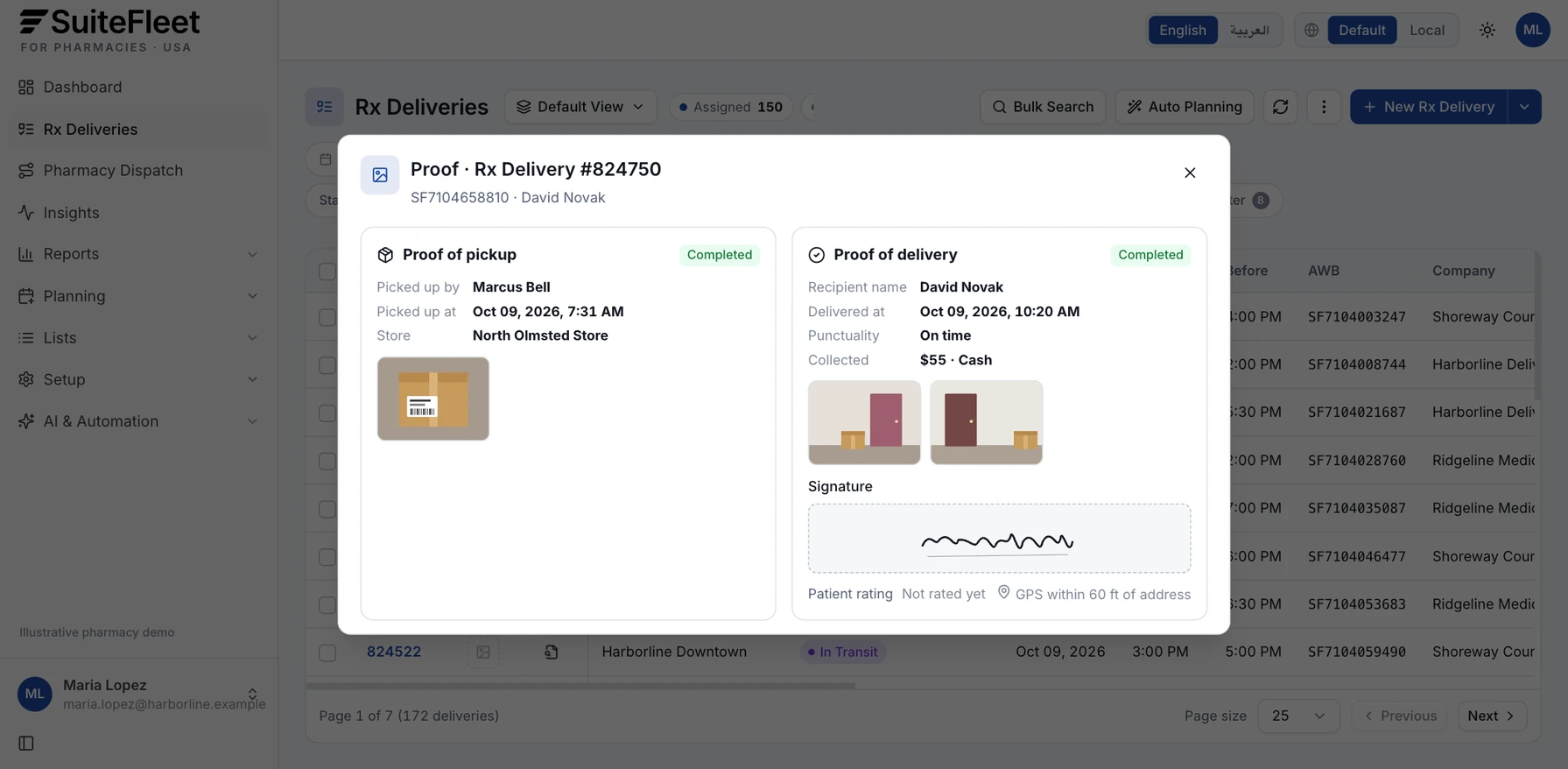
SuiteFleet records proof of pickup and proof of delivery for each order. In the example, the record shows who collected the bag at the North Olmsted store, who received it, when it arrived, whether it was on time, the $55 copay collected, delivery photos, a signature, and a GPS check against the address.
Connect delivery with your pharmacy systems
Your pharmacy management system should stay the system of record for prescriptions and patients. Delivery software should receive only what the delivery needs, such as the address, window, handling note, and copay, without staff typing it twice.
NetSuite and Shopify have published SuiteFleet connectors. A pharmacy management system would need a custom integration through SuiteFleet's API, and what can be exchanged depends on the access each vendor supports.
SuiteFleet's API supports custom integration work. During setup, map only the fields delivery needs: recipient, phone, window, handling notes, copay, cancellations, and status updates. Agree how changes flow back, so the counter and the dispatcher always see the same information.
Compare SuiteFleet with five pharmacy delivery options
Pharmacies can choose a dedicated delivery platform or use the delivery tools inside their pharmacy software. The comparison below places SuiteFleet alongside two general delivery platforms and three pharmacy-specific options.
Compare the systems using the same busy-day order file. Include refrigerated orders, signature-required orders, tight windows, and a late refill, and see how much work still stays at the counter.
Protect the medicine, the patient's privacy, and the handoff
A good route is only part of safe delivery. Rules differ by state, so start with your board of pharmacy. Missouri's prescription delivery rule, for example, requires every pharmacy that delivers, mails, or ships prescriptions to keep written policies, including how medication stays within the temperature requirements recommended by the manufacturer or USP. It allows delivery directly to the patient or the patient's authorized designee. The Massachusetts Board of Pharmacy's delivery guidance recommends policies for temperature excursions, time-temperature studies in summer and winter, a calibrated temperature monitor beside cold products, and a signature on delivery for Schedule II to V medications.
Privacy belongs in the same plan. HHS guidance says a pharmacist can use professional judgment to release a filled prescription to a family member or friend picking it up for the patient, so agree in advance what drivers should do when someone other than the patient answers the door. HIPAA's minimum necessary standard is a useful habit for delivery notes too: give the driver what the handoff requires, and nothing more.
Software can carry these instructions, require a code or a signature, and keep a timestamped record. SuiteFleet's pharmaceutical delivery page also describes temperature threshold tracking and exception alerts for cold-chain routes. Cooler bags, trained staff, and the pharmacist's judgment still do the physical and clinical work.
Plan your next afternoon run
SuiteFleet gives retail pharmacies one place to manage delivery promises, driver assignments, routes, and proof. Test it against your busiest day. Bring your store locations, driver shifts, delivery windows, and a sample order file, and ask to see the plan, the exceptions, and how a late refill changes the work.
Book a free SuiteFleet demonstration to see how dispatch planning and route optimization can fit your pharmacy delivery operation.