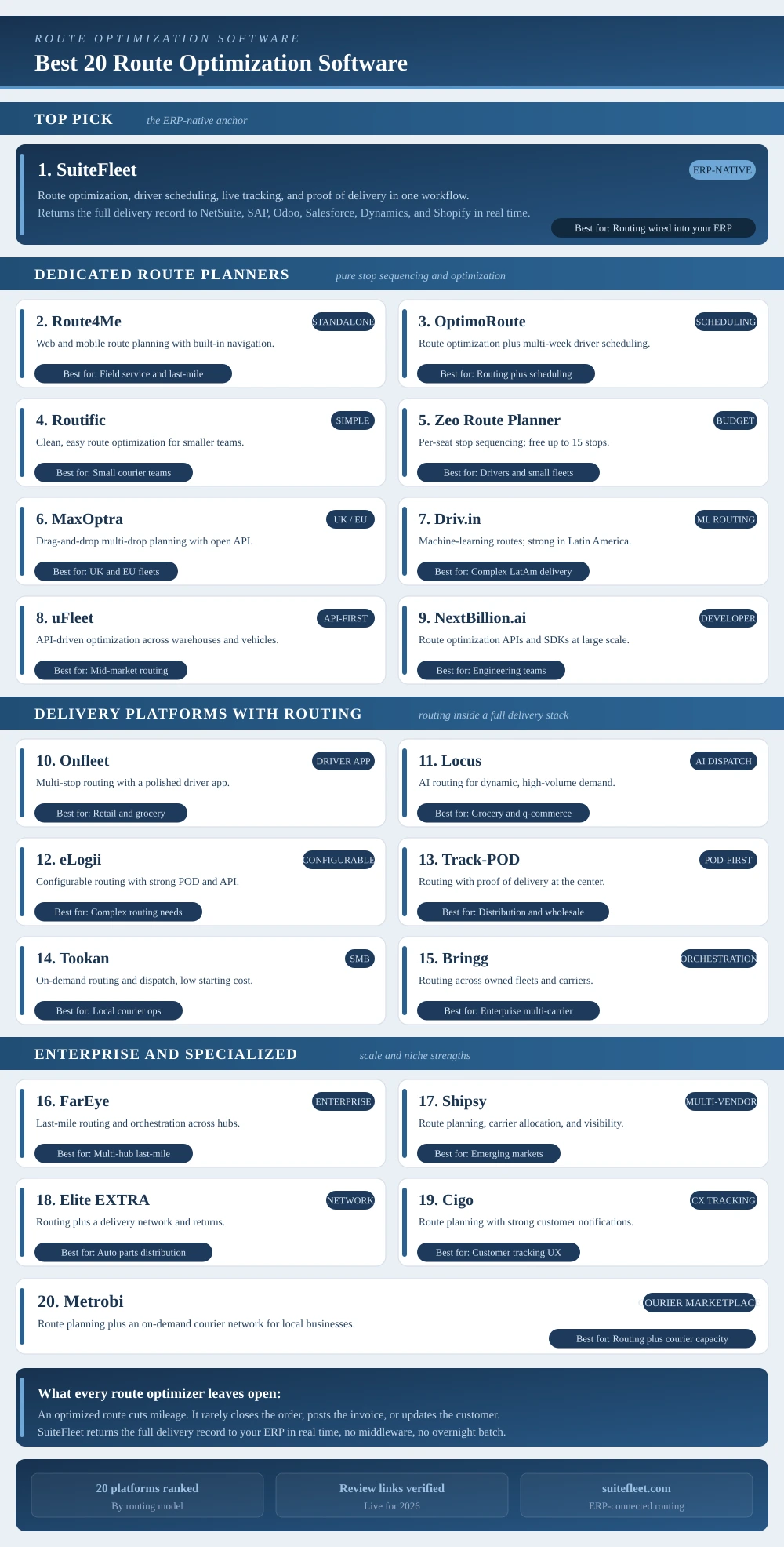
Route optimization software turns a list of stops into the most efficient sequence for each driver, factoring in time windows, capacity, traffic, and driver hours. The difference between platforms is what happens around the route: how orders arrive, how the plan adjusts mid-day, how proof of delivery is captured, and whether any of it reaches your ERP. Here are the 20 best route optimization software platforms for 2026, each with a short summary and a verified review link so you can check the field feedback yourself.
TL;DR: SuiteFleet leads for fleets that need route optimization wired natively into an ERP. Route4Me, OptimoRoute, Routific, MaxOptra, Driv.in, Zeo, uFleet, and NextBillion.ai lead as dedicated route planners. Onfleet, Locus, eLogii, Track-POD, Tookan, Bringg, FarEye, Shipsy, Elite EXTRA, Cigo, and Metrobi bring routing inside a broader delivery platform. Pick by how much of the workflow around the route you need to run.
The 20 Best Route Optimization Software Platforms
1. SuiteFleet
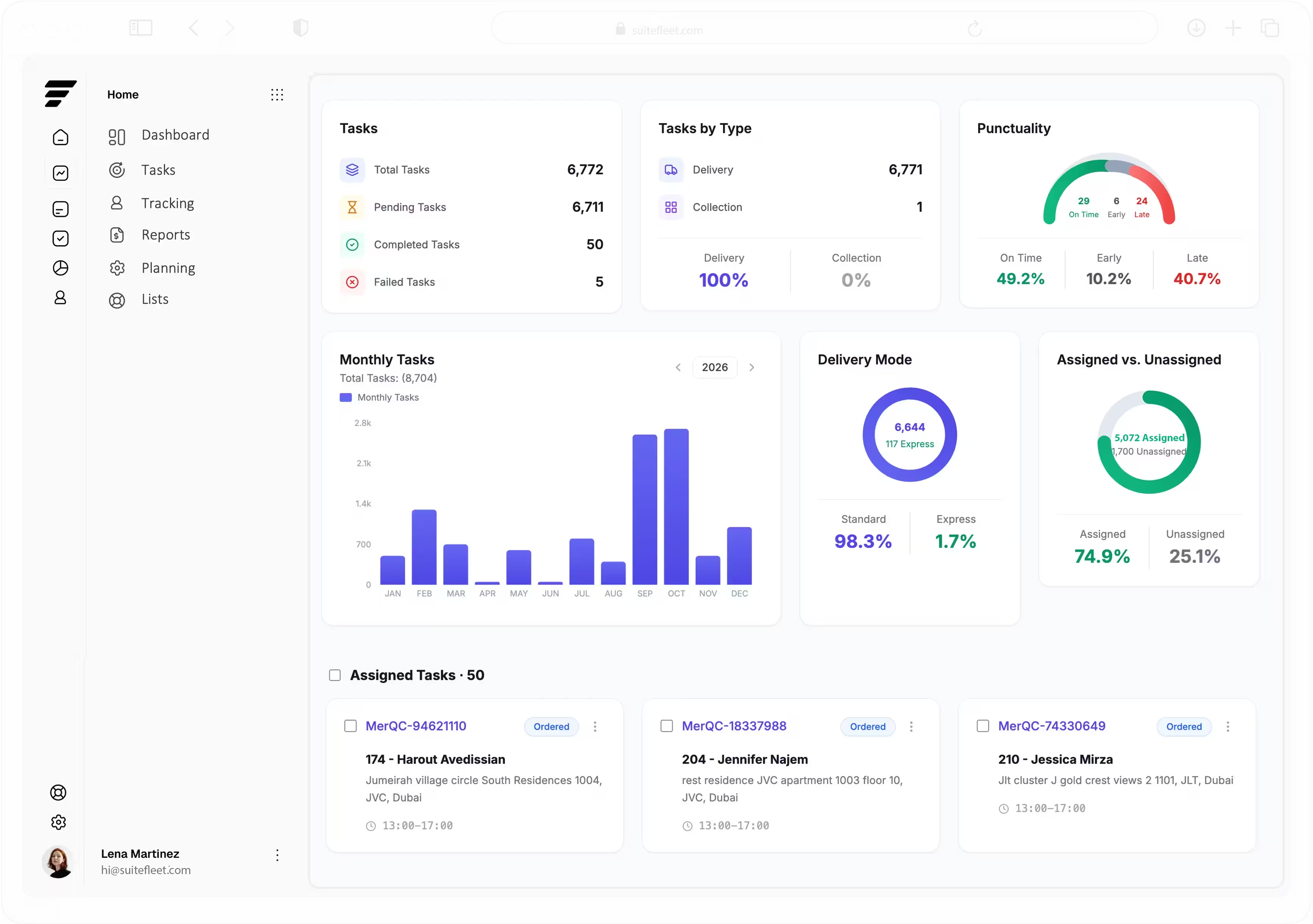
SuiteFleet is a route optimization and delivery execution platform built for operations that run on an ERP. It optimizes routes, schedules drivers, tracks vehicles live, and captures proof of delivery, then returns the full delivery record to NetSuite, SAP, Odoo, Salesforce, Dynamics, Shopify, or WooCommerce in real time through native connectors, with no middleware.
Best for: ERP-run fleets that need routing and delivery data connected to the system of record. Read SuiteFleet reviews on G2
2. Route4Me

Route4Me is one of the most widely used route planning and optimization platforms, pairing a web planner with a driver app that includes built-in navigation. It plans and sequences stops quickly and suits field service, field sales, and last-mile teams that want a proven standalone router.
Best for: Field service and last-mile teams that want fast, standalone route planning.
Read Route4Me reviews on Capterra
3. OptimoRoute
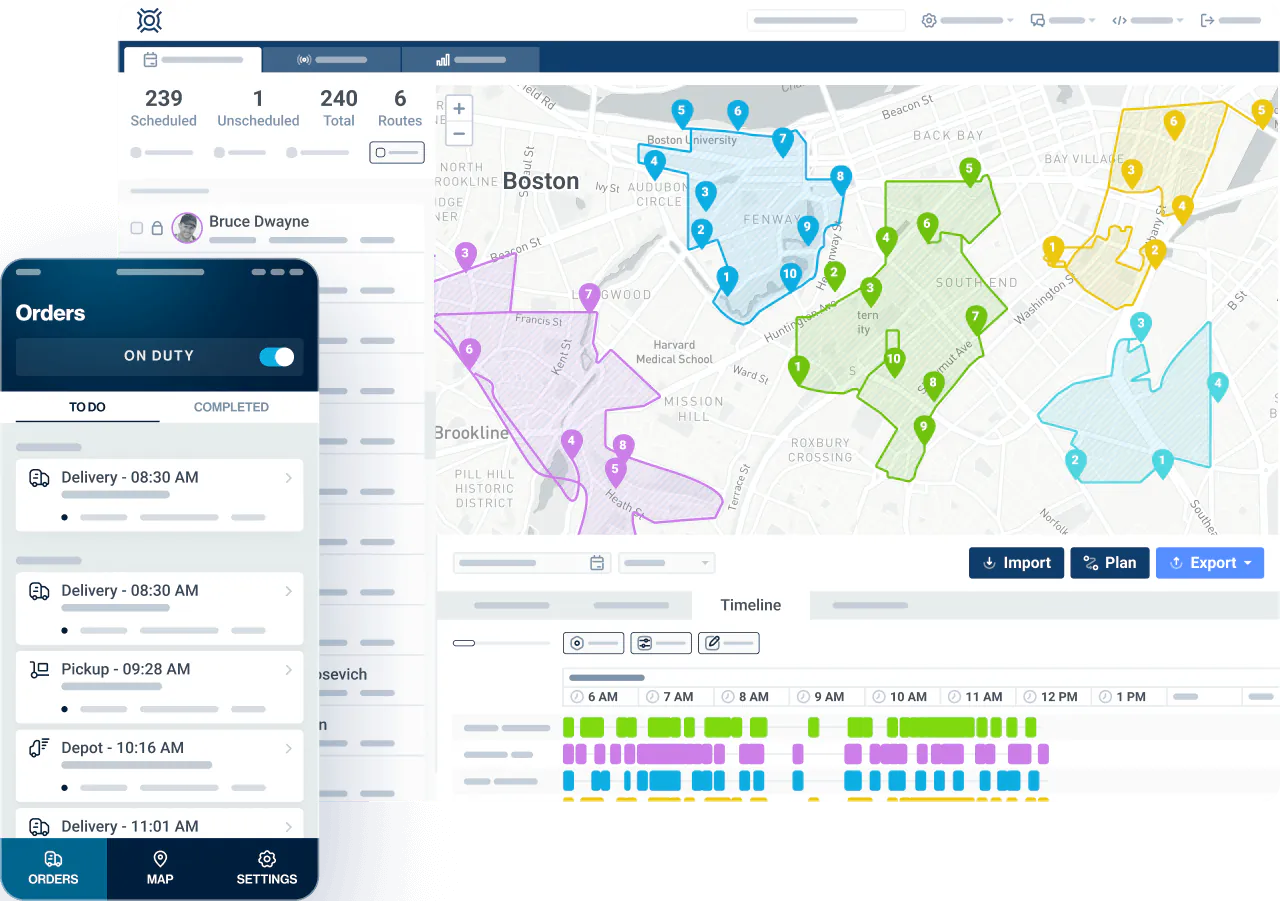
OptimoRoute combines route optimization with workforce scheduling, letting planners build driver schedules weeks in advance around work hours, breaks, and time windows. Its per-driver model and clean planning tools make it popular with delivery and field-service operations.
Best for: Delivery and field-service teams that want routing plus advanced scheduling.
Read OptimoRoute reviews on Capterra
4. Routific

Routific is a route optimization platform known for simplicity, a clean interface, and an easy-to-use driver app. It does the core planning well and is a strong fit for smaller courier and delivery teams that want to be up and running quickly.
Best for: Small delivery and courier teams that want simple, fast route setup.
Read Routific reviews on Capterra
5. Zeo Route Planner

Zeo Route Planner is a per-seat route planning tool for drivers and fleet owners, with fast stop sequencing, live driver tracking, and customer updates. A free tier for up to 15 stops makes it an accessible entry point for very small operations.
Best for: Individual drivers and small fleets that want affordable route sequencing.
6. MaxOptra

MaxOptra is a route optimization platform strong in the UK and Europe, with drag-and-drop planning, an open API, and telematics integrations. It handles multi-drop day routes well and scales from a handful of vehicles to large fleets across food, furniture, construction, and pharma.
Best for: UK and European multi-drop delivery fleets.
Read MaxOptra reviews on Capterra
7. Driv.in

Driv.in (Drivin) uses machine learning to optimize routes around distance, traffic, and delivery windows, with real-time management and strong adoption across Latin America. Its multi-stop planning and KPI tracking suit complex delivery operations that want data-driven routing.
Best for: Complex delivery operations, with particular strength in Latin America.
Read Driv.in reviews on Capterra
8. uFleet
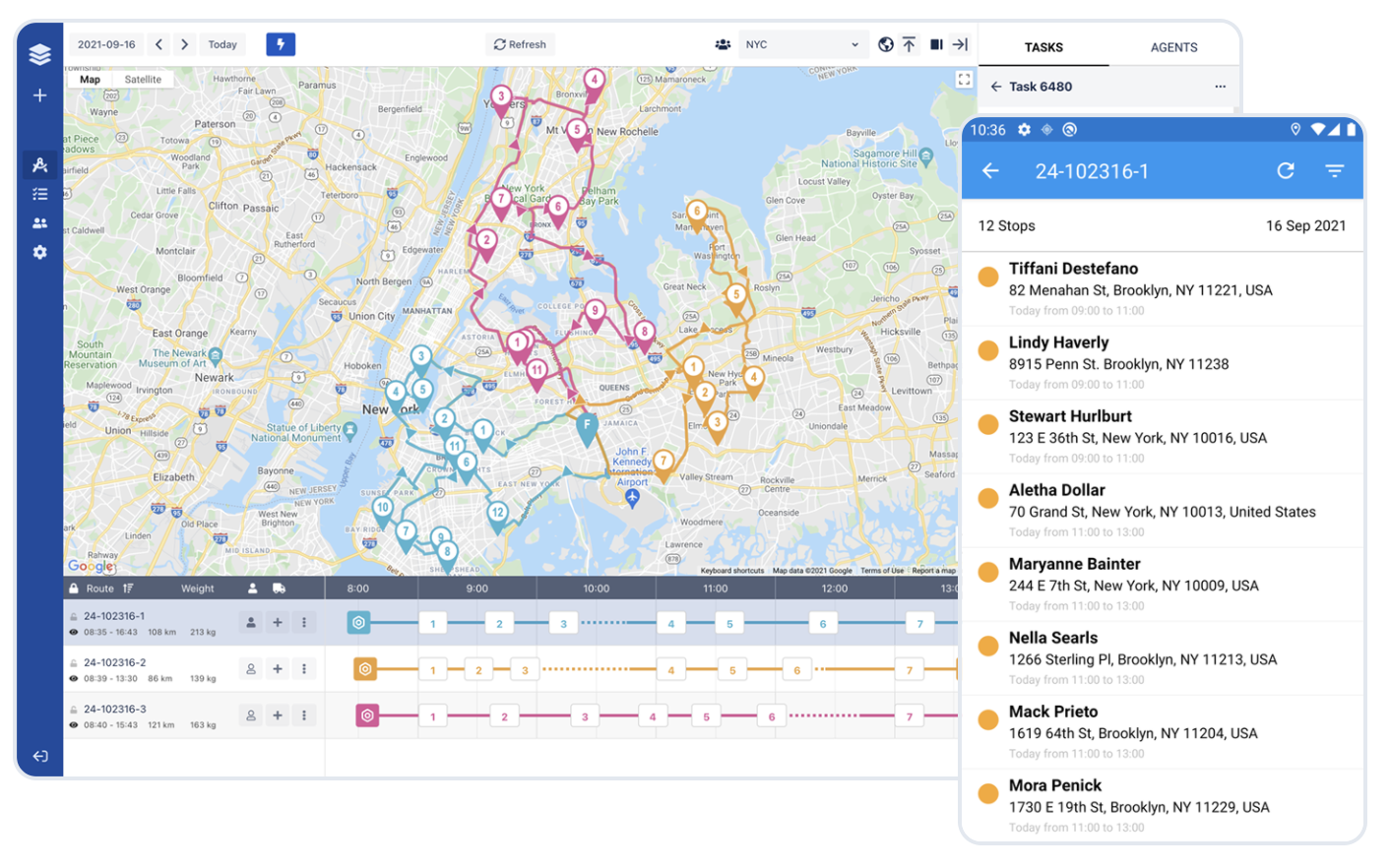
uFleet is a route optimization and delivery management platform with a strong API, built to optimize hundreds of deliveries at once across warehouses and vehicles. It suits mid-market retail and grocery operations that want dynamic routing wired into their order management or ERP.
Best for: Mid-market operations that need API-driven dynamic routing.
9. NextBillion.ai

NextBillion.ai provides route optimization APIs and SDKs for large-scale logistics, with 50-plus constraints, large-matrix support, and dynamic re-optimization. It is developer-first, aimed at engineering teams that want to build routing into their own applications.
Best for: Engineering teams building route optimization into their own stack.
Read NextBillion.ai reviews on G2
10. Onfleet
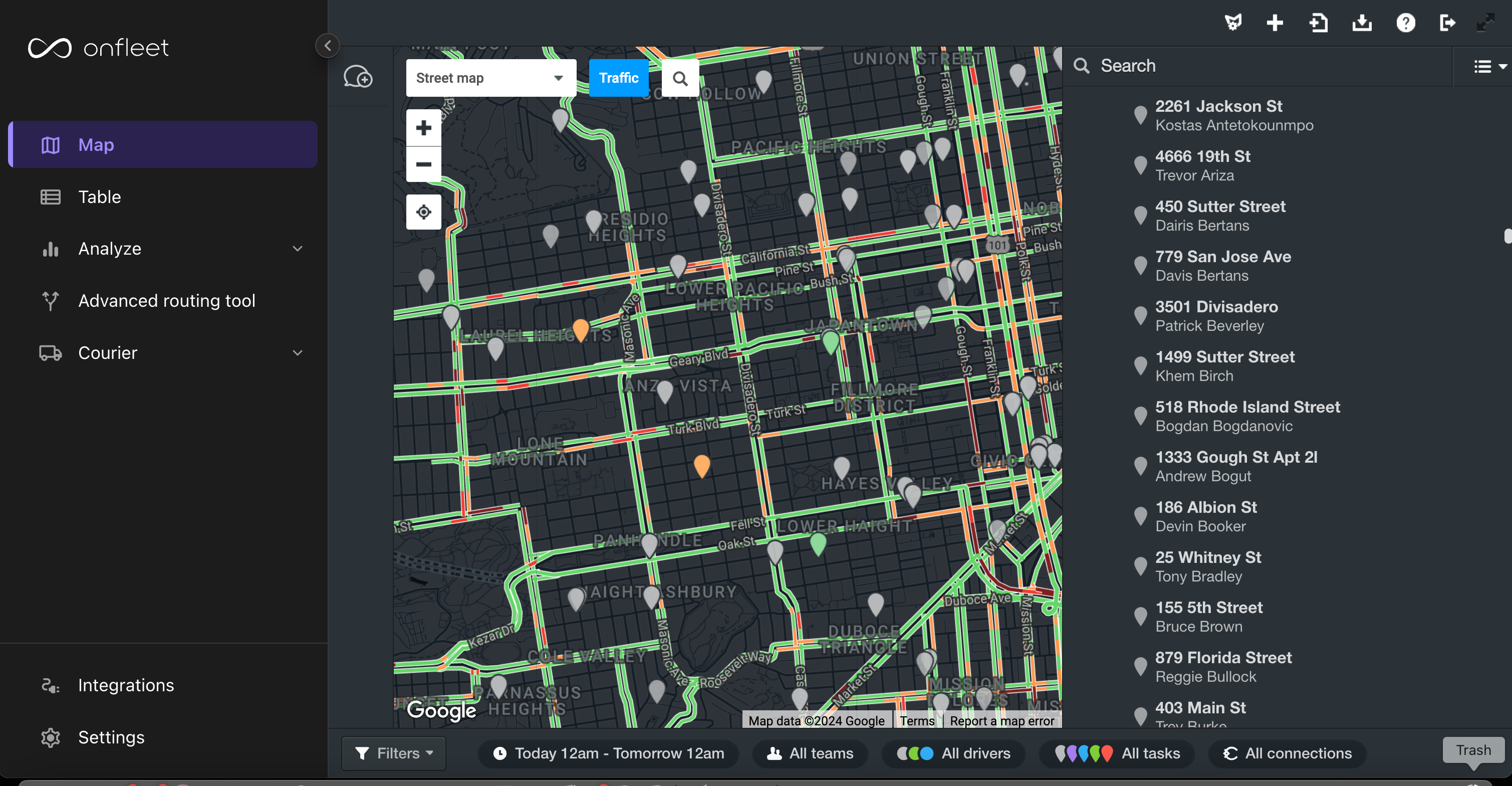
Onfleet pairs multi-stop route optimization with a polished driver app, live tracking, and automated customer notifications. Its clean dispatcher dashboard makes it a common fit for retail, grocery, and pharmacy last-mile delivery.
Best for: Retail, grocery, and pharmacy last-mile delivery.
11. Locus

Locus is an AI-driven route optimization and dispatch platform built for dynamic, high-volume delivery, accounting for real-world constraints like traffic, capacity, and service windows. It is a strong fit for large grocery and quick commerce operations with unpredictable demand.
Best for: Enterprise grocery and quick commerce with dynamic demand.
12. eLogii

eLogii is a highly configurable route optimization and delivery management platform with strong proof-of-delivery capture and a well-documented API. It suits complex operations that want to shape routing rules and workflows around specific constraints.
Best for: Complex operations that need configurable routing and POD.
Read eLogii reviews on Capterra
13. Track-POD

Track-POD combines route optimization with a proof-of-delivery-first delivery platform, handling partial delivery, overdelivery, and quantity capture cleanly. It is a strong fit for distribution and wholesale operations where accurate delivery records drive billing.
Best for: Distribution and wholesale operations centered on proof of delivery.
Read Track-POD reviews on Capterra
14. Tookan
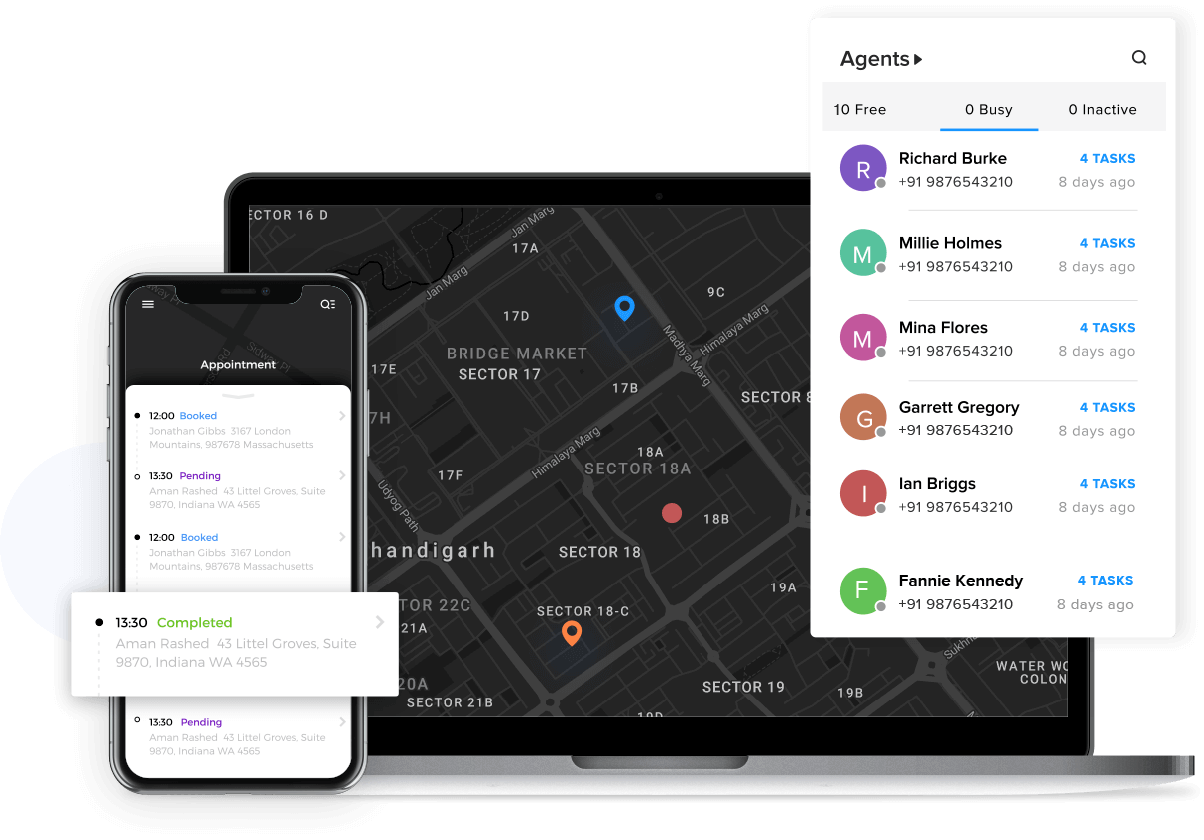
Tookan is an on-demand delivery platform with route optimization, driver apps, and real-time tracking, connecting to common stacks by webhook or API. Its low starting cost and flexibility make it a practical choice for SMBs and local courier operations.
Best for: SMBs and local courier operations that want flexible, low-cost routing.
15. Bringg

Bringg is a delivery orchestration platform that plans and manages routing across owned fleets and third-party carriers in one interface. It suits enterprise retail and grocery operations that need one control layer over many delivery providers.
Best for: Enterprise operations orchestrating owned fleets and carriers together.
16. FarEye

FarEye is an enterprise last-mile platform combining route optimization, orchestration, and real-time visibility across the order-to-door journey. It fits large retail, e-commerce, and logistics operations managing high volumes across multiple hubs and cities.
Best for: Enterprise last-mile operations across many hubs.
17. Shipsy

Shipsy is a logistics platform covering route planning, carrier allocation, and end-to-end visibility, with a strong presence in emerging markets. It suits multi-vendor operations managing both owned fleets and external transport partners.
Best for: Multi-vendor operations in emerging markets.
18. Elite EXTRA
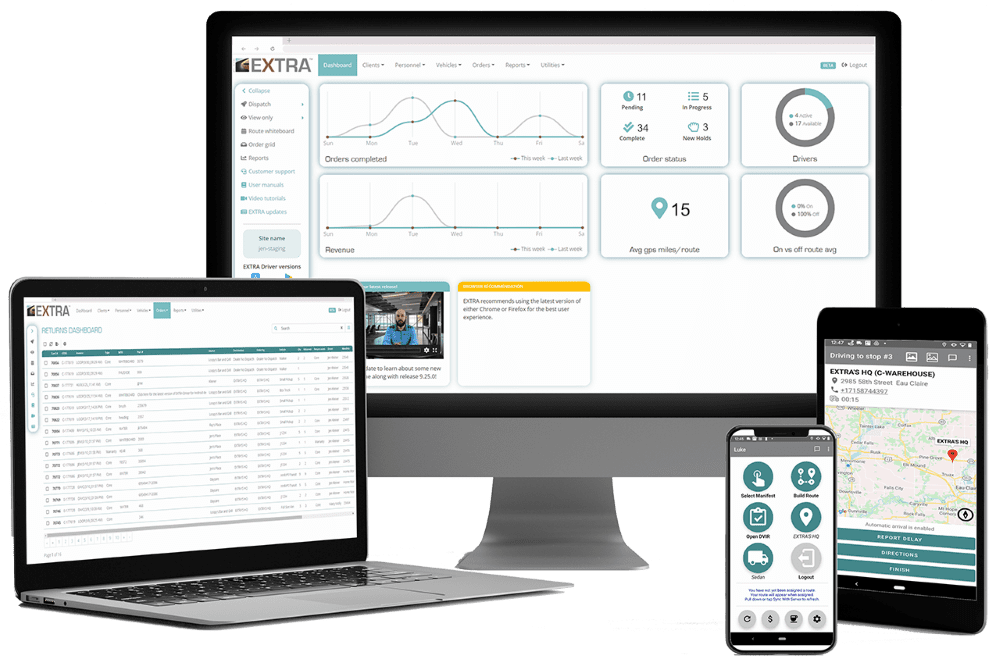
Elite EXTRA combines real-time routing and scheduling with a third-party delivery network and returns management, and is strong in automotive parts distribution. It lets operations run their own drivers and tap outside capacity when demand spikes.
Best for: Distribution operations that mix owned drivers with a delivery network.
Read Elite EXTRA reviews on G2
19. Cigo Tracker
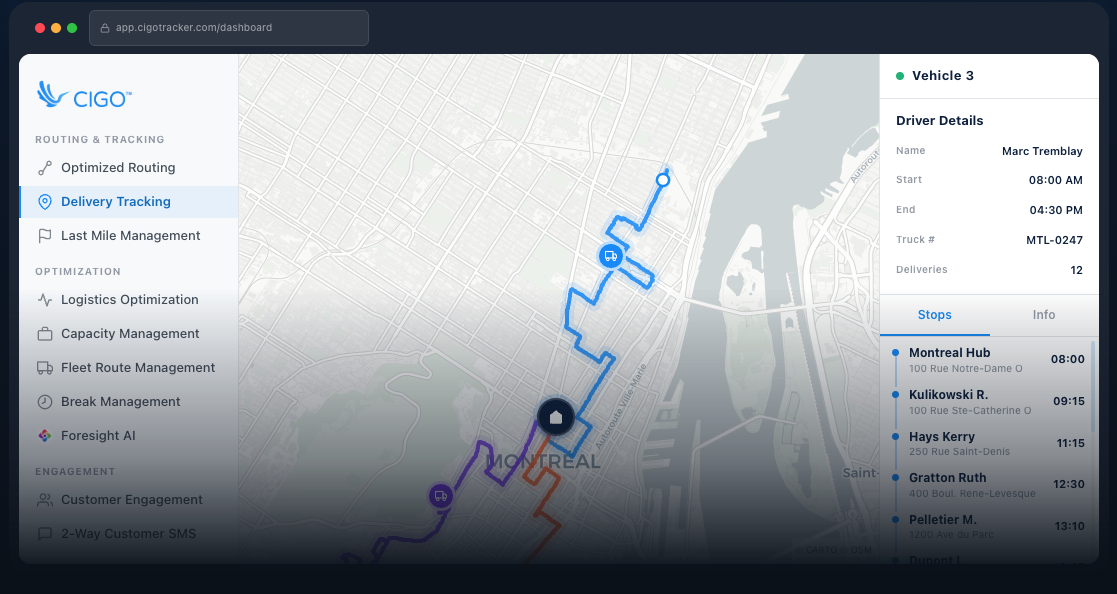
Cigo is a route planning and delivery management platform with dynamic customer notifications and real-time tracking, and integrations with common commerce systems. Its strength is a polished customer-facing tracking experience.
Best for: Mid-size operations that prioritize the customer tracking experience.
Read Cigo reviews on Capterra
20. Metrobi

Metrobi pairs route planning and delivery software with a courier marketplace, so businesses can route their own drivers or tap a vetted driver network. It is popular with local businesses that want routing plus on-demand delivery capacity.
Best for: Local businesses that want route planning plus courier capacity.
How to Choose Route Optimization Software
Start from how much of the workflow around the route you need to run. If you only need to sequence stops, a dedicated planner like Route4Me, OptimoRoute, Routific, MaxOptra, Zeo, or Driv.in does that well. If you are a developer building routing into your own product, NextBillion.ai and uFleet lead on APIs. If you need routing inside a full delivery platform with tracking and proof of delivery, Onfleet, Locus, eLogii, Track-POD, Tookan, Bringg, FarEye, Shipsy, Elite EXTRA, Cigo, and Metrobi cover that range from SMB to enterprise.
The factor most buyers underestimate is what happens after the route runs. A platform that optimizes routes but leaves the delivery data in a separate app still leaves your team reconciling by hand. If your operation runs on NetSuite, SAP, Odoo, Salesforce, Dynamics, Shopify, or WooCommerce, the connector and what it returns matter as much as the routing engine, which is where SuiteFleet is built to lead.
Frequently Asked Questions
What is route optimization software?
Route optimization software calculates the most efficient sequence of stops for each driver, factoring in time windows, vehicle capacity, driver hours, and traffic. It replaces manual planning, reduces mileage and fuel cost, and helps drivers complete more stops per day. The more advanced platforms re-optimize dynamically as conditions change during the day.
What is the best route optimization software in 2026?
There is no single best platform, because the right choice depends on your operation. Route4Me, OptimoRoute, and Routific lead among dedicated route planners. NextBillion.ai leads for developers who want routing APIs. SuiteFleet leads for fleets that need route optimization wired natively into an ERP such as NetSuite, SAP, Odoo, Salesforce, or Dynamics.
How much does route optimization software cost?
Pricing is usually per driver or per vehicle per month, and ranges from low-cost plans for small fleets to quote-based enterprise pricing. The subscription is rarely the largest cost. Implementation and integration work, especially connecting routing to your ERP, often exceed it, so evaluate total cost of ownership rather than the sticker price.
Which route optimization software integrates with NetSuite?
SuiteFleet is built for NetSuite, connecting through a native SuiteApp connector without middleware. Orders flow from NetSuite into the platform, routes are optimized and dispatched, drivers capture proof of delivery, and confirmed delivery data returns to NetSuite in real time to close the fulfillment record and trigger billing.
Does route optimization software work for field service, not just delivery?
Yes. Many of these platforms, including Route4Me, OptimoRoute, and Zeo, are used for field service, field sales, and territory management as well as delivery. The routing engine is the same. What differs is whether the platform captures the job or service details your field operation needs at each stop.
Route Optimization That Closes the Loop
Every platform on this list can build an efficient route. Far fewer connect that route back to the systems that run the business. Optimized routes cut mileage and fuel, but the full return comes when the delivery data, proof, status, and cost, updates your ERP automatically the moment each stop is closed.
That is the layer SuiteFleet is built for. Route optimization, driver scheduling, live tracking, and proof of delivery run as one workflow, with confirmed status syncing back to NetSuite, SAP, Odoo, Salesforce, Microsoft Dynamics, Shopify, and WooCommerce automatically, without middleware or overnight batch jobs. It deploys in weeks and scales whether you run five vehicles or five hundred.