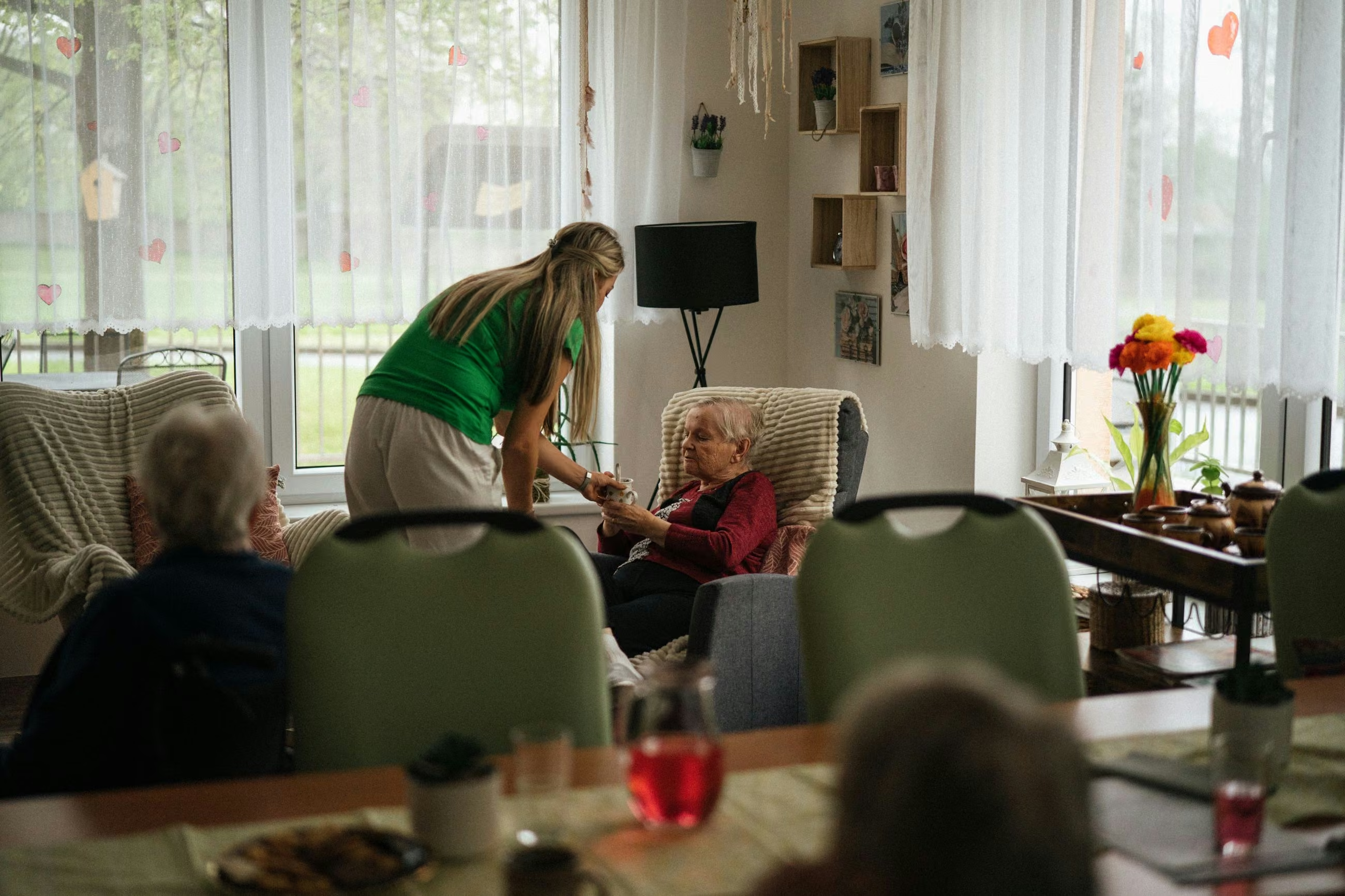
In long-term care, the customer is a building, and the deadline is the med pass.
It is 3:30 on a Tuesday afternoon. A new resident arrived from the hospital at a skilled nursing facility in Wards Corner, and her first doses need to be on the med cart before the 9:00 p.m. med pass. A nursing facility a few blocks away opened its emergency kit this morning, and the kit has to come back to the pharmacy for restocking. Three dozen facilities are on today's schedule, and most of their orders go out on the evening run. Every tote leaves sealed, and every handoff ends with a nurse's signature.
Someone has to decide which driver takes each stop, in what order, and whether the schedule each facility was promised still holds.
That is the job of delivery management for long-term care pharmacies. SuiteFleet brings facility deliveries, dispatch planning, route optimization, and proof of delivery into one shared workflow, so the pharmacy can run the evening from a plan instead of a stack of manifests.
Let's follow Denise, the dispatch lead at a long-term care pharmacy group serving facilities across Hampton Roads, Virginia, from four pharmacy sites, through a worked example. The screens are long-term care demo illustrations; names, addresses, maps, and figures are examples.
Start with each facility's delivery schedule
A long-term care pharmacy does not deliver to a front door. It delivers to a nurses' station, a med room, or a house manager, on a schedule the facility agreed to. Routine runs arrive at set times. STAT orders for new admissions and urgent starts arrive between runs. Return pickups bring back discontinued medications and opened emergency kits.
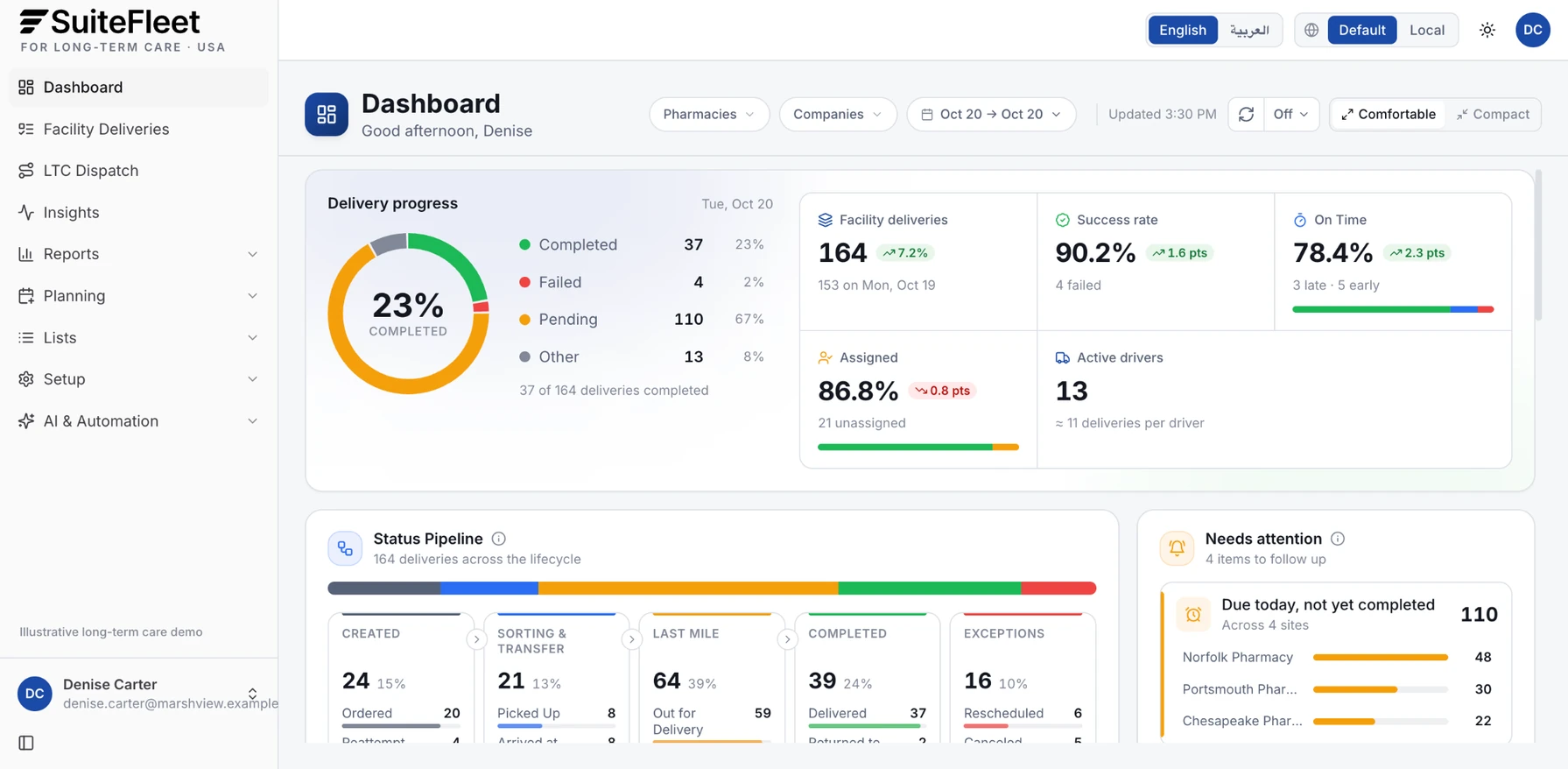
The dispatch lead starts with the day as a whole. The dashboard shows 164 facility deliveries, 37 completed, 21 still without a driver, and 110 still due across four sites. Most of the open work belongs to the evening run.
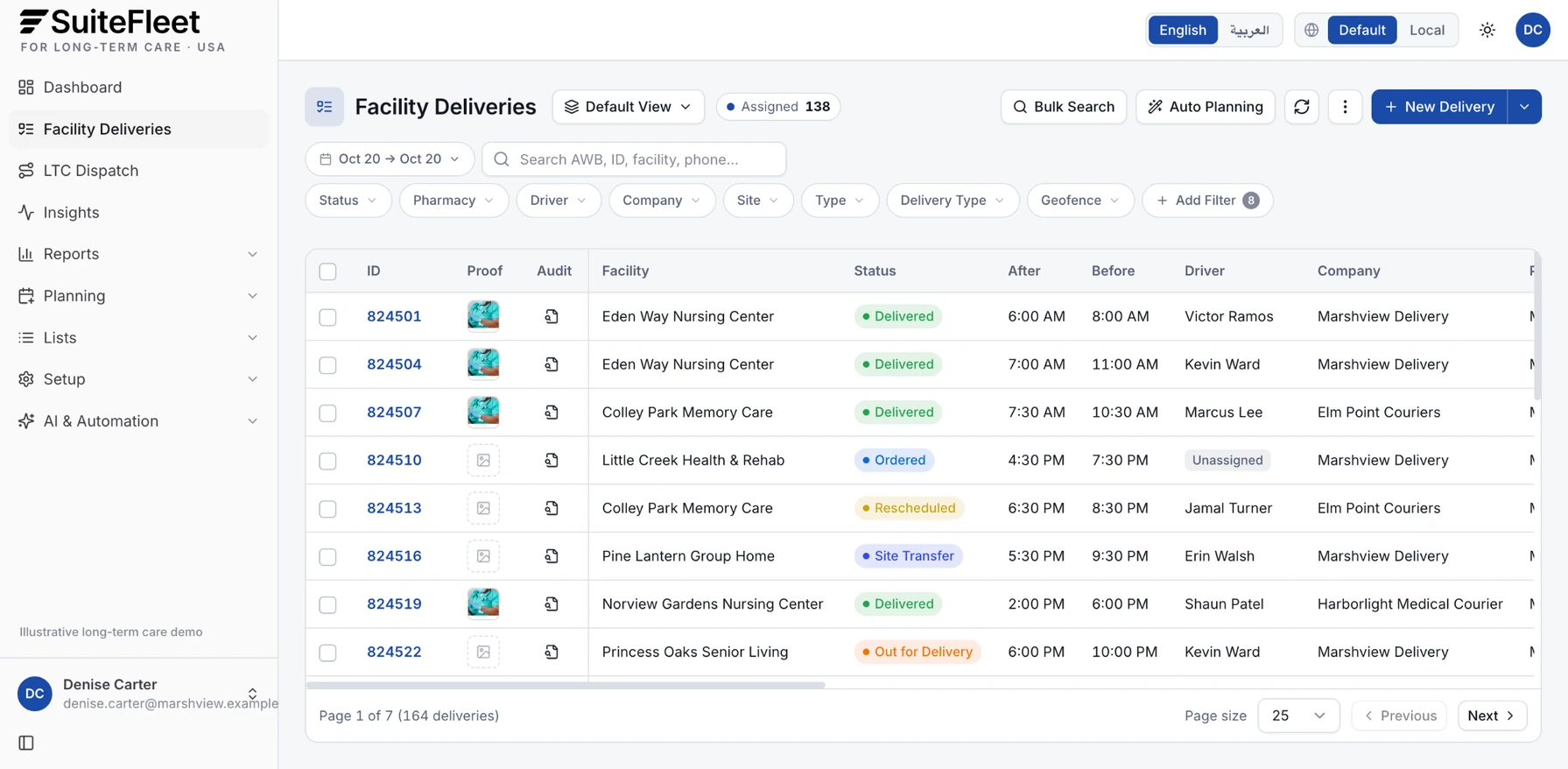
Good delivery starts when the order is entered. "Deliver to Little Creek" is far less useful than "Rehab wing, Station 3. STAT: new admission. First doses before the 9 PM med pass. Hand to charge nurse."
SuiteFleet's delivery list keeps the facility, status, delivery window, driver, and company in the same view, so the dispatch lead can see which facilities are covered and which orders still need a driver. The company column also shows which drivers work for the pharmacy and which come from courier partners.
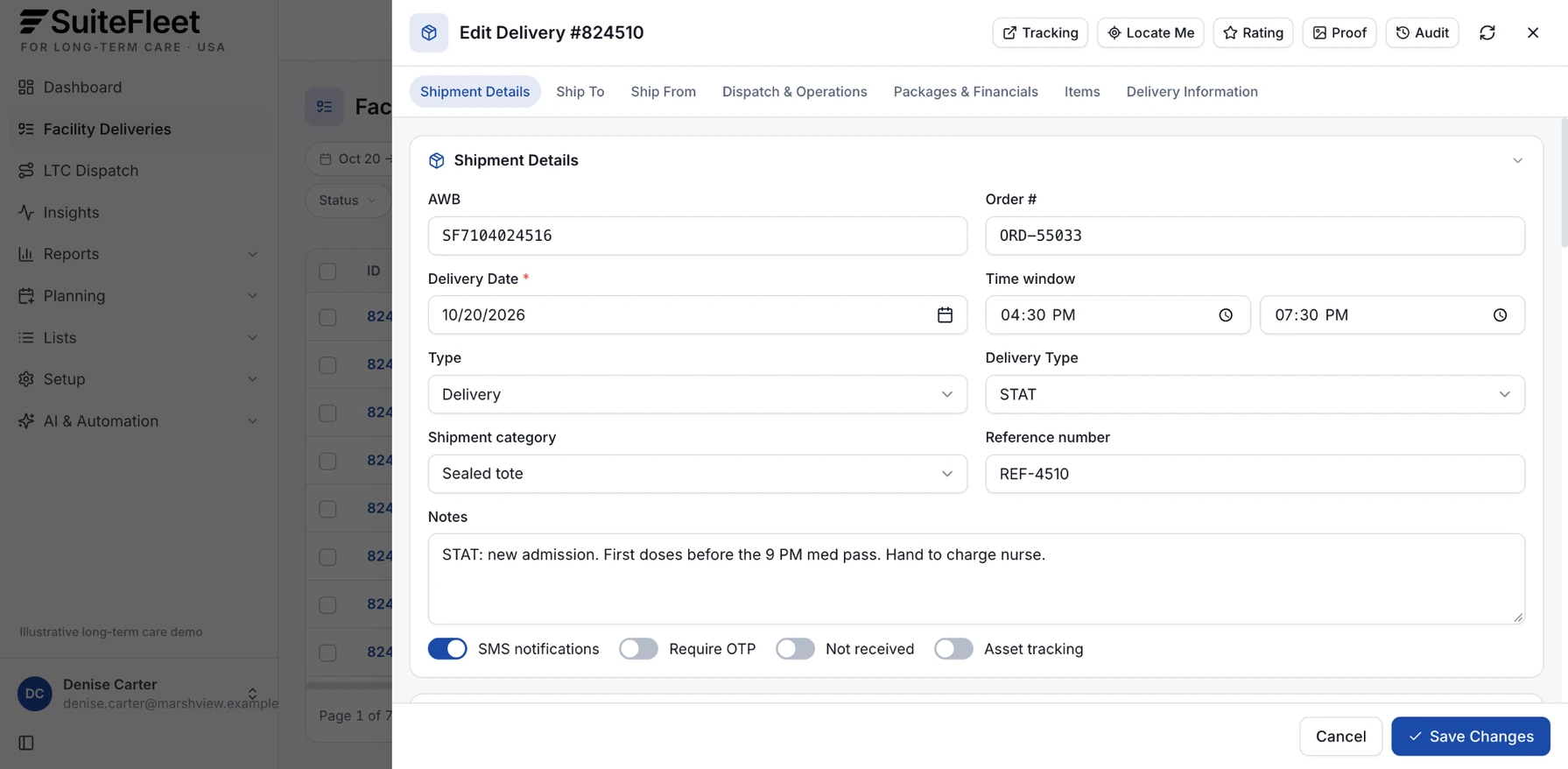
For the STAT order, the dispatch lead opens the details screen. The delivery type is STAT, the window runs from 4:30 to 7:30 p.m., the shipment is a sealed tote, and the note tells the driver who should receive it. Notice what the note leaves out: the driver needs the handoff instruction, not the resident's medication list.
Plan runs around facilities, shifts, and handoffs
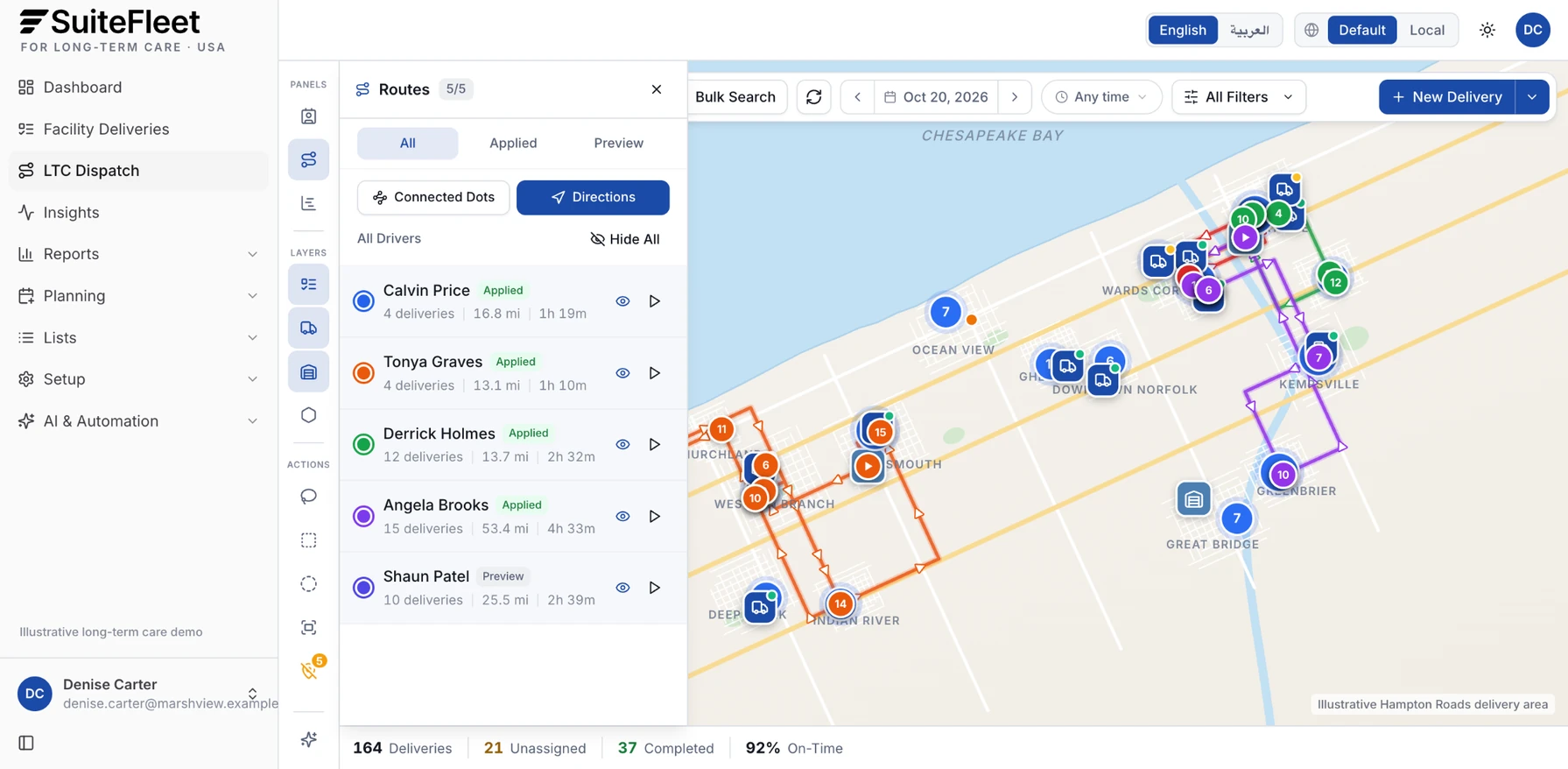
Counting stops per driver hides the real workload. Fifteen deliveries over 53.4 miles is a different shift from four deliveries over 13.1 miles. A facility handoff also takes longer than a doorstep drop: the driver waits for a nurse, the totes are counted, and controlled substances need a signature. In an interview with America's Pharmacist, one closed-door pharmacy described drivers making 15 to 25 stops a night and stressed signed records so that pharmacy and facility staff stay accountable.
In SuiteFleet's dispatch workbench, each driver's route appears with its delivery count, distance, and duration, next to the map. The dispatch lead can compare workloads before adding anything new.
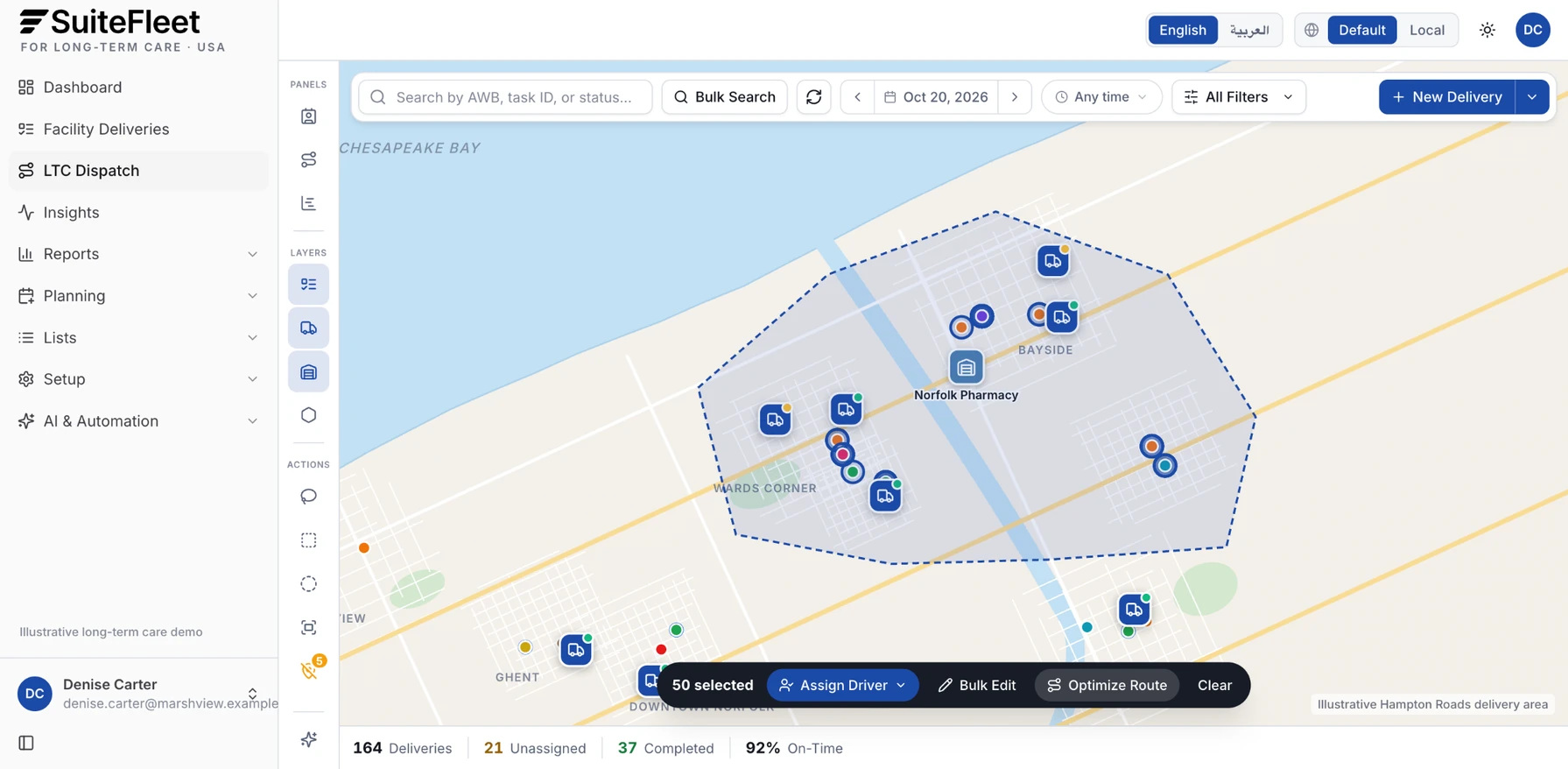
The open evening work clusters around the Norfolk pharmacy site. The dispatch lead uses the lasso tool to select deliveries across Wards Corner, Norview, and Bayside, including the STAT order and the emergency kit return. The selection bar then offers to assign a driver, edit in bulk, or optimize the route.
Fit STAT orders and returns into the evening run
Of the 50 deliveries selected, 34 still need to be delivered. The optimizer leaves out the ones already delivered, canceled, failed, or being processed for return. The dispatch lead enables the three drivers on the 4:00 to 11:00 p.m. shift from the Norfolk site: one pharmacy driver and two drivers from a courier partner.
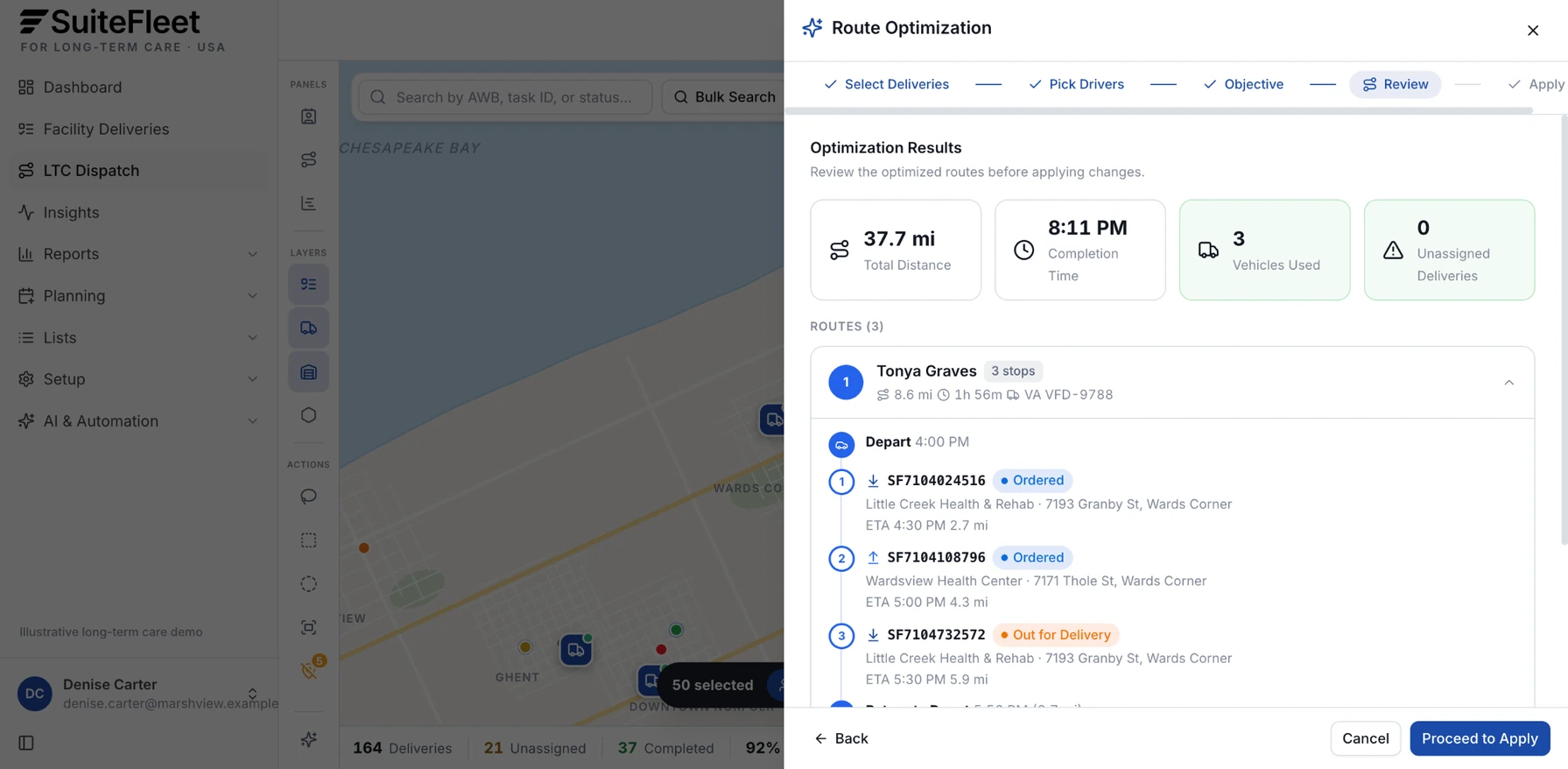
SuiteFleet's optimizer offers four goals: Fastest Completion, Shortest Distance, Fewest Vehicles, and Balanced Workload. The dispatch lead keeps Fastest Completion, leaves Respect Time Windows switched on, and raises the time per stop from the default 10 minutes to 20, because a facility handoff includes a tote count and a signature.
The results preview shows three routes, 37.7 miles in total, the last stop finished by 8:11 p.m., and no unassigned deliveries. The STAT order becomes the first stop on the pharmacy driver's route, with an estimated arrival of 4:30 p.m., the moment its window opens and well before the 9:00 p.m. med pass. The emergency kit pickup at the nearby nursing facility follows at 5:00 p.m.
This is the practical value of long-term care route planning: a workable decision while there is still time to change it. To see whether it is working, track deliveries completed before each facility's cutoff, time from STAT order to signature, failed first attempts, and emergency kits returned on time. The screens show the workflow; your own operating data will show the improvement.
Close the loop with chain-of-custody proof
Facilities call back. "Did the evening totes arrive?" "Who signed for the controlled substances?" The answer should take seconds, not a call to the driver.
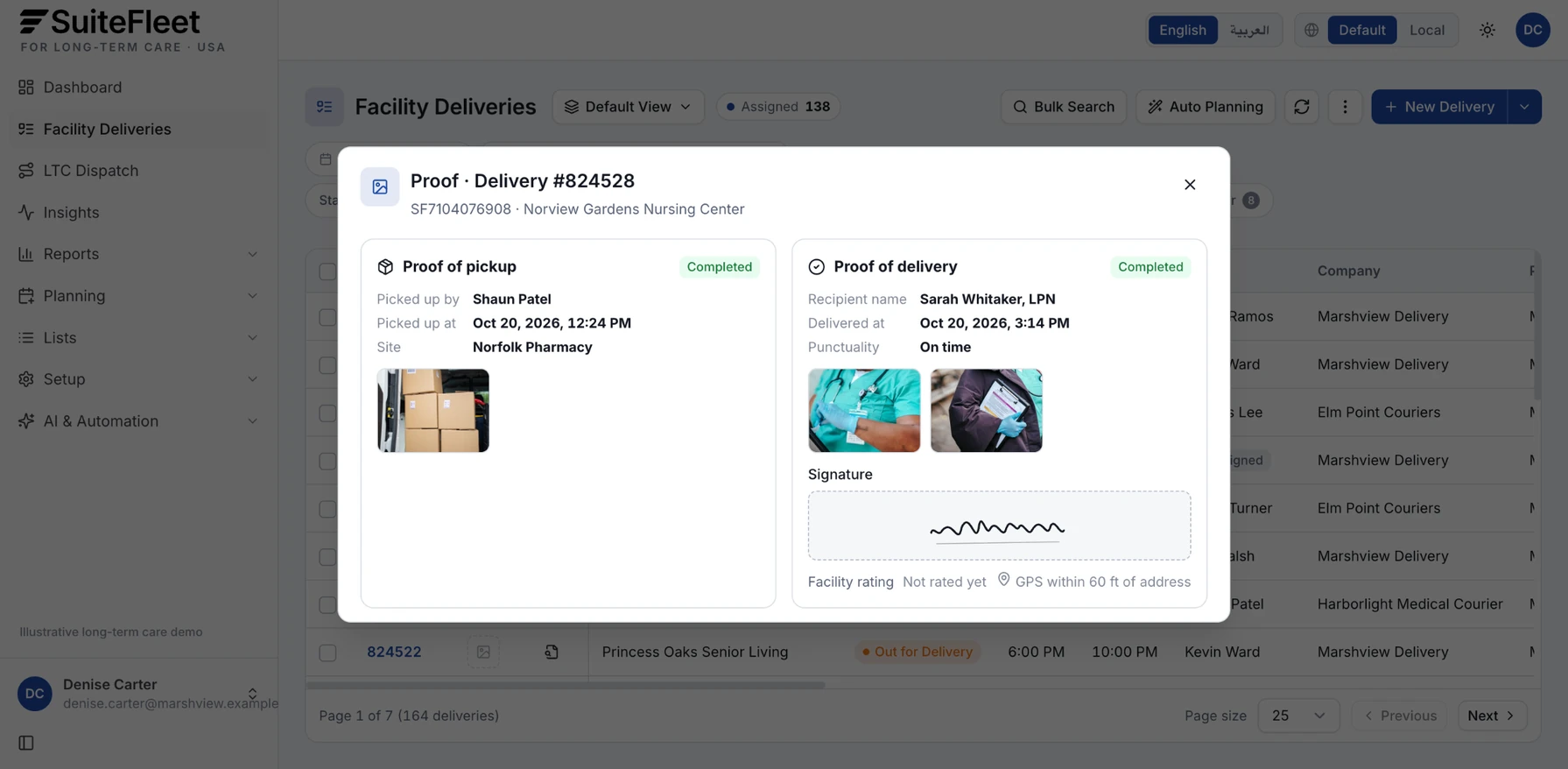
SuiteFleet records proof of pickup and proof of delivery for each order. In the example, the record shows the driver who collected the totes at the Norfolk pharmacy site, the nurse who received them, when they arrived, whether they were on time, delivery photos, a signature, and a GPS check against the facility address. This driver works for the courier partner, and the record has the same fields a pharmacy driver's would.
Connect delivery with your pharmacy system and facility EHRs
Your pharmacy system should stay the system of record for orders, medication records, and billing, and facilities keep their own EHRs. Delivery software should receive only what the delivery needs, without staff typing it twice. NetSuite has a published SuiteFleet connector. A long-term care pharmacy system or facility EHR would need a custom integration through SuiteFleet's API, subject to the access each vendor supports.
SuiteFleet's API supports custom integration work. During setup, map only the fields delivery needs: facility, unit, window, STAT flag, tote count, handling notes, return pickups, and status updates.
Compare SuiteFleet with five long-term care delivery options
Long-term care pharmacies can choose a dedicated delivery platform or use the delivery tools that come with their pharmacy software. The comparison below places SuiteFleet alongside two general delivery platforms and three long-term care pharmacy options.
When is your pharmacy system's delivery tool enough?
Many long-term care pharmacy systems already offer a delivery app or add-on, so the fair question is why you would add another system. Often you should not. If one pharmacy runs its own drivers on fixed facility routes, and the built-in manifests and signatures satisfy your facilities and auditors, keep delivery next to the order, with one fewer login and no integration to maintain.
A separate delivery platform earns its place when the hard part is coordination rather than the manifest. That usually means:
- Several pharmacy sites share drivers, or one dispatcher plans runs for every site.
- STAT orders arrive all afternoon and the evening routes need to be rebuilt around them.
- Pharmacy drivers work alongside courier partners, and you want the same proof record from both.
- The same drivers also carry work from outside the pharmacy system, such as medical supplies or orders from your ERP.
The evening in this article is that kind of day: four pharmacy sites, a mid-afternoon STAT admission, a kit to collect, and a pharmacy driver working next to two courier drivers. SuiteFleet's pharmaceutical delivery page describes one centralized environment for deliveries from multiple pharmacies, with owned, 3PL, and hybrid fleets. A simple test: if your routes rarely change after the morning cutoff, the tool you have may be enough. If rebuilding the evening run is a daily job, a separate platform is worth evaluating.
Either way, compare the options using the same admission-heavy order file, with STAT orders, controlled substances, refrigerated items, and kit returns, and see how much work still lands on the dispatcher.
Keep emergency kits, controlled drugs, and records in order
A good route is only part of safe long-term care delivery. Nursing homes that take part in Medicare and Medicaid must follow the federal pharmacy services rule, 42 CFR 483.45. It requires procedures for accurately acquiring, receiving, dispensing, and administering drugs, and a system of records of receipt and disposition of all controlled drugs, reconciled periodically. Delivery is where the pharmacy's records and the facility's receiving records meet.
Because the example pharmacy is in Virginia, its emergency supplies also follow the Virginia Board of Pharmacy:
- An emergency drug kit is sealed, access is restricted to a licensed nurse, pharmacist, or prescriber, a form is completed when it is opened, and it must be returned to the pharmacy within 72 hours for replenishing.
- A stat-drug box is sealed, each seal carries a unique identifier that the pharmacy records, and the box goes back to the pharmacy once it has been opened.
Those returns are delivery work. In the example, the opened emergency kit becomes a pickup on the evening route with its own window, a note can carry a stat-drug box's seal number, and the proof record shows who handed it over and when. Pharmacies outside Virginia should check their own board of pharmacy, because rules differ by state.
Software can carry instructions, schedule returns, and keep a signed, timestamped record, but it does not make a pharmacy or facility compliant on its own. Written procedures, sealed totes, trained staff, and the pharmacist's oversight still do the physical and clinical work.
Plan your next evening run
SuiteFleet gives long-term care pharmacies one place to manage facility schedules, STAT orders, driver assignments, routes, returns, and proof. Test it against your busiest admission day. Bring your facility list and cutoffs, driver shifts, courier partners, and a sample order file, and ask to see the plan, the exceptions, and how a late STAT order changes the evening.
Book a free SuiteFleet demonstration to see how dispatch planning and route optimization can fit your long-term care delivery operation.