Quick commerce lives or dies on minutes. A grocery or convenience order promised in 15 to 30 minutes leaves no room for a dispatcher working off a spreadsheet, a driver guessing the next stop, or a delivery status that reaches the ERP the next morning. The q-commerce software below is ranked on the things that actually decide whether those minutes hold: dispatch speed, rider and dark-store coordination, live tracking, and whether the confirmed delivery closes the order in your system of record. Each entry includes a verified review link so you can check the field feedback yourself.
The 10 Best Q-Commerce Software Platforms
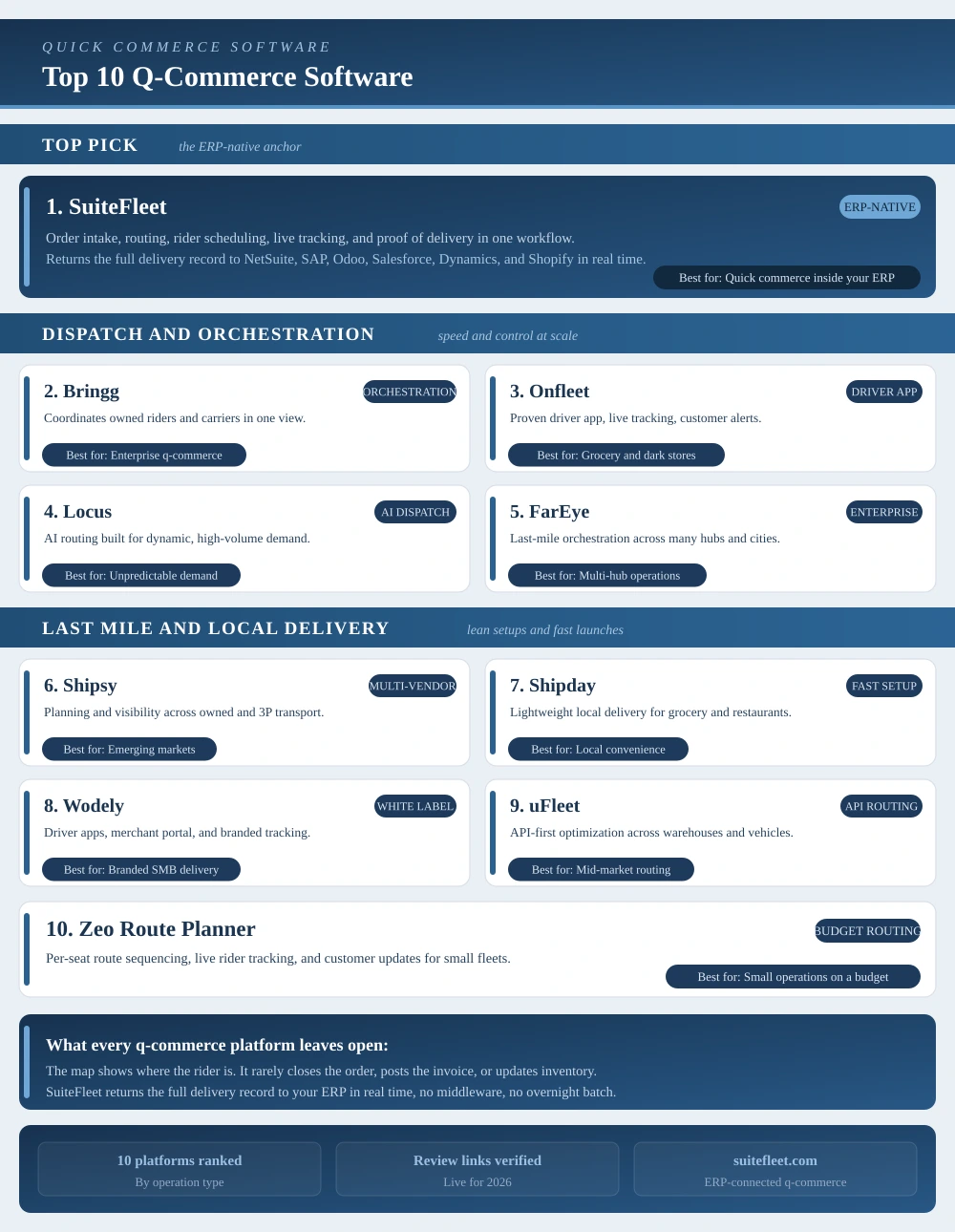
1. SuiteFleet
SuiteFleet is a fleet and logistics platform built for quick commerce operations that run on top of an ERP or commerce system. It covers order intake, route optimization, driver scheduling, live GPS tracking, digital proof of delivery, and customer notifications, then returns the full delivery record to the source system in real time through native connectors, no middleware. Where most q-commerce tools stop at the delivery, SuiteFleet closes the loop back into the order, the invoice, and the customer record before the next wave of orders lands. Best for: NetSuite, SAP, Odoo, Salesforce, Dynamics, Shopify, and WooCommerce operations that need quick commerce delivery inside the ERP. Read SuiteFleet reviews on G2
2. Bringg
Bringg is a delivery orchestration platform that coordinates owned fleets and third-party carriers in one interface, with strength in grocery and retail quick commerce. It suits operators running high order volumes across many stores or dark stores that need one control layer over multiple delivery providers.Best for: Enterprise quick commerce orchestrating owned riders and carriers together. Read Bringg reviews on G2
3. Onfleet
Onfleet is a widely used delivery platform with a strong driver app, real-time tracking, and automated customer notifications, popular with grocery, convenience, and dark-store operations. Its clean dispatcher dashboard and route sequencing make it a practical fit for fast local delivery at scale.Best for: Grocery and dark-store operations that want a proven driver app. Read Onfleet reviews on G2
4. Locus
Locus is an AI-driven dispatch and route optimization platform built for dynamic, high-volume delivery, with strong adoption in grocery and quick commerce. Its optimization engine accounts for real-world constraints such as traffic, capacity, and service windows, which matters when orders arrive unpredictably and windows are tight.Best for: High-volume operations that need AI dispatch for unpredictable demand. Read Locus reviews on G2
5. FarEye
FarEye is an enterprise last-mile platform combining orchestration, real-time visibility, and branded customer experiences across the order-to-door journey. It fits large quick commerce and retail operations managing high volumes across multiple hubs, cities, and delivery partners.Best for: Enterprise quick commerce that needs orchestration across many hubs. Read FarEye reviews on G2
6. Shipsy
Shipsy is a logistics platform covering route planning, carrier allocation, and end-to-end shipment visibility, with a strong presence in quick commerce across emerging markets. It suits multi-vendor operations that need to manage both owned riders and external transport partners from one system.Best for: Emerging-market quick commerce mixing owned and outsourced delivery. Read Shipsy reviews on G2
7. Shipday
Shipday is a lightweight delivery platform focused on restaurants, ultra-fast grocery, and local businesses, with fast setup and SMS notifications. It is a fit for smaller quick commerce operations that need to launch local delivery quickly without a heavy implementation.Best for: Local grocery and convenience operations that need fast setup. Read Shipday reviews on Capterra
8. Wodely
Wodely, formerly WooDelivery, is a delivery management platform with driver apps, a merchant portal, route optimization, and proof of delivery for couriers, retail, and e-commerce. Its white-label apps and add-ons make it a flexible option for smaller quick commerce operators that want a branded delivery experience.Best for: SMB quick commerce that wants white-label driver and customer apps. Read Wodely reviews on Capterra
9. uFleet
uFleet is a route optimization and delivery management platform with a strong API, built to optimize hundreds of deliveries at once across warehouses and vehicles. It suits mid-market retail and grocery operations that want dynamic routing wired into their order management or ERP.Best for: Mid-market operations that need API-driven dynamic routing. Read uFleet reviews on G2
10. Zeo Route Planner
Zeo Route Planner is a per-seat route planning tool for fleet owners and drivers, with fast route sequencing, live driver tracking, and customer updates. It is a low-cost entry point for small quick commerce operations that need efficient daily route planning without enterprise complexity.Best for: Small operations that need affordable rider route planning. Read Zeo reviews on Capterra
How to Choose the Right Q-Commerce Software
Start from the operational gap, not the feature list. Operations orchestrating owned riders and outside carriers at scale should shortlist Bringg, Onfleet, Locus, and FarEye. Emerging-market and multi-vendor quick commerce is well served by Shipsy. Local and SMB operations should look at Shipday, Wodely, uFleet, and Zeo for fast setup and affordable routing.
The dividing line most buyers underestimate is what the platform returns to the system of record. In quick commerce, where order volume is high and margins are thin, a tool that pushes a nightly "delivered" flag creates reconciliation work at exactly the wrong scale. A platform that returns the full delivery record, timestamp, proof, and exception reason, in real time keeps the order, the invoice, and the inventory current between waves. If your operation runs on NetSuite, SAP, Odoo, Salesforce, Dynamics, Shopify, or WooCommerce, that connector matters more than any single map feature, which is where SuiteFleet is built to lead.
Frequently Asked Questions
What is q-commerce software?
Q-commerce software, or quick commerce software, manages the real-time execution of ultra-fast delivery: taking an order, dispatching a rider, tracking the delivery live, capturing proof of delivery, and returning confirmed status to the ERP or commerce system the same day. It is built for the 15-to-30-minute grocery, convenience, and dark-store models that traditional shipping and freight tools were never designed to support.
What is the best q-commerce software in 2026?
There is no single best platform, because the right choice depends on the gap you are closing. Bringg, Onfleet, and Locus lead for dispatch and orchestration at scale. Shipday and Wodely lead for local and SMB operations. SuiteFleet leads for quick commerce operations that need delivery execution wired natively into an ERP such as NetSuite, SAP, Odoo, Salesforce, or Dynamics.
How is quick commerce software different from standard delivery software?
Standard delivery software handles scheduled, often multi-day shipments through carriers. Quick commerce software is built for same-hour delivery from dark stores or local outlets, with dynamic dispatch, live rider tracking, and instant proof of delivery. The speed and volume of q-commerce put far more weight on real-time dispatch, exception handling, and same-day data return than standard delivery tools are designed to carry.
Which q-commerce software integrates with NetSuite?
SuiteFleet is built for NetSuite, connecting through a native SuiteApp connector without middleware. Orders flow from NetSuite into the platform, riders capture proof of delivery at each stop, and confirmed delivery data returns to NetSuite in real time to close the fulfillment record and trigger billing, which keeps high order volumes reconciled without manual entry.
What is the best q-commerce software for small businesses?
Small quick commerce operations usually want fast setup, low cost, and simple routing. Shipday, Wodely, and Zeo all fit that profile for local delivery and route planning. Businesses that also run an ERP or commerce platform, even at smaller scale, should look at SuiteFleet, which connects to NetSuite, Odoo, Shopify, Salesforce, and WooCommerce without a custom integration project.
The ERP Angle Most Q-Commerce Software Leaves Open
Almost every platform on this list can dispatch a rider and track a delivery. Far fewer close the loop back into the systems that run the business, and in quick commerce that gap compounds fast. A map shows you where the rider is. A platform connected to your ERP tells you the order is delivered, the proof is captured, the invoice can post, and inventory is current, all before the next wave of orders lands.
That is the layer SuiteFleet is built for. Order intake, route optimization, driver scheduling, live GPS tracking, digital proof of delivery, and customer notifications run as one workflow, with confirmed status syncing back to NetSuite, SAP, Odoo, Salesforce, Microsoft Dynamics, Shopify, and WooCommerce automatically, without middleware or overnight batch jobs. It deploys in weeks and scales whether you run five riders or five hundred.