.svg)
.webp)


The Shopify–SuiteFleet integration links fulfillment orders and fulfillments to delivery tasks. Dispatchers review destinations, assign drivers, and follow delivery attempts in SuiteFleet. Each result returns through the configured connection to the matching source record, preserving fulfillment-order line items and any outstanding quantities.
Connector availability: SuiteFleet plans to publish its Shopify connector on Shopify App Store, subject to the marketplace review and release process.
1. Start with the Shopify order
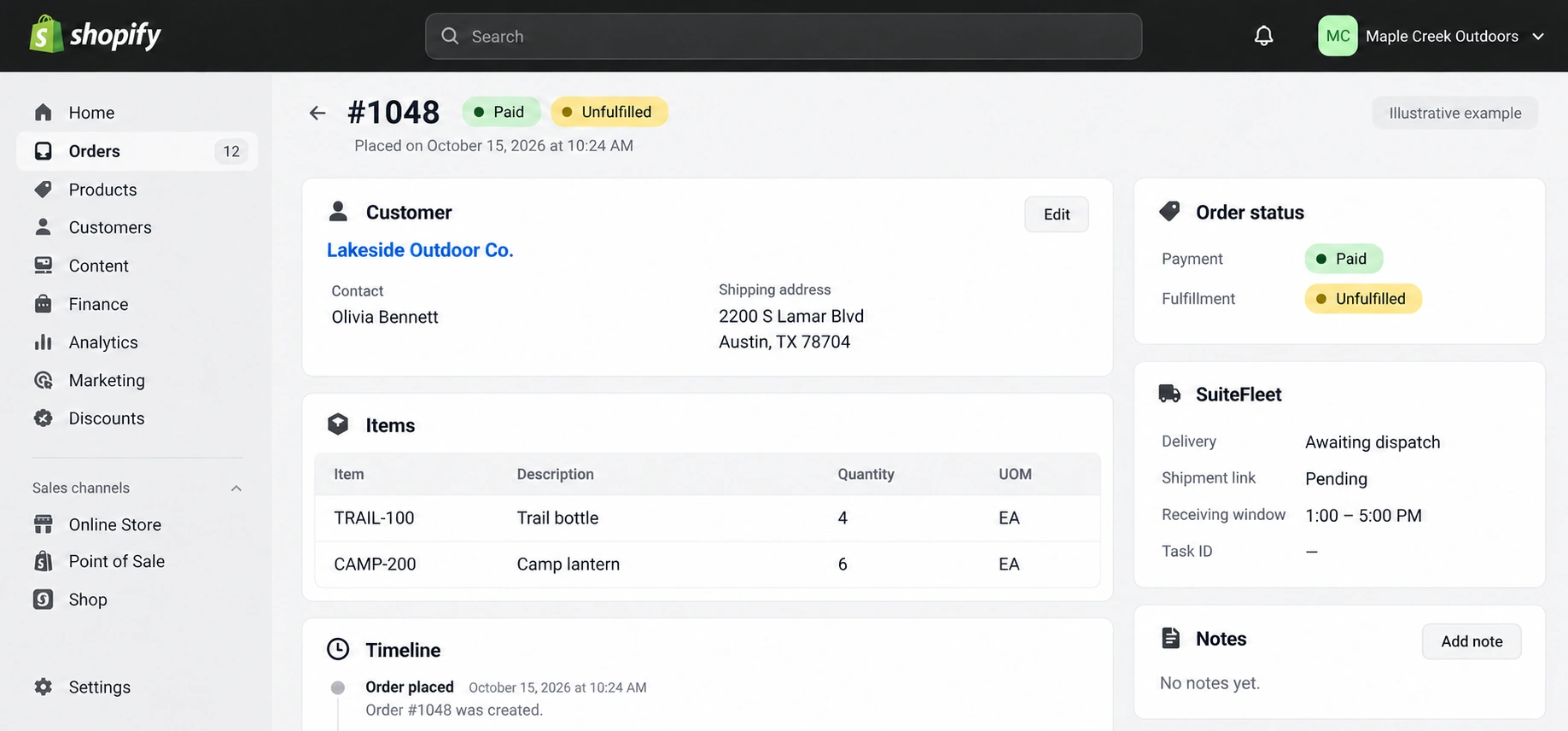
Open the source order #1048 for Lakeside Outdoor Co. and inspect its delivery destination, line quantities, and configured SuiteFleet relationship. The example contains two lines with quantities 4 and 6 in the units shown.
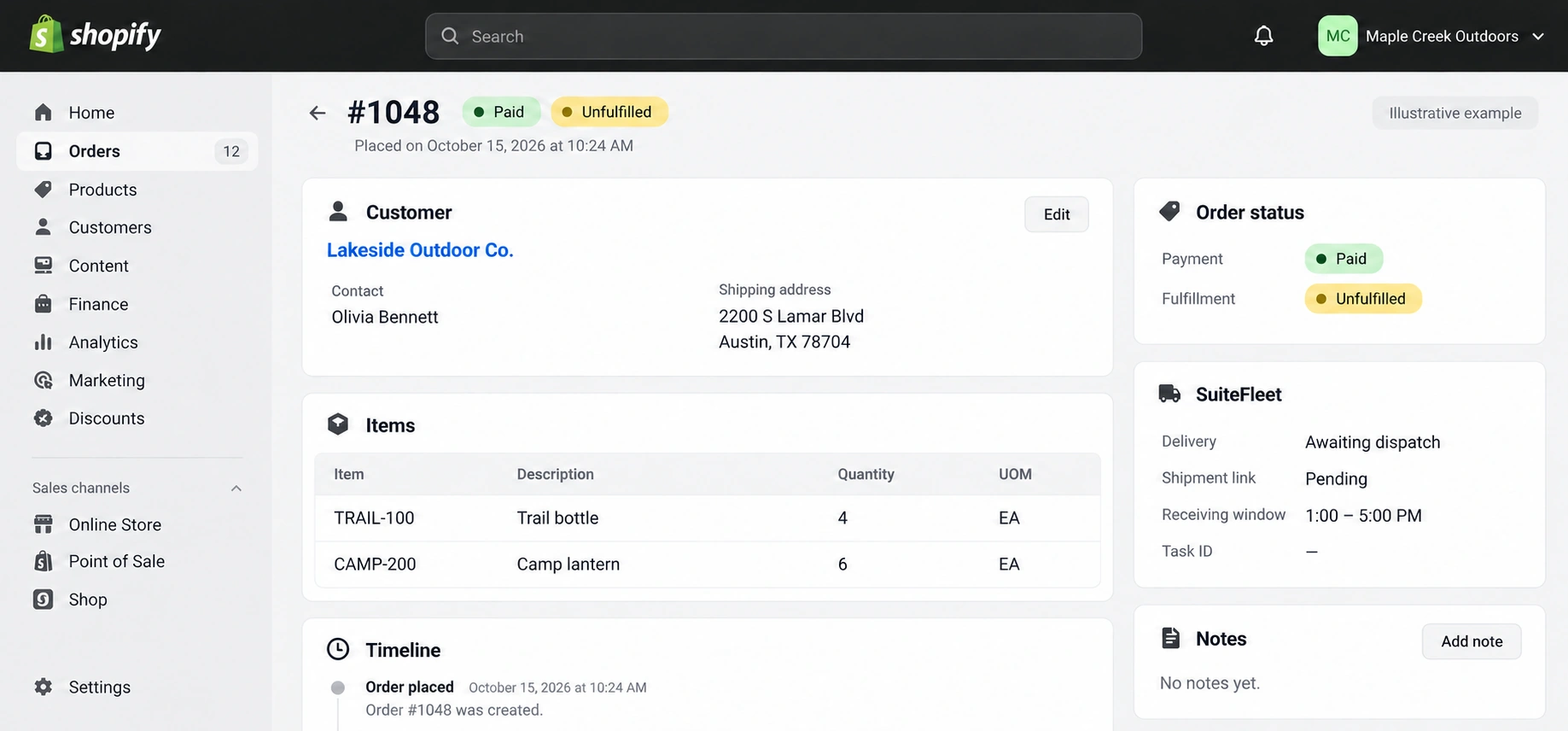
Select an open order with eligible unfulfilled physical items. Check payment or credit policy, fraud review, fulfillment holds, and assigned location before release. Do not dispatch a held, canceled, or not-yet-due scheduled fulfillment order.
Shopify can split one order into several fulfillment orders and locations. Preserve the fulfillment-order line IDs and explicit quantities when creating a fulfillment. Moving work between locations or splitting it after export changes the assignment; the connector must reconcile that change before dispatch. Shopify order statuses.
2. Configure the field mapping
Preserve this relationship before exporting delivery work:
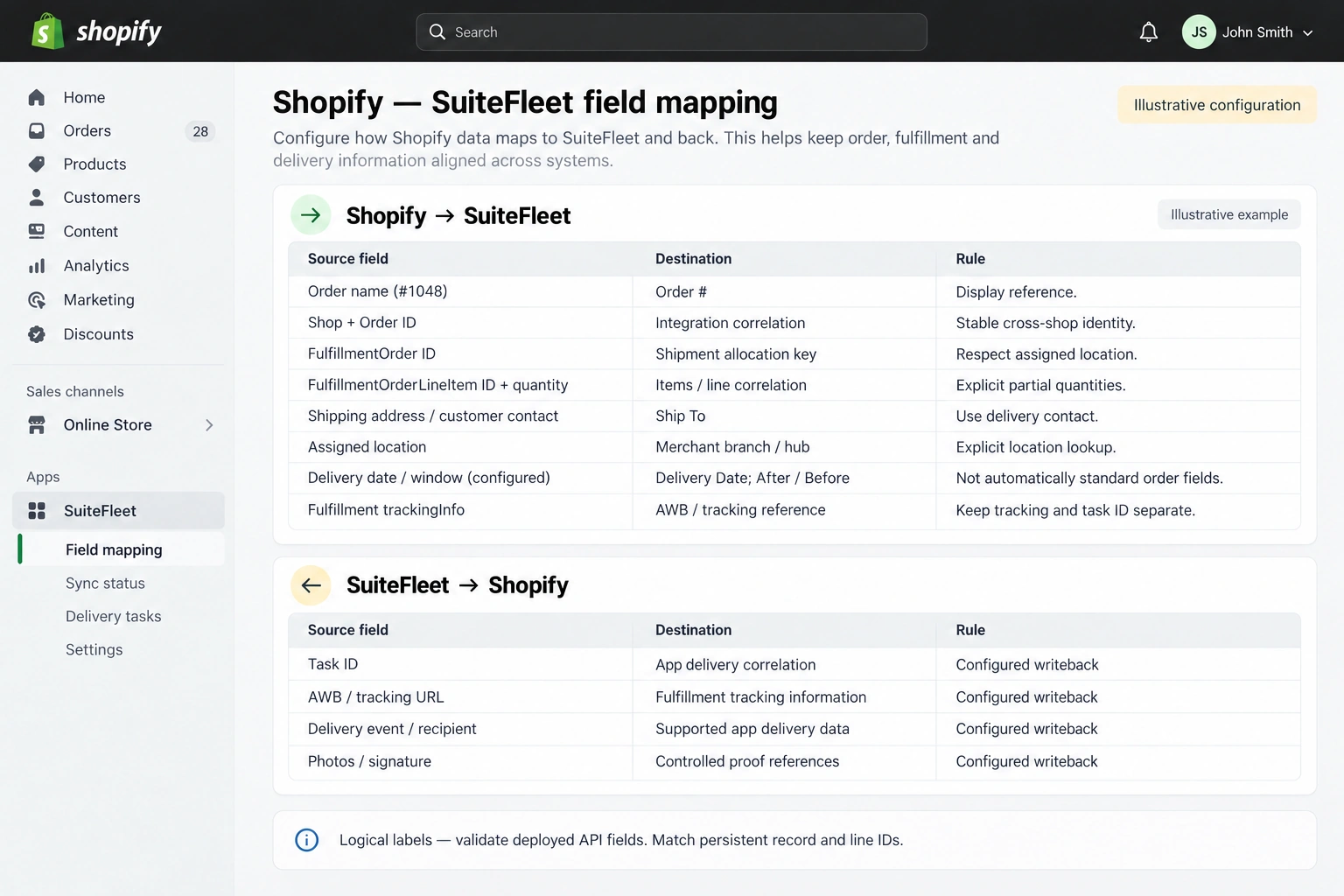
| Shopify source | SuiteFleet destination | Rule |
|---|---|---|
| Order name (#1048) | Order # | Display reference. |
| Shop + Order ID | Integration correlation | Stable cross-shop identity. |
| FulfillmentOrder ID | Shipment allocation key | Respect assigned location. |
| FulfillmentOrderLineItem ID + quantity | Items / line correlation | Explicit partial quantities. |
| Shipping address / customer contact | Ship To | Use delivery contact. |
| Assigned location | Merchant branch / hub | Explicit location lookup. |
| Delivery date / window (configured) | Delivery Date; After / Before | Not automatically standard order fields. |
| Fulfillment trackingInfo | AWB / tracking reference | Keep tracking and task ID separate. |
| SuiteFleet result | Shopify destination | Writeback rule |
|---|---|---|
| Task ID | App delivery correlation | Confirm field access during configuration. |
| AWB / tracking URL | Fulfillment tracking information | Confirm field access during configuration. |
| Delivery event / recipient | Supported app delivery data | Confirm field access during configuration. |
| Photos / signature | Controlled proof references | Confirm field access during configuration. |
Shopify documents the GraphQL Admin API fulfillmentCreate operation and trackingInfo. Specify the selected fulfillment-order line items and quantities; omitting the line list can fulfill all remaining items. Fulfillment-order scopes and assigned-location permissions must match the app’s role. Shopify fulfillment solutions.
3. Create and verify the SuiteFleet task
Send only the released shipment allocation through the configured interface. Store the returned task ID before reporting successful export. If the request times out, check for an existing task under the persistent shipment key before retrying creation.
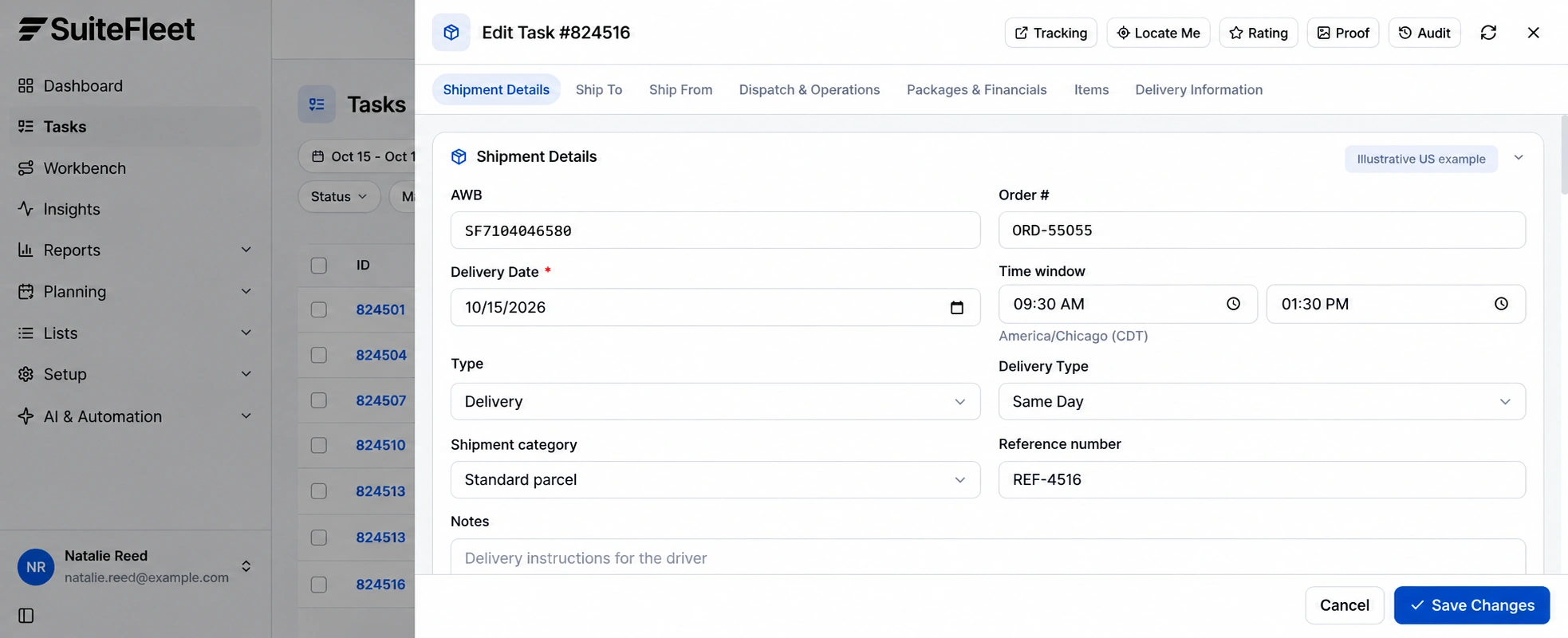
Compare Ship To, Items, delivery date, receiving window, and instructions with Fulfillment F-1048-1. Preserve item units independently from package count. A package quantity of one can contain several product units; neither value should silently replace the other.
Treat unmapped origins, missing contacts, and invalid addresses as actionable exceptions. Record the failing record key and field so the responsible user can correct the source and retry without re-entering the entire order.
4. Dispatch and manage exceptions
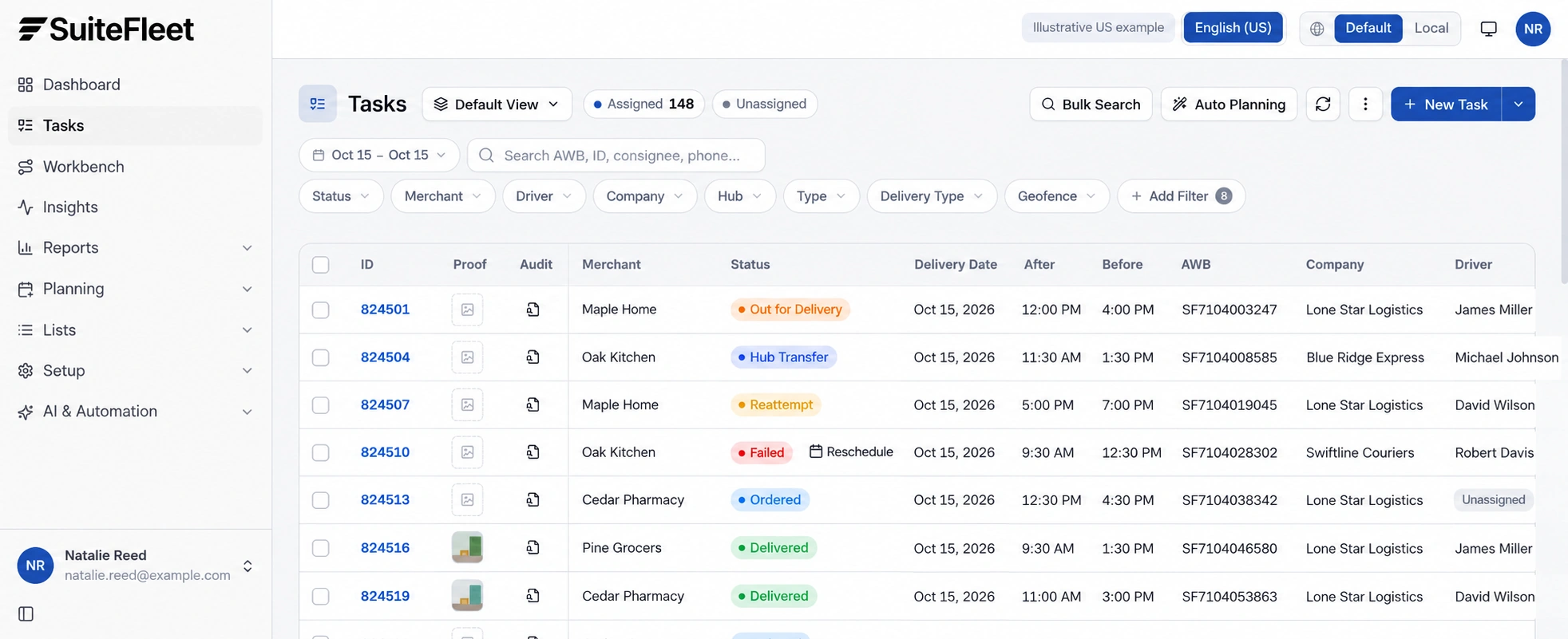
Use Tasks to filter operational work and open Dispatch & Operations to review Company, Driver, and Hub. Agree whether the connector or dispatcher owns each field; order updates should not silently overwrite an active driver assignment.
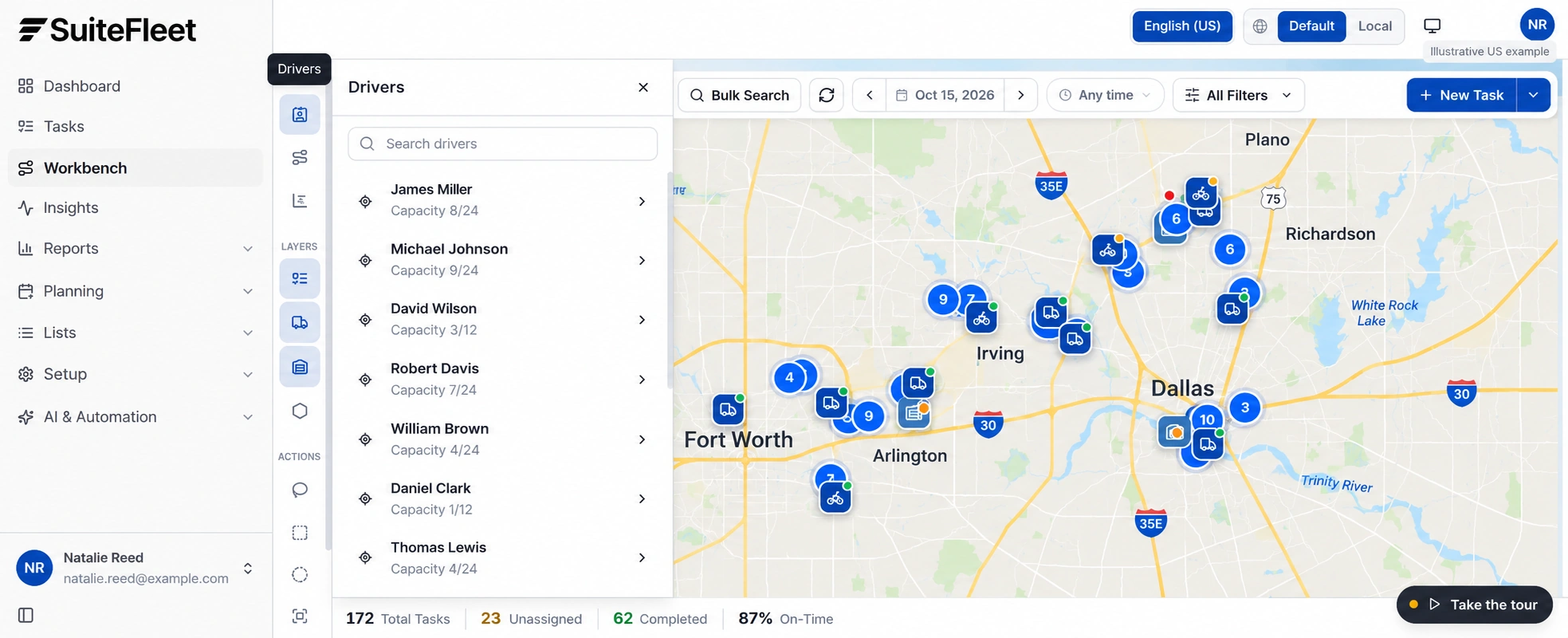
Workbench adds a geographic view of tasks and drivers. Inspect unresolved locations before dispatch and confirm that the driver can meet the receiving window. Keep route planning subordinate to actual release eligibility and warehouse readiness.
One fulfilled shipment must not hide another unfulfilled group in the same order. If only 4 of 10 units are released, keep the other 6 outstanding and retain a separate task and fulfillment relationship for the later shipment.
For a failed or rescheduled stop, retain the attempt, reason, and original shipment relationship. Decide whether the next action is redelivery, return handling, address correction, or customer contact before creating more work.
5. Review delivery before writeback
On completion, match the result to the stored task and shipment identifiers. Review recipient and required proof, then reconcile accepted quantities at source-line level. Route missing or contradictory evidence for review instead of deriving acceptance from Delivered alone.
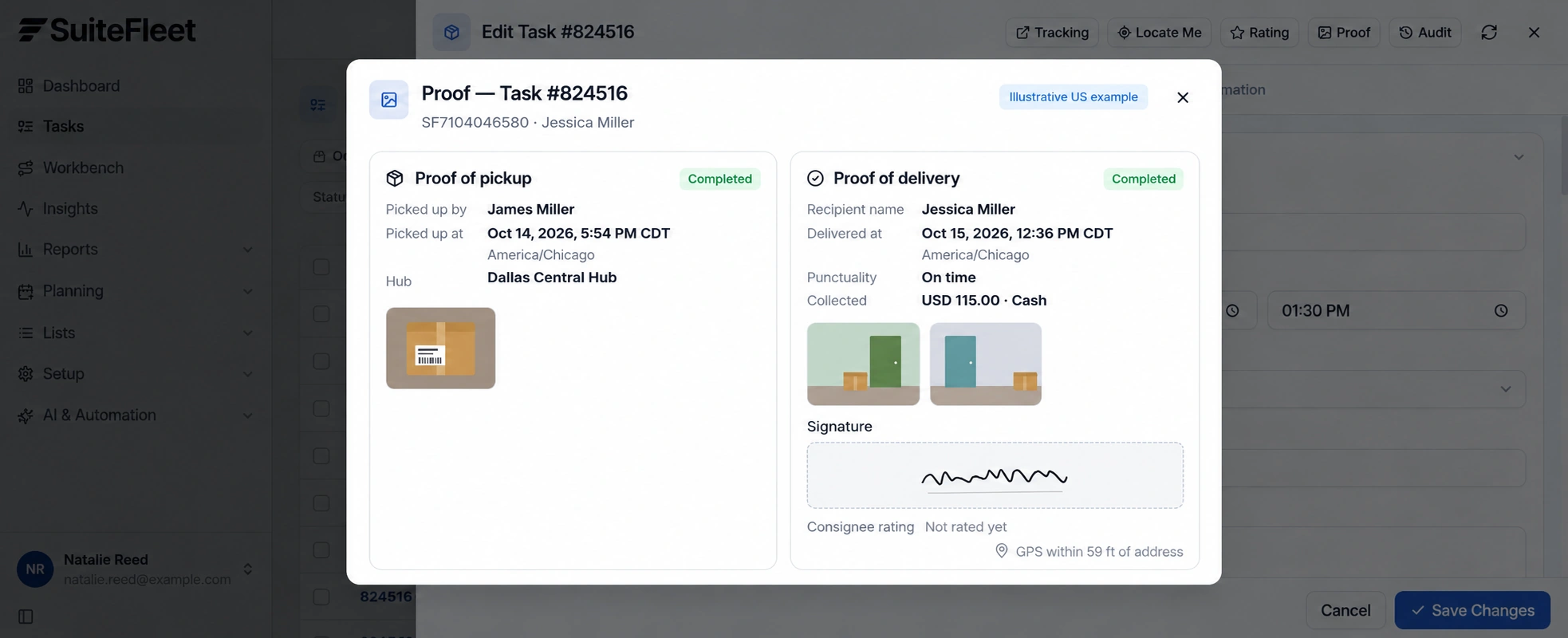
Deduplicate repeated completion messages and preserve event order. Store actual completion time separately from sync time; a later retry must not make an old delivery look newly completed. Keep delivery success and writeback success as distinct audit outcomes.
6. Verify the result in Shopify
Reconcile the appropriate fulfillment and its tracking information. A Fulfilled order reflects shipped items, while a delivered event describes customer receipt. Store proof metadata through the supported integration and verify each fulfillment before concluding the whole order is delivered. Shopify order statuses.
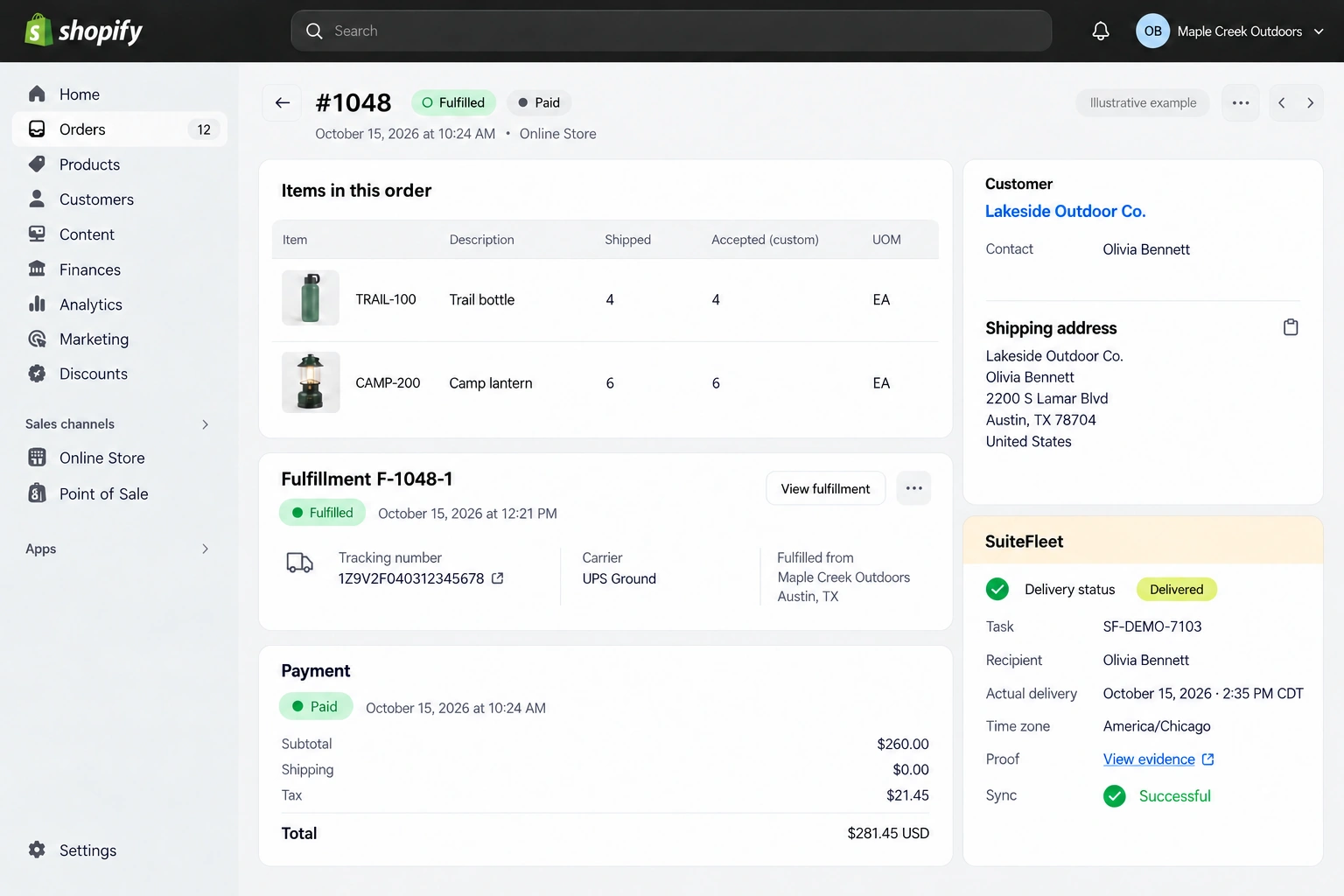
Fulfillment F-1048-1; task SF-DEMO-7103; recipient Olivia Bennett; actual handover October 15, 2026 · 2:35 PM CDT (America/Chicago). First line: 4 shipped and 4 accepted. Second line: 6 shipped and 6 accepted.
Read back the linked record and review every outstanding allocation before marking the full order delivered. Test partial shipment, partial acceptance, failed delivery, duplicate completion, and delayed writeback. Keep inventory posting, receipt evidence, and payment reconciliation under their respective configured rules.
Frequently asked questions
Which Shopify records should link to SuiteFleet?
Shopify can split one order into several fulfillment orders and locations. Preserve the fulfillment-order line IDs and explicit quantities when creating a fulfillment. Moving work between locations or splitting it after export changes the assignment; the connector must reconcile that change before dispatch.
How should delivery completion update Shopify?
Reconcile the appropriate fulfillment and its tracking information. A Fulfilled order reflects shipped items, while a delivered event describes customer receipt. Store proof metadata through the supported integration and verify each fulfillment before concluding the whole order is delivered.




.png)