


The delivery management layer Workday was never built to run — routes, live tracking, and proof of delivery synced back to your financial and workforce data.
Routes, live tracking, and proof of delivery, synced straight into your Workday financial and workforce data.

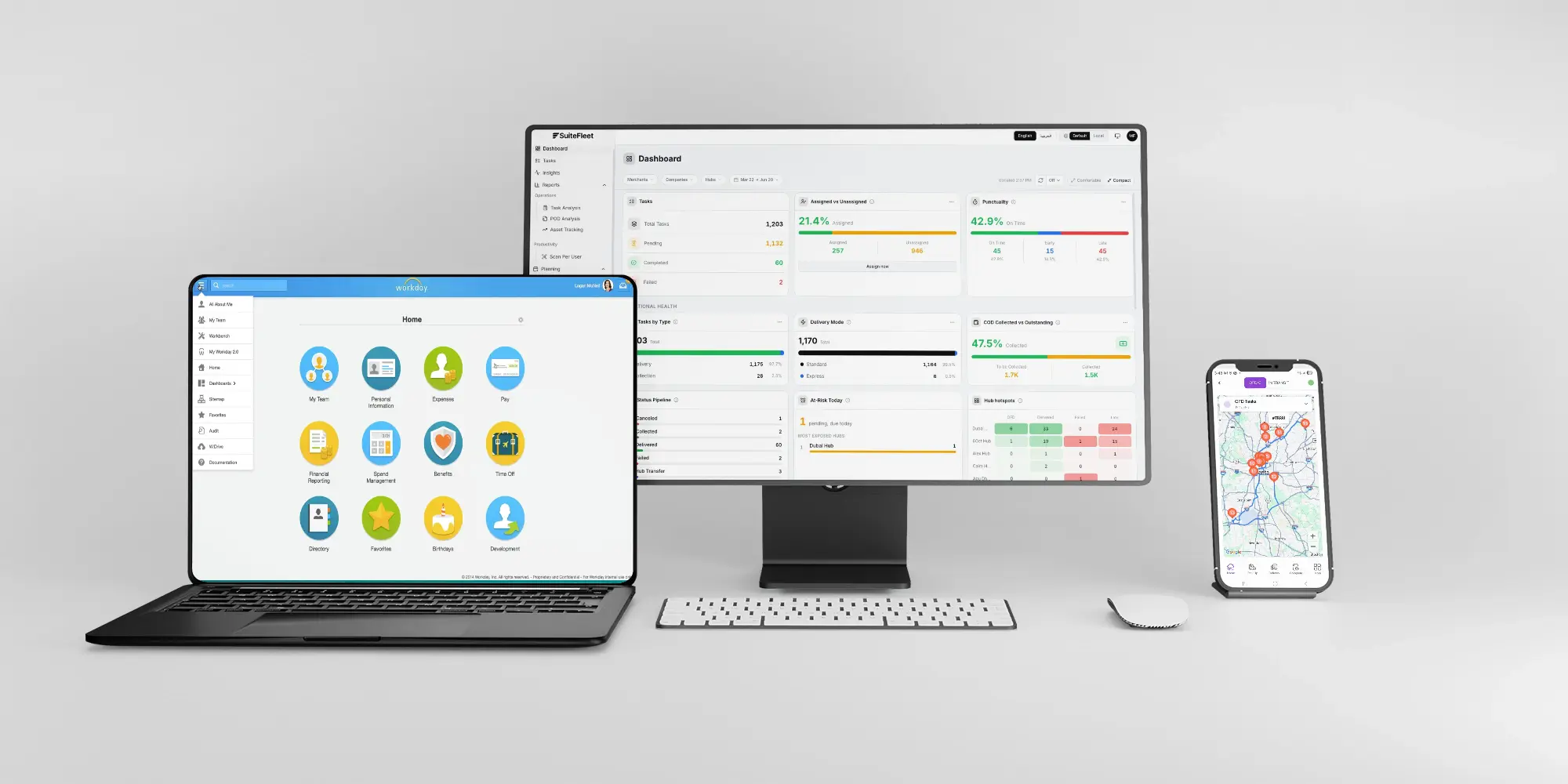
.webp)


Workday is where your financial and workforce data lives. Workday Financial Management delivers enterprise-grade accounting, budgeting, procurement, and expense management. Workday HCM manages the entire employee lifecycle from recruiting through payroll. Together, they give CFOs and CHROs a unified view of financial and workforce performance with real-time precision.
But Workday is a finance and HR system — not an operational logistics platform. The delivery operations your fleet runs every day — routes, drivers, vehicles, fuel, proof of delivery — exist entirely outside Workday. Delivery costs appear in your Workday financial reports as bulk expense entries with no granular breakdown: a single line for "delivery operations" that combines fuel, driver labor, vehicle wear, and failed delivery costs into one number finance teams cannot act on. Driver labor appears in HCM as generic timecard entries with no connection to routes, stops, or delivery performance. How much does each delivery actually cost? Which routes are profitable and which are losing money? How many deliveries did each driver complete per hour? Workday cannot answer any of these questions because the operational data never reaches it.
SuiteFleet is the delivery operations engine that generates the data Workday needs. Every delivery is planned, dispatched, tracked, and confirmed through SuiteFleet. The resulting operational data — cost per delivery, driver hours per route, fuel consumption, on-time rates, fleet utilization — flows into Workday Financial Management and HCM, replacing estimated lump sums with precise, per-delivery financial and workforce intelligence.
What Workday Manages — and What It Cannot
Workday Financial Management is purpose-built for enterprise accounting: general ledger, accounts payable, expense management, procurement, budgeting, and financial reporting. Workday HCM manages hiring, workforce planning, compensation, benefits, time tracking, and payroll. Both systems excel at answering how much things cost and who is doing the work.
Where both stop is the operational delivery itself. Workday has no mechanism for planning delivery routes, dispatching drivers, tracking vehicles via GPS, sending customers ETA notifications, or capturing proof of delivery. It cannot tell you that Tuesday's Route 7 cost 23% more than Monday's because a failed delivery forced a re-attempt. It cannot tell you that Driver A completes 12 stops per hour while Driver B completes 8. It cannot tell you that fuel costs for the eastern zone are 30% higher because routes aren't optimized. Workday sees the total expense — it cannot see the operational decisions that created it.
For organizations running their own delivery fleet on Workday, that means your most expensive logistics operation is invisible to your financial systems. Delivery budgets are built on historical estimates. Cost overruns are discovered after the fact. Driver overtime is approved without knowing whether it was caused by poor routing or genuine demand. SuiteFleet makes delivery operations visible to Workday for the first time.
What Changes When Workday and SuiteFleet Are Connected
- Granular cost tracking: Cost per delivery, cost per mile, fuel per route, and vehicle operating costs tracked at the stop level and synced to Workday Financial Management cost centers — replacing the single "delivery expense" line item with actionable granular data.
- Route optimization: Delivery stops sequenced by geography, time windows, and driver availability — reducing fuel costs, vehicle wear, and driver hours at the source, directly improving the numbers that reach Workday.
- Intelligent dispatch: Drivers assigned to deliveries based on proximity, capacity, and delivery priority — reducing idle time, unnecessary mileage, and overtime hours that inflate Workday labor costs.
- Driver mobile app: Drivers execute optimized routes with turn-by-turn navigation, stop-level delivery details, and one-tap proof of delivery — while the app automatically logs shift start/end, route duration, and break time for Workday HCM alignment.
- Live fleet visibility: Dispatchers see every driver's real-time GPS position, delivery progress, and dynamic ETA on one console — the same GPS data generates mileage tracking and route data that drives Workday expense allocations.
- Driver time tracking: Automated shift logging, route duration, delivery completion timestamps, and idle time — aligned with Workday HCM time entries for accurate payroll processing without manual timecard reconciliation.
- Rich proof of delivery: Digital signature, geotagged photo, GPS coordinates, and timestamp captured at every stop — providing the confirmation layer that connects delivery operations to Workday financial processes and audit requirements.
- Customer notifications: Automated SMS and email alerts with branded live tracking links — reducing failed delivery attempts and the re-delivery costs that silently inflate your Workday delivery expense reports.
- Delivery analytics for Workday planning: On-time rates, cost per delivery trends, driver utilization, stops per hour, and fleet capacity metrics — feeding Workday budgeting and forecasting with actual operational data instead of historical estimates.
- Overtime intelligence: When driver overtime is triggered, SuiteFleet provides the operational context — was it a routing issue, demand spike, or failed delivery re-attempt? — giving Workday HCM the "why" behind the hours.
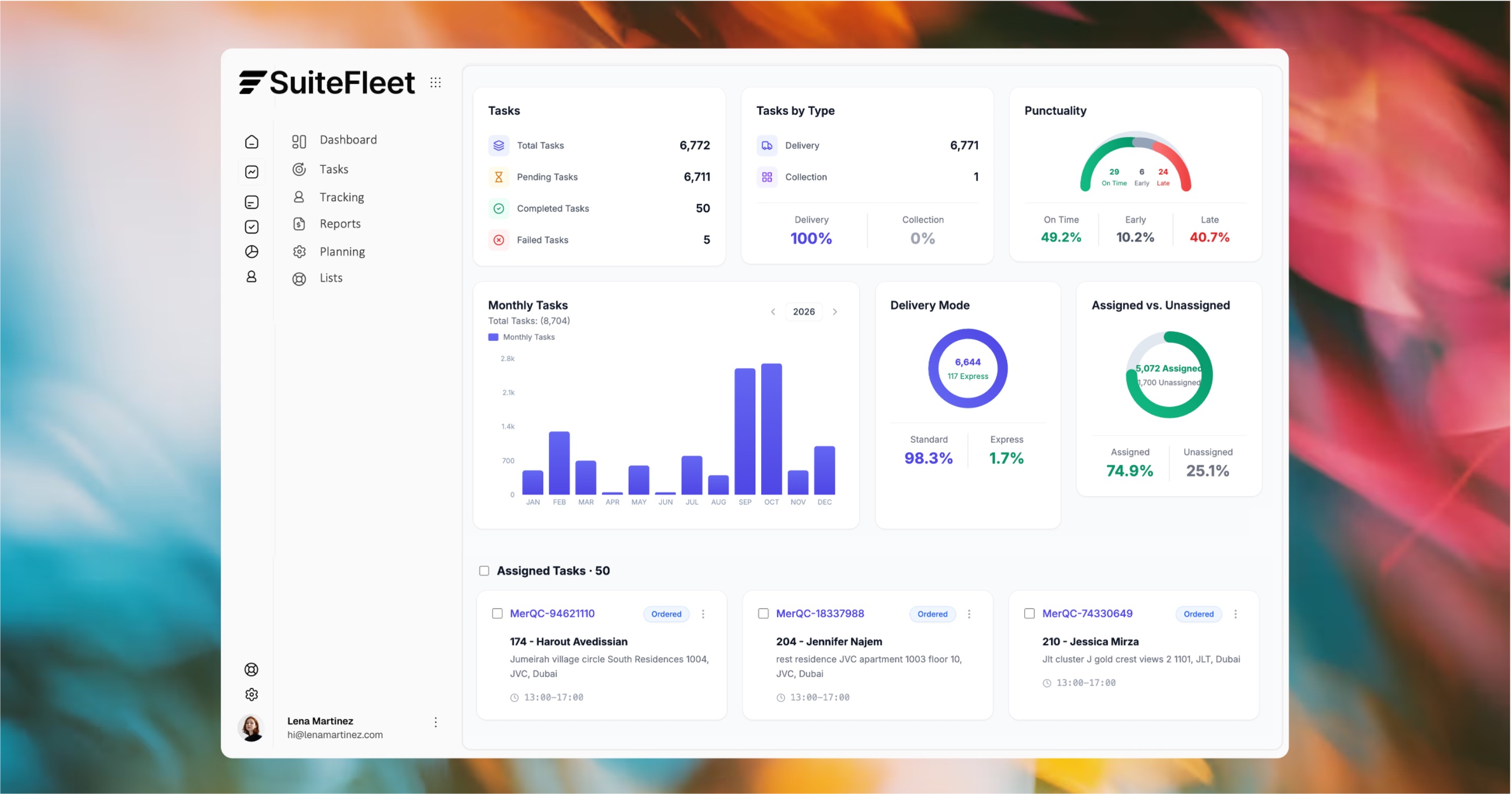

Your Workday delivery data drives real routes.

Who This Is For
SuiteFleet is the right fit for Workday organizations running their own delivery fleet, where delivery costs are a black hole in financial reports and driver labor data lacks operational context.
The fit is strongest for:
- Retailers and e-commerce businesses on Workday running their own delivery fleet, where delivery expenses appear as lump sums in Workday Financial Management with no visibility into cost per delivery, cost per route, or cost per customer
- Healthcare and pharmaceutical distributors on Workday managing time-sensitive, compliance-heavy delivery operations where proof of delivery documentation and delivery cost tracking are essential for audit and financial reporting
- Food service and beverage companies on Workday running daily multi-stop delivery routes, where route optimization directly impacts the fuel and labor costs that flow into Workday
- Manufacturers and distributors on Workday delivering finished goods with their own fleet, where delivery costs are estimated in budgets because no operational system tracks them at the delivery level
- Finance teams using Workday budgeting and forecasting for delivery operations, who build delivery budgets on historical estimates because actual delivery-level cost data never reaches Workday
- HR teams using Workday HCM for driver payroll, who approve timecards and overtime with no visibility into whether labor hours were driven by operational demand or inefficient routing
If your delivery costs are immaterial to your Workday financials, or your deliveries move exclusively through third-party carriers with carrier-provided invoicing, the SuiteFleet-Workday integration may not be necessary. If you run your own fleet and delivery costs are a significant expense line in Workday that no one can break down, SuiteFleet is the operational layer that makes those costs visible and actionable.
Technical Integration Details
- Authentication: Connects to Workday through Workday REST APIs and Workday Integration Cloud, using OAuth 2.0 authentication. Compatible with Workday's standard integration security model.
- Financial data sync: Delivery cost data — cost per delivery, fuel per route, vehicle costs, delivery fees — syncs to Workday Financial Management and maps to your existing chart of accounts, cost centers, expense categories, and project codes.
- HCM data sync: Driver shift data — clock-in/out times, route duration, delivery count, overtime hours, and break time — syncs to Workday HCM for payroll processing, time tracking, and workforce analytics. Aligns with Workday time entry structures for seamless reconciliation.
- Workday Integration Cloud: For organizations using Workday Integration Cloud as their integration middleware, SuiteFleet connects through standard EIB (Enterprise Interface Builder) or custom integrations — maintaining Workday's established integration architecture.
- Cost allocation rules: Configurable mapping between SuiteFleet delivery cost categories and Workday cost centers, departments, or projects. Delivery costs can be allocated by customer, region, product type, or any dimension your Workday financial model requires.
- Proof of delivery for audit: Digital signature, photo, and GPS timestamp records available as supporting documentation for Workday financial transactions — meeting audit trail requirements for delivery expense verification.
- No order sync required: Unlike ERP integrations, the Workday integration is data-out, not order-in. SuiteFleet receives delivery tasks from your order management or ERP system. Workday receives the financial and labor data SuiteFleet generates. Workday does not need to send order or shipment data to SuiteFleet.
How It Works
- Delivery tasks flow into SuiteFleet from your order management or ERP system — Workday is not the order source.
- SuiteFleet plans optimized routes, dispatches drivers, and tracks deliveries in real time — reducing costs at the source.
- Drivers execute routes with turn-by-turn navigation, capturing proof of delivery and generating shift, mileage, and cost data at every stop.
- Dispatchers monitor fleet performance live, re-routing as conditions change and flagging cost exceptions in real time.
- Delivery cost data syncs to Workday Financial Management cost centers. Driver labor data syncs to Workday HCM time entries. Delivery KPIs feed Workday budgeting and forecasting — all automatically.


.jpg)

.png)