Why Every TMS System Evaluation Starts in the Wrong Place
Most TMS system evaluations start with a feature list. A procurement team assembles forty requirements, vendors respond with capability matrices, and the organisation picks the best TMS system with the highest score. The problem: the feature list rarely reflects the specific operational gap the organisation is actually trying to close.
Transportation Management System describes at least four distinct operational functions: planning and procuring freight, executing last-mile delivery, tracking freight in real time, and managing carrier connectivity and cross-border compliance. Each function has dedicated systems built for it. Evaluating a last-mile execution platform on the same matrix as a global freight planning system produces a meaningless comparison.
This guide takes a different approach. It maps ten TMS systems to the function each one is built for, explains the operational conditions where each performs best, and closes with a decision guide organised by situation rather than feature score. No rankings. No ratings. The right TMS system depends entirely on which function you are missing.
The Four Functions of a TMS System
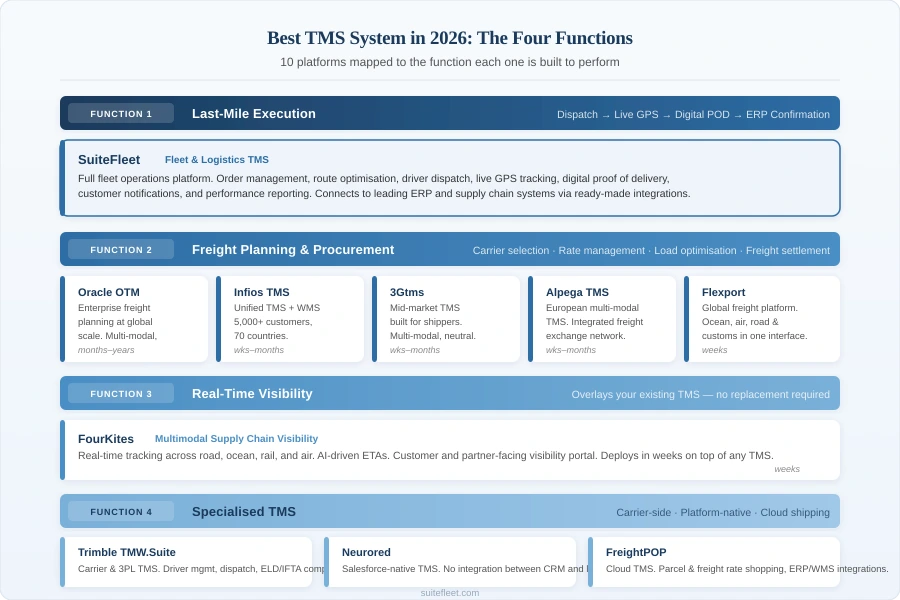
Every platform in this guide falls into one of these categories. Before evaluating vendors, it helps to identify which function your current operation is missing.
Last-Mile Execution
Takes the delivery order from your TMS system or ERP and runs it through to completion — dispatching drivers, optimising routes, tracking vehicles live, and capturing proof of delivery at the door. This is the function that connects a freight plan to the physical handoff at the customer's address. Enterprise freight planning systems leave this layer open by design. SuiteFleet is built for it.
Freight Planning and Procurement
Manages carrier selection, rate negotiation, load tendering, and freight settlement — usually upstream, inside or alongside the ERP. Oracle OTM, Infios TMS, 3Gtms, Alpega, and Flexport operate in this space at different scales and geographies. They plan freight with precision. Once the load is tendered, their involvement typically ends.
Real-Time Visibility
Overlays existing TMS systems and carrier systems to make freight visible in transit — across modes, carriers, and geographies. FourKites operates here. These platforms don't replace a TMS system; they make the one you already have transparent to operations, customer service, and customers.
Specialised: Carrier-Side, Platform-Native, Cloud Shipping
TMS systems built for specific operational contexts that don't fit cleanly into the three categories above: carrier and 3PL operations (Trimble TMW.Suite), organisations running a specific CRM or ERP platform (Neurored on Salesforce), or mid-market shippers needing parcel and freight rate management without an enterprise implementation (FreightPOP).
10 TMS Systems: What Each One Does
LAST-MILE EXECUTION
SuiteFleet Fleet and Logistics TMS
SuiteFleet is the best TMS system for fleet and last-mile delivery execution — managing the complete delivery operation from the moment an order is created to confirmed delivery and reporting. Dispatchers get a single interface to assign drivers, optimize routes dynamically, track every vehicle on a live map, and respond to exceptions in real time. Managers receive end-of-shift performance data pulled directly from the field: completion rates, delivery success rates, driver activity, and customer confirmation without waiting on manual driver reports.
The platform covers order management, route planning and optimisation, driver dispatch, live GPS tracking, digital proof of delivery, and customer notifications as a unified workflow. The entire operation runs through one system, from dispatch to delivery confirmation.
For operations using Oracle NetSuite, Odoo, Shopify, Salesforce, Microsoft Dynamics, and many more systems, SuiteFleet connects through ready-made integration connectors. Orders flow in automatically, and confirmed delivery status is returned to the ERP the same day, closing the loop without a custom integration project or middleware layer.
Core capabilities: Order management, route optimization, driver dispatch, live GPS, digital POD, customer notifications, performance reporting
ERP integration: Ready-made connectors for Oracle NetSuite, Salesforce, Odoo, Microsoft Dynamics, and many more — no custom build required
Deployment: Weeks
FREIGHT PLANNING AND PROCUREMENT
Oracle Transportation Management (OTM) Enterprise Freight Planning
Oracle OTM sets the standard for enterprise freight planning at scale. It manages multi-modal load optimization, carrier rate management, freight settlement, and global trade compliance across networks of significant size and complexity. Organisations handling freight across dozens of carriers, hundreds of lanes, and multiple international modes rely on OTM for the planning layer that determines which carrier moves which load at which rate — and ensures that movement complies with applicable regulations.
OTM's core strength is depth. The platform can model freight networks and rate structures that no mid-market TMS system can match. It connects to Oracle's broader supply chain ecosystem, and through the Oracle Business Network, provides direct access to carriers and logistics providers inside the planning workflow.
The function OTM does not cover natively is last-mile execution. Once a load is tendered, OTM's visibility into the delivery itself is limited. Operations running Oracle OTM and managing their own fleet or last-mile delivery typically add a dedicated execution layer — such as SuiteFleet — to close that gap without replacing OTM.
Planning depth: Multi-modal load optimisation, complex carrier rate modelling, freight settlement, global trade compliance
Network access: Oracle Business Network connects to carriers, trading partners, and logistics providers
Integration: Native Oracle ERP integration across finance, procurement, and supply chain
Deployment: Months to years
Infios TMS Unified Supply Chain Execution TMS
Infios is the supply chain execution platform that emerged from Korber Supply Chain Software's acquisition of MercuryGate in 2024, followed by a full rebrand in March 2025. The result is a TMS system that brings together TMS, WMS, and order management in a single supply chain execution suite — an architecture that gives operations access to transportation planning and warehouse management on the same data model without managing separate vendors for each function.
The TMS component — the former MercuryGate platform — carries forward MercuryGate's strengths in multi-modal freight planning, carrier management, rate management, and load tendering across truckload, LTL, intermodal, and parcel. What Infios adds on top is the integration with warehouse and fulfilment operations that makes it a broader supply chain execution platform rather than a standalone TMS system. With 5,000+ customers across 70 countries, the platform has significant reach across mid-to-large enterprise operations.
For organisations evaluating a mid-market TMS, Infios is now the answer to the question of what MercuryGate has become — and for those who want TMS functionality alongside WMS without a multi-vendor integration project, the unified platform offers a materially different value proposition than buying the two systems separately.
TMS capability: Multi-modal planning, carrier management, rate management, load tendering, freight audit
Unified platform: TMS, WMS, and order management on one platform — acquired MercuryGate's TMS in 2024
Scale: 5,000+ customers across 70 countries as of 2025 rebrand
Deployment: Weeks to months depending on scope
3Gtms Mid-Market Shipper TMS
3Gtms is a TMS system built from the ground up for shippers — companies that move their own freight rather than freight forwarders acting as intermediaries or carriers managing their own fleets. That distinction matters more than it appears: most mid-market TMS systems require customers to work around features built for forwarders or adapt to carrier-side workflows that don't apply to a shipper's operation. 3Gtms eliminates that friction.
The platform covers the core shipper TMS functions — multi-modal load planning, carrier management, rate management, load tendering, shipment tracking, and freight audit — in a package that a mid-size logistics team can configure and operate without deep professional services involvement. It also handles private fleet management alongside carrier freight, which makes it a practical choice for shippers running a mix of owned and contracted capacity.
What 3Gtms trades in exchange for its shipper-first design is depth at the enterprise end: for global freight networks with highly complex carrier contract structures and international compliance requirements, enterprise platforms will outperform it. Within its target segment, however, its configurability and deployment speed are consistent differentiators.
Shipper focus: Built specifically for shippers — not freight forwarders or carriers — eliminating irrelevant functionality
Core coverage: Multi-modal load planning, carrier management, rate management, freight audit, private fleet support
Configurability: Operations teams can configure workflows, carriers, and rate structures without major professional services involvement
Deployment: Weeks to months
Alpega TMS European Multi-Modal TMS
Alpega is the TMS system built around European logistics. It provides the carrier connectivity, rate management, and multi-modal execution capabilities that European manufacturers, retailers, and distributors need to manage road freight, rail, sea, and parcel — with a freight exchange network that gives shippers direct access to spot capacity across European lanes. For organisations managing freight primarily within Europe or across EMEA cross-border lanes, Alpega addresses the regional specificity that global platforms often handle poorly.
The platform's integrated freight exchange — built on the Teleroute and TimoCom carrier networks — is a meaningful differentiator. Rather than connecting to a carrier's system through a general API, Alpega gives European shippers access to a freight marketplace for spot loads directly within the TMS workflow. That combination of contracted carrier management and on-demand spot capacity in one interface reduces the operational overhead of managing separate tools for each.
Alpega is less established outside of Europe. For operations with freight primarily in North America, the platform's regional carrier network and European compliance focus deliver less value than they do for EMEA-based shippers.
Geographic strength: Strongest TMS system for European and EMEA-focused freight operations
Freight exchange: Integrated access to Teleroute and TimoCom carrier networks for spot capacity within the TMS
Multi-modal coverage: FTL, LTL, rail, sea, and parcel all managed from one platform
Deployment: Weeks to months
Flexport Tech-Forward Global Freight Platform
Flexport approaches global freight management differently from traditional TMS systems. Rather than building a freight planning tool that connects to freight brokers and forwarders through integrations, Flexport operates as both the software platform and the freight service — combining a digital interface for managing shipments with the actual execution of ocean, air, road, and customs across international lanes. That combination makes it meaningfully distinct from a software-only TMS system: the data you see in the platform reflects your actual shipment, managed by Flexport, rather than data fed in from external carrier systems.
For organisations that import or export frequently, Flexport's end-to-end visibility across ocean, air, and drayage in one interface addresses the fragmentation that is the normal experience of international freight. Flexport consolidates that into one interface, one data model, and one point of accountability.
Its focus on international freight means it is less suited to domestic distribution operations or private fleet management. For organisations whose primary logistics challenge is international import/export complexity rather than last-mile delivery, it addresses a problem that most domestic TMS systems were not designed to solve.
Global freight: Ocean, air, road, and customs managed end-to-end in one platform
Software and service: Flexport operates the freight as well as provides the platform — one point of accountability across international modes
Visibility: Real-time data across the full international shipment lifecycle from booking to customs clearance
Best fit: Importers and exporters managing significant international freight volume
REAL-TIME VISIBILITY
FourKites Multimodal Supply Chain Visibility
FourKites is a supply chain visibility platform built to answer a single question that most TMS systems cannot answer reliably: where is my freight right now, and when will it actually arrive? It connects to carriers across road, ocean, rail, and air, processes real-time location data, runs predictive ETA models, and delivers that information through an interface that operations teams, customer service teams, and customers can access directly. For enterprises where freight status inquiries are a significant operational overhead, FourKites surfaces the data that eliminates those inquiries.
The platform sits as a visibility layer on top of whatever TMS system is already in place, whether Oracle OTM, Infios, a proprietary system, or no formal TMS at all. It doesn't require changes to the underlying planning system. It reads data from carriers and augments it with machine learning models trained on historical carrier performance, weather, traffic, and port conditions — producing ETAs that are more accurate than carrier-reported estimates.
FourKites also offers a supply chain collaboration layer that extends beyond tracking: customers and trading partners can be given direct access to shipment status without requiring them to call operations. For logistics teams dealing with high volumes of customer status enquiries, that self-service capability alone recaptures meaningful operational time.
Visibility coverage: Real-time tracking across road, ocean, rail, and air carriers worldwide
Predictive ETAs: Machine learning models that incorporate carrier performance patterns, weather, traffic, and port conditions
Collaboration: Customer and partner-facing visibility portal — reduces status inquiry volume to operations teams
Deployment: Weeks — overlays existing TMS without requiring changes to the underlying system
SPECIALISED: CARRIER TMS | PLATFORM-NATIVE TMS | CLOUD SHIPPING TMS
Trimble TMW.Suite Carrier and 3PL TMS
Trimble TMW.Suite is the TMS system built for the carrier side of the freight industry. Where every other platform on this list serves the shipper — the organisation tendering freight to carriers — TMW.Suite serves the carrier: the trucking company, the private fleet operator, or the third-party logistics provider running their own assets and drivers. Its scope covers the full carrier operation, from load planning and dispatch through driver management, ELD and IFTA compliance, settlements, and business intelligence.
Trimble's acquisition of TMW Systems brought together TMW.Suite's carrier TMS capability with Trimble's broader transportation technology portfolio, which includes telematics, mapping, and routing. That integration gives TMW.Suite customers access to vehicle intelligence data — driver behaviour, fuel consumption, maintenance alerts — alongside freight operations data in a way that most standalone TMS systems cannot replicate.
For organisations evaluating the carrier side of TMS, TMW.Suite represents a platform that was built to run a transportation company rather than to manage freight procurement. The distinction determines whether it belongs in an evaluation at all — if the organisation is a shipper, it is the wrong tool. If it is a carrier or 3PL running its own fleet, it is purpose-built for exactly that.
Carrier operations: Load planning, dispatch, driver management, load board, freight brokerage
Compliance: ELD, IFTA, HOS — built for regulatory compliance in asset-based trucking operations
Telematics integration: Connected to Trimble's vehicle intelligence platform for driver behaviour, fuel, and maintenance data
Best fit: Trucking carriers and 3PLs managing their own fleet operations
Neurored Salesforce-Native TMS
Neurored is built on a structural premise that no other TMS system on this list shares: it runs natively on the Salesforce platform. That means it is not integrated with Salesforce — it is Salesforce, extended to manage transportation and supply chain. Customer data, account data, sales pipeline data, and logistics data share the same objects, the same database, and the same user interface. There is no middleware, no data synchronisation project, and no translation layer between the CRM and the TMS.
For organisations that manage freight as part of a broader customer relationship — where sales and logistics teams need to see the same data about the same customer — Neurored's architecture eliminates a category of friction that conventional TMS integrations never fully resolve. A sales representative can see the status of a customer's active shipment in the same interface they use to manage the account. A logistics manager can see the customer's tier and contract terms without leaving the TMS workflow.
Neurored's trade-off is the same as any platform-native solution: its value is highest for organisations already running Salesforce as their core CRM. For organisations not on Salesforce, the platform's architecture is a constraint rather than an advantage, and the freight planning and execution capabilities alone do not differentiate it sufficiently to justify a Salesforce adoption solely for the TMS.
Platform architecture: Runs natively on Salesforce — no integration layer between CRM and logistics data
TMS capability: Shipment planning, carrier management, load tracking, freight optimisation, supply chain visibility
Best fit: Salesforce customers who want logistics and customer relationship data on one platform
Deployment: Weeks for Salesforce customers — faster than external TMS integrations
FreightPOP Cloud Mid-Market TMS
FreightPOP is a cloud-based TMS system built specifically for the operational reality of mid-market shippers: managing parcel and freight side by side, connecting to multiple carriers without negotiating EDI projects with each one, and integrating with existing ERP and WMS systems without a multi-month implementation. It handles rate shopping across carriers, booking, shipment tracking, and freight audit from a single platform — covering both parcel shipments and LTL/truckload freight in one interface, which most TMS systems handle poorly.
Its integration library is a practical differentiator. FreightPOP connects to major ERP systems — including NetSuite, SAP, and Oracle — and to WMS platforms, giving operations the ability to pull shipment data in and push status updates out without building custom integrations. For companies that have recently grown beyond spreadsheet-based shipping and need to get a TMS system running quickly without a systems integration project, that connectivity shortens deployment significantly.
FreightPOP targets mid-market operations specifically. It is not designed for the freight complexity of enterprise TMS deployments — global multi-modal networks, highly customised carrier contract structures, and enterprise-scale compliance requirements are beyond its scope. Within its target segment, its combination of deployment speed, multi-mode coverage, and ERP connectivity is a practical match for the most common mid-market TMS problem.
Multi-mode coverage: Parcel and freight (LTL, truckload) in one platform — a combination most TMS systems handle separately
Carrier connectivity: Multi-carrier rate shopping without individual EDI negotiations for each carrier
ERP/WMS integrations: Pre-built connections to NetSuite, SAP, Oracle, and major WMS platforms
Deployment: Weeks — significantly faster than enterprise TMS timelines
TMS System Comparison at a Glance
Finding the Right TMS System for Your Operation
The right TMS system depends on which function you need — not on analyst rankings or feature matrices. Use this guide to match your operational situation to the TMS system built for it.
The Last-Mile Gap That Most TMS System Evaluations Miss
There is a structural gap in most freight planning TMS deployments that rarely appears on the evaluation scorecard. Enterprise TMS systems — Oracle OTM and its contemporaries — were designed to manage freight procurement. They plan loads, select carriers, manage rates, and tender freight with precision. What happens after the freight is tendered — the actual delivery to the end address — is outside the design specification of those platforms.
For organisations running a private or contracted delivery fleet, that gap is where the operation lives. Drivers make stops. Customers aren't home. Deliveries are refused. Routes run over time. None of that is visible in Oracle OTM. None of it flows back to the ERP automatically. The plan and the execution exist in separate worlds, and the reconciliation between them happens through phone calls, messaging apps, and end-of-day driver reports.
SuiteFleet is built specifically for that execution layer. It connects to your existing systems, picks up where the freight planning TMS ends, dispatches drivers, tracks every vehicle in real time, captures digital proof of delivery at the door, and returns confirmed delivery status to the ERP the same day. The combination of a freight planning platform and a last-mile execution TMS system is what a complete operation looks like.
Frequently Asked Questions
What is the best TMS system in 2026?
There is no single best TMS system — the right platform depends on which operational function you are missing. SuiteFleet is the best TMS system for last-mile delivery execution and own-fleet dispatch. Oracle OTM is the best TMS system for enterprise freight planning at scale. FourKites is the best TMS system for real-time freight visibility. FreightPOP and 3Gtms are the best TMS systems for mid-market shippers. This guide maps all 10 options to the function each one is built for.
What is a TMS system used for?
A TMS system (Transportation Management System) is software used to plan, execute, and optimize the movement of goods. Depending on the platform, a TMS system can handle freight planning and carrier selection, last-mile delivery execution, real-time shipment visibility, carrier connectivity, cross-border compliance, or a combination of these functions. Most businesses need a TMS system that addresses a specific gap in their existing logistics operation rather than a single platform that covers everything.
What is the difference between a TMS system and an ERP for logistics?
An ERP manages core business processes — finance, inventory, orders, and procurement. A TMS system manages the physical movement of goods — routes, carriers, drivers, and deliveries. Most ERPs include limited TMS functionality, which is why businesses add a dedicated TMS system for delivery execution, freight planning, or visibility. The best TMS systems integrate bidirectionally with the ERP so logistics data flows back into financial and inventory records automatically.
Which TMS system is best for last-mile delivery?
SuiteFleet is the strongest TMS system for last-mile delivery and own-fleet dispatch. It covers route optimization, driver dispatch, live fleet tracking, proof of delivery capture, and customer notifications — all connected to your existing ERP via ready-made integrations for Oracle NetSuite, Salesforce, SAP, Shopify, Odoo, and Microsoft Dynamics. Implementation typically takes 2 to 4 weeks.
How long does a TMS system implementation take?
It depends on the TMS system and integration scope. Last-mile execution platforms like SuiteFleet typically deploy in 2 to 4 weeks using ready-made connectors. Mid-market TMS systems like FreightPOP and 3Gtms typically take weeks to months. Enterprise TMS systems like Oracle OTM require months to years depending on network complexity, carrier contract structure, and integration scope. Always confirm deployment timelines with vendors before signing a contract.
What TMS system works with Oracle NetSuite?
SuiteFleet is the most deeply integrated TMS system for Oracle NetSuite. It connects natively without middleware, covers route optimization, driver dispatch, live fleet tracking, and digital proof of delivery, and writes delivery outcomes back to NetSuite records automatically. FreightPOP and Shipwell also integrate with NetSuite for multi-carrier shipping and freight visibility use cases.
See SuiteFleet in Your Environment
SuiteFleet is the TMS system built for the execution layer that enterprise freight planning platforms leave open. It connects to your existing systems, dispatches drivers, tracks every vehicle in real time, and returns confirmed delivery status to your ERP the same day.
Book a free demo today to see exactly how SuiteFleet closes the last-mile execution gap in your existing system environment.