A beverage delivery promise is a window that closes before the doors open. In Texas it also ends with payment, because beer has to be paid for in cash or a cash equivalent on or before delivery. For a keg account, the empties have to come back on the same truck.
It is 1:35 on a Friday afternoon in Austin, Texas. A music venue on Red River Street ordered four half-barrel kegs, two sixth-barrels, and 12 cases of beer for tonight's show, to arrive between 2:00 and 4:00 p.m., well before doors open at 6:00. The order is staged at the distributor's Austin warehouse, one of 30 orders in this afternoon's wave for bars, restaurants, and venues downtown, in East Austin, and along South Congress. Three keg trucks with liftgates leave the warehouse at 1:45.
Someone has to decide which truck takes which accounts, how to split the heavy keg stops so no driver lifts far more than the others, which stops collect a check at the door, and how the office will prove that every invoice was signed, every beer order was paid, and every empty keg came back.
That is the job of delivery management for beverages. SuiteFleet brings delivery windows, dispatch planning, route optimization, handling notes, payment at delivery, and proof of pickup and delivery into one workflow, so a beer and beverage distributor can plan each wave around its accounts' windows instead of around whichever truck is free.
Let's follow Rachel Kemper, the operations manager at Pecanwood Beverage Co., a fictional beer and beverage distributor with two warehouses and two depots in metro Austin, through a worked example. The screens are beverage demo illustrations; names, addresses, maps, and figures are examples.
Start from the account's window, not the truck's route
Beer distribution is account work. In the National Beer Wholesalers Association's Distributor Productivity Report summary, a typical distributor in the survey serves more than 1,200 retail accounts, 55% of them on-premise accounts such as bars and restaurants, with more than 5,500 tap handles pouring draft beer, 34 driver routes a week, and over 1,100 SKUs across 280 brands. NBWA's industry fast facts put draft beer at 9% of beer sold in 2023 and cans at 60%, so most stops are cases, and the stops with kegs are the heaviest.
In the example, every account gets a two-hour window. Sales reps take pre-sell orders the day before, standing weekly orders repeat, and same-day add-ons and rush orders arrive during the morning. Early-route trucks leave at 5:30 a.m. for convenience stores, grocers, liquor stores, and bars that receive before lunch. Day-route trucks cover the rest of the metro, and an afternoon keg wave serves the downtown venues and bars that need product before the evening.
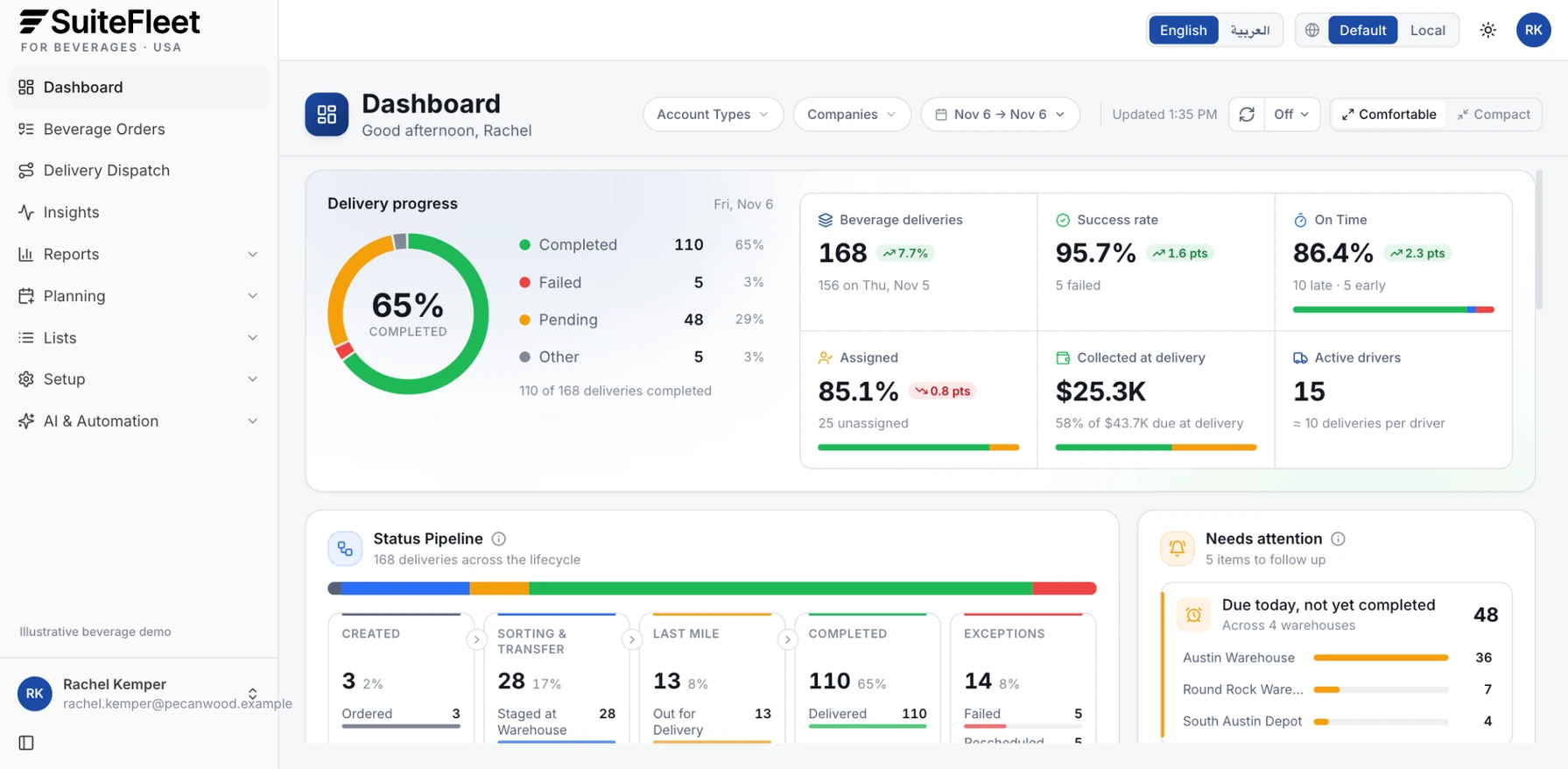
The operations manager starts with the day as a whole. The dashboard shows 168 beverage deliveries: 110 completed, 5 failed, and 48 still due across the four sites, 36 of them at the Austin warehouse. Twenty-five deliveries are still unassigned, most of them waiting for the afternoon wave. Because beer in the example is paid for at or before delivery, the dashboard also shows $25.3K collected at delivery so far, 58% of the $43.7K due at delivery today.
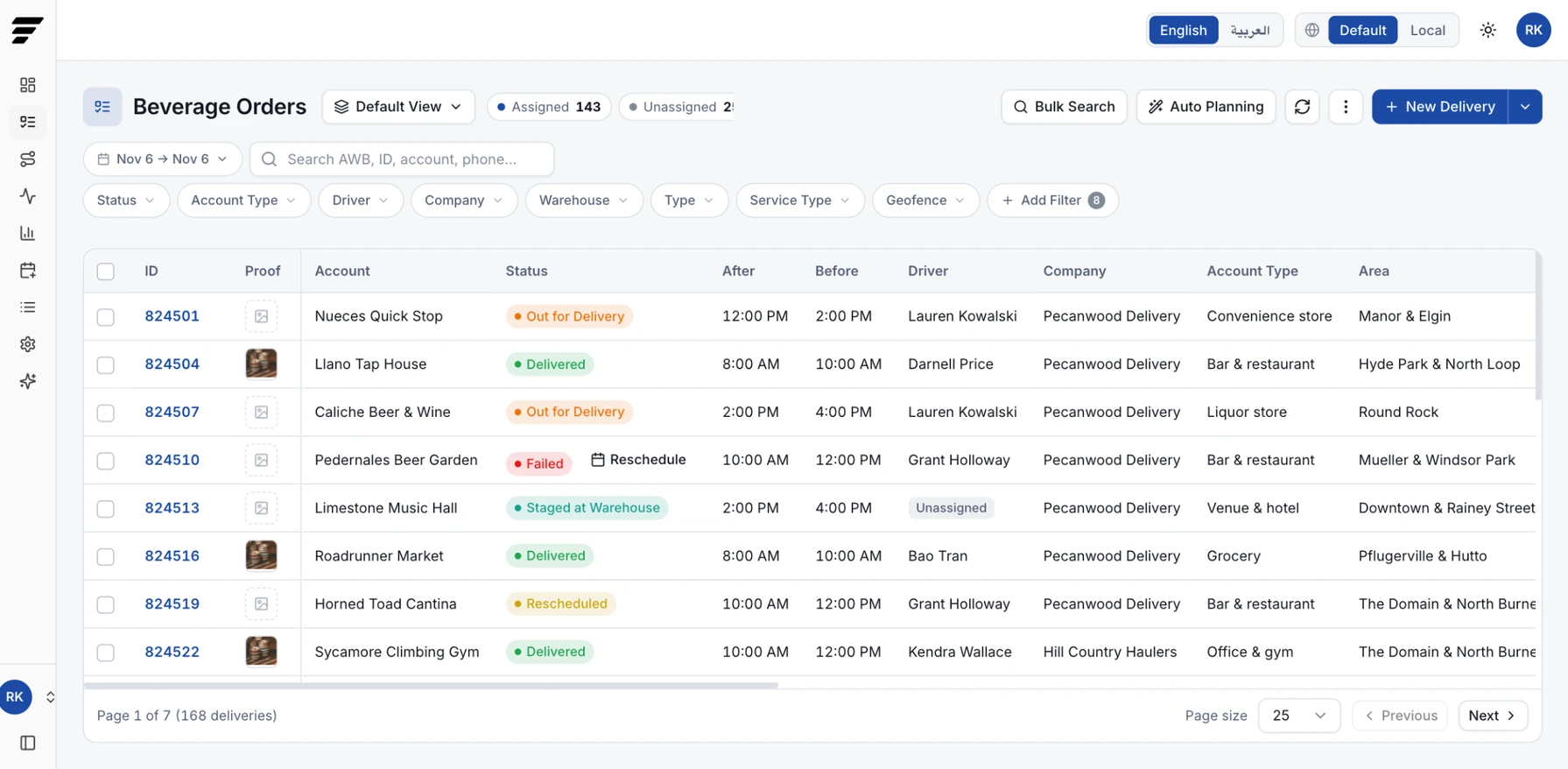
SuiteFleet's delivery list keeps the account, status, window, driver, company, account type, and area in the same view. The company column separates Pecanwood's own trucks from two contract carriers that, in the example, carry only non-alcoholic orders such as water and soft drinks for offices and gyms. The Red River Street venue, Limestone Music Hall, sits near the top of the list, staged at the warehouse for its 2:00 to 4:00 p.m. window and still unassigned.
Put kegs, cases, empties, and payment on the same order
A keg order is three jobs at one stop: deliver the full kegs, collect the empties, and settle the invoice. Miss one, and the trouble shows up later as a short keg count at the warehouse, a deposit dispute, or an unpaid invoice that should never have left the truck.
For the venue's order, the operations manager opens the details screen. The service type is Pre-sell order, the window runs from 2:00 to 4:00 p.m., and the handling is Kegs, empties back. The note tells the driver what is on the order and what to do at the door: four half-barrel kegs, two sixth-barrels, and 12 cases of beer; pick up six empty kegs and note the count on the invoice; paid by EFT before delivery, so there is nothing to collect; use the loading door; the bar manager checks the order and signs the invoice. Asset tracking is switched on, so the kegs are followed as reusable assets.
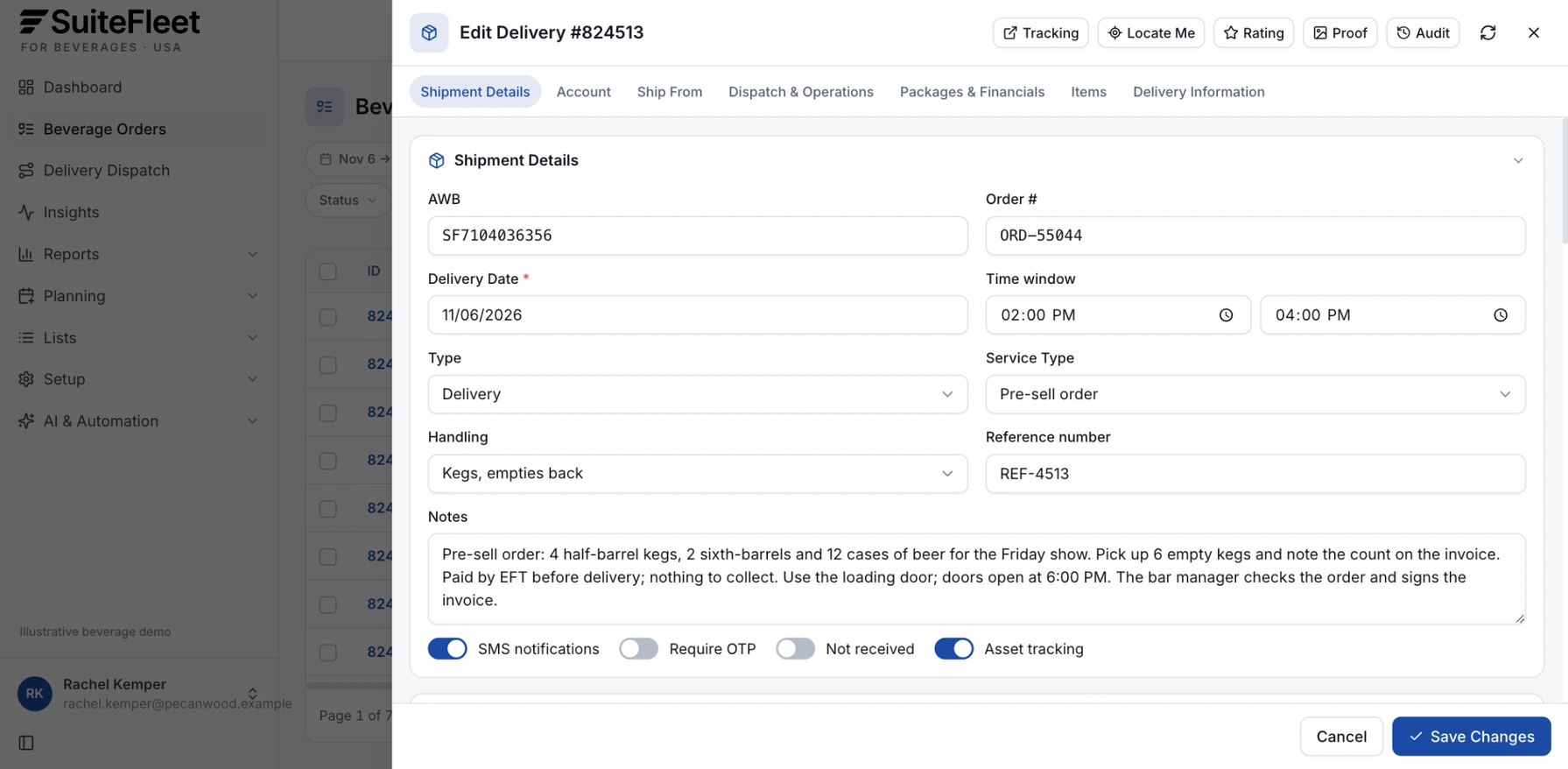
Every delivery in the example carries a handling type (Cases and packs; Kegs, empties back; Pallet drop, liftgate for grocers' docks; or Non-alcoholic only), its kegs, cases, and empties as items, and a payment instruction. Of the day's 168 orders, 99 were paid by electronic funds transfer before delivery, 58 pay at the door by check, cashier's check, money order, or cash, and 11 non-alcoholic office and gym orders go on account. The demo also includes an Asset Tracking report that follows reusable items from dispatch to return, which is where a keg count belongs at the end of the day. The 30 orders in the afternoon wave send out 113 kegs and are due to bring back 115 empties.
Plan the afternoon keg wave from the warehouse
The afternoon wave cannot be planned at 5:00 a.m., because some of its orders are same-day add-ons, and none of them is ready until it is picked and staged. In the example, the Austin warehouse plans its 2:00, 3:00, and 4:00 p.m. windows at 1:35, when the orders are staged and the three keg trucks leave in ten minutes.
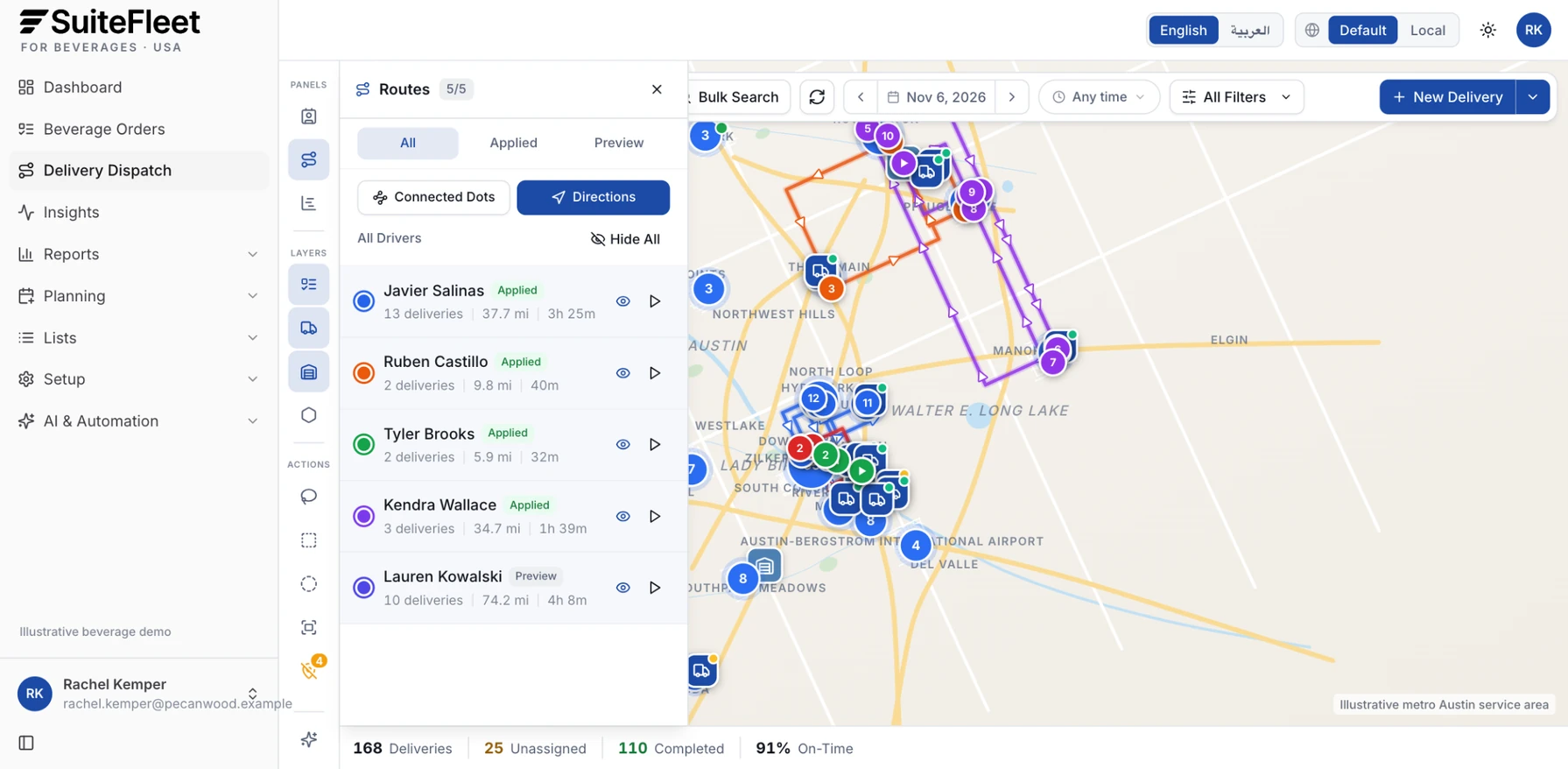
Counting orders hides the real workload. In SuiteFleet's dispatch workbench, each driver's route appears with its delivery count, distance, and duration. In the example, an early-route driver has 13 deliveries over 37.7 miles, a contract carrier's driver has three non-alcoholic deliveries over 34.7 miles, and a day-route driver in the north has a 10-stop preview over 74.2 miles. Two of the keg trucks hold only two staged orders each so far.
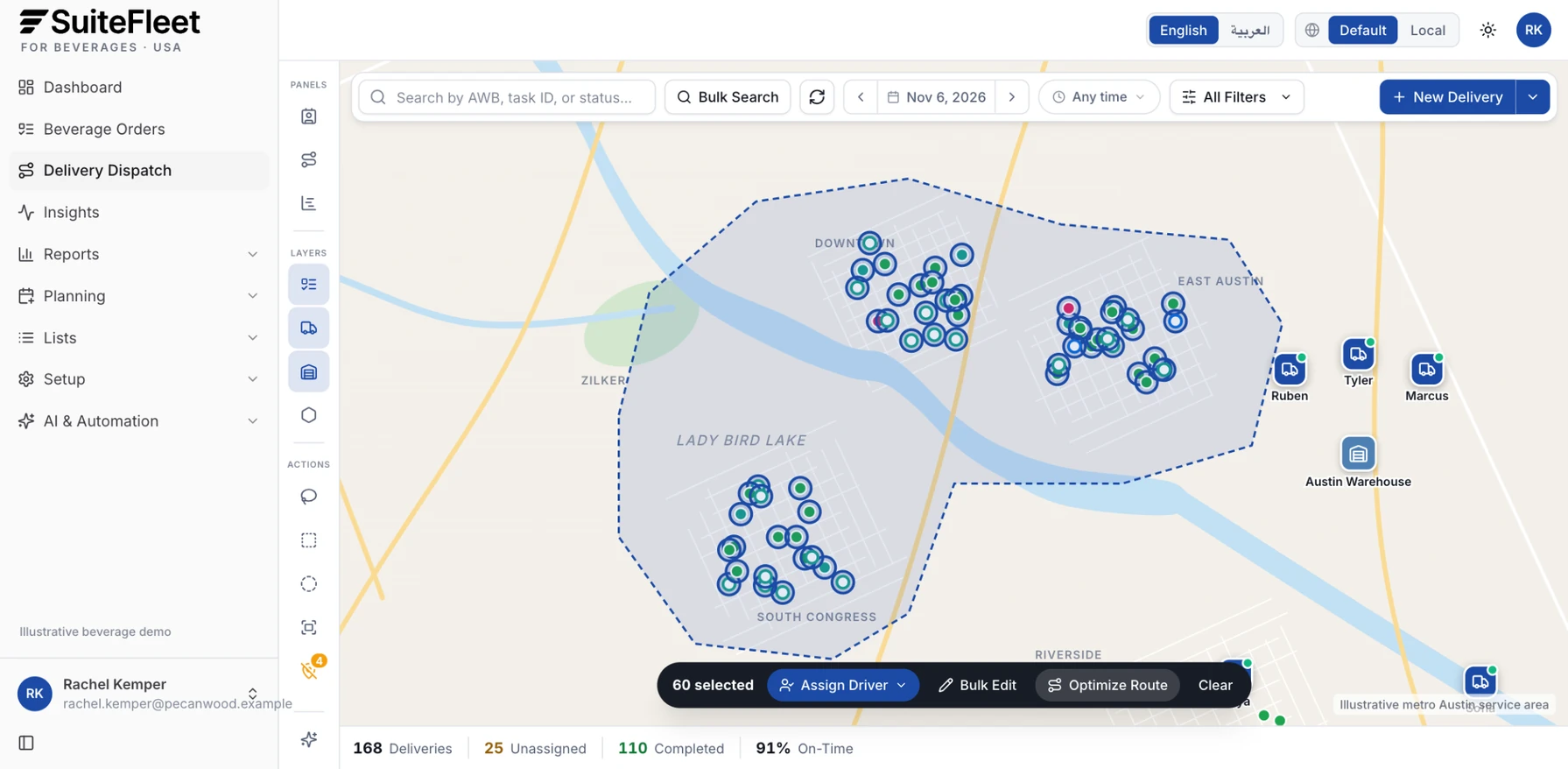
The afternoon wave covers three parts of central Austin: downtown and Rainey Street, East Austin and East Sixth, and South Congress and Bouldin. The operations manager uses the lasso tool to select those deliveries, including the venue's order. The selection bar then offers to assign a driver, edit in bulk, or optimize the route.
Balance the keg stops across three trucks
Of the 60 deliveries selected, 30 can still be planned: 28 staged at the warehouse and 2 still being picked. The optimizer leaves out the 30 morning deliveries that are already delivered or on their way back to the warehouse. The operations manager enables the three keg trucks that start at the Austin warehouse at 1:45 p.m. Each shows 12 of its 14 stops free, the truck's Max Deliveries for this plan, because each already holds two staged orders. She leaves Reassign Assigned Deliveries switched off, so those orders stay on their trucks.
SuiteFleet's optimizer offers four goals: Fastest Completion, Shortest Distance, Fewest Vehicles, and Balanced Workload. The operations manager chooses Balanced Workload, which spreads stops evenly across drivers. On a keg wave, an even split matters more than a few saved miles, because every stop means rolling kegs into a walk-in cooler and loading empties onto the liftgate. She leaves Respect Time Windows switched on and sets the time per stop to 20 minutes instead of the default 10, to allow for unloading, the empty count, the invoice signature, and payment.
The results preview shows three routes, 34.7 miles in total, the last truck back at the warehouse by 5:38 p.m., and no unassigned deliveries. Each truck gets 10 stops in its own part of the wave and works through the windows in order: the 2:00 p.m. stops first, then the 3:00, then the 4:00. The downtown truck covers 12.5 miles, and the venue on Red River Street is its second stop, at 2:20 p.m. The East Austin truck covers 8.7 miles and the South Congress truck 13.5 miles.
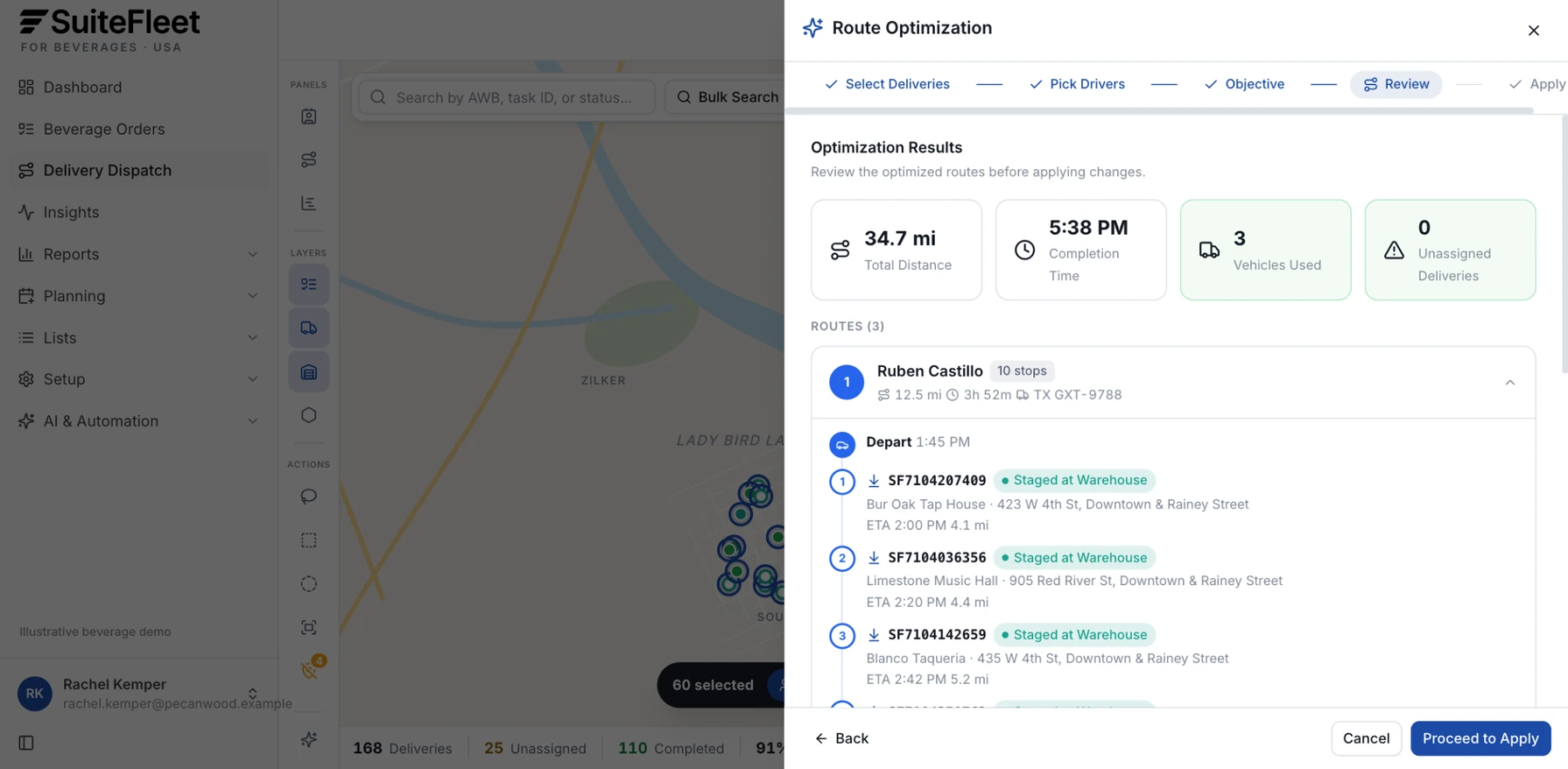
The optimizer balances stops, not kegs or weight, so the operations manager checks the loads by eye before applying the plan. The three routes carry 35, 41, and 37 kegs, close enough for the trucks and crews in the example. The East Austin route has six stops that pay at the door, against one and two on the other routes, so she confirms that its driver has the check and cash procedure for the day. Once the plan is applied, the route order becomes the loading order: the last stop goes on the truck first. To see whether the waves work, track deliveries inside their window, empties returned against kegs delivered, payments deposited on time, and stops per hour. The screens show the workflow; your own operating data will show the improvement.
Handle closed doors and unpaid orders
A failed beverage delivery usually starts with the account, not the truck. The bar is not open yet, the receiver has stepped out, or the manager cannot pay. In the example, 5 deliveries failed: 3 with the reason "No payment ready," 1 with "No receiver on site," and 1 with "Wrong address or dock." Five others were delivered on a second attempt, and four orders are on their way back to the warehouse.
"No payment ready" is the reason to watch. Under the Texas cash law described below, a driver cannot leave beer on credit, so the order goes back on the truck. The failure reason tells sales and the credit team which accounts to call before the next pre-sell order, for example to move them to EFT before delivery. "Business closed" and "No receiver on site" point the other way, to the account's receiving hours, which belong in its window.
Prove the delivery, the payment, and the signature
Accounts and auditors ask after the fact: "Did we get the empties back?" or "Who signed, and how did they pay?" The answer should take seconds, not a call to a driver on another route.
SuiteFleet records proof of pickup and proof of delivery for each stop. In the example, the record for a morning delivery to Hackberry Tap House on East Sixth Street shows the driver who picked up the order at the Austin warehouse at 6:03 a.m., the general manager who received it at 9:12 a.m., inside the 8:00 to 10:00 a.m. window, $1,285 collected by check, photos of the kegs and cases, a signature, and a GPS check within 60 feet of the address.
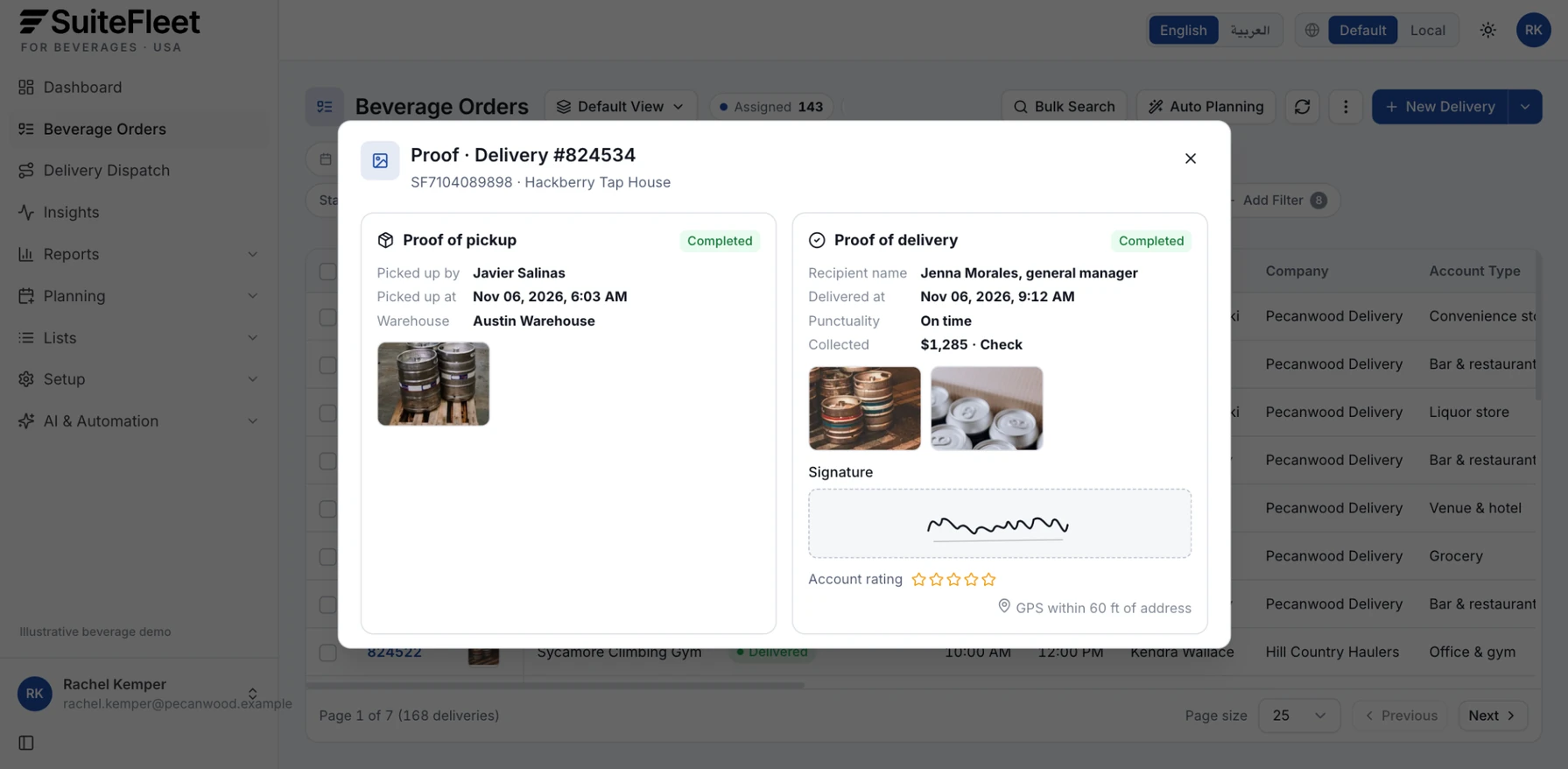
The proof record is not the invoice. In most distributors, the invoice lives in the route accounting system, so decide during setup how the driver's signed invoice and the SuiteFleet record link, and when each check goes to the bank, because the timestamp on a collected check starts the deposit clock described below.
Connect delivery with your route accounting system, ERP, and payments
Your route accounting system or ERP should stay the record for orders, pricing, invoices, deposits, and settlement. Delivery software needs only what the driver needs: the account, address, dock or door, window, handling type, kegs, cases, empties, payment instruction, and note, plus the result to send back. NetSuite has a published SuiteFleet connector, and SuiteFleet says it plans to publish a Microsoft Dynamics 365 Business Central connector. Beverage systems would need a custom integration through SuiteFleet's API, subject to the access each vendor supports.
SuiteFleet's API supports custom integration work. During setup, decide which system marks an order as paid before the truck leaves, so a driver never collects a check from an account that already paid by EFT, and so an account that must pay at the door shows the amount due on the driver's phone.
Compare SuiteFleet with five beverage delivery options
The comparison below places SuiteFleet alongside two general routing and delivery platforms and three options built for beverage distribution: a routing module from a route accounting suite, a mobile route accounting app, and distribution software for direct store delivery.
When is your route accounting system's delivery tool enough?
Most beverage route accounting systems include routing, a driver app, or both, so the fair question is why you would add a delivery platform. Often you should not. If your trucks run the same routes every week, your route accounting system already prints the manifest, and the drivers settle on the same handheld, its tools may be all you need.
A separate delivery platform earns its place when the hard part is coordination rather than the route itself. That usually means:
- Your own trucks and contract carriers deliver into the same neighborhoods, and you want one plan and one proof record for all of them.
- Waves are planned from staged orders that keep changing until shortly before the trucks leave, including same-day add-ons.
- Kegs, pallet drops, and non-alcoholic orders each need the right truck, crew, or carrier.
- Orders come from more than one system, such as a route accounting system, an ERP, and a B2B ordering portal.
The Friday in this article is that kind of day: a keg wave planned at 1:35 p.m. from 30 staged orders, three trucks balanced to ten stops each, payments at the door on every route, and contract carriers working next to Pecanwood's own trucks. If the afternoon wave is a daily scramble, compare the options on the same busy day's order list and see how much work still lands on the operations manager.
Follow the Texas cash law on every beer delivery
A good route is only part of a clean beer delivery in Texas. The handoff has to follow the state's cash law for malt beverages and its invoice rule.
The Texas Alcoholic Beverage Commission's cash and credit law page explains section 102.31 of the Alcoholic Beverage Code this way:
- Distributors may accept only a full cash payment for malt beverages when selling to retailers, before or at the time of delivery.
- Accepted payment is U.S. currency, completed electronic funds transfers, cashier's checks, certified checks, money orders, and bank drafts payable on demand. Post-dated checks are not cash sales.
- A distributor that accepts a check or draft must deposit it for payment within two business days.
- A retailer violates the cash law when its check or draft is returned for insufficient funds, and the distributor must report it to TABC within two business days of discovering it. TABC counts business days as Monday through Saturday, except federal holidays.
TABC Rule 45.131 adds the paperwork. An invoice must accompany each delivery, with the names and permit numbers of the seller and the retailer, a full description of the products, the price, and the place and date of delivery. The retailer signs the seller's copy to verify receipt and accuracy, and the seller signs to acknowledge that payment was received on or before delivery. The current rule says invoices are kept for four years and may be created, signed, and kept electronically; TABC's advisory MPA065, last amended in 2022, still says two years, so check the rule itself. The advisory also describes a central payment option for a retailer with several locations that receive deliveries from the same distributor on the same day.
Wine and spirits work differently. Wholesalers may sell them to retailers on credit, with payment due by the 25th for deliveries from the 1st to the 15th of the month and by the 10th of the next month for the rest, and retailers that fall behind go on TABC's delinquent list. If you carry wine or spirits, keep the two payment rules on separate order lines.
That is why every beer order in the example carries a payment instruction, why the dashboard tracks what was collected at delivery, and why the proof record shows the amount, the method, the receiver, and the time. Software can carry those instructions and keep a timestamped record of every handoff and payment, but it does not make a distributor compliant on its own. The route accounting system, the invoice signatures, the bank deposits, and trained drivers still do that work; confirm the current rules with TABC or a qualified advisor before relying on them.
Plan your next keg wave
SuiteFleet gives beer and beverage distributors one place to manage account windows, staged orders, kegs and empties, payment at delivery, routes, contract carriers, failed deliveries, and proof for every stop. Test it against your busiest day: bring your warehouse and depot locations, route schedule, truck shifts and capacities, contract carriers, and a sample order list with a day's keg orders, pallet drops, and payments at the door, and ask to see how the 1:35 p.m. plan changes when a venue adds kegs for the weekend.
Book a free SuiteFleet demonstration to see how dispatch planning and route optimization can fit your beverage distribution operation.