A parts store's promise to a repair shop ends at the service counter: the right part, in the shop's hands, before the car on the lift costs the shop its afternoon.
It is 11:35 on a Tuesday morning in metro Detroit. Sobczak Auto Service in Dearborn Heights has a customer's pickup on the lift and a dead alternator on the bench. The shop promised the truck back by 3:00 p.m., so it orders a remanufactured alternator as a hot shot, and the old one has to come back as a core. At the Dearborn store, the noon run is staged on the counter, including four batteries for a plumbing company's vans, whose spent batteries also have to come back. Three drivers start at 11:45.
Someone has to decide which driver takes the alternator, which stops ride with it, and how the store will know every part reached the right counter and every core came home.
That is the job of delivery management for auto parts. SuiteFleet brings delivery runs, hot shots, time windows, dispatch planning, route optimization, pickups, and proof of pickup and delivery into one workflow, so a parts distributor can plan each run around its shops' promises instead of around whichever driver is standing at the counter.
Let's follow Dana, the operations manager at a fictional parts distributor in metro Detroit with a hub in Madison Heights and stores in Dearborn, Livonia, and Roseville, through a worked example. The screens are auto parts demo illustrations; names, addresses, maps, and figures are examples.
Know which promise each delivery carries
For a distributor that sells to repair shops, delivery is how the business competes. O'Reilly's annual report for 2025 lists "multiple daily deliveries" in its program for professional customers. AutoZone's 2025 annual report describes prompt delivery and commercial credit for repair garages, dealers, and fleets. Genuine Parts, which owns NAPA, says in its 2025 annual report that commercial customers make up about 80% of its automotive sales and that its stores sit close to repair shops, "enabling frequent deliveries."
An independent distributor makes the same promises with fewer stores. In the example, each store sends a run to its shops every two hours from 8:00 a.m., and a standard order joins the next run. A hot shot leaves on its own with a 45-minute window, because a car is on a lift. Some accounts get a scheduled route stop for stock orders, the hub sends store transfers to the stores, and drivers pick up cores, spent batteries, and wrong parts on the same routes.
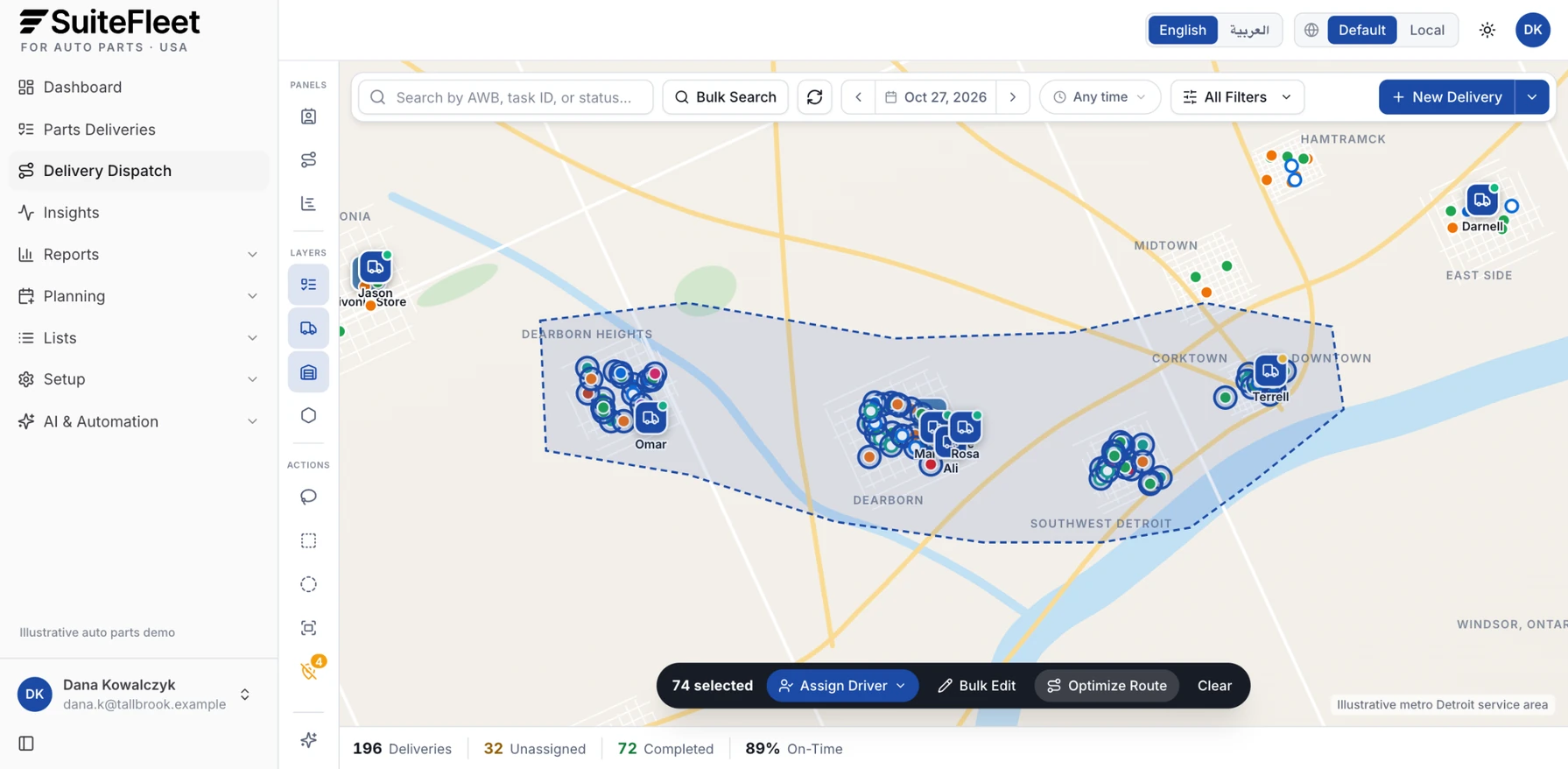
The operations manager starts with the day as a whole. The dashboard shows 196 parts deliveries: 72 completed, 9 failed, and 104 still due across the hub and three stores, 51 of them at the Dearborn store. Thirty-two are still unassigned, most of them waiting for the noon run.
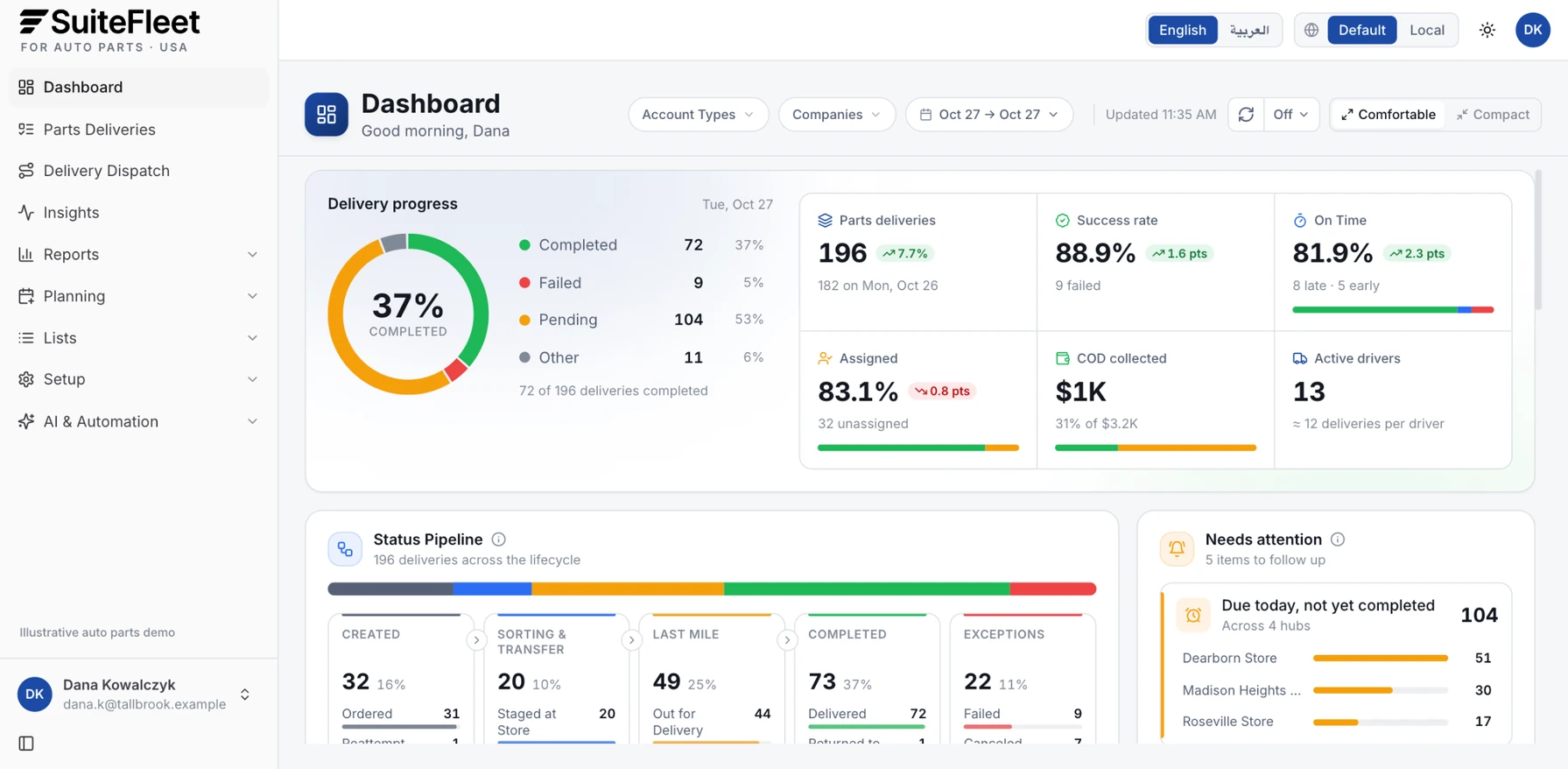
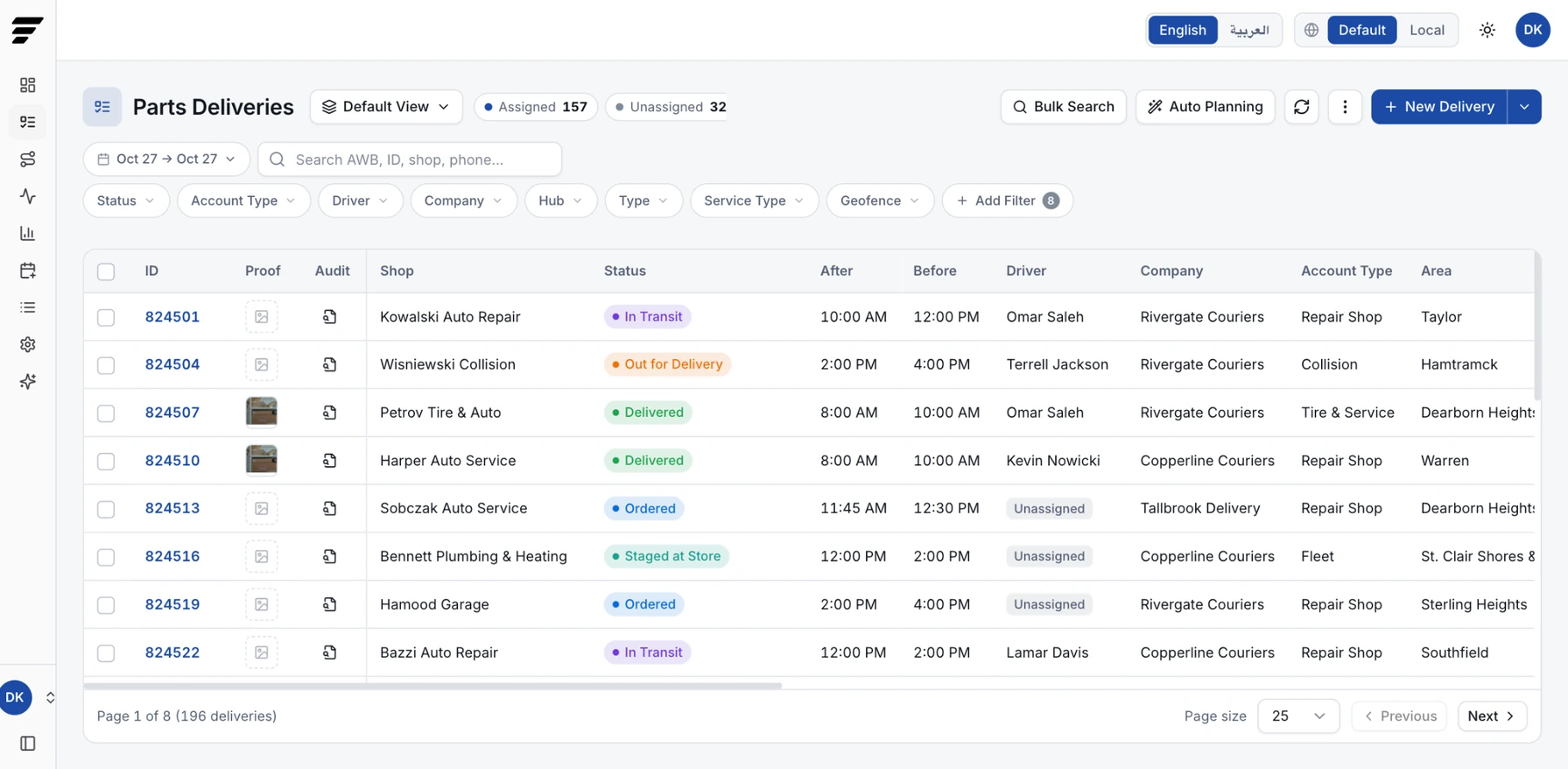
SuiteFleet's delivery list keeps the shop, status, window, driver, courier company, account type, and area in the same view. The company column separates the distributor's own drivers from two courier partners that cover overflow. The Sobczak hot shot sits near the top, ordered four minutes ago and still unassigned.
Put the part, the core, and the handling on every delivery
A parts delivery fails in small ways: the wrong counter, a battery tipped on its side, or a core that never comes back. The details that prevent those failures belong on the delivery itself.
For the hot shot, the operations manager opens the details screen. The service type is Hot shot, the window runs from 11:45 a.m. to 12:30 p.m., and the handling is Core or return. The note tells the driver what is at stake and what to bring back: the truck is on the lift in bay 2 under repair order 51873, the alternator goes to the service writer for a signature, and the old alternator comes back in the new unit's box with the core tag.
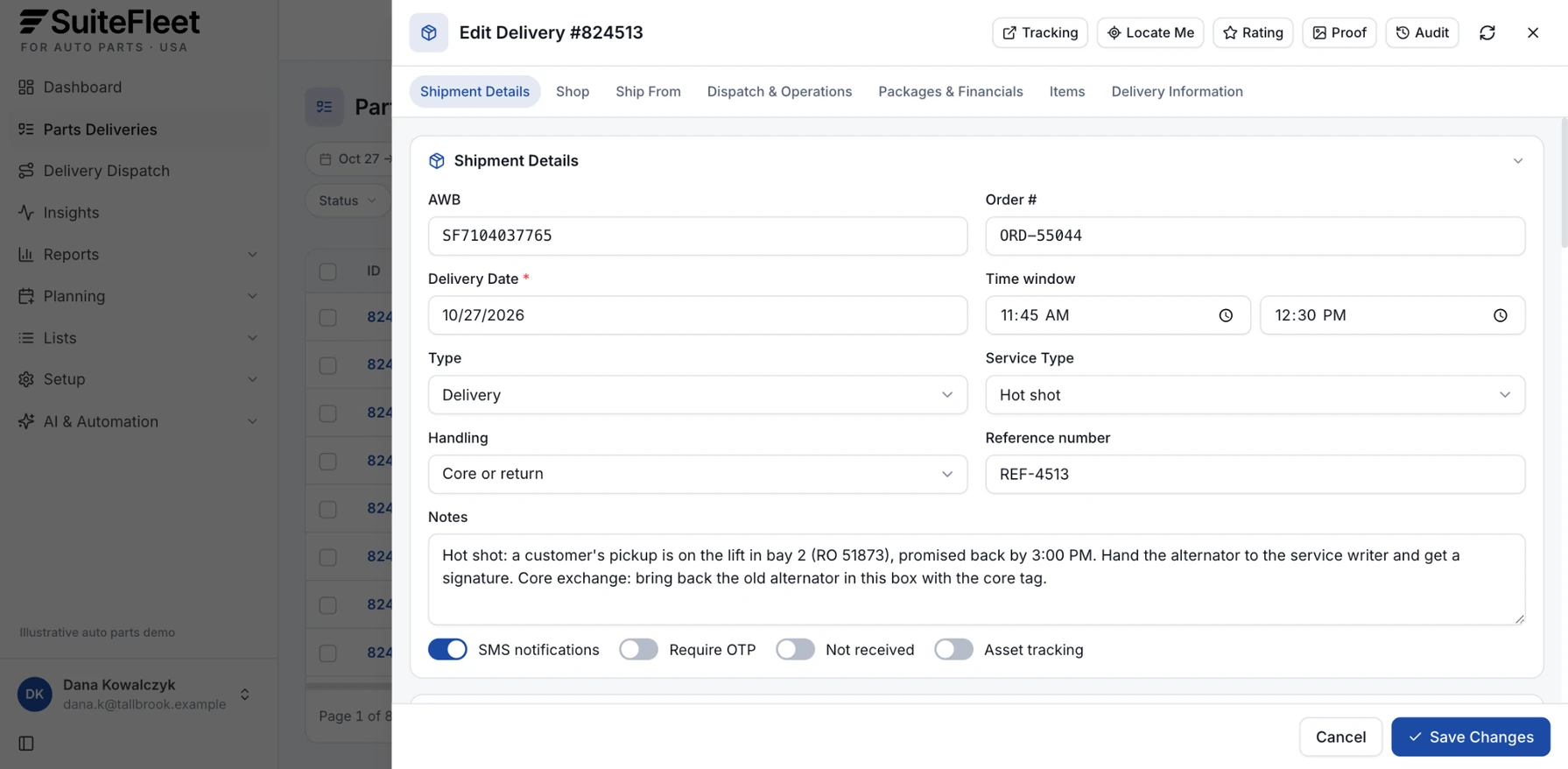
Cores are where parts delivery and parts accounting meet. AutoZone's annual report explains the usual arrangement: many remanufactured parts carry a core component, the customer is charged for it unless a used core is returned, and the charge is refunded if the core comes back later. In the example, the alternator's invoice shows the part and a core charge on separate lines, so the shop sees why the old unit matters and the driver knows what to collect.
Every delivery in the example carries a handling type (Standard parts, Heavy or oversize, Batteries, keep upright, or Core or return for any stop where something comes back), its items, and a drop note such as "Leave the parts in the parts room by the side door and get a signature." Cash accounts carry a reminder to collect payment first.
Plan the noon run while the parts are still on the counter
The noon run cannot be planned at 7:00 a.m., because most of its orders do not exist yet. Shops tear down cars in the morning and order before lunch. By 11:30, the Dearborn store has the run staged and a hot shot that has to go first.
Counting stops hides the real workload. In SuiteFleet's dispatch workbench, each driver's route appears with its delivery count, distance, and duration. In the example, one day-shift driver in Macomb County has 21 deliveries over 91.8 miles, while another has 11 over 65.4 miles. The two Dearborn drivers who start at 11:45 each hold only two staged stops so far.
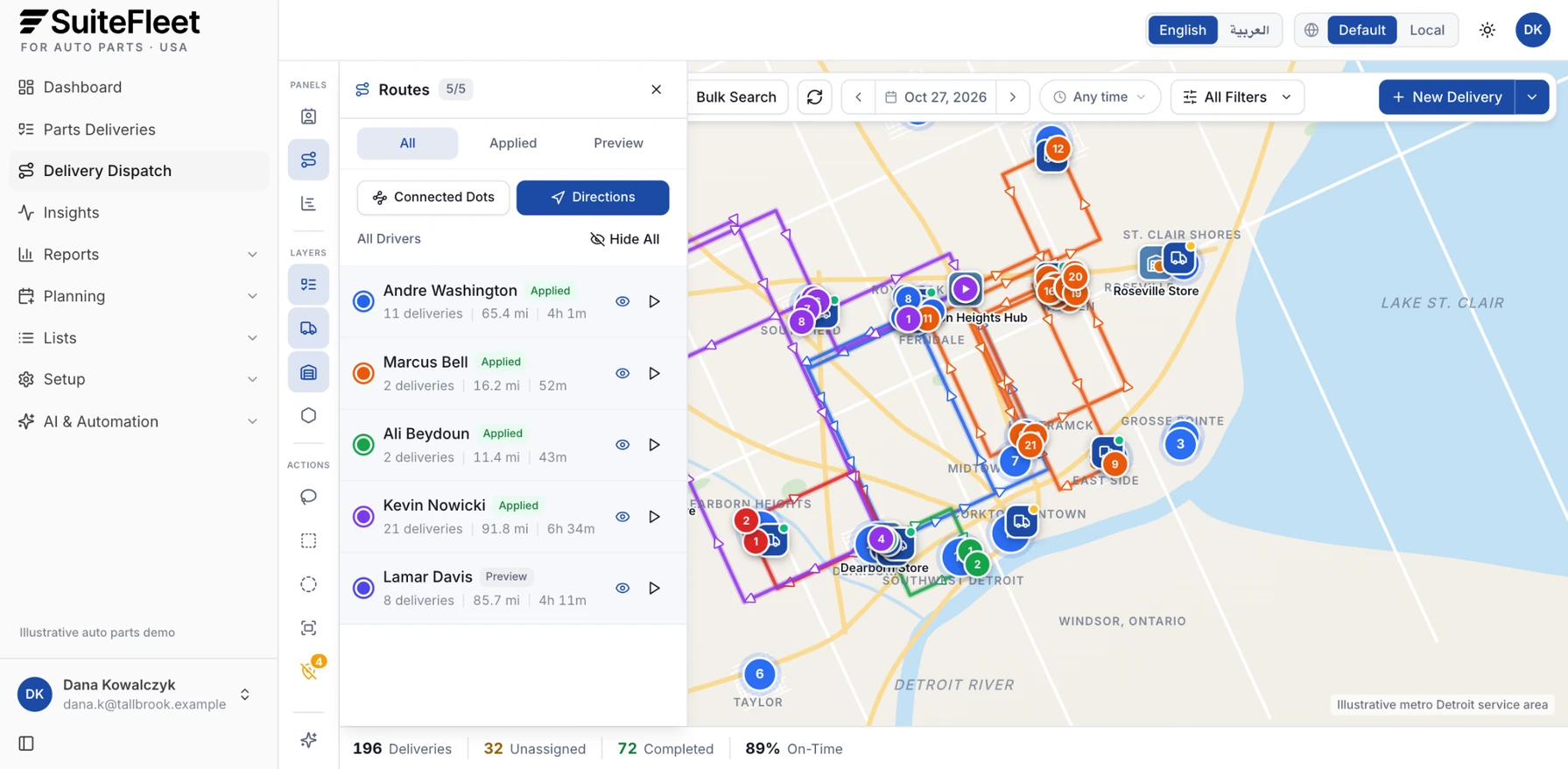
The Dearborn store's noon run covers Dearborn Heights, Dearborn, Southwest Detroit, Corktown, and Downtown. The operations manager uses the lasso tool to select those deliveries, including the Sobczak hot shot and the fleet battery stop. The selection bar then offers to assign a driver, edit in bulk, or optimize the route.
Let the hot shot lead and the noon run fill in
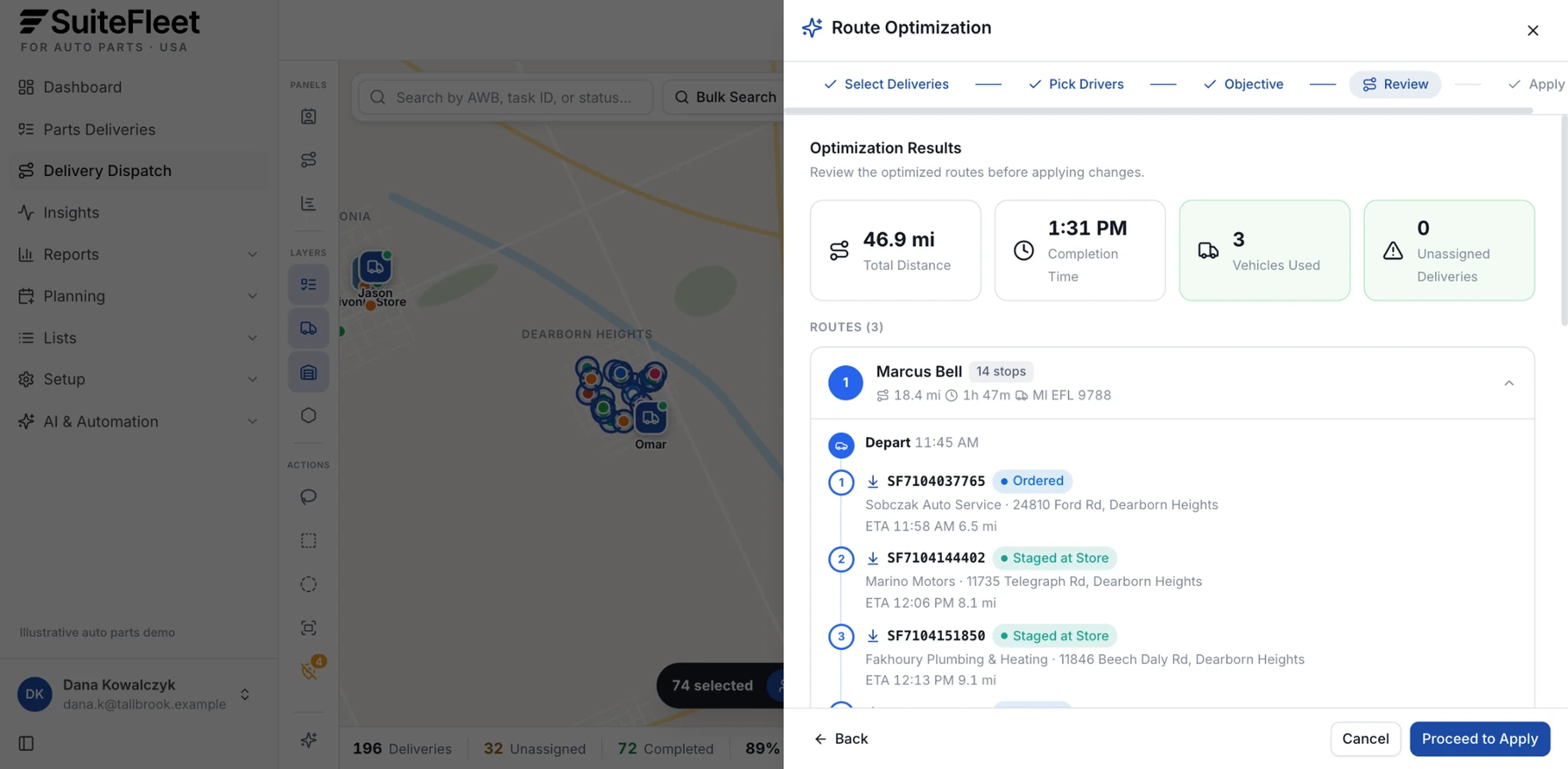
Of the 74 deliveries selected, 45 can still be planned. The optimizer leaves out the 29 that are already delivered, failed, canceled, or being returned. The operations manager enables the three drivers who start at the Dearborn store at 11:45 a.m.: two from the distributor's own delivery team and one from a courier partner. She leaves Reassign Assigned Stops switched off, so the 18 deliveries already on day-shift drivers' routes stay where they are. The plan covers the other 27.
SuiteFleet's optimizer offers four goals: Fastest Completion, Shortest Distance, Fewest Vehicles, and Balanced Workload. The operations manager keeps Fastest Completion, because shops measure the store by how soon the parts arrive. She leaves Respect Time Windows switched on and sets the time per stop to 5 minutes instead of the default 10, because a counter handoff with a signature is quick.
The results preview shows three routes, 46.9 miles in total, every driver back at the store by 1:31 p.m., and no unassigned deliveries. The hot shot is the first stop on an in-house driver's route, arriving at 11:58 a.m., well inside its window. Thirteen more Dearborn Heights and Dearborn stops follow on the same route, including two wrong-part returns and a pickup of three AC compressor cores. The second in-house driver takes eight Southwest Detroit stops over 12.6 miles, with the fleet battery delivery third, at 12:10 p.m. The courier partner takes five Corktown and Downtown stops and is back at the store by 12:43 p.m.
Before applying the plan, the operations manager checks one thing the optimizer was not asked to decide: every battery stop is on an in-house route, for the hazardous materials reasons described below. Once the plan is applied, the route order becomes the loading order: load the last stop first and keep batteries upright and strapped. To see whether the runs work, track deliveries inside their window, hot shots within the promise, cores returned, and parts refused. The screens show the workflow; your own operating data will show the improvement.
Bring back cores, batteries, and wrong parts on the same routes
Much of parts logistics runs in reverse. In the example, the day includes 26 pickups (11 core pickups, 7 battery pickups, 6 wrong-part returns, and 2 warranty returns) alongside 34 deliveries with a core exchange. As separate trips they would add miles; as stops on the shop runs, the driver who brings a starter carries last week's cores back.
Wrong parts are the most common failure in the example: 5 of the 9 failed deliveries carry the reason "Wrong part, refused." A refused part is not just a failed stop. The car is still on the lift, so the counter has to correct the order and send the right part on the next run or a new hot shot, and the refused part has to come back for credit. Failure reasons such as "Wrong part, refused," "Shop closed," and "Wrong address or entrance" show which problems start at the counter and which start on the road.
Tag every core and return at the shop. A core without a tag looks like every other old alternator on the returns shelf, and the credit dispute that follows is hard to settle.
Prove the handoff at the parts counter
Shops ask questions after the fact: "We never got those calipers," or "Who signed for the radiator?" The answer should take seconds, not a call to a driver three stops away.
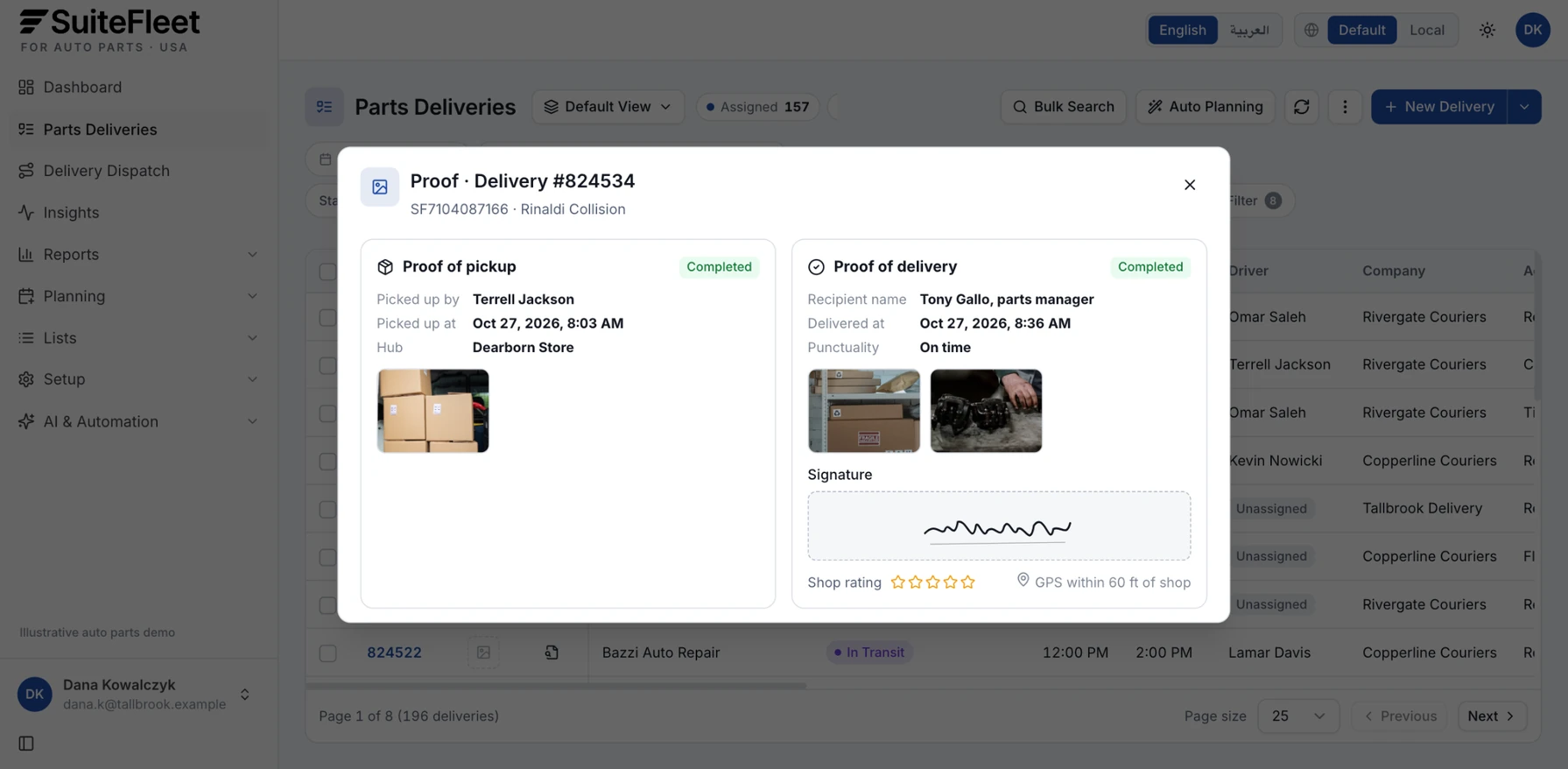
SuiteFleet records proof of pickup and proof of delivery for each stop. In the example, the record for a morning delivery to Rinaldi Collision in Corktown shows the driver who picked up the calipers and pads at the Dearborn store at 8:03 a.m., the parts manager who received them at 8:36 a.m., whether the drop was on time, photos of the parts on the shelf and the old calipers handed back as cores, a signature, and a GPS location check. This driver works for a courier partner, and the record has the same fields an in-house driver's would.
Connect delivery with your business system, ordering platforms, and ERP
Your business system should stay the record for orders, pricing, invoices, cores, and credits. Delivery software needs only what the driver needs: the shop, address, drop spot, window, handling type, items, and drop note, plus the result to send back. NetSuite and Shopify have published SuiteFleet connectors. Auto parts business systems and ordering networks would need a custom integration through SuiteFleet's API, subject to the access each vendor supports.
SuiteFleet's API supports custom integration work. During setup, decide where core status lives. The business system should own the core charge and credit, and the delivery record should only report whether the driver collected the core.
Compare SuiteFleet with five auto parts delivery options
The comparison below places SuiteFleet alongside two general delivery platforms and three options built for or sold into the auto parts market: two from business system vendors and a delivery service that supplies drivers.
When is your business system's delivery tool enough?
Many parts business systems include a delivery tool, and some distributors hand overflow to a delivery service, so the fair question is why you would add a delivery platform. Often you should not. If you run one store with two drivers on fixed loops and your business system already captures signatures, its delivery tool may be all you need. If a delivery service meets your windows and photographs every drop, that may cover the hot shots you cannot.
A separate delivery platform earns its place when the hard part is coordination rather than the single run. That usually means:
- The hub, several stores, and courier partners deliver into the same shops, and you want one plan and one proof record for all of them.
- Hot shots have to fit into runs that are already planned, and the noon run is rebuilt every day at 11:30.
- Cores, battery pickups, and wrong-part returns ride the same routes as deliveries.
- Orders come from more than one system, such as the business system, an online store, and an ERP.
The Tuesday in this article is that kind of day: a hub and three stores, a hot shot that has to beat a 12:30 p.m. window, four batteries out and four back, and in-house drivers working next to a courier partner. If the noon run is a daily scramble, compare the options on the same busy day's delivery list and see how much work still lands on the operations manager.
Carry batteries under the materials of trade rules, and take the old ones back under Michigan law
A good route is only part of a safe parts delivery. Wet lead-acid batteries are a Class 8 corrosive material under the federal Hazardous Materials Regulations, and a parts van may carry them most days, sometimes with airbags too.
For businesses that deliver their own products, the key provision is the materials of trade exception in 49 CFR 173.6. The definition in 49 CFR 171.8, as PHMSA quoted it in a 2010 letter, covers hazardous materials carried "by a private motor carrier in direct support of a principal business" other than transportation. PHMSA has applied it to the parts trade: in a June 2000 interpretation, it said the exception may apply to wholesale distribution centers resupplying dealerships, and in a December 2010 interpretation, to a small dealership delivering airbags and seat belts in its own van, provided all conditions in 173.6 are met. Those conditions include:
- Each package of a Class 8 material in Packing Group II or III may not exceed 30 kg (66 lb) gross mass.
- Batteries need no outer packaging if they are secured against shifting in cages, carts, bins, boxes, or compartments.
- The driver must be told that the vehicle carries hazardous materials and what the section requires.
- The aggregate gross weight of all materials of trade on one vehicle may not exceed 200 kg (440 lb).
The last point is where routing meets compliance: four batteries of about 46 lb are 184 lb, but a route that also collects spent batteries can approach the limit. For larger battery loads, 49 CFR 173.159(e) exempts wet batteries moved by highway from the other requirements if no other hazardous materials ride in the same vehicle, the batteries are loaded or braced to prevent damage and short circuits, other freight is secured against them, and the vehicle carries nothing shipped by anyone else except when consolidating batteries for recycling. Non-spillable batteries have their own section, 49 CFR 173.159a. Because the materials of trade exception is written for private carriers, the example keeps batteries on in-house vans; if a courier partner carries them, confirm which rules it operates under.
Because the example distributor is in Michigan, state battery law applies too. Part 171 of the Natural Resources and Environmental Protection Act defines a distributor as a person who sells batteries to retailers and a retailer as a person who sells batteries to consumers, and it says:
- A retailer must accept used lead-acid batteries from customers at or near the point of sale, in a quantity at least equal to the new batteries it sells, and post a notice that includes "State law requires retailers to accept used lead acid batteries upon the purchase or within 30 calendar days of the purchase of a lead acid battery" (MCL 324.17103).
- A retailer may dispose of used lead-acid batteries only by delivering them to a distributor or its authorized agent, an approved collection, recycling, or smelting facility, or a manufacturer.
- A distributor must accept used lead-acid batteries from retailers in a quantity at least equal to the new batteries it sells, and must remove them from the point of collection within 90 days (MCL 324.17105).
The third point shapes the battery pickups. A repair shop that sells and installs batteries may count as a retailer under that definition, which makes the distributor's driver part of how spent batteries leave the shop. Recording each battery delivered and each spent battery collected gives a running count by shop, so the next pickup can be scheduled well inside the 90 days. Distributors outside Michigan should check their own state's battery law.
Software can carry handling rules, keep battery stops on the right vans, and keep a signed, timestamped record of every delivery and pickup, but it does not make a distributor compliant on its own. Trained drivers, secured cargo, and the company's own hazardous materials procedures still do that work; confirm the current rules with PHMSA or a qualified advisor before relying on any exception.
Plan your next noon run
SuiteFleet gives parts distributors one place to manage delivery runs, hot shots, store transfers, core and battery pickups, returns, routes, and proof for every handoff. Test it against your busiest weekday: bring your store locations, run schedule, hot shot promise, driver shifts, courier partners, and a sample delivery list with a day's cores and returns, and ask to see how a late-morning hot shot changes the noon run.
Book a free SuiteFleet demonstration to see how dispatch planning and route optimization can fit your auto parts delivery operation.