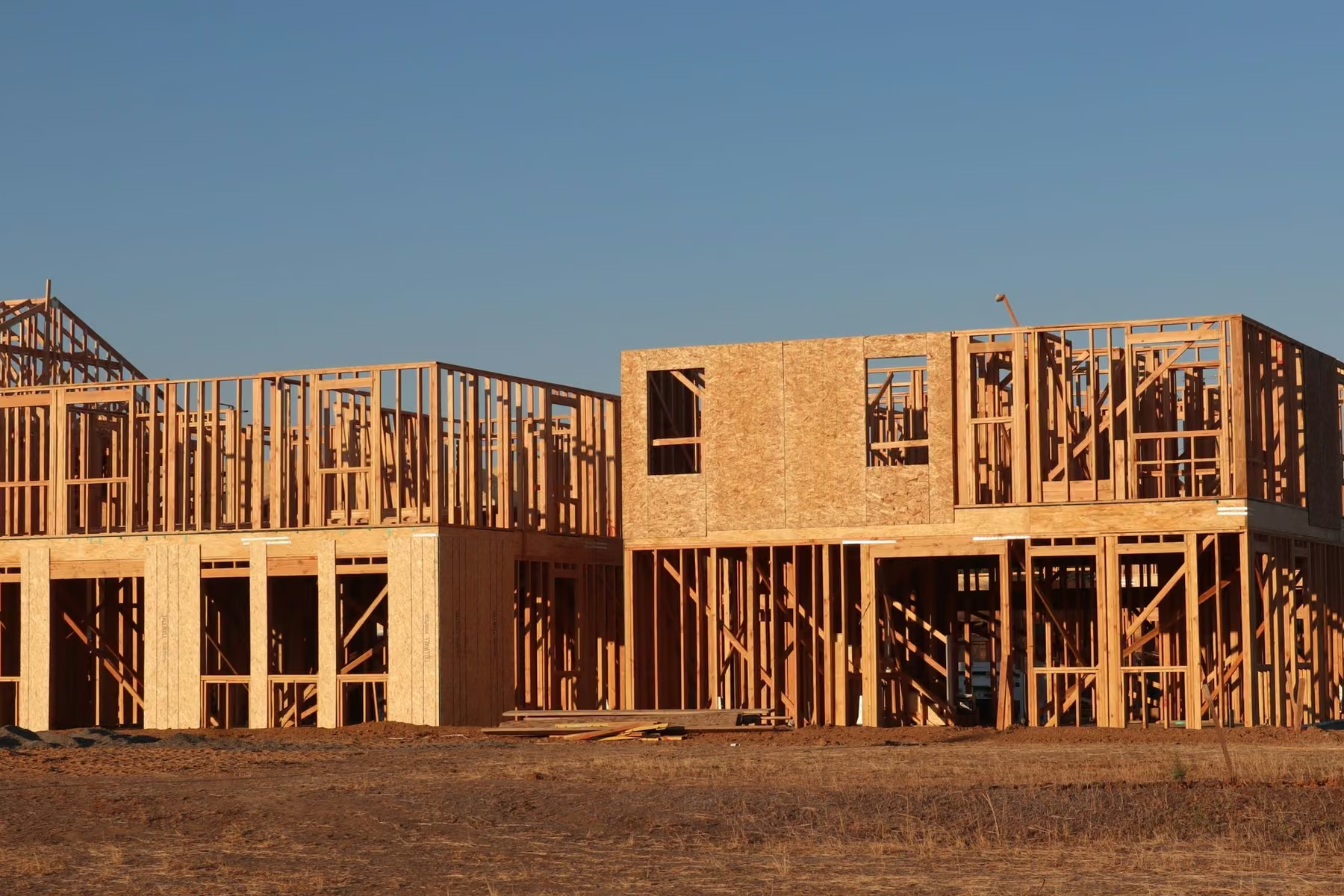
A jobsite delivery promise is a window set by the site, not the truck. The crew has to be ready to receive, the street has to be open for the truck, and the ground has to hold the outriggers. For some loads, the way the material comes off the truck decides which safety rules apply.
It is 11:40 on a Thursday morning in Denver, Colorado. A general contractor building a four-story apartment building on Walnut Street in RiNo needs 150 sheets of drywall stocked to floors 2 to 4 between noon and 2:00 p.m., the hours of the lane closure on its street permit. The drywall is staged at the supplier's Commerce City yard, one of 12 boom deliveries in this afternoon's wave to sites in RiNo and Five Points, Highland and Sunnyside, and Central Park. Three knuckle-boom trucks leave the yard at 11:50.
Someone has to decide which truck takes which sites, in what order, how to get every stop done before the crews leave at the end of the day, and how the office will prove what was delivered, where it was placed, and who signed for it.
That is the job of delivery management for construction. SuiteFleet brings delivery windows, dispatch planning, route optimization, handling notes, and proof of pickup and delivery into one workflow, so a building materials supplier can plan each wave around jobsite windows and site access instead of around whichever truck is free.
Let's follow Erin Castellano, the operations manager at Kestrel Ridge Building Supply, a fictional building materials supplier with four yards in metro Denver, through a worked example. The screens are construction demo illustrations; names, addresses, maps, and figures are examples.
Start from the jobsite's window, not the truck's route
For contractors, a late delivery is a labor problem. In the 2026 Construction Hiring and Business Outlook from the Associated General Contractors of America and Sage, 57% of responding firms named an insufficient supply of workers or subcontractors among their biggest concerns for 2026, and 56% named rising direct labor costs. Nearly half (45%) reported no supply-chain issues in 2025. When the crew is the scarce resource, a drywall load that arrives after the hangers have moved on costs more than the delivery itself.
In the example, every jobsite gets a two-hour window. Contractors order by the afternoon before for scheduled deliveries, phased job releases come off each project's material list, and same-day add-ons and hot shots arrive during the morning. Early-route trucks with truck-mounted forklifts leave at 6:00 a.m. for framing packages, trusses, and ground drops before the crews start. Day-route trucks cover the rest of the metro, and an afternoon boom wave stocks drywall and roofing on central Denver sites.
The operations manager starts with the day as a whole. The dashboard shows 150 jobsite deliveries: 102 completed, 6 failed, and 38 still due across the four yards, 22 of them at the Commerce City yard. Seven deliveries are still unassigned, six of them waiting for the afternoon wave.
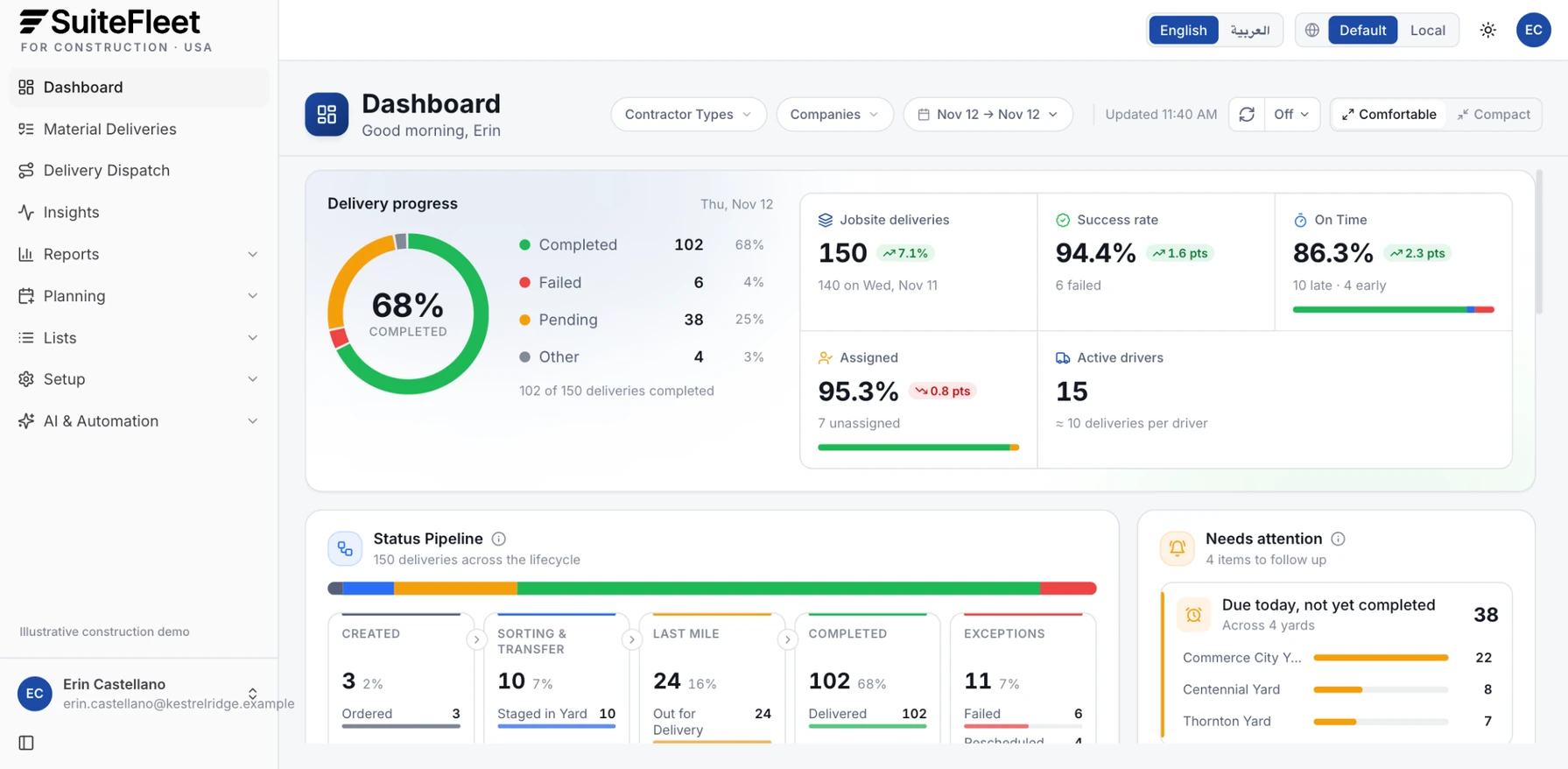
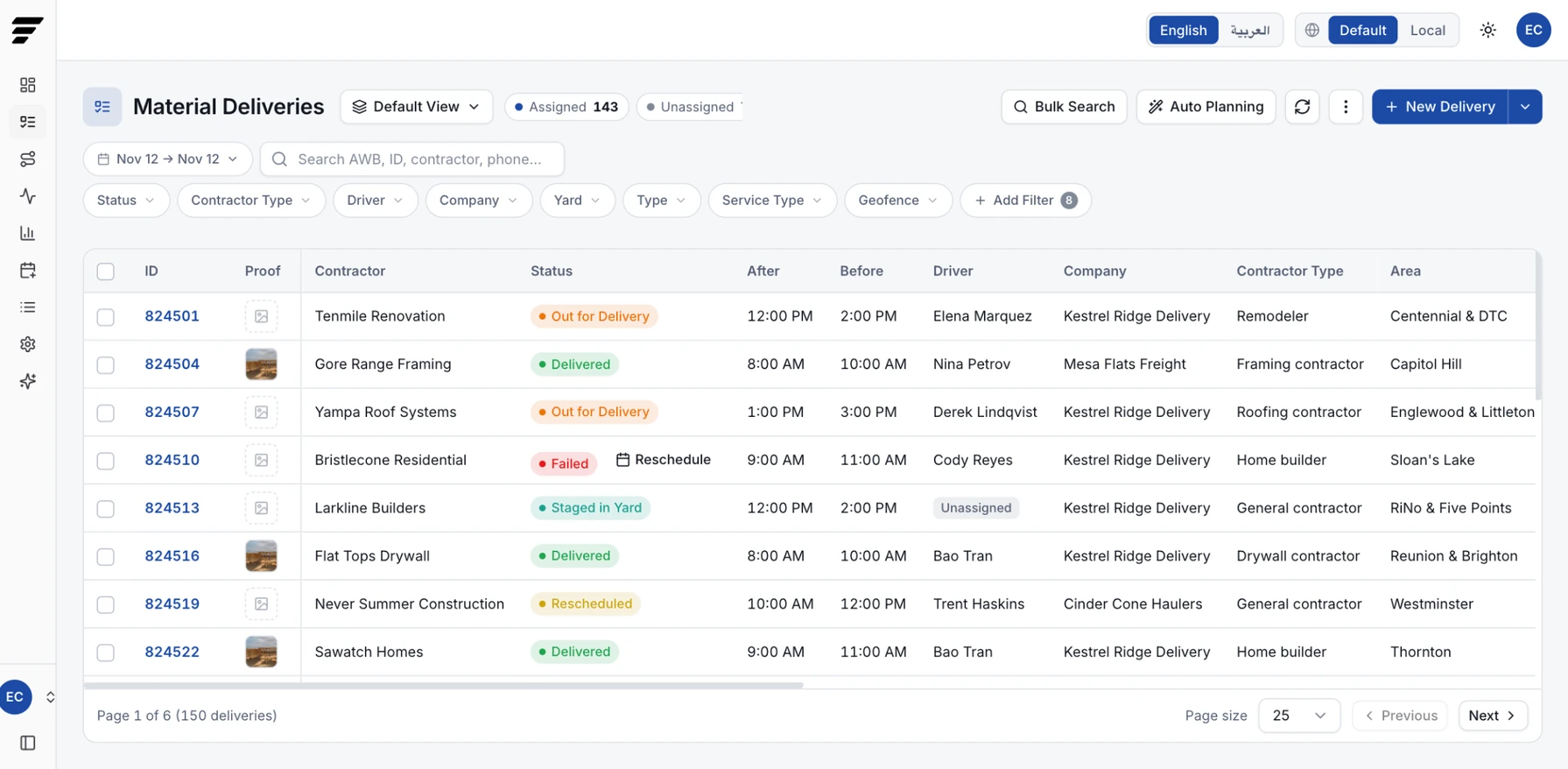
SuiteFleet's delivery list keeps the contractor, status, window, driver, company, contractor type, and area in the same view. The company column separates Kestrel Ridge's own trucks from two contract haulers that, in the example, take only ground drops and hand-unload orders, never boom or crane work. The Walnut Street order for Larkline Builders sits near the top of the list, staged in the yard for its noon to 2:00 p.m. window and still unassigned.
Put the material, the unload method, and the site instructions on the same order
A jobsite delivery fails in small ways. The truck sets up on the wrong side of the building, under the power lines. The boom operator stocks the wrong floor. The forklift drops the lumber on the driveway the concrete crew needs tomorrow. Each mistake shows up later as a re-handle, a back charge, or a crew that waited.
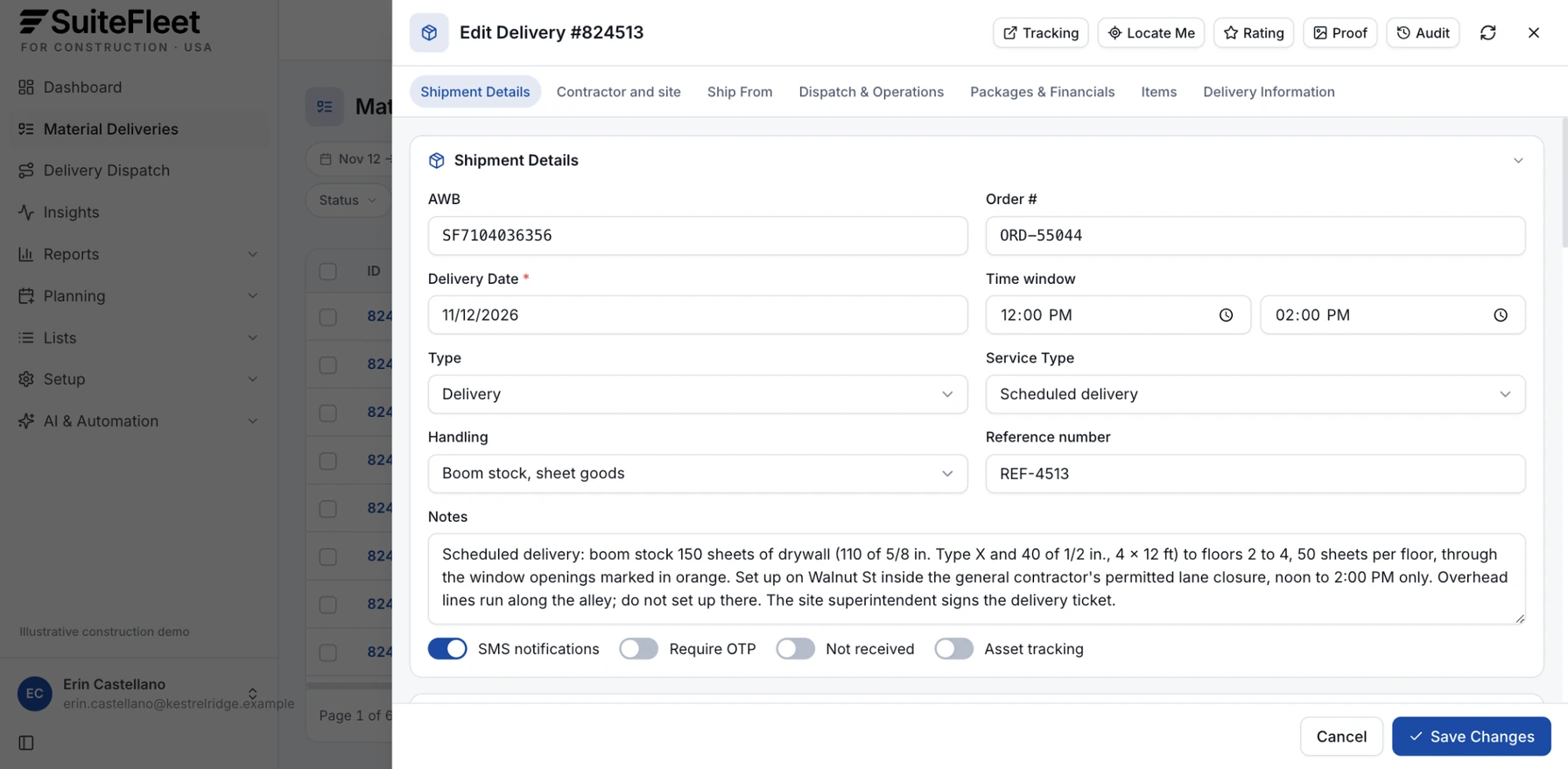
For the Walnut Street order, the operations manager opens the details screen. The service type is Scheduled delivery, the window runs from noon to 2:00 p.m., and the handling is Boom stock, sheet goods. The note tells the driver what is on the order and how to deliver it: 150 sheets of drywall, 110 of 5/8 in. Type X and 40 of 1/2 in., all 4 x 12 ft; 50 sheets to each of floors 2 to 4 through the window openings marked in orange; set up on Walnut Street inside the general contractor's permitted lane closure, noon to 2:00 p.m. only; overhead lines run along the alley, so do not set up there; the site superintendent signs the delivery ticket.
Every delivery in the example carries one of four handling types, because the unload method decides the truck, the crew, and the rules: Ground drop, forklift; Boom stock, sheet goods; Truss set, crane rules; and Hand unload for doors, windows, and trim. Of the day's 150 orders, 70 are boom deliveries of drywall, sheathing, or shingles, 49 are ground drops, 21 are truss sets, and 10 are hand-unload orders. Each order lists its materials as items, and the note says where they go.
Plan the afternoon boom wave from the yard
The afternoon wave cannot be planned at 6:00 a.m., because the morning's results and the contractors' calls decide what is ready. Some sites push their stocking a day when the framing inspection slips, and others add a load once the hangers are ahead of schedule. In the example, the Commerce City yard plans its noon, 1:00, and 2:00 p.m. windows at 11:40, when the loads are staged and the three boom trucks leave in ten minutes.
Counting orders hides the real workload. In SuiteFleet's dispatch workbench, each driver's route appears with its delivery count, distance, and duration. In the example, an early-route driver has 19 deliveries over 83.6 miles, a contract hauler's driver has 7 deliveries over 53.6 miles, and a day-route driver in the northeast has a 3-stop preview over 21.3 miles. Two of the boom trucks hold only two staged orders each so far.
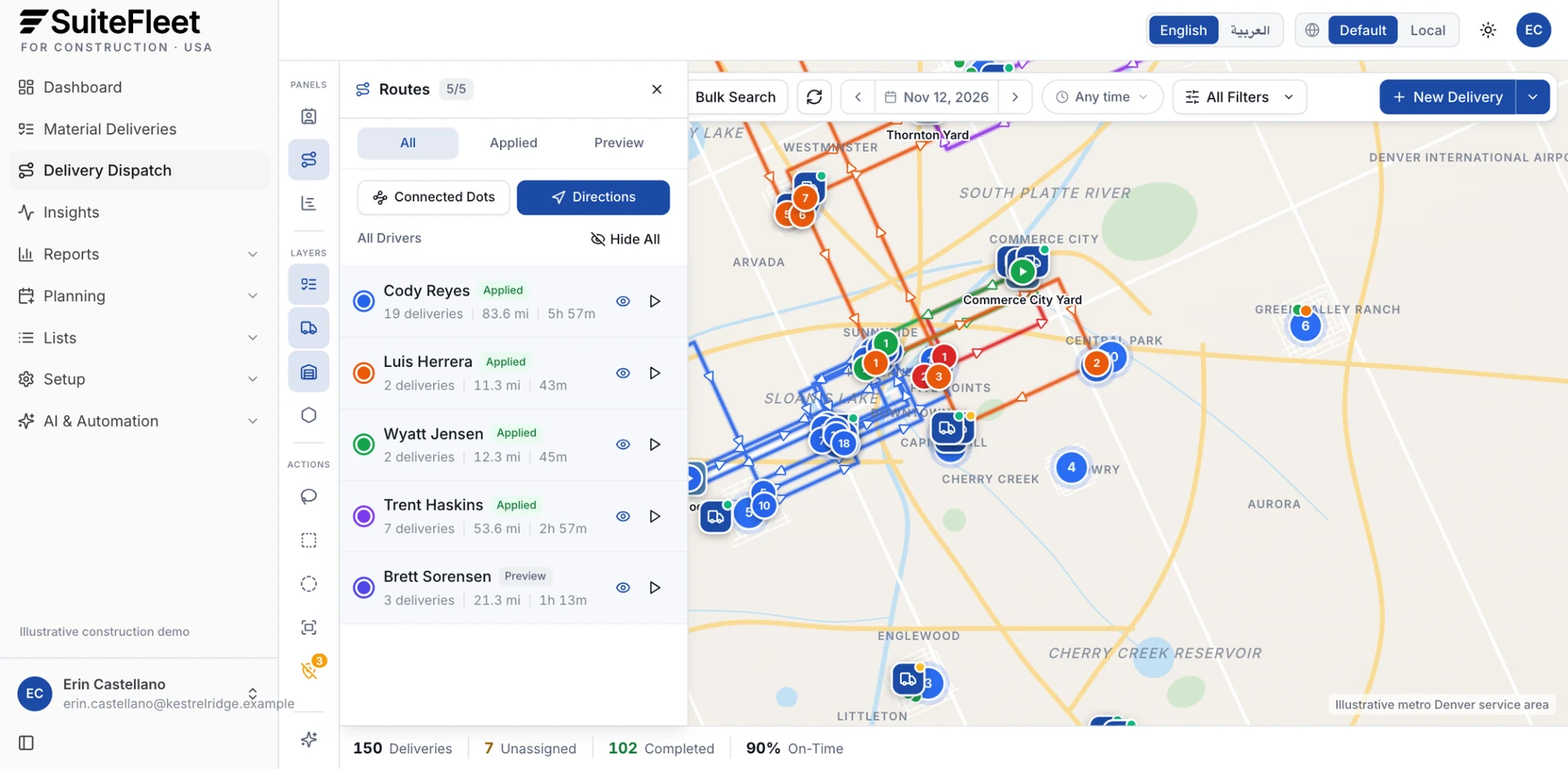
The afternoon wave covers three parts of central Denver: RiNo and Five Points, Highland and Sunnyside, and Central Park. The operations manager uses the lasso tool to select those deliveries, including the Walnut Street order. The selection bar then offers to assign a driver, edit in bulk, or optimize the route.

Finish the boom wave before the crews leave
Of the 36 deliveries selected, 12 can still be planned: 10 staged in the yard and 2 still being pulled. The optimizer leaves out the 24 morning deliveries that are already delivered or failed. The operations manager enables the three boom trucks that start at the Commerce City yard at 11:50 a.m. and leaves Reassign Assigned Deliveries switched off, so the six orders already on the trucks stay where they are.
SuiteFleet's optimizer offers four goals: Fastest Completion, Shortest Distance, Fewest Vehicles, and Balanced Workload. The operations manager chooses Fastest Completion, which finishes all deliveries as early as possible. On a boom wave, an early finish matters more than a few saved miles: the sites close in the late afternoon, and in November the light goes soon after. She leaves Respect Time Windows switched on and sets the time per stop to 45 minutes instead of the default 10, to allow for setting the outriggers, stocking several floors, and getting the ticket signed.
The results preview shows three routes, 37.3 miles in total, the last truck back at the yard by 3:27 p.m., and no unassigned deliveries. Each truck gets four stops in its own part of the wave and works through the windows in order: the noon stops first, then 1:00, then 2:00. The RiNo truck covers 12.7 miles, and the Walnut Street order is its first stop, at noon. The Highland truck covers 12.6 miles and the Central Park truck 11.9 miles.
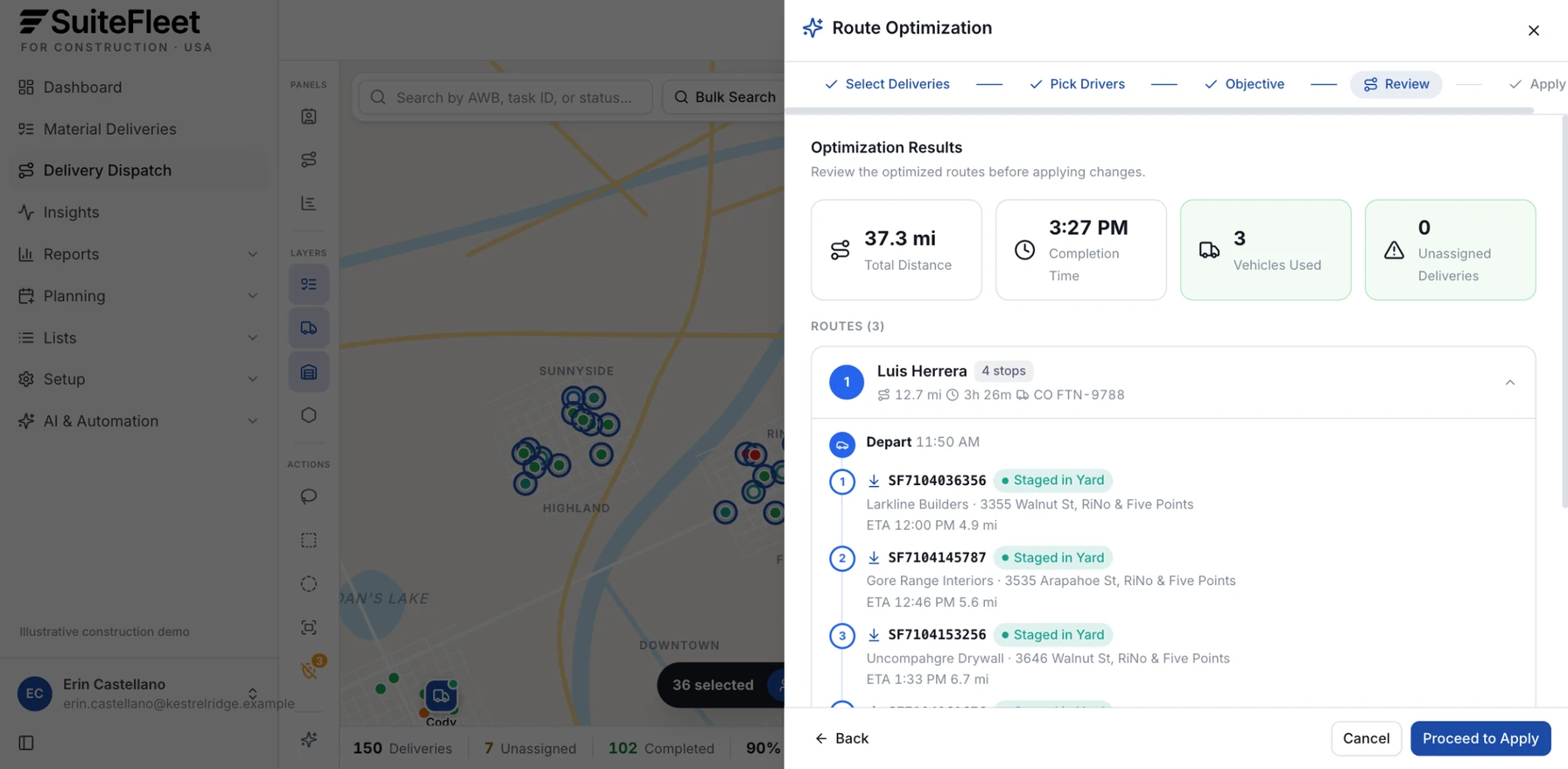
In this example, the optimizer plans stops and windows without checking weight, so the operations manager checks each load by eye before applying the plan. The wave carries 634 sheets of drywall and 85 bundles of shingles, about 68,000 pounds in all. The RiNo route carries about 31,100 pounds, the Highland route about 22,700, and the Central Park route about 14,200; in the example, each boom truck can carry up to 34,000 pounds, so all three loads fit. Once the plan is applied, the route order becomes the loading order: the last stop goes on the truck first. To see whether the waves work, track deliveries inside their window, re-handles and back charges, failed deliveries by reason, and stops per truck per day. The screens show the workflow; your own operating data will show the improvement.
Handle sites that are not ready
A failed construction delivery usually starts at the site, not the truck. The gate is locked, no one is there to receive, or the site is not ready: the laydown area is full, the ground is soft, or the floor the drywall is meant for is not framed. In the example, 6 deliveries failed: 3 with the reason "No one on site to receive," 2 with "Site not ready for delivery," and 1 with "Site gate locked." Three others were delivered on a second attempt, and one order is on its way back to the yard.
"Site not ready" is the reason to watch, because it is the most expensive one to repeat. The truck has already made the trip, and the boom truck's slot for the day is gone. The failure reason tells sales and the project team which contractors to call before the next release, for example to confirm the floor is ready or the laydown area is clear the afternoon before. "Site gate locked" and "No one on site" point to the site's receiving hours and contact, which belong on the order.
Prove the delivery, the placement, and the signature
Contractors and project managers ask after the fact: "Did all the studs come?" or "Who signed, and where did you put it?" The answer should take seconds, not a call to a driver on another route.
SuiteFleet records proof of pickup and proof of delivery for each stop. In the example, the record for a morning framing package to a builder near Sloan's Lake shows the driver who picked up the order at the Lakewood yard at 6:10 a.m., the site superintendent who received it at 7:41 a.m., inside the 7:00 to 9:00 a.m. window, photos of the load, a signature, and a GPS check within 60 feet of the address.
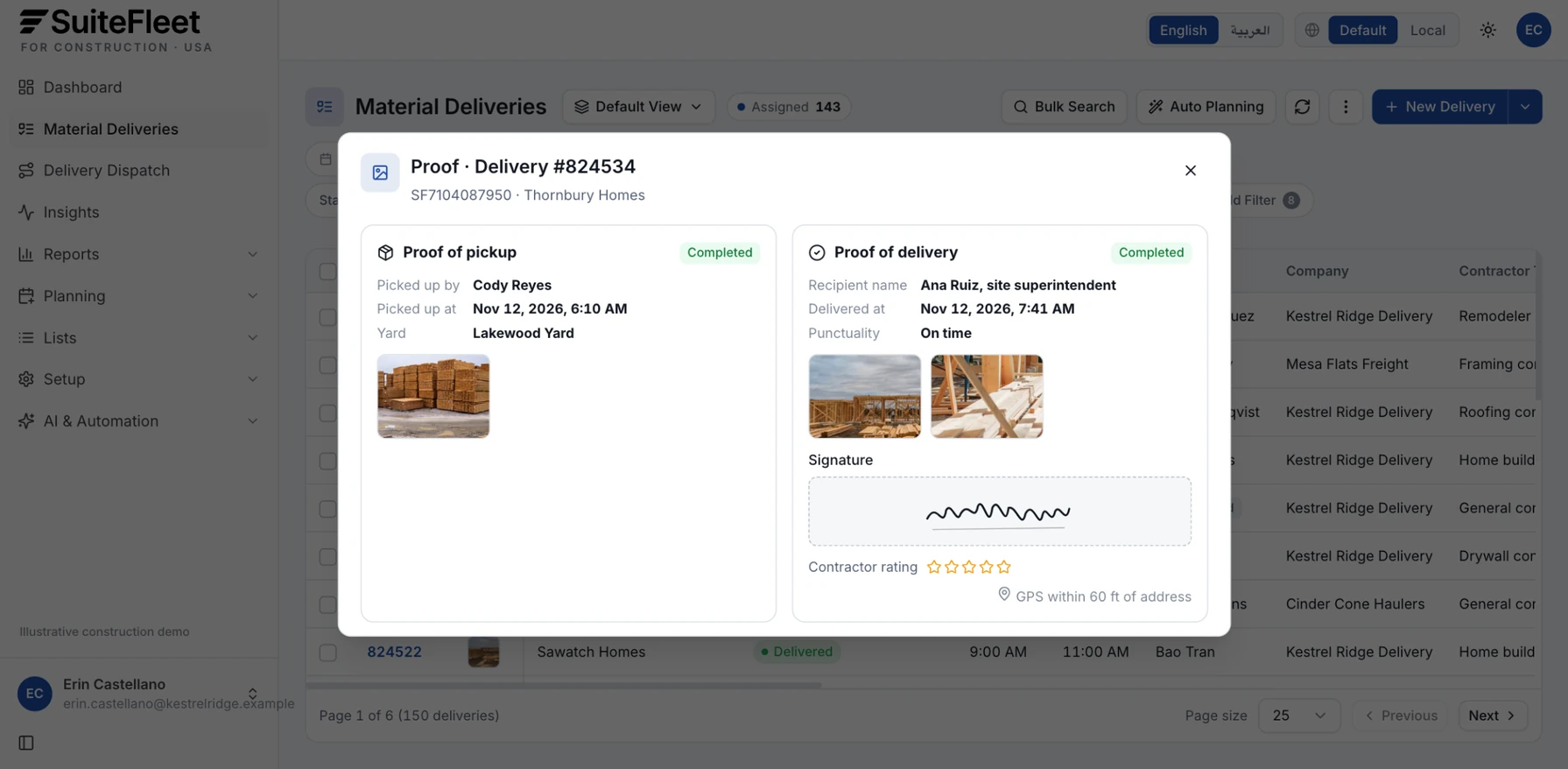
The proof record is not the delivery ticket or the invoice. In most suppliers, those live in the ERP, so decide during setup how the signed ticket and the SuiteFleet record link, and which photos the driver must take. For a drop on the laydown area, a photo of the load where it sits settles most questions about short counts and damage.
Connect delivery with your ERP and your contractors' systems
Your ERP should stay the record for orders, pricing, inventory, delivery tickets, and invoices. Delivery software needs only what the driver needs: the contractor, site address, gate or entrance, window, handling type, materials, site instructions, and site contact, plus the result to send back. NetSuite has a published SuiteFleet connector, and SuiteFleet says it plans to publish an Acumatica connector. Building supply systems and contractor platforms would need a custom integration through SuiteFleet's API, subject to the access each vendor supports.
SuiteFleet's API supports custom integration work. During setup, decide which system owns the window and the site instructions, so a change the contractor calls in reaches the driver's phone instead of a note on a printed ticket.
Compare SuiteFleet with five construction delivery options
The comparison below places SuiteFleet alongside two general routing and delivery platforms and three options built for building materials: a dispatch and delivery module from a lumber and building materials ERP, a proof of delivery app from another, and a delivery network for construction suppliers.
When is your ERP's delivery tool enough?
Most lumber and building materials ERPs include a dispatch module, a driver app, or both, so the fair question is why you would add a delivery platform. Often you should not. If your trucks run from one yard, your dispatcher builds the manifests in the ERP, and the drivers capture proof on the ERP's app, its tools may be all you need. For an occasional rush load, a delivery network can add trucks without adding software.
A separate delivery platform earns its place when the hard part is coordination rather than the manifest itself. That usually means:
- Several yards serve overlapping parts of the metro, and you want one plan and one proof record for all of them.
- Your own boom and flatbed trucks and contract haulers deliver into the same neighborhoods, and each needs the right kind of order.
- Waves are planned from staged loads that keep changing until shortly before the trucks leave, including same-day add-ons and pushed releases.
- Orders come from more than one system, such as an ERP, a contractor portal, and calls from site superintendents.
The Thursday in this article is that kind of day: a boom wave planned at 11:40 a.m. from 12 staged and pending loads, three trucks routed through three windows, a street permit that sets one site's window, and contract haulers working next to Kestrel Ridge's own trucks. If the afternoon wave is a daily scramble, compare the options on the same busy day's order list and see how much work still lands on the operations manager.
Know when a boom delivery becomes crane work
A good route is only part of a safe jobsite delivery. In Colorado, which does not have an OSHA-approved state plan, federal OSHA covers most private-sector workplaces, and its construction crane standard draws a line through the middle of a supplier's deliveries.
29 CFR 1926.1400 excludes articulating or knuckle-boom truck cranes that deliver material to a construction site in two cases:
- When the crane transfers materials from the truck to the ground without arranging them in a particular sequence for hoisting.
- When the crane transfers building supply sheet goods or packaged materials, such as sheets of drywall or plywood, bags of cement, shingles, or rolls of roofing felt, from the truck onto a structure using a fork or cradle at the end of the boom, but only when the truck crane has a properly functioning automatic overload prevention device.
The exclusion does not apply when the crane holds, supports, or stabilizes material while it is attached to the structure, or when the material is a prefabricated component such as roof trusses, wall panels, or precast concrete, or a structural steel member. In those cases the crane standard applies. Under section 1926.1427, the employer must ensure each operator is trained, certified or licensed, and evaluated before operating covered equipment, with a few exceptions, such as equipment rated to lift 2,000 pounds or less. Under section 1926.1402, the controlling entity on the site must ensure the ground is prepared to support the equipment and tell the operator about known hazards beneath the setup area, such as voids, tanks, or utilities. Under section 1926.1408, the employer must determine before operations whether any part of the equipment or load could get closer than 20 feet to a power line and, if so, follow one of the standard's options. OSHA has also explained, in a 2016 letter of interpretation, that placing material in a particular position to facilitate construction by another employer can be construction work even when the load is set on the ground.
Streets add a local rule. In Denver, short-term use of the public right-of-way, such as a lane closure, goes through the Department of Transportation and Infrastructure's street occupancy permits, submitted with a traffic plan, and closures in downtown Denver are coordinated with other contractors at a meeting every two weeks. When a boom truck has to set up in the street, the permit's hours become the delivery window.
That is why every order in the example carries a handling type that matches the unload method, why truss sets say "crane rules apply," and why the notes name the setup side, the overhead lines, and the ground. Software can carry those instructions to the right truck and keep a timestamped record of every handoff, but it does not make a delivery compliant on its own. Trained and qualified operators, the contractor's site preparation, and the supplier's own safety program still do that work; confirm how the rules apply to your equipment and deliveries with OSHA or a qualified safety professional.
Plan your next boom wave
SuiteFleet gives building materials suppliers one place to manage jobsite windows, staged loads, handling types, site instructions, routes, contract haulers, failed deliveries, and proof for every stop. Test it against your busiest day: bring your yard locations, truck types and shifts, contract haulers, and a sample order list with a day's boom deliveries, ground drops, and truss sets, and ask to see how the 11:40 a.m. plan changes when a superintendent pushes a stocking load to tomorrow.
Book a free SuiteFleet demonstration to see how dispatch planning and route optimization can fit your building materials delivery operation.