A grocery delivery promise is the one-hour slot the customer picked, and it ends at the door: the right totes, frozen food still frozen, and for beer or wine, an adult with ID.
It is 2:35 on a Friday afternoon in metro Orlando. This morning, a customer on Palmer Avenue in Winter Park ordered six totes of groceries for the 4:00 to 5:00 p.m. slot, including a bag of frozen food, a 12-pack of beer, and two bottles of wine. The Winter Park store has picked the order, swapped two items for substitutes the customer approved, and staged the totes by temperature, beside dozens of other afternoon orders. Three drivers start at 2:45: two in refrigerated vans and one from a courier partner with cooler bags.
Someone has to decide which driver takes which orders, which van carries the frozen bags, and how the store will know every order arrived inside its slot and every beer and wine order reached an adult with ID.
That is the job of delivery management for grocery. SuiteFleet brings delivery slots, dispatch planning, route optimization, handling notes, delivery codes, and proof of pickup and delivery into one workflow, so a grocer can plan each delivery wave around the slots customers chose instead of around whichever driver is free.
Let's follow Teresa Albright, the operations manager at a fictional grocer with four stores in metro Orlando (Winter Park, Oviedo, Dr. Phillips, and Lake Nona), through a worked example. The screens are grocery demo illustrations; names, addresses, maps, and figures are examples.
Treat the slot as the promise
Online grocery is no longer a side channel. In its survey for September 2026, Brick Meets Click found that 64% of U.S. households bought groceries online during the month and that online grocery sales grew just over 16% from a year earlier. It also found that orders delivered within three hours of being placed made up about two-thirds of delivery orders. Customers expect to pick the time, often for the same day, and to get their groceries inside it.
In the example, customers choose a one-hour slot from 8:00 a.m. to 7:00 p.m. through the store's app, its website, a phone order, or a business account. A same-day slot is booked that morning, a scheduled slot a day or more ahead, and a standing order repeats every week; offices place weekly break-room orders on business accounts. Before 3:00 p.m., customers can also choose express delivery within two hours.
The operations manager starts with the day as a whole. The dashboard shows 204 grocery deliveries: 69 completed, 6 failed, and 115 still due across the four stores, 62 of them at the Winter Park store. Thirty-three are still unassigned, most of them waiting for the afternoon wave.
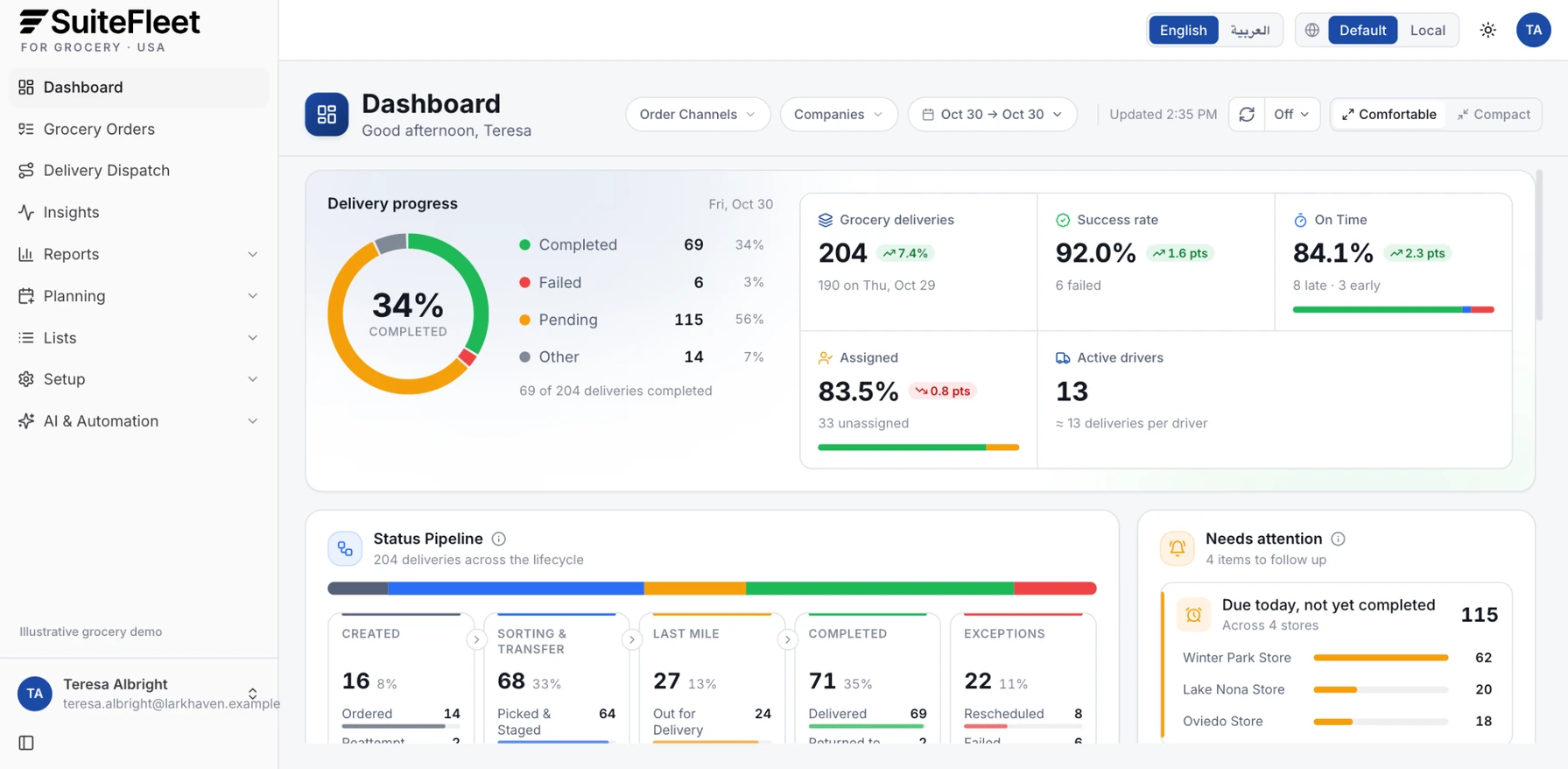
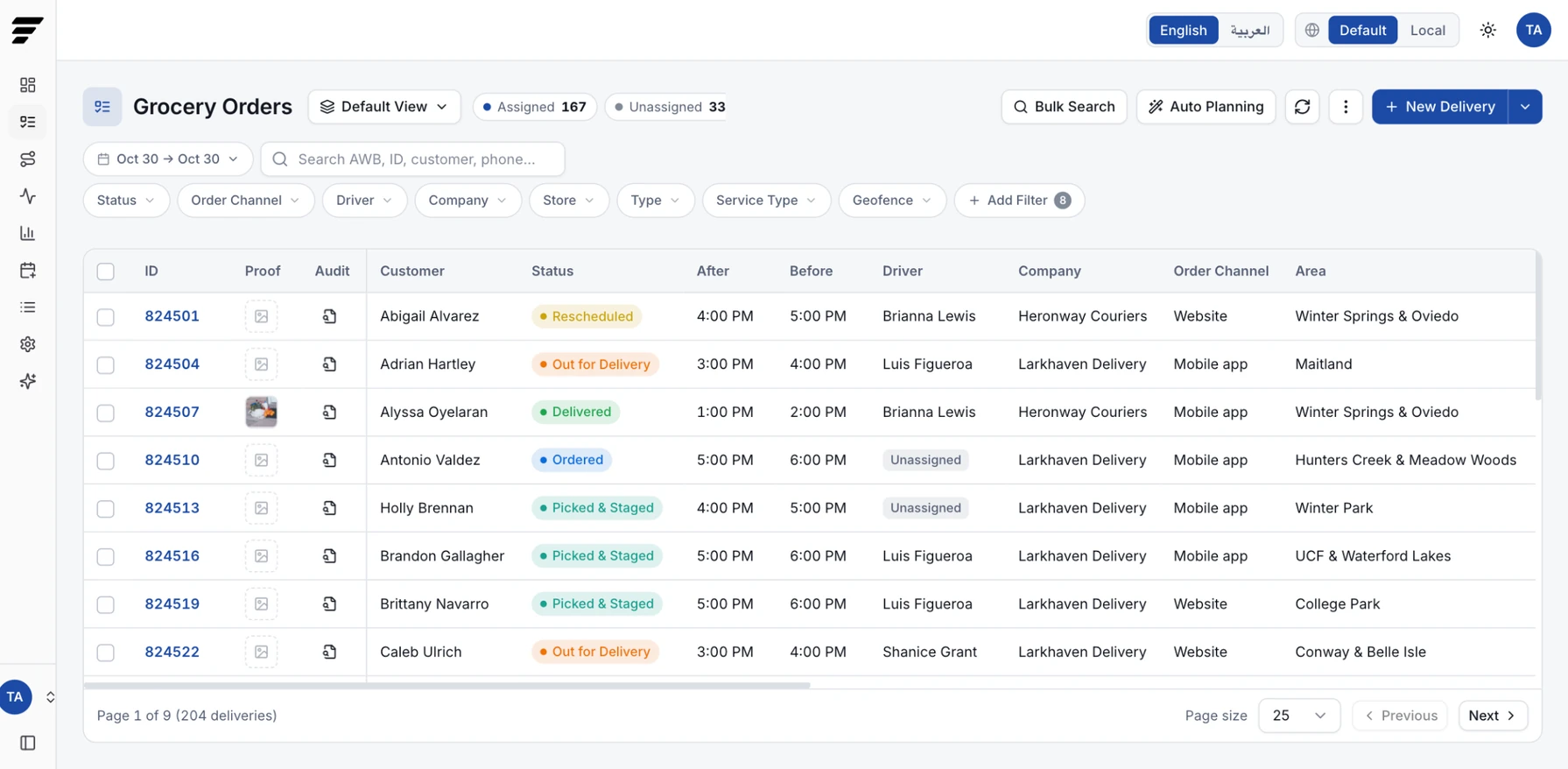
SuiteFleet's delivery list keeps the customer, status, slot, driver, courier company, order channel, and area in the same view. The company column separates the grocer's own delivery team from two courier partners that cover busy slots. The Palmer Avenue order sits near the top of the list, marked Picked & Staged for the 4:00 to 5:00 p.m. slot and still unassigned.
Pick, substitute, and stage by temperature
A grocery delivery can fail before a driver touches it: an item is out of stock, the substitute is wrong, or the frozen bag sits beside the ambient totes for an hour. In a store-based operation, pickers shop each order shortly before its slot, offer substitutes or refunds for missing items, and stage the totes by temperature: ambient on shelves, chilled in a cooler, frozen in a freezer. In the example, 62 of the day's orders carry an approved substitution and 22 a refund for an item that was out of stock.
Status shows where each order stands: Ordered means it is still being picked, and Picked & Staged means its totes are bagged and waiting in the right temperature zone. At 2:35, most 3:00 and 4:00 p.m. orders are staged, and many 5:00 p.m. orders are still being picked.
For the Palmer Avenue order, the operations manager opens the details screen. The service type is Same-day slot, the window runs from 4:00 to 5:00 p.m., and the handling is Beer or wine, ID 21+. The note tells the driver what is in the order and what to do at the door: six totes (three ambient, two chilled, one frozen), a 12-pack of beer, and two bottles of wine; ask for the delivery code and check photo ID; never leave beer or wine at the door. Require OTP is switched on, so a one-time code is required at handover.
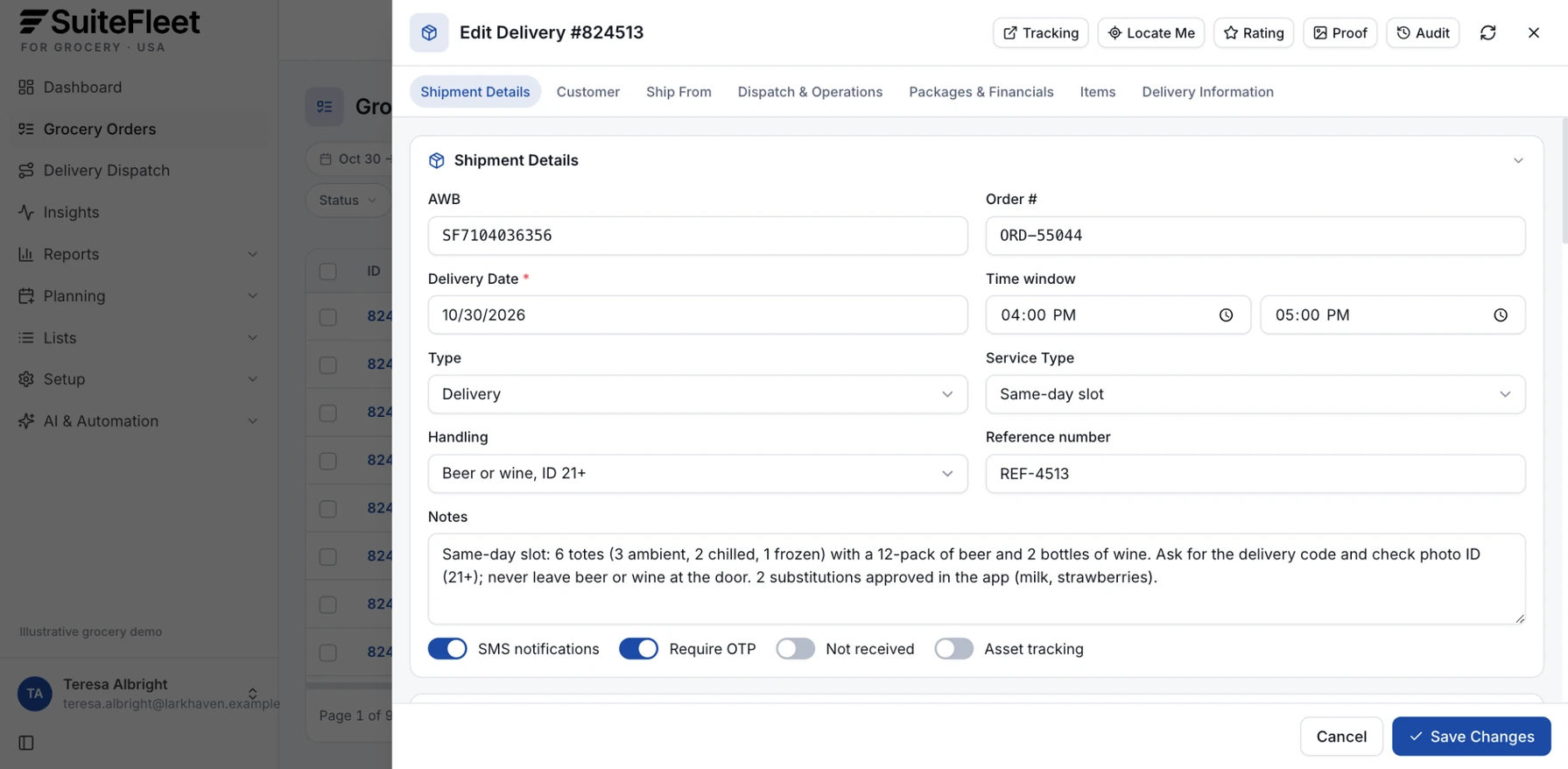
Every delivery in the example carries a handling type (Ambient & chilled, Includes frozen, Beer or wine, ID 21+, or Heavy cases for water and office orders), its totes by temperature as items, and a drop note. Orders with frozen food tell the driver to keep the frozen bag in the van's freezer section until the door and to hand it over in person.
Plan the afternoon wave once the pick is staged
The afternoon wave cannot be planned at 7:00 a.m., because many of its orders are placed during the morning and none of them is ready until it is picked. Plan too late, though, and drivers stand at the store while the first slot opens. In the example, the Winter Park store plans its 3:00, 4:00, and 5:00 p.m. slots at 2:35, when the earlier slots are staged and the drivers start in ten minutes.
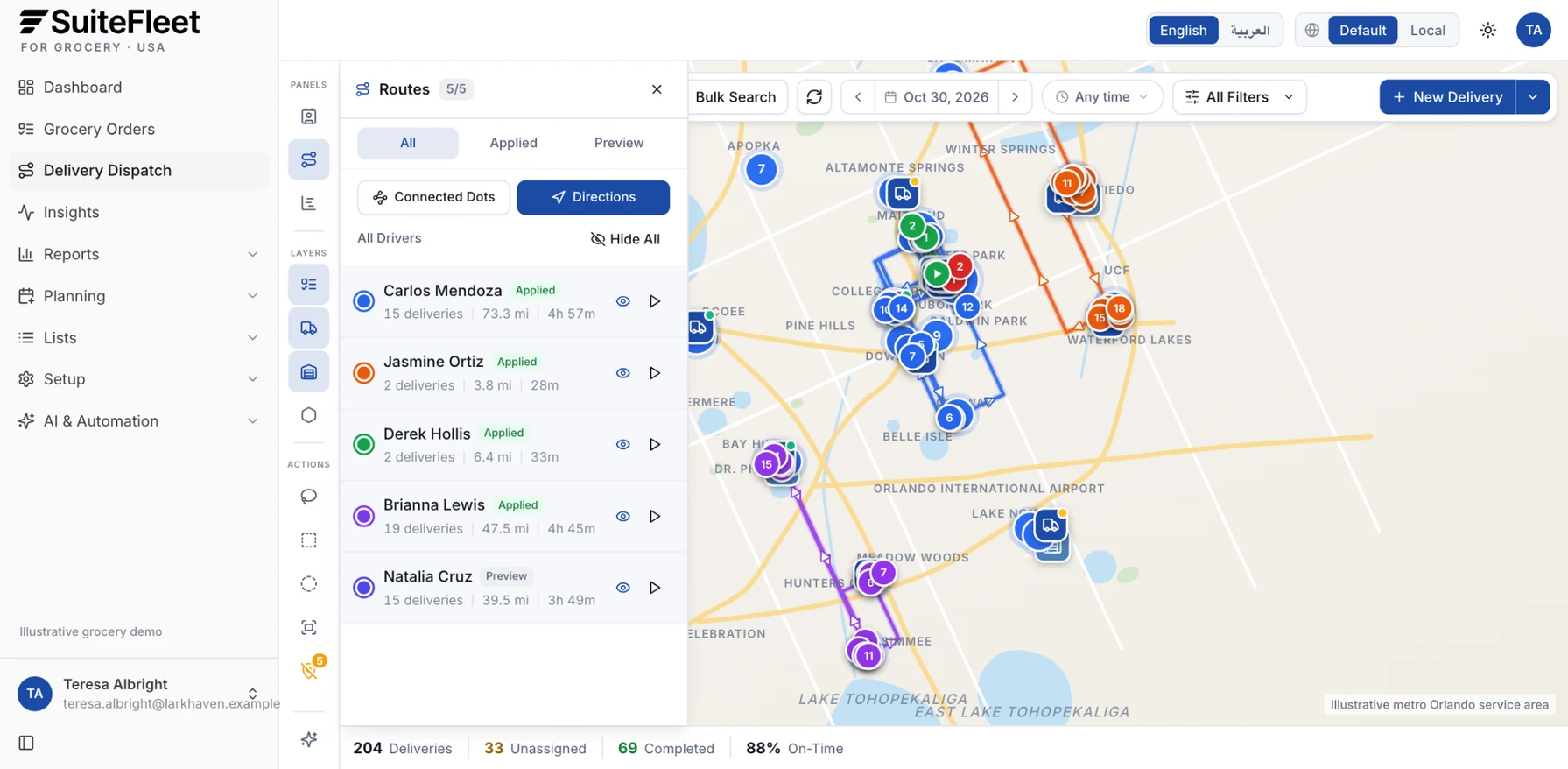
Counting orders hides the real workload. In SuiteFleet's dispatch workbench, each driver's route appears with its delivery count, distance, and duration. In the example, one opening-shift driver has 15 deliveries over 73.3 miles, while a courier partner's driver covering Winter Springs and Oviedo has 19 over 47.5 miles. Two of the drivers who start at 2:45 each hold only two staged orders so far.
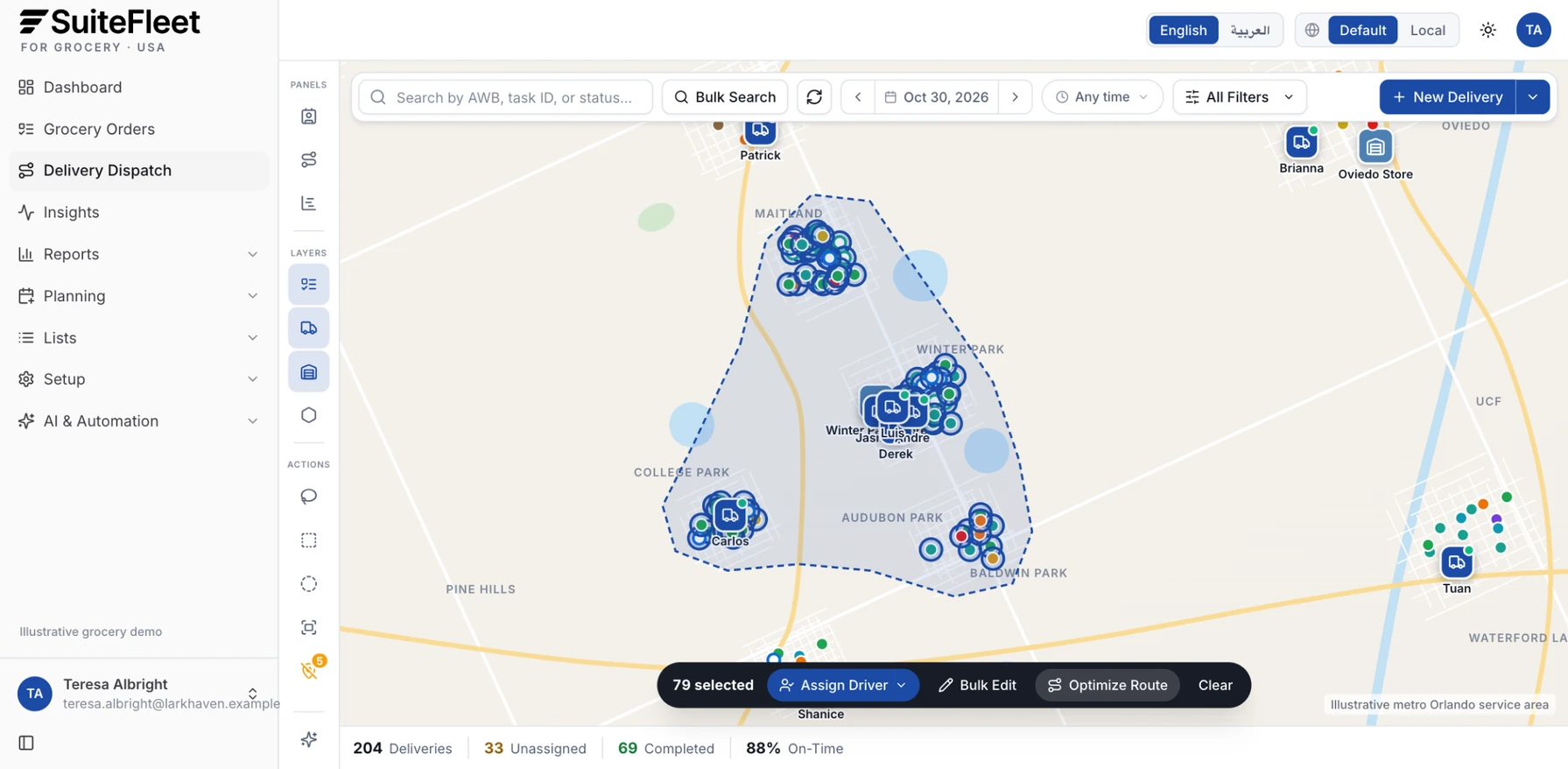
The Winter Park store's afternoon wave covers Winter Park, Maitland, Baldwin Park, Audubon Park, and College Park. The operations manager uses the lasso tool to select those deliveries, including the Palmer Avenue order. The selection bar then offers to assign a driver, edit in bulk, or optimize the route.
Fit every order inside its one-hour slot
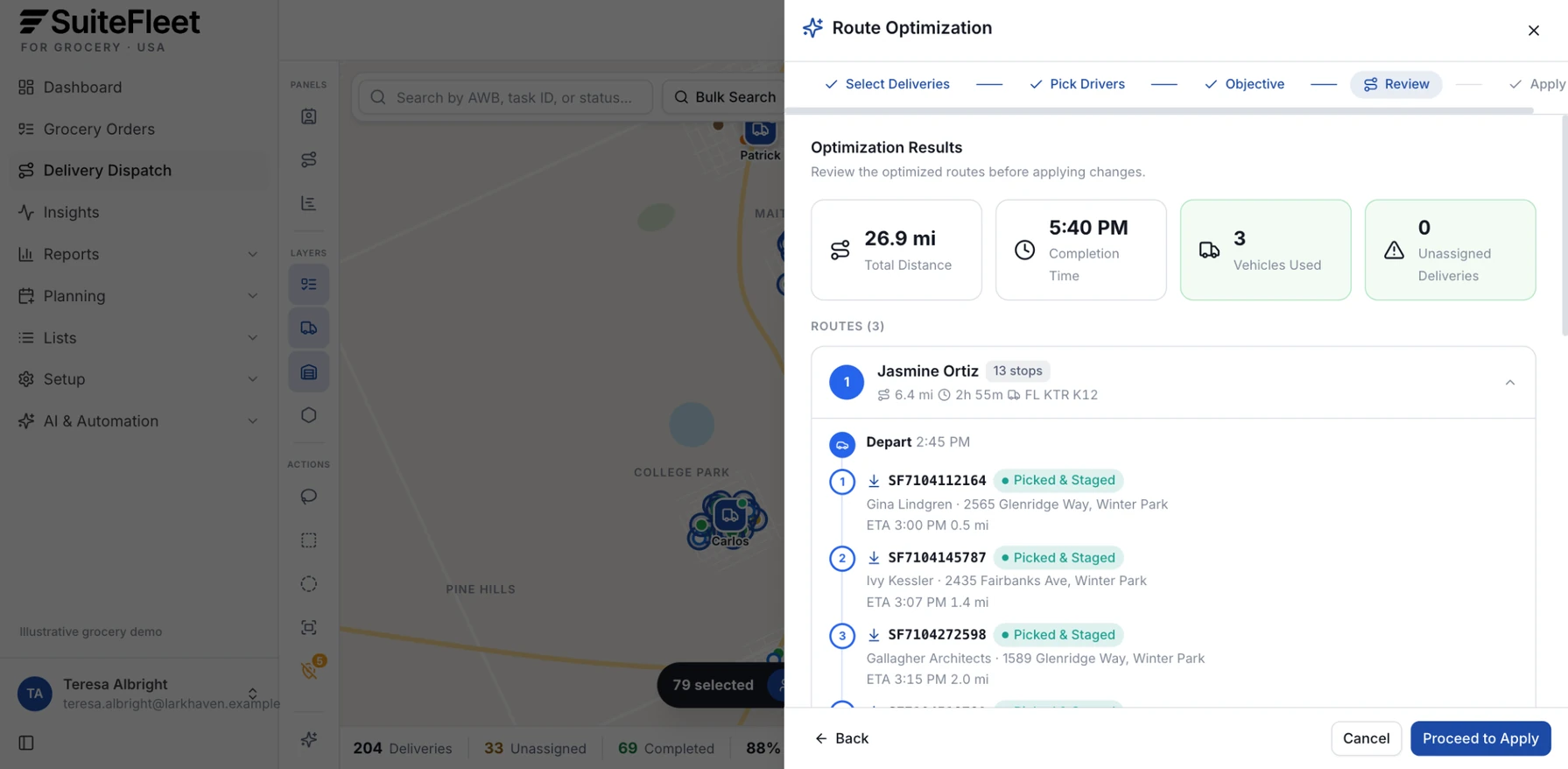
Of the 79 deliveries selected, 56 can still be planned. The optimizer leaves out the 23 that are already delivered, failed, canceled, or being returned. The operations manager enables the three drivers who start at the Winter Park store at 2:45 p.m.: two in-house drivers in refrigerated vans and a courier partner's driver in a minivan with cooler bags. She leaves Reassign Assigned Deliveries switched off, so the orders that already have other drivers, such as the midday driver's Baldwin Park stops, stay with them. The plan covers the other 33.
SuiteFleet's optimizer offers four goals: Fastest Completion, Shortest Distance, Fewest Vehicles, and Balanced Workload. The operations manager chooses Shortest Distance: with one-hour slots, finishing early helps little, because a driver who reaches a 4:00 p.m. stop at 3:45 waits for the slot to open, while fewer miles mean less time on the road for cold food. She leaves Respect Time Windows switched on, so every stop stays inside its slot, and sets the time per stop to 6 minutes instead of the default 10, because most handoffs are a few totes at a front door.
The results preview shows three routes, 26.9 miles in total, every driver back at the store by 5:40 p.m., and no unassigned deliveries. Each route works through the slots in order: the 3:00 p.m. stops first, then the 4:00, then the 5:00. The first refrigerated van takes 13 Winter Park stops over 6.4 miles, and the Palmer Avenue order is its seventh stop, at 4:21 p.m., well inside its slot. The second refrigerated van takes 12 Maitland stops over 9.5 miles, including four orders with frozen food. The courier partner takes eight College Park stops over 11 miles and is back at the store by 5:14 p.m.; none of the afternoon College Park orders includes frozen food, so cooler bags are enough for that part of the zone.
Before applying the plan, the operations manager checks two things the optimizer was not asked to decide: every order with frozen food is on a refrigerated van, and every driver, including the courier partner's, knows the ID rule, because all three routes carry beer or wine. Once the plan is applied, the route order becomes the loading order: load the last stop first. To see whether the waves work, track deliveries inside their slot, frozen bags handed over in person, ID refusals, and substitutions accepted. The screens show the workflow; your own operating data will show the improvement.
Bring failed handoffs back cold and rebook
A failed grocery delivery is a food problem as well as a route problem: the frozen and chilled totes have to go back into cold storage, the customer needs a new slot, and beer or wine cannot be left at an empty house. In the example, 6 deliveries failed, 5 with the reason "Customer not home" and 1 with "No adult 21+ with ID," and 12 others were delivered on a second attempt.
Failure reasons such as "Wrong address or gate code" and "Business closed" also show which problems start at checkout and which start at the door; a missing gate code is better fixed in the checkout form than on the driver's phone. When an order fails, the driver brings it back to its store, the totes go back into cold storage, and customer service offers the next open slot. The store's own food safety procedures, not the driver, decide which items can go back on the shelf.
Prove the handoff at the door
Customers ask after the fact: "Where is my ice cream?" or "Who signed for the wine?" The answer should take seconds, not a call to a driver five stops away.
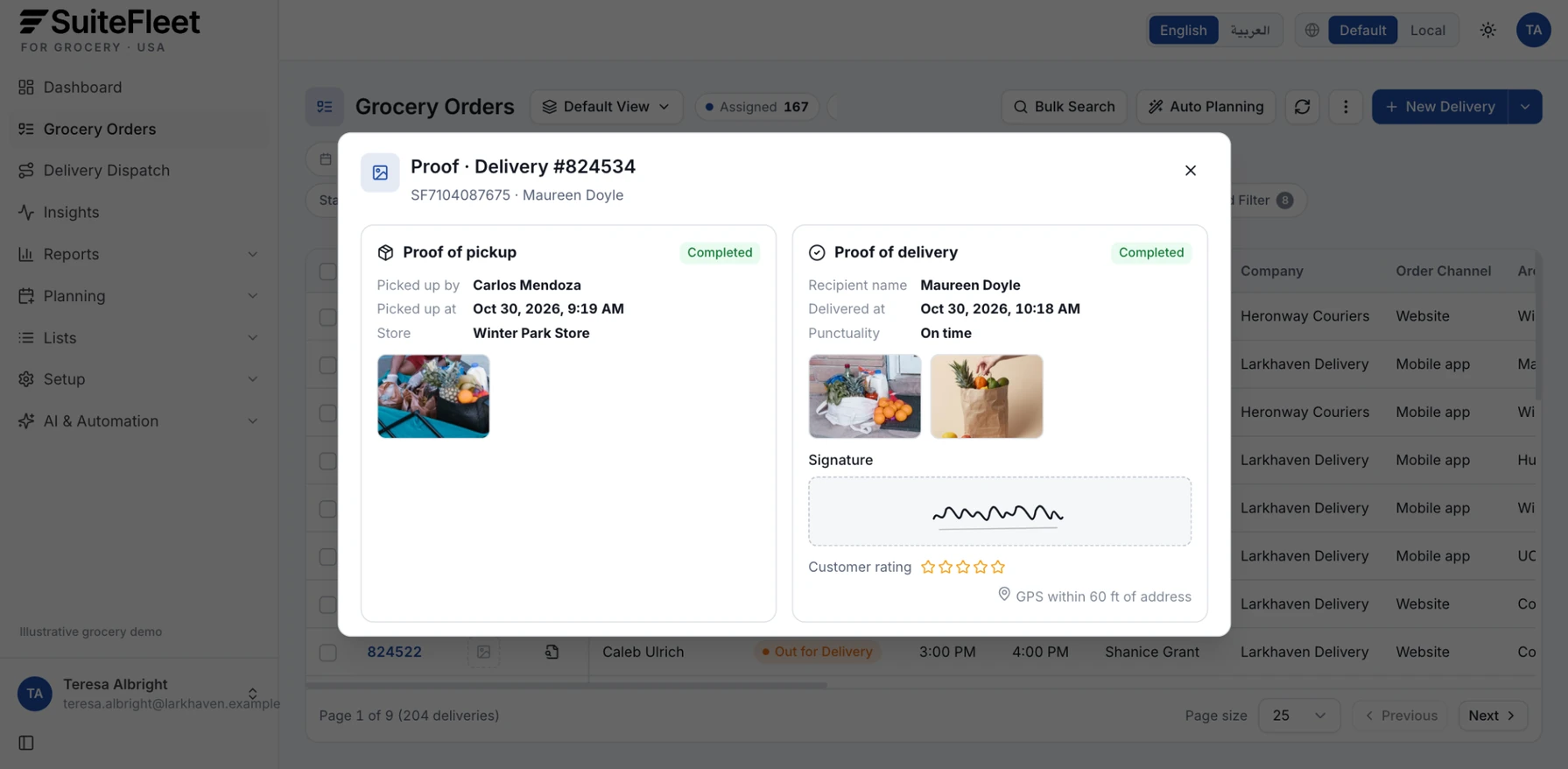
SuiteFleet records proof of pickup and proof of delivery for each stop. In the example, the record for a scheduled morning delivery in College Park with two bottles of wine shows the driver who picked up the order at the Winter Park store at 9:19 a.m., the customer who received it at 10:18 a.m., inside the 10:00 to 11:00 a.m. slot, photos of the groceries at the door, a signature, and a GPS check within 60 feet of the address.
For beer and wine, decide during setup how the driver records the ID check, for example in the delivery note, and confirm with your advisors what Florida's documentation requirement, described below, needs in your operation.
Connect delivery with your POS, eCommerce platform, and ERP
Your POS and eCommerce platform should stay the record for orders, prices, substitutions, refunds, and payments. Delivery software needs only what the driver needs: the customer, address, gate code, slot, handling type, totes by temperature, and drop note, plus the result to send back. NetSuite and Shopify have published SuiteFleet connectors. Grocery POS and eCommerce platforms would need a custom integration through SuiteFleet's API, subject to the access each vendor supports.
SuiteFleet's API supports custom integration work. During setup, decide where the final basket lives. The POS or eCommerce platform should own substitutions, refunds, and the split between SNAP and card payments, and the delivery record should only report whether the order was handed over, returned, or rebooked.
Compare SuiteFleet with five grocery delivery options
The comparison below places SuiteFleet alongside two general delivery platforms and three options built for grocery: an eCommerce platform with delivery management, fulfillment software from a grocery marketplace, and a delivery service with its own shoppers and drivers.
When is your eCommerce platform's delivery tool enough?
Many grocery eCommerce platforms include delivery tools or pass orders to delivery networks, so the fair question is why you would add a delivery platform. Often you should not. If you run one store with a few slots a day and a delivery service picks and delivers for you, its tools may be all you need. If your eCommerce platform already dispatches your own drivers and records ID checks, start there.
A separate delivery platform earns its place when the hard part is coordination rather than the single order. That usually means:
- Several stores, in-house drivers, and courier partners deliver into the same neighborhoods, and you want one plan and one proof record for all of them.
- Each wave is planned from staged orders that keep changing until shortly before the vans leave.
- Frozen food, beer and wine, and heavy cases each need the right van or driver.
- Orders come from more than one system, such as an eCommerce platform, a phone order desk, and business accounts in an ERP.
The Friday in this article is that kind of day: four stores, three slots planned at 2:35 p.m., frozen bags kept on two refrigerated vans, beer and wine on all three routes, and in-house drivers working next to a courier partner. If the afternoon wave is a daily scramble, compare the options on the same busy day's order list and see how much work still lands on the operations manager.
Check ID for beer and wine under Florida law, and follow food safety and SNAP rules
A good route is only part of a safe grocery delivery. Three sets of rules shape the handoff in the example: Florida's Beverage Law, Florida's food safety rules, and USDA's SNAP rules.
For beer and wine, section 561.57 of the Florida Statutes sets the delivery rules for vendors:
- A vendor may deliver sales made at its licensed place of business, and a telephone, electronic, or mail order received there counts as such a sale.
- Deliveries may be made in vehicles the vendor owns or leases or by a third party under contract, including common carriers. Vehicles the vendor owns or leases may be inspected without a warrant during business hours or while they are used to transport or deliver alcoholic beverages.
- Proof of the recipient's identity and age must be "verified and documented at the time of delivery."
- Every delivery, by the store or a third party, must comply with section 562.11, which bars selling, giving, or serving alcoholic beverages to anyone under 21. Its defenses include having carefully checked a driver license, state ID card, passport, or U.S. Uniformed Services ID.
That is why every beer and wine order in the example carries its own handling type, a one-time code, and the instruction never to leave it at the door. If nobody 21 or older can show valid ID, the driver brings the beer and wine back to the store. When a courier partner carries those orders, confirm in the contract who checks and documents the ID.
For cold and frozen food, Florida's Department of Agriculture and Consumer Services adopts most of the FDA's 2022 Food Code by rule 5K-4.002. The Food Code's definition of a food establishment includes an operation that hands food to consumers "through a delivery service such as home delivery of grocery orders." It requires food that needs time and temperature control for safety to be held at 41°F or below (section 3-501.16) and stored frozen foods to be kept frozen (section 3-501.11). Refrigerated vans and insulated totes keep food cold; delivery software can keep frozen orders on the right vans, keep the time from staging to the door short, and record when each order left the store and reached the customer.
For SNAP, USDA's Food and Nutrition Administration says benefits may pay only for eligible food, and delivery fees and other associated charges may not be paid with SNAP. Its list of eligible items excludes beer, wine, and liquor. A retailer that accepts SNAP online needs FNA authorization and a platform that supports online PIN entry through an approved processor, split payment for items and fees that SNAP does not cover, and checks that only eligible food is bought with benefits. In the example, 26 orders split payment between SNAP EBT and a card at checkout, so the driver never handles payment.
Software can carry handling rules, keep frozen orders on refrigerated vans, require a code at the door, and keep a signed, timestamped record of every handoff, but it does not make a grocer compliant on its own. Trained drivers, working cold storage, and the store's own alcohol and food safety procedures still do that work; confirm the current rules with Florida regulators or a qualified advisor before relying on them.
Plan your next afternoon wave
SuiteFleet gives grocers one place to manage delivery slots, staged orders, frozen and beer and wine handling, routes, courier partners, failed handoffs, and proof for every delivery. Test it against your busiest day: bring your store locations, slot schedule, driver shifts, vehicles, courier partners, and a sample order list with a day's frozen, beer and wine, and SNAP orders, and ask to see how the 2:35 p.m. plan changes when the 5:00 p.m. slot fills up.
Book a free SuiteFleet demonstration to see how dispatch planning and route optimization can fit your grocery delivery operation.