In lab outreach, most of the work is pickups, and every route ends at the same door: accessioning, before the lab's cutoff.
It is 2:30 on a Thursday afternoon. An urgent care in Henrietta called at 2:05 p.m. for a STAT pickup. An endocrinology practice in Brighton has a frozen specimen in its freezer that cannot go in the lockbox. Dozens of physician offices and patient service centers still expect their afternoon sweep, and their bags travel at three temperatures: ambient, refrigerated, and frozen. Everything collected this afternoon has to reach the core lab's accessioning bench by 7:00 p.m. to make tonight's testing.
Someone has to decide which courier takes each stop, in what order, and whether the bags will reach the lab in time and at the right temperature.
That is the job of delivery management for clinics and lab specimens. SuiteFleet brings pickup requests, dispatch planning, route optimization, and proof of pickup and delivery into one shared workflow, so a lab can run the afternoon sweep from a plan instead of a phone log.
Let's follow Janelle, the courier supervisor at a regional clinical laboratory serving physician offices, urgent cares, and its own patient service centers across Greater Rochester, New York, from a core lab and three hubs, through a worked example. The screens are lab courier demo illustrations; names, addresses, maps, and figures are examples.
Start with the lab's cutoff, not the clinic's closing time
A specimen courier route works backward from the lab. Offices close at 5:00 or 5:30 p.m., but the deadline that matters is when the lab stops accepting specimens for the evening run. The specimen has its own clock too: Labcorp's specimen guidance says serum must be separated from cells within 45 minutes to two hours depending on the test, and a late pickup squeezes everything after it.
The work comes in three kinds. Standing stops are the daily sweeps to each client. Will-calls are offices that phone in for a pickup they do not usually need. STAT pickups are urgent and go straight to the lab.
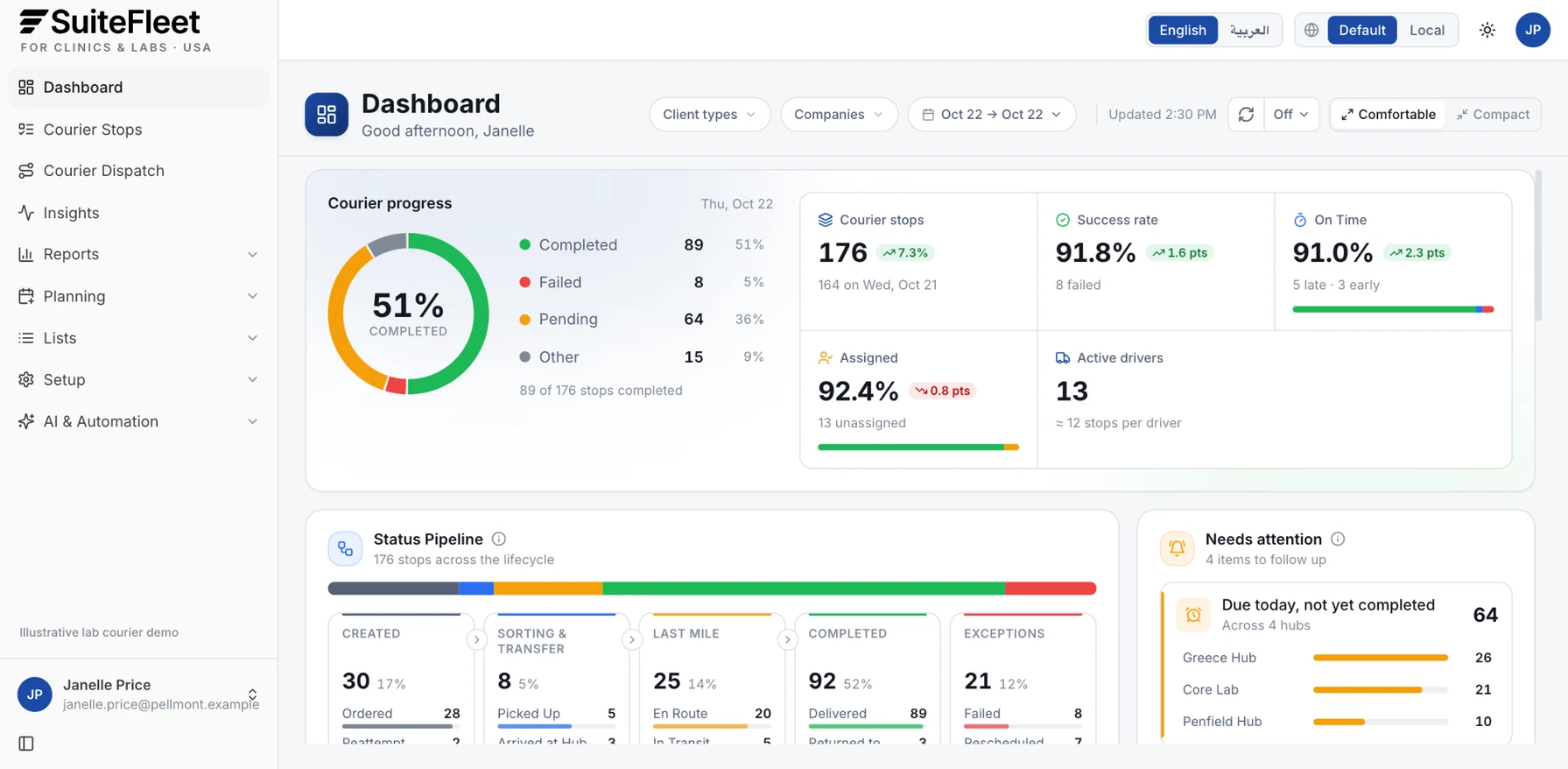
The supervisor starts with the day as a whole. The dashboard shows 176 courier stops, 89 completed, 13 still without a courier, and 64 still due across four hubs. Most of the open work belongs to the afternoon sweep.
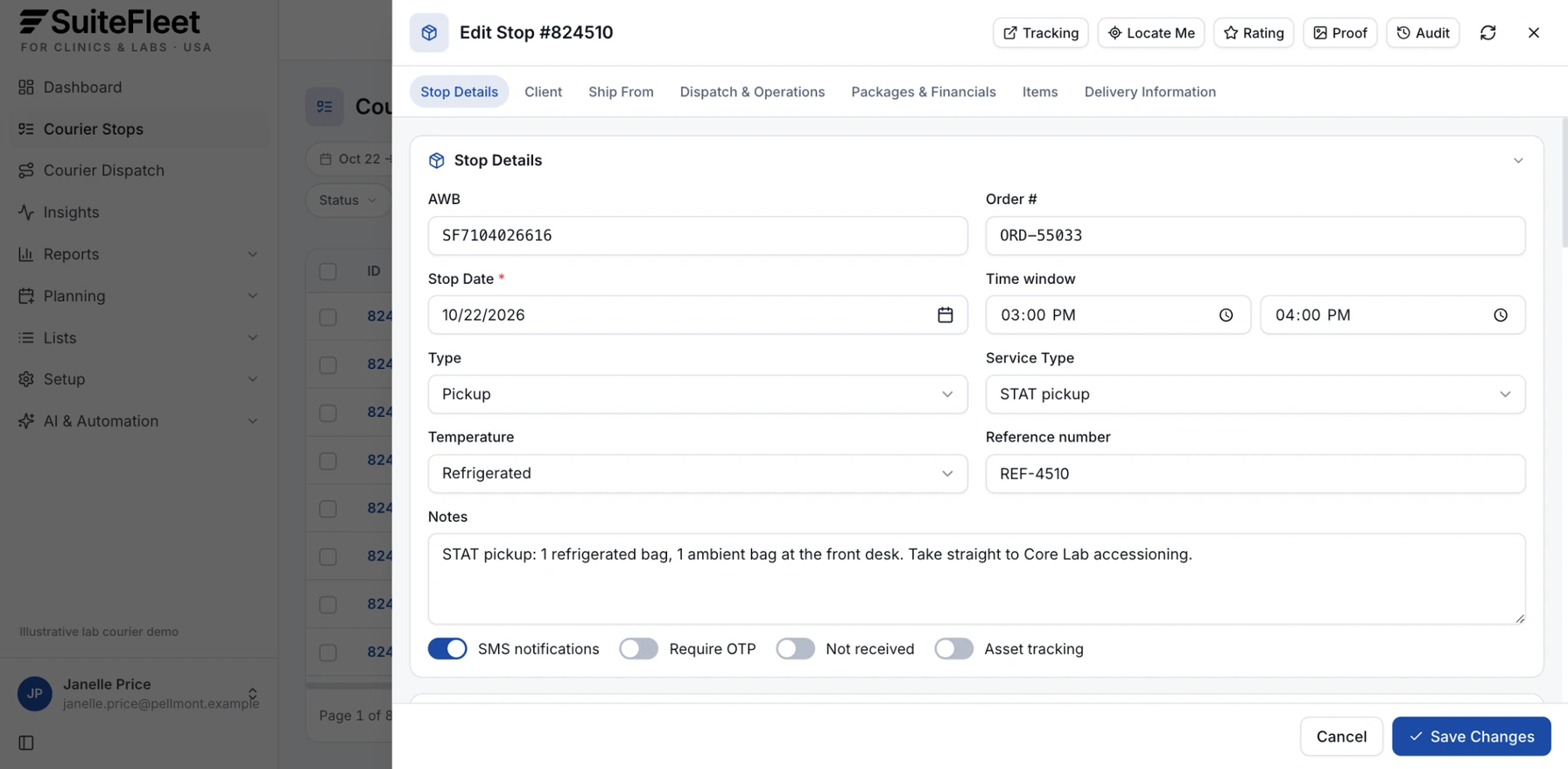
Good pickups start when the request is entered. "Pickup at Thornwick" is far less useful than "STAT pickup: 1 refrigerated bag, 1 ambient bag at the front desk. Take straight to Core Lab accessioning."
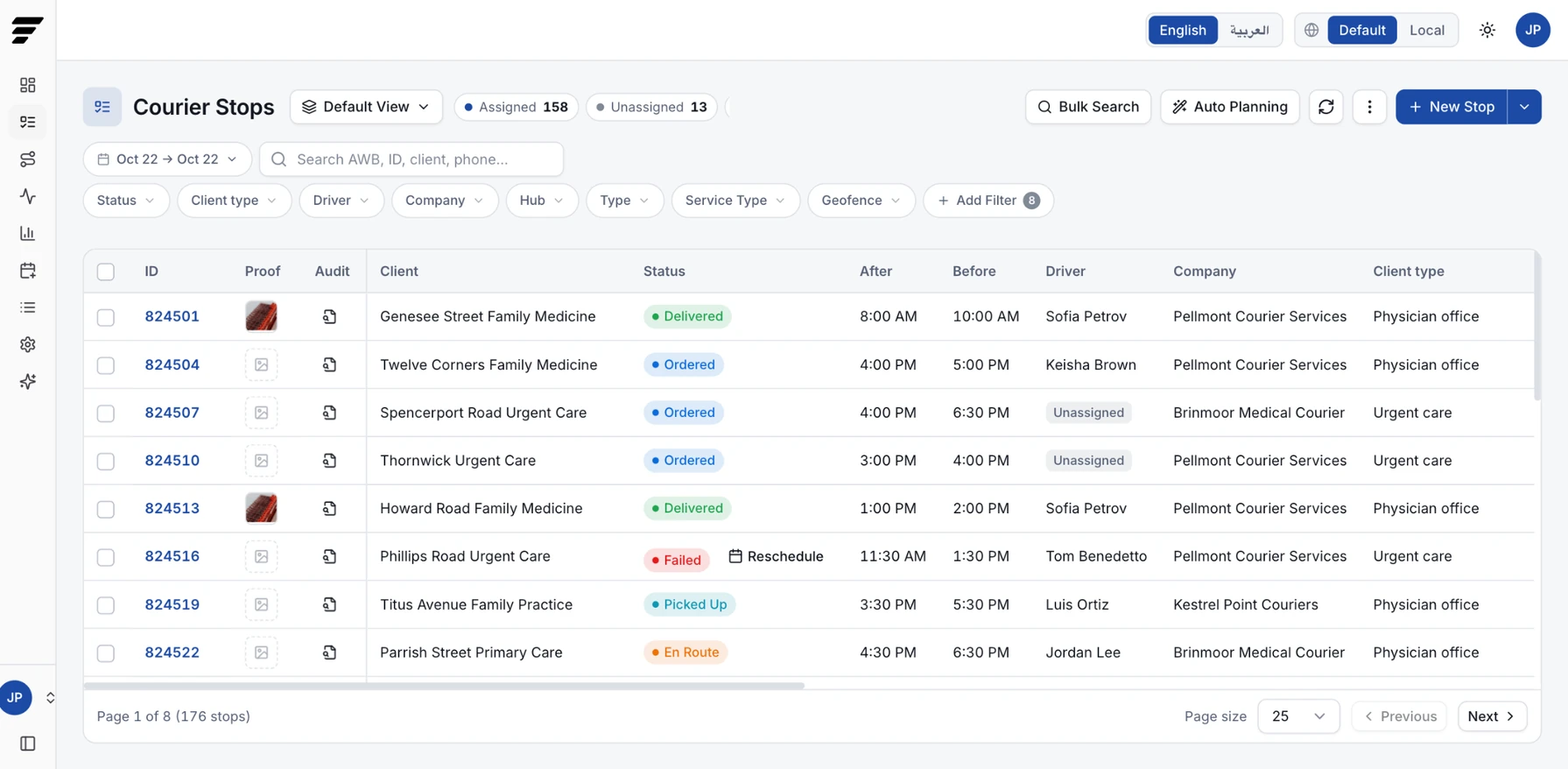
SuiteFleet's stop list keeps the client, status, pickup window, courier, company, and client type in the same view, so the supervisor can see which offices are covered and which stops still need a courier. The company column also shows which couriers work for the lab and which come from courier partners.
For the STAT pickup, the supervisor opens the details screen. The type is Pickup, the service type is STAT pickup, the window runs from 3:00 to 4:00 p.m., the temperature is refrigerated, and the note gives the bag count and where the bags go. The note carries bags and temperatures, not patient names or test orders.
Keep ambient, refrigerated, and frozen specimens apart
Temperature is where specimen courier work differs most from parcel delivery, so labs ask offices to bag specimens by temperature. The Cleveland Clinic Laboratories lockbox instructions are a good example: ambient and refrigerated specimens go in different colored bags, refrigerated bags sit on a frozen gel pack with a divider so they do not freeze, and frozen specimens never go in the lockbox. They stay in the office freezer until a courier comes for them.
The lockbox itself is a weak point. A 2021 Clinical Laboratory News feature, published by the association now known as ADLM, notes that there are no universal standards for courier lockboxes. It cites a study in which lockboxes with ice packs averaged 22.3°C (about 72°F), while those without averaged 42.6°C (about 109°F), and it calls the courier leg the longest part of a sample's journey. In Rochester, the same lockbox sits in July heat and January cold.
SuiteFleet does not cool anything; the couriers' coolers and dry ice do that. What it can do is make temperature part of each stop. In the example, every pickup carries its temperature and bag counts, and the frozen will-call says "not the lockbox" and asks for the dry-ice cooler. SuiteFleet's pharmaceutical delivery page also describes temperature threshold tracking, exception alerts, and time-in-transit monitoring for temperature-sensitive routes, and lists laboratory samples among the items it supports.
Plan the afternoon sweep as pickups that meet at one lab
A sweep is not a delivery run in reverse. The stops are short, often a lockbox or a front desk, but there are many of them, and every route has to end at the lab. Counting stops per courier still hides the real workload: thirty stops over 141 miles is a very different day from five stops over 11 miles.
In SuiteFleet's dispatch workbench, each courier's route appears with its stop count, distance, and duration, next to the map. The supervisor can compare workloads before planning the afternoon.
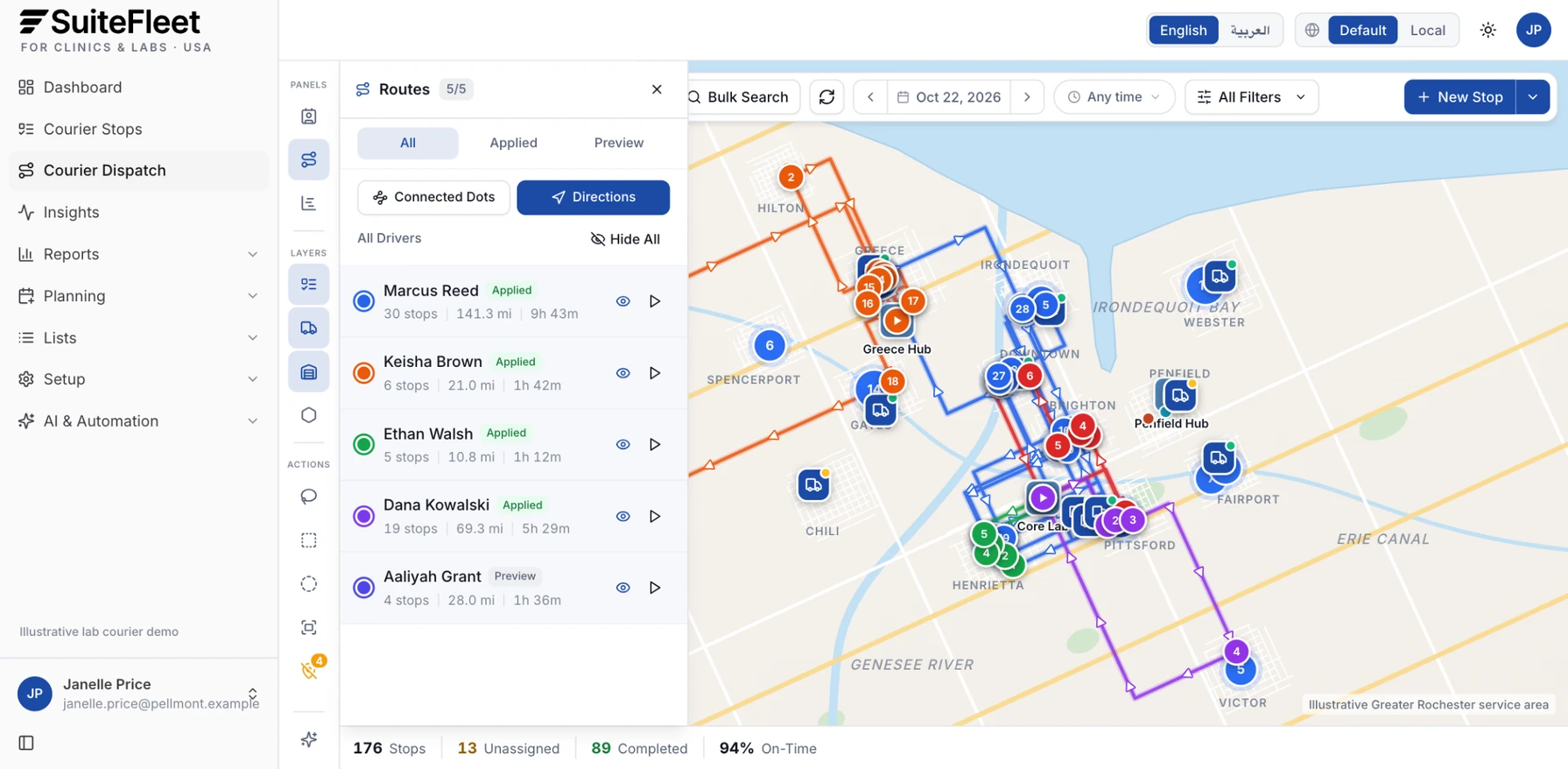
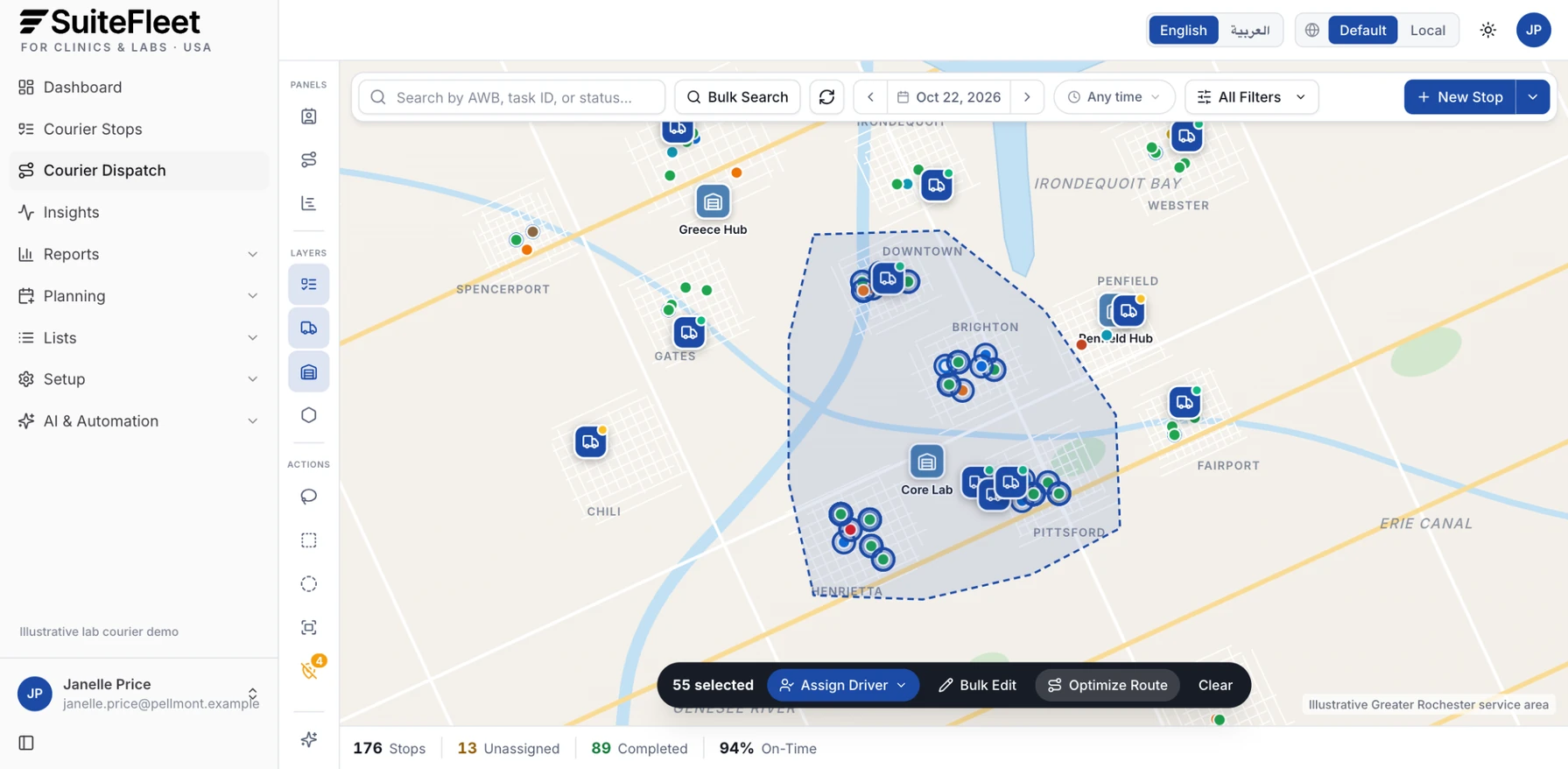
The open afternoon work clusters around the core lab. The supervisor uses the lasso tool to select stops across Downtown, Brighton, Pittsford, and Henrietta, including the STAT pickup and the frozen will-call. The selection bar then offers to assign a courier, edit in bulk, or optimize the route.
Fit STAT and will-call pickups into the sweep
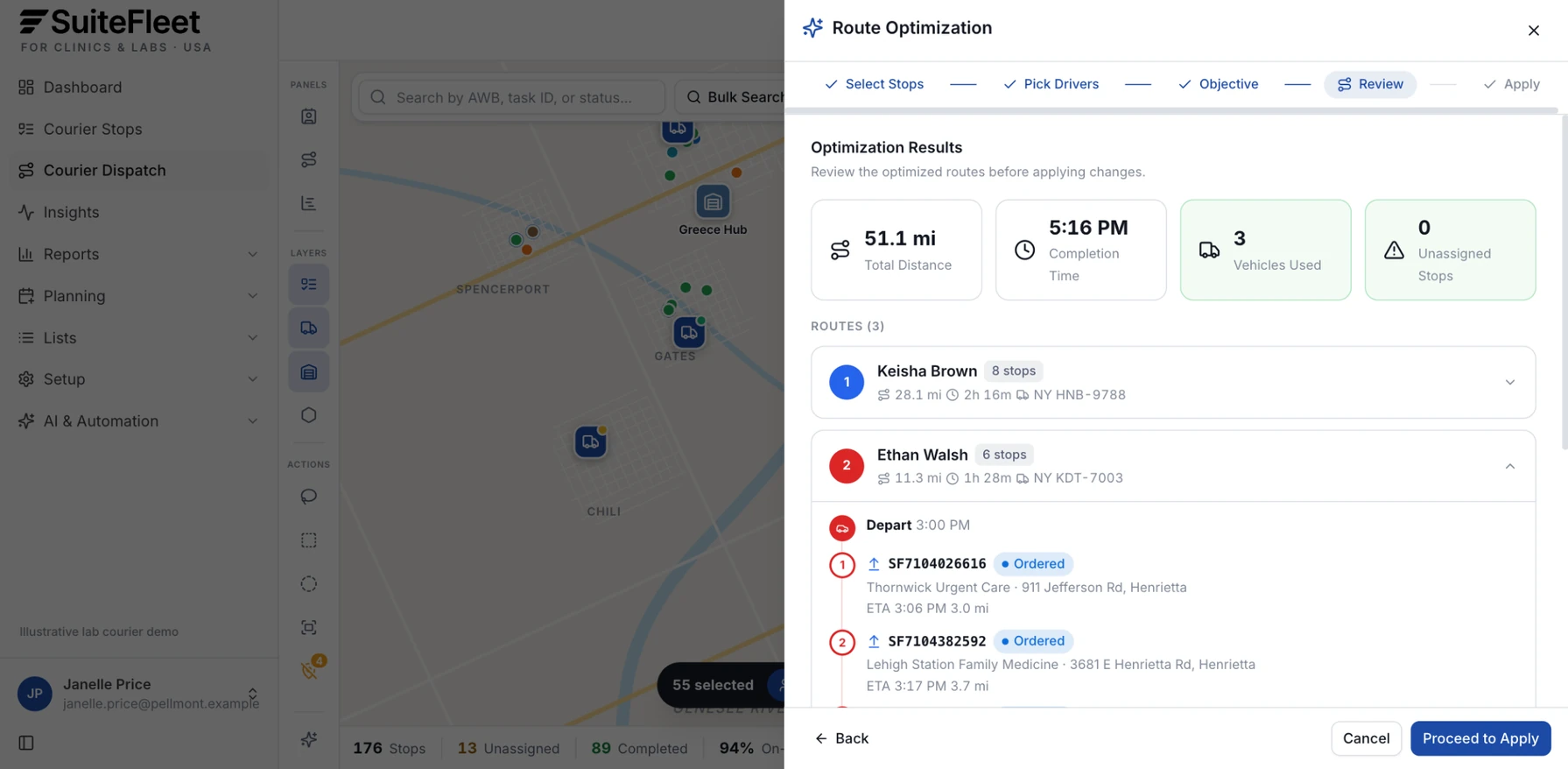
Of the 55 stops selected, 24 are still open. The optimizer leaves out the ones already completed, failed, or canceled. The supervisor enables the three couriers on the 3:00 to 11:00 p.m. shift who start at the core lab: one lab courier and two drivers from a courier partner. She leaves Reassign Assigned Stops switched off, so the six open stops already on a day-shift courier's route stay with that courier. The plan covers the 18 stops that are unassigned or already with the afternoon couriers, including one box of collection supplies for a family practice, so pickups and a drop-off share the same route.
SuiteFleet's optimizer offers four goals: Fastest Completion, Shortest Distance, Fewest Vehicles, and Balanced Workload. The supervisor keeps Fastest Completion, because specimens that reach the lab sooner leave more time for processing. She leaves Respect Time Windows switched on and keeps the default 10 minutes per stop, because most stops are a lockbox or a front-desk handoff.
The results preview shows three routes, 51.1 miles in total, the last pickup finished by 5:16 p.m., and no unassigned stops. The STAT pickup becomes the first stop on a courier partner's route, with an estimated arrival of 3:06 p.m., six minutes after its window opens. The frozen will-call is the fourth stop on the lab courier's route, at 3:52 p.m., inside its 3:30 to 5:00 p.m. window, so the specimen spends little time out of the office freezer.
This is the practical value of specimen route planning: a workable decision while there is still time to change it. The last pickup ends well before the 7:00 p.m. cutoff, which leaves room for the drive back and a late will-call. To see whether it is working, track specimens received before the cutoff, time from STAT call to accessioning, missed or late standing stops, and specimens rejected at accessioning for temperature or age. The screens show the workflow; your own operating data will show the improvement.
Close the chain of custody at accessioning
Offices and the lab both ask questions after the fact. "Did the courier take the refrigerated bag?" "When did it reach the lab?" The answer should take seconds, not a call to the courier.
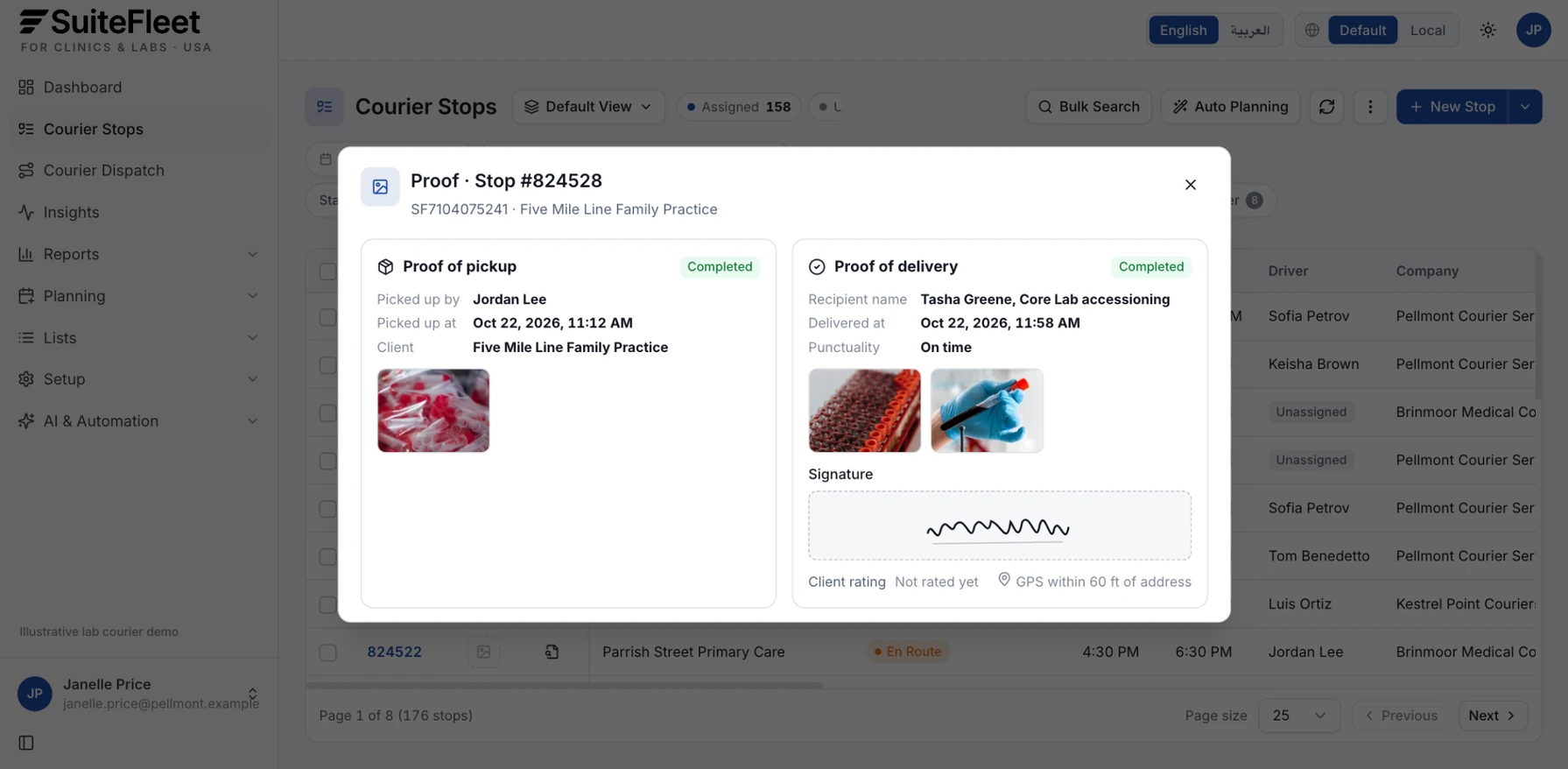
SuiteFleet records proof of pickup and proof of delivery for each stop. In the example, the record shows the courier who collected three bags from a family practice's lockbox in Penfield at 11:12 a.m., the accessioner who received them at the core lab at 11:58 a.m., whether the stop was on time, photos, a signature, and a GPS location check. This courier works for the courier partner, and the record has the same fields a lab courier's would.
Connect delivery with your LIS, client systems, and coolers
Your laboratory information system (LIS) should stay the system of record for orders, specimens, and results, and client offices keep their own EHRs. Delivery software should receive only what the courier needs: the client, the window, bag counts, temperatures, and handling notes. NetSuite has a published SuiteFleet connector. Lab, EHR, and temperature monitoring systems would need a custom integration through SuiteFleet's API, subject to the access each vendor supports.
SuiteFleet's API supports custom integration work. During setup, map only the fields the courier needs: client, pickup point, window, service type, temperature, bag counts, handling notes, and status updates.
Compare SuiteFleet with five lab courier options
Labs can choose a dedicated delivery platform, courier software built for medical couriers, the courier tools that come with their laboratory software, or an outsourced courier service. The comparison below places SuiteFleet alongside two general delivery platforms and three lab-specific options.
When is your LIS courier module or courier partner enough?
Some laboratory software already tracks couriers, and some labs hand the whole job to a courier service, so the fair question is why you would add a delivery platform. Often you should not. If your routes are fixed and your LIS already logs pickups and arrivals, keep the courier work where the specimens are tracked. If an outsourced courier meets your cutoffs and shows you pickup confirmations, that may be enough too.
A separate delivery platform earns its place when the hard part is coordination rather than the single pickup. That usually means:
- Lab couriers and courier partners cover the same region, and you want one plan and one proof record for both.
- STAT and will-call requests arrive all afternoon, and the sweep has to be rebuilt around them.
- Several hubs and patient service centers feed one core lab, or one supervisor plans for all of them.
- The same couriers also deliver collection supplies or carry other work, such as hospital or pharmacy runs.
The afternoon in this article is that kind of day: a core lab and three hubs, a STAT call at 2:05 p.m., a frozen will-call, and a lab courier working next to two partner drivers. A simple test: if your sweeps rarely change after the morning, the tool you have may be enough. If rebuilding the afternoon sweep is a daily job, a separate platform is worth evaluating.
Either way, compare the options using the same busy day's stop list, with standing stops, will-calls, STAT pickups, frozen specimens, and supply deliveries, and see how much work still lands on the supervisor.
Follow CLIA, DOT, and New York's specimen rules
A good route is only part of safe specimen transport. Federal CLIA rules require a laboratory to have written policies for specimen submission and handling, 42 CFR 493.1242, including the conditions for specimen transportation. The lab must document the date and time it receives each specimen, and a lab that accepts referral specimens must give its clients written instructions for collecting and handling them.
Because the example lab is in New York, its patient service centers also follow the state's rule on collection and acceptance of specimens, 10 NYCRR 58-1.7, in the version effective September 2, 2026. Among other requirements, it says to:
- Store and transport each specimen under storage criteria suited to the specimen type and the test requested, keeping it as close to its original condition as possible.
- Transport specimens in a manner designed to minimize the chance of exposing staff or the public to infection or other hazards.
- Keep a daily accession record at each collecting station, including the date and time each specimen was forwarded to the clinical laboratory.
The vehicle has rules too. Under DOT's hazardous materials regulations, patient specimens that count as Category B infectious substances (UN3373) travel in triple packaging marked "Biological substances, Category B," and the people who offer or transport them must know those requirements. An exception in 49 CFR 173.134 covers specimens carried by a private or contract carrier in a motor vehicle used exclusively for such materials, and it allows medical or clinical equipment and laboratory products on board if they are properly packaged and secured, which matters when the same courier drops off supplies. PHMSA's guide Transporting Infectious Substances Safely explains which rules apply. OSHA's bloodborne pathogens standard adds that specimens travel in containers that prevent leakage, labeled or color-coded once they leave the facility.
Courier records feed those logs. In the example, the proof record gives each stop a collection time, a courier, and the accessioner who received the bags, and the stop itself carries the temperature and bag counts. Labs outside New York should check their own state's laboratory rules, because they differ by state.
Software can carry instructions, schedule pickups, and keep a signed, timestamped record, but it does not make a lab or courier compliant on its own. Written procedures, proper packaging, coolers and dry ice, trained couriers, and the laboratory's quality system still do that work.
Plan your next afternoon sweep
SuiteFleet gives clinical labs and specimen couriers one place to manage standing stops, will-calls, STAT pickups, courier assignments, routes, and proof. Test it against your busiest sweep. Bring your client list and lab cutoffs, courier shifts, courier partners, and a sample stop list, and ask to see the plan, the exceptions, and how a 2 p.m. STAT call changes the afternoon.
Book a free SuiteFleet demonstration to see how dispatch planning and route optimization can fit your lab courier operation.