A furniture delivery promise is made at the sales counter and kept in the customer's home. The customer takes time off work to be there, the building has to let the crew in, the pieces have to fit through the door and up the stairs, and in California the window itself is set by law.
It is 12:40 on a Saturday afternoon in Sacramento, California. A customer who bought a queen bedroom set at a Roseville showroom nine days ago is waiting at her condo on P Street in Midtown, three floors up. She chose the 1:00 to 5:00 p.m. window, and her building has reserved the freight elevator for the delivery from 1:00 to 4:00 p.m. The crew has to assemble the bed, attach the mirror to the dresser, set up a new mattress and foundation, and take her old mattress and box spring away. Her order is staged at the distribution center in Rancho Cordova, one of 15 deliveries in this afternoon's wave to Midtown and East Sacramento, Arden-Arcade, and Carmichael. Three two-person crews leave in ten minutes.
Someone has to decide which crew takes which homes, in what order, how to keep every stop inside its window, and how the store will prove what was delivered, assembled, and taken back.
That is the job of delivery management for furniture. SuiteFleet brings delivery windows, dispatch planning, route optimization, handling notes, and proof of pickup and delivery into one workflow, so a furniture retailer can plan each wave around its customers' windows and the work inside each home instead of around whichever truck is free.
Let's follow Jasmine Whitaker, the operations manager at Tulegrove Home Furnishings, a fictional furniture and mattress retailer with three showrooms and four warehouses in metro Sacramento, through a worked example. The screens are furniture demo illustrations; names, addresses, maps, and figures are examples.
Start from the customer's four-hour window, not the truck's route
Furniture is a large purchase that customers wait for. In the U.S. Census Bureau's advance monthly retail sales report for September 2026, furniture and home furnishings stores sold an estimated $10.7 billion in the month, seasonally adjusted, up 4.9% from September 2025, while sales for the first nine months of 2026 were 1.5% below the same period of 2025. When each sale matters, a missed window costs more than the trip: the customer took the afternoon off, and the crew has to come back.
In the example, every delivery gets a four-hour window that starts at 7:00, 9:00, or 11:00 a.m., or at 1:00 or 3:00 p.m. Early crews leave at 6:30 a.m. and take windows that start by 11:00 a.m. Day crews cover the rest of the metro from 9:00 a.m. Two contract carriers run threshold and room-of-choice deliveries from 8:00 a.m. And an afternoon wave of three two-person crews covers the central neighborhoods from the Rancho Cordova distribution center.
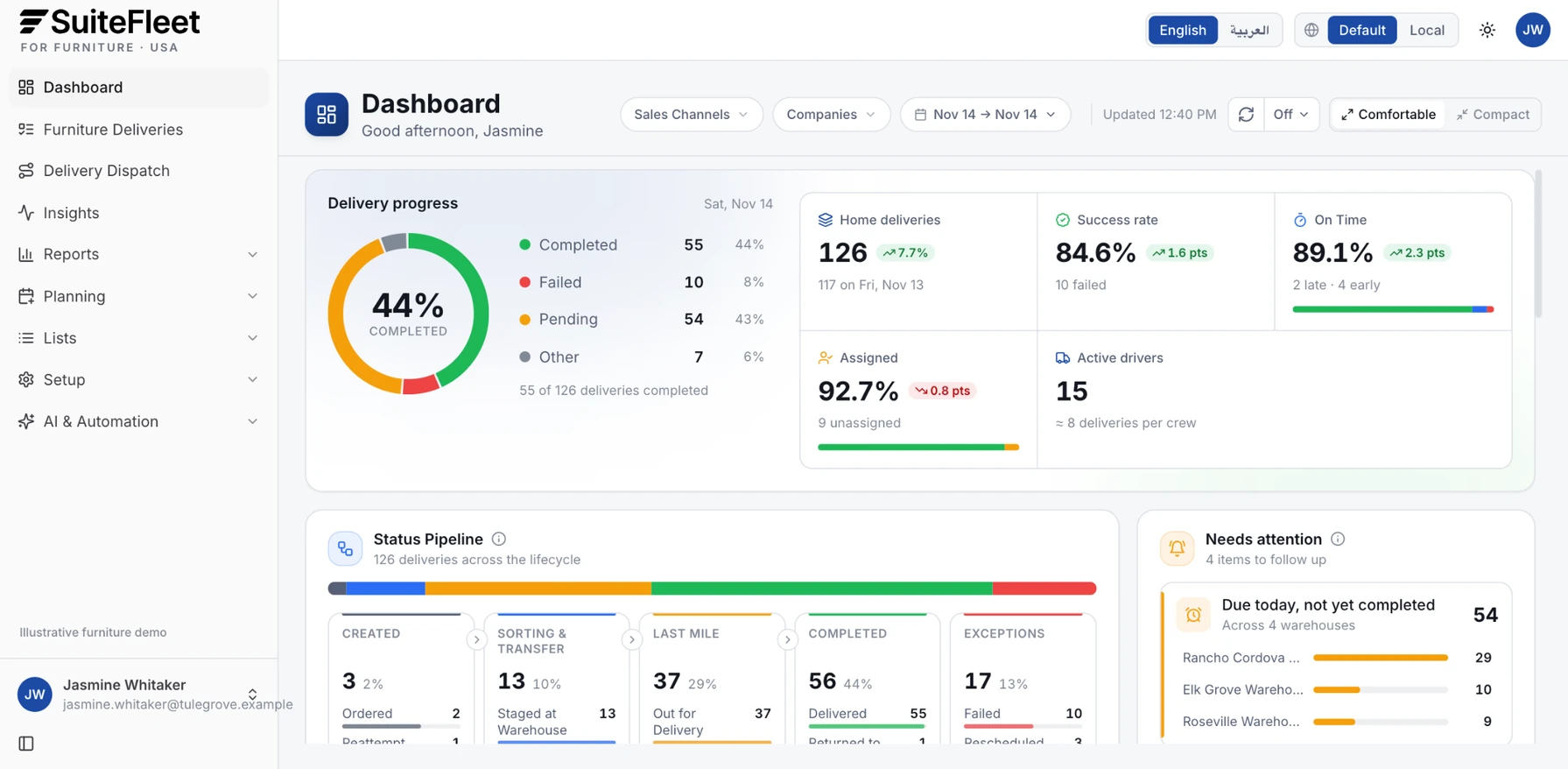
The operations manager starts with the day as a whole. The dashboard shows 126 home deliveries: 55 completed, 10 failed, and 54 still due across the four warehouses, 29 of them from the Rancho Cordova distribution center. Nine deliveries are still unassigned, and all nine are waiting for the afternoon wave.
SuiteFleet's delivery list keeps the customer, status, window, driver, company, sales channel, and area in the same view. The Sold At column shows whether each order came from a showroom, the online store, or a phone order. The company column separates Tulegrove's own crews from the two contract carriers that, in the example, take only room-of-choice and threshold deliveries, never assembly or mattress take-back. The P Street order sits near the top of the list, staged at the warehouse for its 1:00 to 5:00 p.m. window and still unassigned.

Put the pieces, the room, and the building on the same order
A furniture delivery fails in small ways. The sofa will not turn the corner of the stairwell. The building wants an elevator booking the store never arranged. The old mattress stays in the bedroom because no one told the crew the customer accepted take-back. Each mistake shows up later as a second trip, a damage claim, or an unhappy call to the showroom.
For the P Street order, the operations manager opens the details screen. The service type is Scheduled delivery, the window runs from 1:00 to 5:00 p.m., and the handling is White glove, assembly. The note tells the crew what to do and how to get in: assemble the queen bed, attach the mirror to the dresser, and place the two nightstands in the primary bedroom; set up the queen mattress and foundation; pick up the used queen mattress and box spring at no charge, because the customer accepted take-back; third-floor condo, elevator reserved 1:00 to 4:00 p.m., freight entrance on 22nd Street; call 30 minutes before arrival; the customer inspects each piece and signs.

Every delivery in the example carries one of four handling types, because the work inside the home decides the crew, the truck, and the time on site: Threshold, boxed; Room of choice; White glove, assembly; and Mattress, take-back. Of the day's 126 orders, 49 are room-of-choice deliveries of sofas, sectionals, and recliners, 39 are white glove deliveries of bedroom and dining sets, 29 are mattress deliveries, and 9 are boxed threshold drops. On 20 of the 29 mattress orders, the customer accepted take-back of the used mattress.
Plan the afternoon wave from the distribution center
The afternoon wave cannot be planned at 6:30 a.m., because the morning's results and the customers' calls decide what is ready. Some customers move their window, and others add a piece when a special order arrives early. In the example, the Rancho Cordova distribution center plans its 1:00 and 3:00 p.m. windows at 12:40, when the orders are staged and the three crews leave in ten minutes.
Counting orders hides the workload. In SuiteFleet's dispatch workbench, each driver's route appears with its delivery count, distance, and duration. In the example, an early-route crew has 12 deliveries over 65.9 miles, a contract carrier's driver has 4 deliveries over 33.4 miles, and a day-route crew in Folsom has a 10-stop preview over 40.9 miles. Two of the afternoon crews hold only two staged orders each so far.

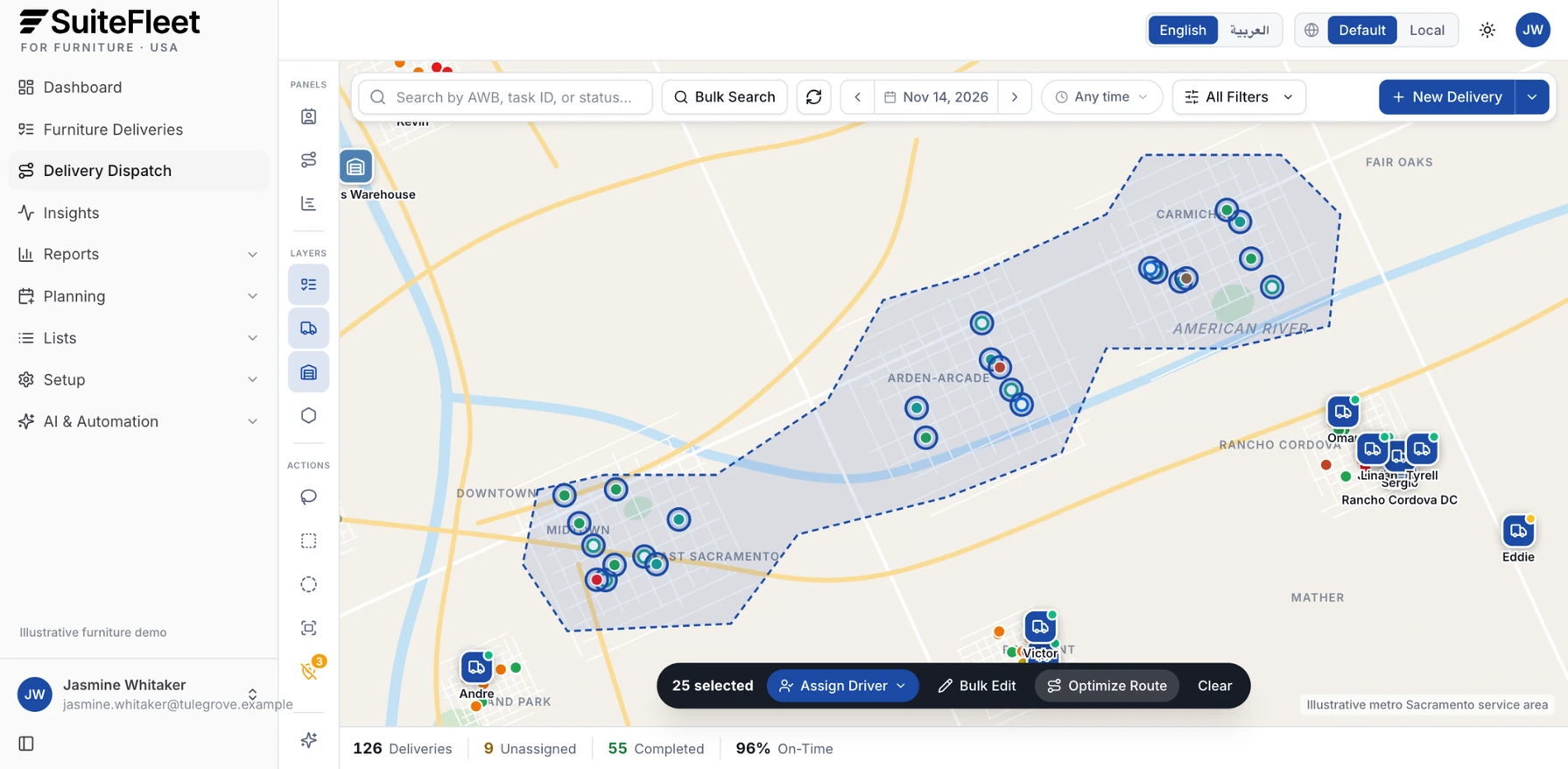
The afternoon wave covers three parts of central Sacramento: Midtown and East Sacramento, Arden-Arcade, and Carmichael. The operations manager uses the lasso tool to select those deliveries, including the P Street order. The selection bar then offers to assign a driver, edit in bulk, or optimize the route.
Keep every stop inside its window
Of the 25 deliveries selected, 15 can still be planned: 13 staged at the warehouse and 2 still being pulled. The optimizer leaves out the 10 morning deliveries that are already delivered, failed, returned, or canceled. The operations manager enables the three crews that start at the Rancho Cordova distribution center at 12:50 p.m. and leaves Reassign Assigned Deliveries switched off, so the six orders already on the trucks stay where they are.
SuiteFleet's optimizer offers four goals: Fastest Completion, Shortest Distance, Fewest Vehicles, and Balanced Workload. The operations manager chooses Fastest Completion, which finishes all deliveries as early as possible. On a furniture wave, an early finish matters more than a few saved miles: a crew that runs late at 2:00 p.m. pushes every later customer toward the edge of the window. She leaves Respect Time Windows switched on and sets the time per stop to 45 minutes instead of the default 10, to allow for carrying the pieces in, assembling them, and walking the customer through the inspection.
The results preview shows three routes, 61.2 miles in total, the last crew back at the distribution center by 5:32 p.m., and no unassigned deliveries. Each crew gets five stops in its own part of the wave and works through the windows in order: the 1:00 p.m. stops first, then 3:00 p.m. The Midtown crew covers 28.9 miles and reaches the P Street condo at 2:49 p.m., so it should finish inside both the customer's window and the elevator booking. The Arden-Arcade crew covers 19.4 miles and the Carmichael crew 12.8 miles.
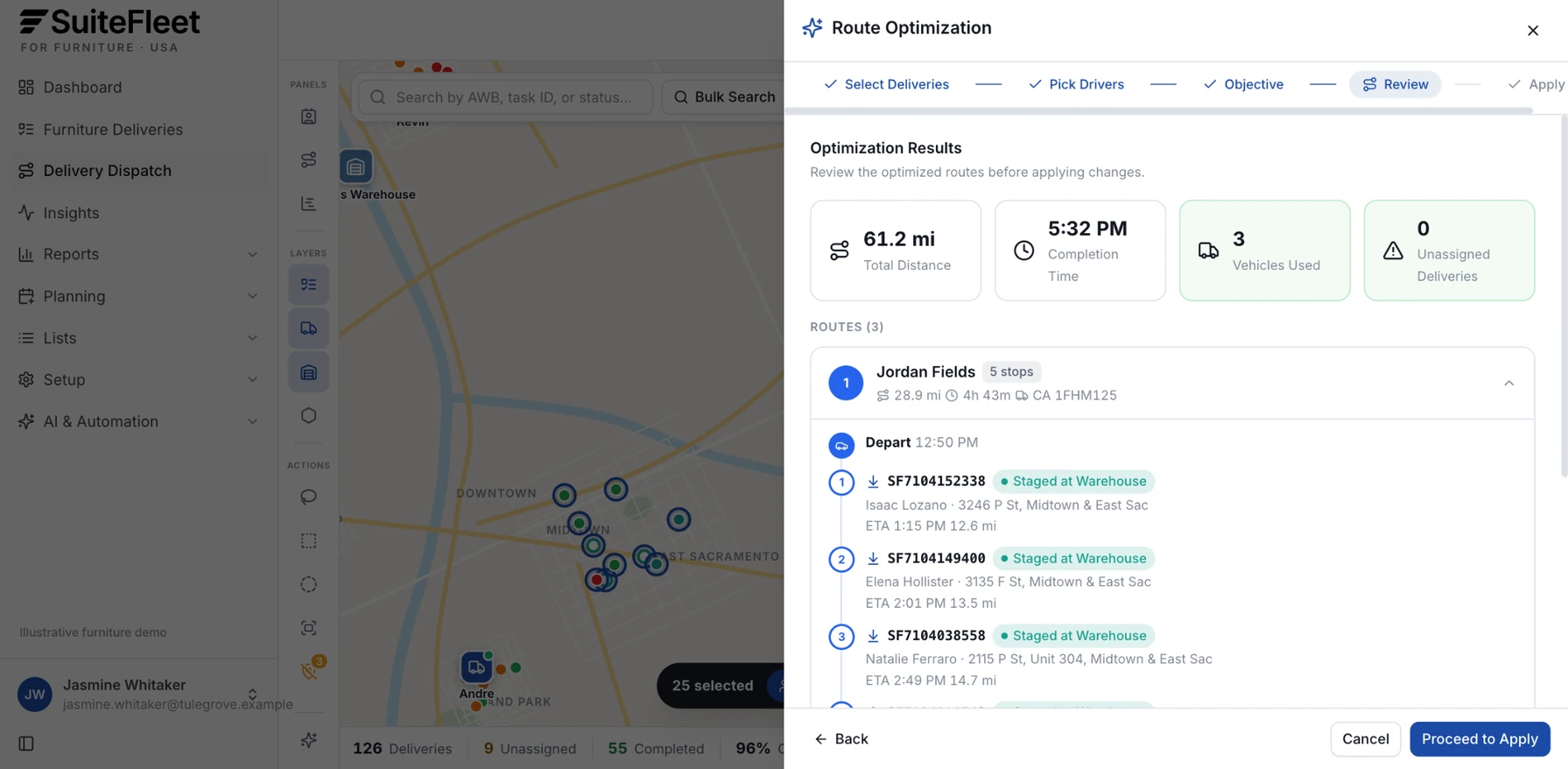
In this example, the optimizer plans stops and windows without checking cubic volume, so the operations manager checks each load by eye before applying the plan. The wave carries about 990 cubic feet of furniture and mattresses: about 320 on the Midtown route, 400 on the Arden-Arcade route, and 270 on the Carmichael route. In the example, Tulegrove plans each 26-foot box truck to about 1,200 cubic feet, so all three loads fit, with room left for the three used mattress sets that come back on the same trucks. Once the plan is applied, the route order becomes the loading order: the last stop goes on the truck first, and space near the door stays free for the first take-back. To see whether the waves work, track deliveries inside their window, second trips, damage claims, and failed deliveries by reason. The screens show the workflow; your own operating data will show the improvement.
Handle the deliveries that do not go in
A failed furniture delivery usually starts at the door, not the truck. No one is home, the building has not arranged access, the piece does not fit, or the customer refuses an item that arrived damaged. In the example, 10 deliveries failed: 4 with the reason "Item does not fit," 2 with "Building access not arranged," 2 with "Damaged, refused," and 2 with "Customer not home." Four others are rescheduled or waiting for a second attempt, and two orders are on their way back to the warehouse or already there.
"Item does not fit" is the reason to watch, because it is the most expensive one to repeat. The crew has carried a sectional to a doorway it cannot pass, the piece goes back on the truck, and the customer often wants a different item, not a second attempt. The failure reason tells sales which questions to ask at the counter, such as the width of the front door and the turn at the top of the stairs. "Building access not arranged" points to the same habit: condo orders need the elevator booking on the order before the delivery day, not a call from the crew in the lobby.
Prove the delivery, the room, and the condition
Customers and showroom staff ask after the fact: "Did they take the old mattress?" or "Was the sofa damaged when it arrived?" The answer should take seconds.
SuiteFleet records proof of pickup and proof of delivery for each stop. In the example, the record for a morning room-of-choice delivery of a sofa, loveseat, and coffee table to a house in Land Park shows the driver who picked up the order at the Elk Grove warehouse at 6:42 a.m., the customer who received it at 9:48 a.m., inside the 7:00 to 11:00 a.m. window, photos of the pieces in the living room, a signature, and a GPS check within 60 feet of the address.
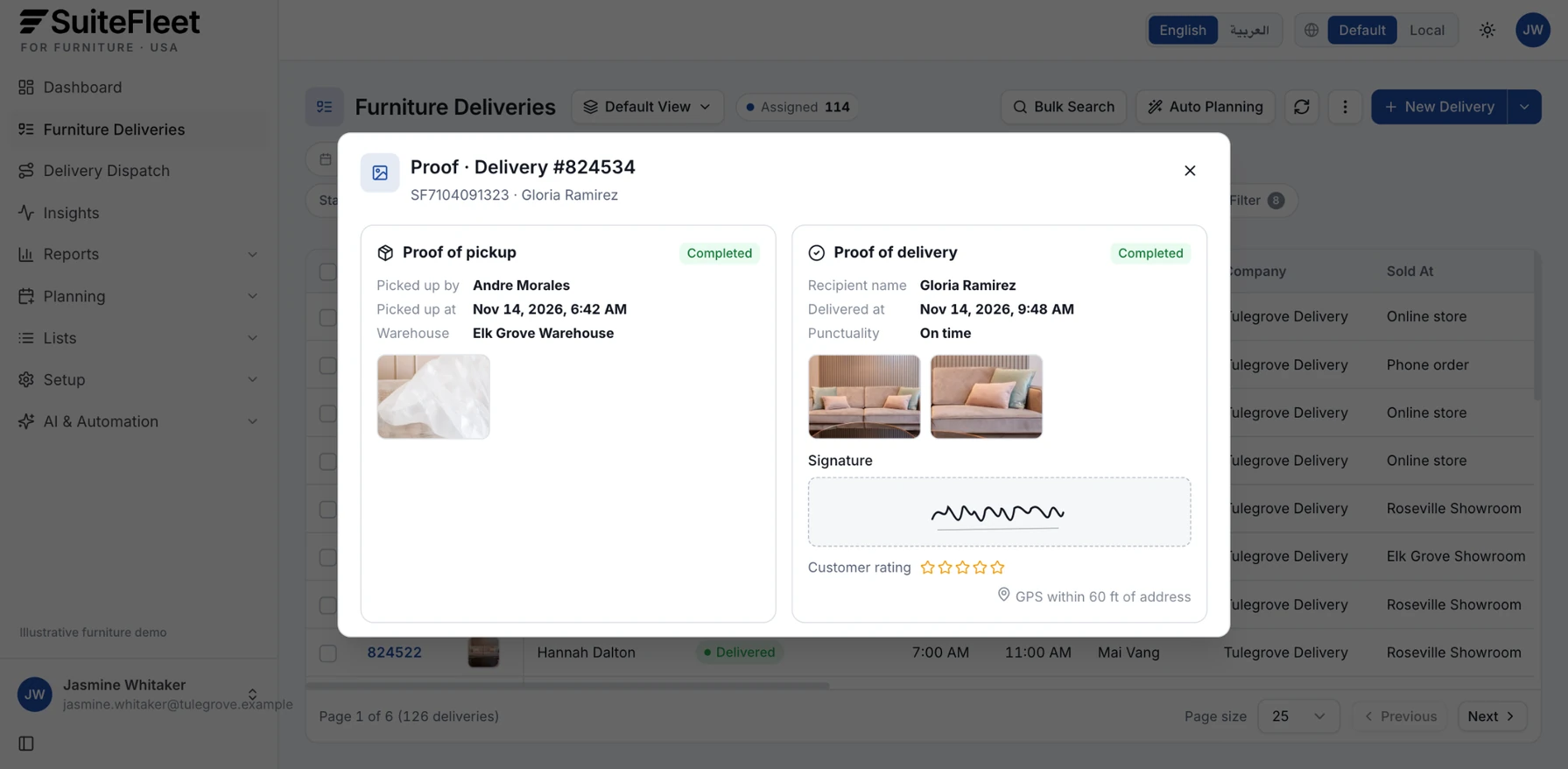
The proof record is not the sales order or the invoice. In most furniture retailers, those live in the retail management system, so decide during setup how the signed delivery and the SuiteFleet record link, and which photos the crew must take. For an assembled bedroom set, a photo of each piece in place settles most damage questions, and a photo of the used mattress on the truck shows that take-back was done.
Connect delivery with your retail system and your online store
Your retail management system should stay the record for sales orders, inventory, special orders, financing, and invoices. Delivery software needs only what the crew needs: the customer, address, building access, window, handling type, pieces, and take-back choice, plus the result to send back. NetSuite has a published SuiteFleet connector, and SuiteFleet has an app listed on the Shopify App Store. Furniture retail systems and furniture website platforms would need a custom integration through SuiteFleet's API, subject to the access each vendor supports.
SuiteFleet's API supports custom integration work. During setup, decide which system owns the window, the take-back choice, and the building instructions, so a change the customer calls in reaches the crew's phone instead of a note on a printed manifest.
Compare SuiteFleet with five furniture delivery options
The comparison below places SuiteFleet alongside two general delivery platforms with furniture setups and three options built for furniture retail: the delivery tools of two furniture retail management systems and a home delivery network for big and bulky goods.
When is your furniture retail system's delivery tool enough?
Most furniture retail systems include delivery scheduling, manifests, or both, so why add a delivery platform? Often you should not. If your crews run from one warehouse, your delivery manager builds the manifests in the retail system, and the crews follow a printed route, its tools may be all you need. For deliveries far outside your area, a home delivery network can take the order without adding software.
A separate delivery platform earns its place when the hard part is coordination rather than the manifest itself. That usually means:
- Several warehouses serve overlapping parts of the metro, and you want one plan and one proof record for all of them.
- Your own two-person crews and contract carriers deliver into the same neighborhoods, and each needs the right kind of order.
- Waves are planned from staged orders that keep changing until shortly before the trucks leave, including window changes and special orders that arrive early.
- Orders come from more than one system, such as a retail system, an online store, and phone orders.
The Saturday in this article is that kind of day: an afternoon wave planned at 12:40 p.m. from 15 staged and pending orders, three crews routed through two windows, a condo elevator booking inside one customer's window, three mattress take-backs, and contract carriers working next to Tulegrove's own crews. If the afternoon wave is a weekly scramble, compare the options on the same busy day's order list and see how much work still lands on the operations manager.
Keep the four-hour promise and the mattress take-back offer
A good route is only part of a lawful furniture delivery in California. Two state rules shape the example.
The first is the window. Under California Civil Code section 1722, when a retailer with 25 or more employees sells merchandise to be delivered later by the retailer or its agent, and the parties agree that the consumer must be present, they must agree on a four-hour period for the delivery. In the example, Tulegrove has more than 25 employees. The section also says:
- If the delivery is not made within the four-hour period, except for delays caused by unforeseen or unavoidable occurrences beyond the retailer's control, the consumer may bring an action in small claims court for lost wages, expenses actually incurred, or other actual damages, up to a total of $600.
- An action is not valid if the consumer was not present when the delivery was attempted within the period, or if the retailer made a diligent attempt to notify the consumer by telephone or in person of a delay beyond its control. A new two-hour period can then be arranged.
- Logs and other business records kept in the ordinary course of business are prima facie evidence of the agreed period and of the time the merchandise was delivered.
- A contract provision in which the consumer agrees to waive these rights is void.
The second is the old mattress. CalRecycle's mattress enforcement guidance for the Used Mattress Recovery and Recycling Act says retailers that sell mattresses in California must offer to take back a used mattress at no additional charge when they deliver a new one to a California consumer. When the retailer or a third-party contractor delivers the mattress, the offer is made at the time of delivery; when a common carrier delivers it, the retailer offers to arrange take-back within 30 days. Retailers must also register with the approved mattress recycling organization, currently the Mattress Recycling Council, and show the recycling charge as a separate line item on the invoice or receipt.
That is why every order in the example carries a four-hour window, why the note asks the crew to call 30 minutes before arrival, and why every mattress order records whether the customer accepted take-back. A timestamped arrival and a recorded call are the kind of business records section 1722 refers to. Software can carry those instructions to the right crew and keep a record of every handoff, but it does not make a delivery compliant on its own. Your crews and your own legal review still do that work; confirm how the rules apply to your business with a qualified professional.
Plan your next delivery day
SuiteFleet gives furniture retailers one place to manage four-hour windows, staged orders, handling types, building instructions, routes, contract carriers, mattress take-backs, failed deliveries, and proof for every stop. Test it against your busiest day: bring your warehouse locations, crews and shifts, contract carriers, and a sample order list with a Saturday's white glove, room-of-choice, and mattress deliveries, and ask to see how the 12:40 p.m. plan changes when a customer moves a window to tomorrow.
Book a free SuiteFleet demonstration to see how dispatch planning and route optimization can fit your furniture delivery operation.