A restaurant catering promise is set by the client's meeting, not by the kitchen. Lunch starts at noon, the buffet has to be set up and hot before the first person walks in, and the building decides how and when the van can unload. In New York City, the health code also says how hot that food has to stay.
It is 9:40 on a Tuesday morning in New York City. A capital firm on Third Avenue in Midtown East has ordered a hot lunch buffet for 40 people in its 21st-floor conference room, and lunch starts at 12:00. The order has to arrive between 11:30 a.m. and noon, come in through the loading dock on East 47th Street, go up in the freight elevator, and be set up in four chafers with fuel. The food is being cooked at the restaurant group's commissary kitchen in Long Island City. It is one of 15 lunches in today's wave to Midtown East, Midtown West, and Hudson Yards. Three vans leave the commissary at 10:30.
Someone has to decide which van takes which office, in what order, and how to make sure every buffet is set up before the meeting starts. The kitchen also has to be able to prove what was delivered, where, and when.
That is the job of delivery management for restaurants. SuiteFleet brings delivery windows, dispatch planning, route optimization, handling notes, and proof of pickup and delivery into one workflow. A restaurant group can plan each catering wave around its clients' event times and buildings instead of around whichever driver is free.
Let's follow Danielle Okafor, the operations manager at Corliss Lane Hospitality, a fictional restaurant group with three restaurants and a commissary kitchen in New York City, through a worked example. The screens are restaurant demo illustrations; names, addresses, maps, and figures are examples.
Start from the client's event time, not the driver's route
Restaurants are growing, but every dollar is contested. In its 2026 State of the Restaurant Industry report, the National Restaurant Association projects industry sales of $1.55 trillion in 2026, with real growth of 1.3%, and says operators plan to add about 100,000 jobs, bringing industry employment to 15.8 million. It also expects operators to invest in more technology that boosts efficiency. For a restaurant that caters, a late corporate lunch is not a small mistake. The meeting starts without food, the client remembers, and next month's order goes to someone else.
In the example, every catering order gets a 30-minute delivery window that ends by the time the event starts, and the setup has to fit inside it. Breakfast windows run from 7:00 to 10:00 a.m. and lunch windows from 11:00 a.m. to 1:00 p.m. Equipment pickups, when drivers collect chafing dish frames and serving trays, run from 2:00 to 5:00 p.m. Evening events start at 5:00 p.m. Early drivers start at 6:00 a.m. and cover breakfast and lunch. Two courier partners take boxed meals and cold platters only. A lunch crew of three vans covers the busiest lunch area, and day drivers handle pickups and evening events.
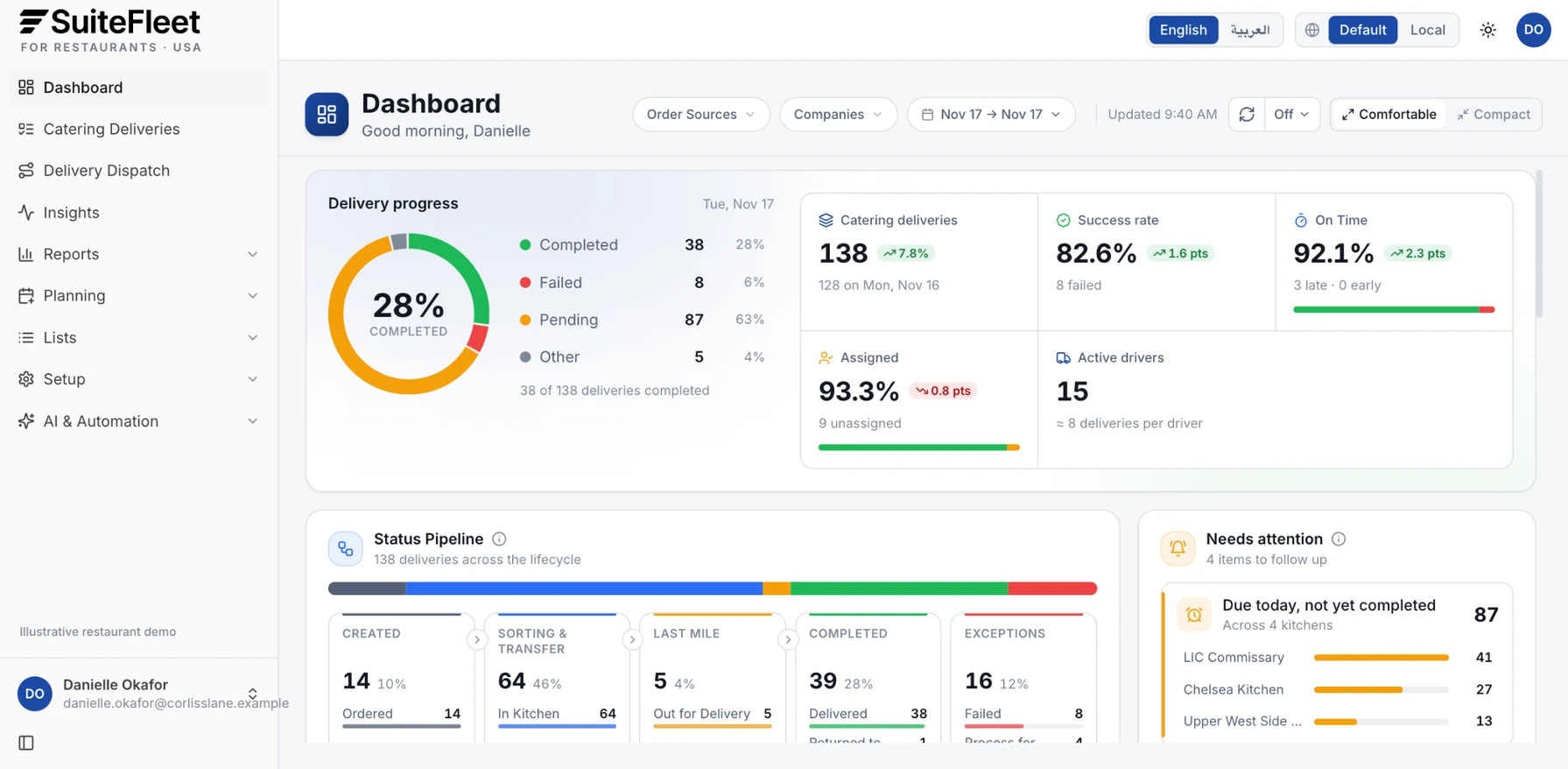
The operations manager starts with the day as a whole. The dashboard shows 138 catering deliveries: 38 completed, 8 failed, and 87 still due across the four kitchens, 41 of them from the Long Island City commissary. Nine deliveries are still unassigned, and all nine are waiting for the lunch wave.
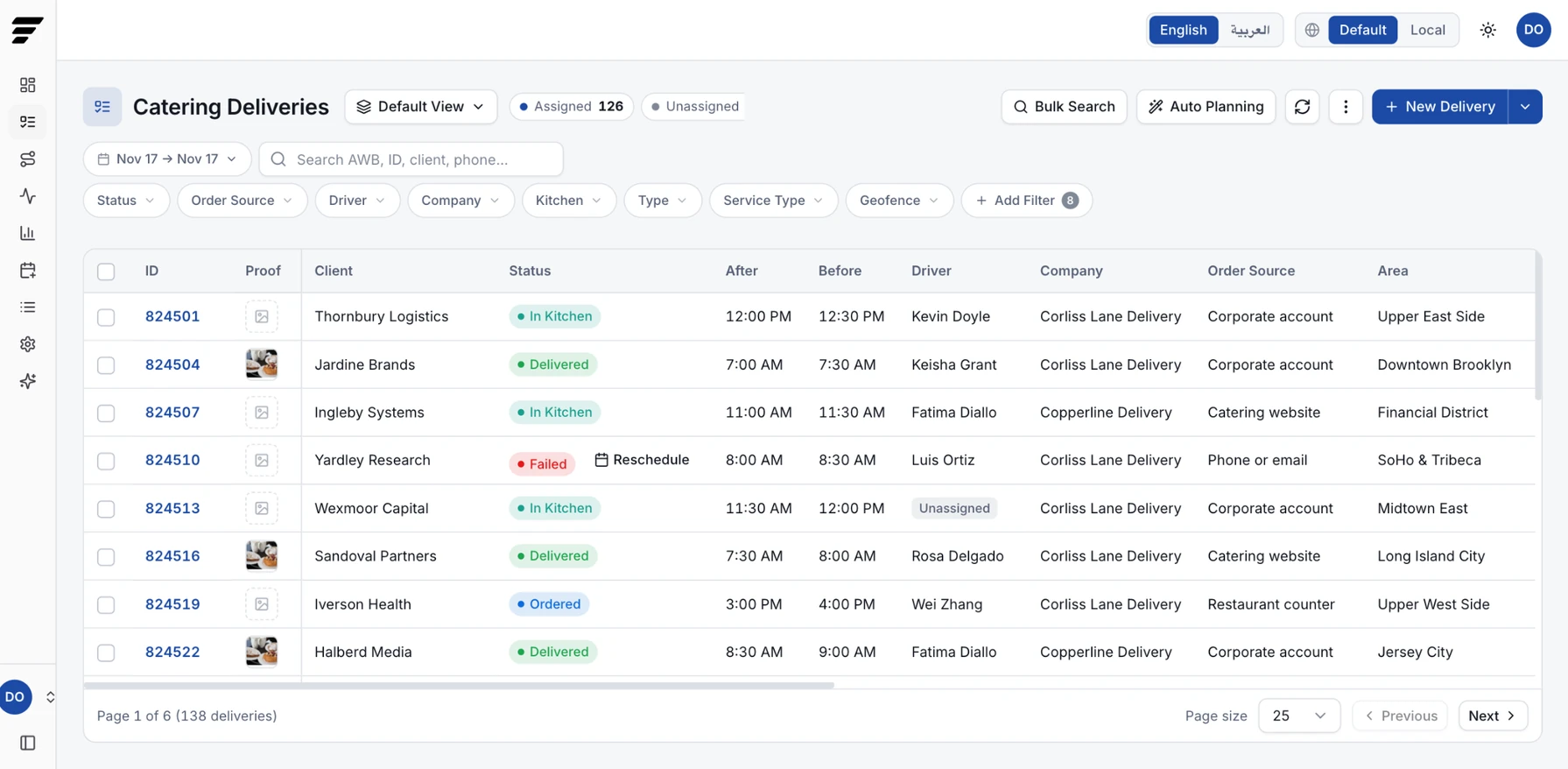
SuiteFleet's delivery list keeps the client, status, window, driver, company, order source, and area in the same view. The order source shows whether each order came from the catering website, a corporate account, phone or email, a catering marketplace, or a restaurant counter. The company column separates Corliss Lane's own drivers from the two courier partners. The Third Avenue order sits near the top of the list, still in the kitchen for its 11:30 a.m. to noon window and unassigned.
Put the menu, the setup, and the building on the same order
A catering delivery fails in small ways. The van waits at the front of a building that only takes deliveries at the loading dock. The security desk turns the driver away because the building has no certificate of insurance on file for the restaurant. The chafers arrive without fuel. Each mistake shows up later as a late lunch, a credit, or a client who orders elsewhere next time.
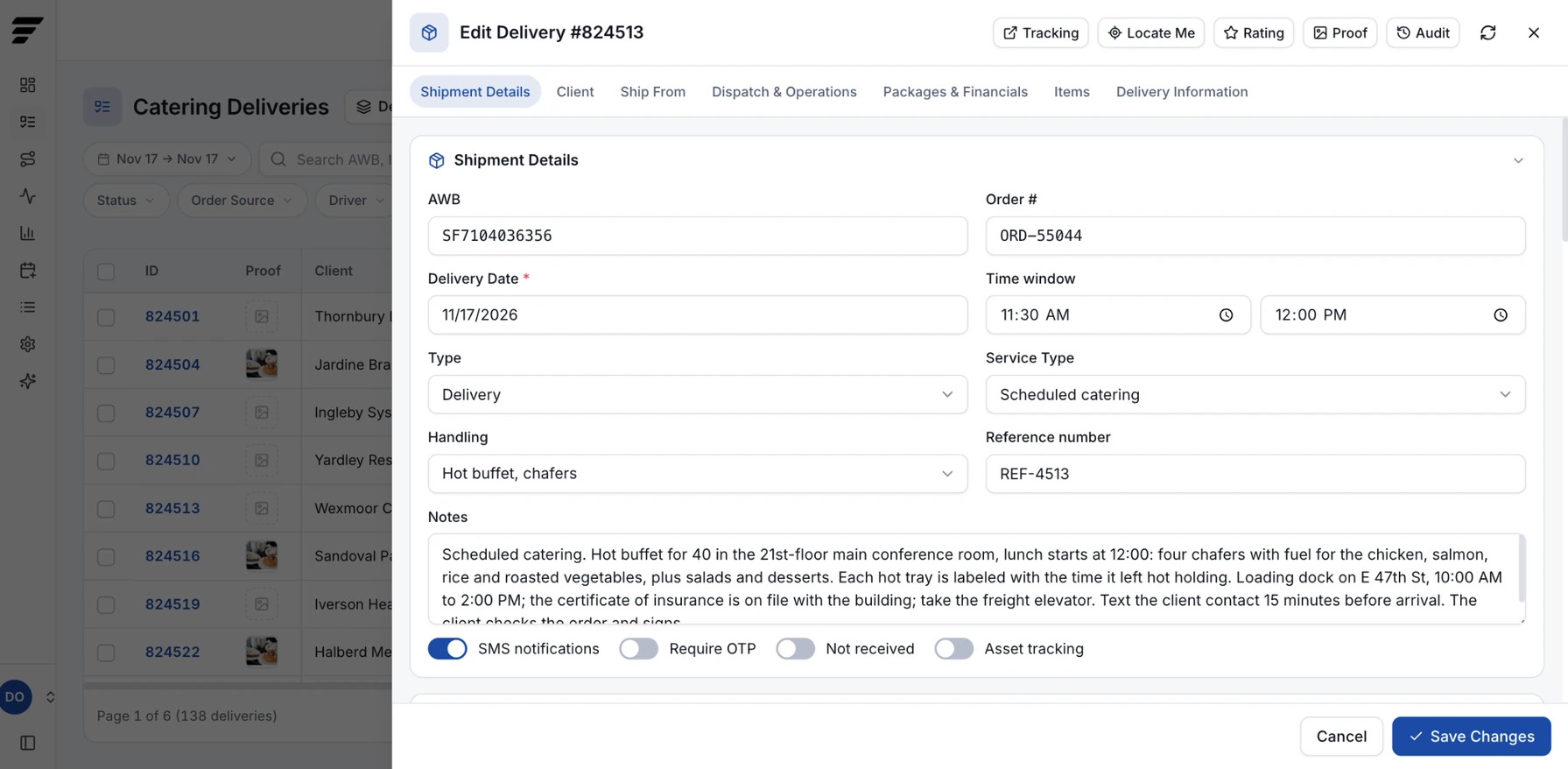
For the Third Avenue order, the operations manager opens the details screen. The service type is Scheduled catering, the window runs from 11:30 a.m. to noon, and the handling is Hot buffet, chafers. The note tells the driver what to bring and how to get in:
- Four chafers with fuel for the chicken, salmon, rice, and roasted vegetables, plus salads and desserts.
- Each hot tray is labeled with the time it left hot holding.
- Loading dock on East 47th Street, open from 10:00 a.m. to 2:00 p.m.
- The certificate of insurance is on file with the building, and the driver takes the freight elevator.
- The driver texts the client contact 15 minutes before arrival, and the client checks the order and signs.
Every delivery in the example carries one of four handling types, because the setup decides the driver, the van, and the time on site: Hot buffet, chafers; Cold platters; Boxed meals; and Equipment pickup. Of the day's 138 orders, 57 are hot buffets, 36 are cold platters, 36 are boxed meals, and 9 are afternoon pickups of chafing dish frames and serving trays. Breakfasts and lunches make up most of the day, with five evening events after 5:00 p.m.
Plan the lunch wave while the kitchen is still cooking
The lunch wave cannot be planned the night before, because the morning decides what is ready. Clients add ten people to a meeting, move lunch to 12:30, or cancel when a meeting is called off. In the example, the commissary plans its 11:00, 11:30, and noon windows at 9:40 a.m., while the hot food is still cooking. The three vans leave at 10:30 a.m.
Counting orders hides the workload. In SuiteFleet's dispatch workbench, each driver's route appears with its delivery count, distance, and duration. In the example, an early driver has 11 deliveries over 16.2 miles. A courier partner's driver has 12 deliveries over 28.4 miles, and a day driver's 13-stop preview of lunches, pickups, and evening events covers 20.5 miles. Two of the lunch vans hold only two orders each so far.
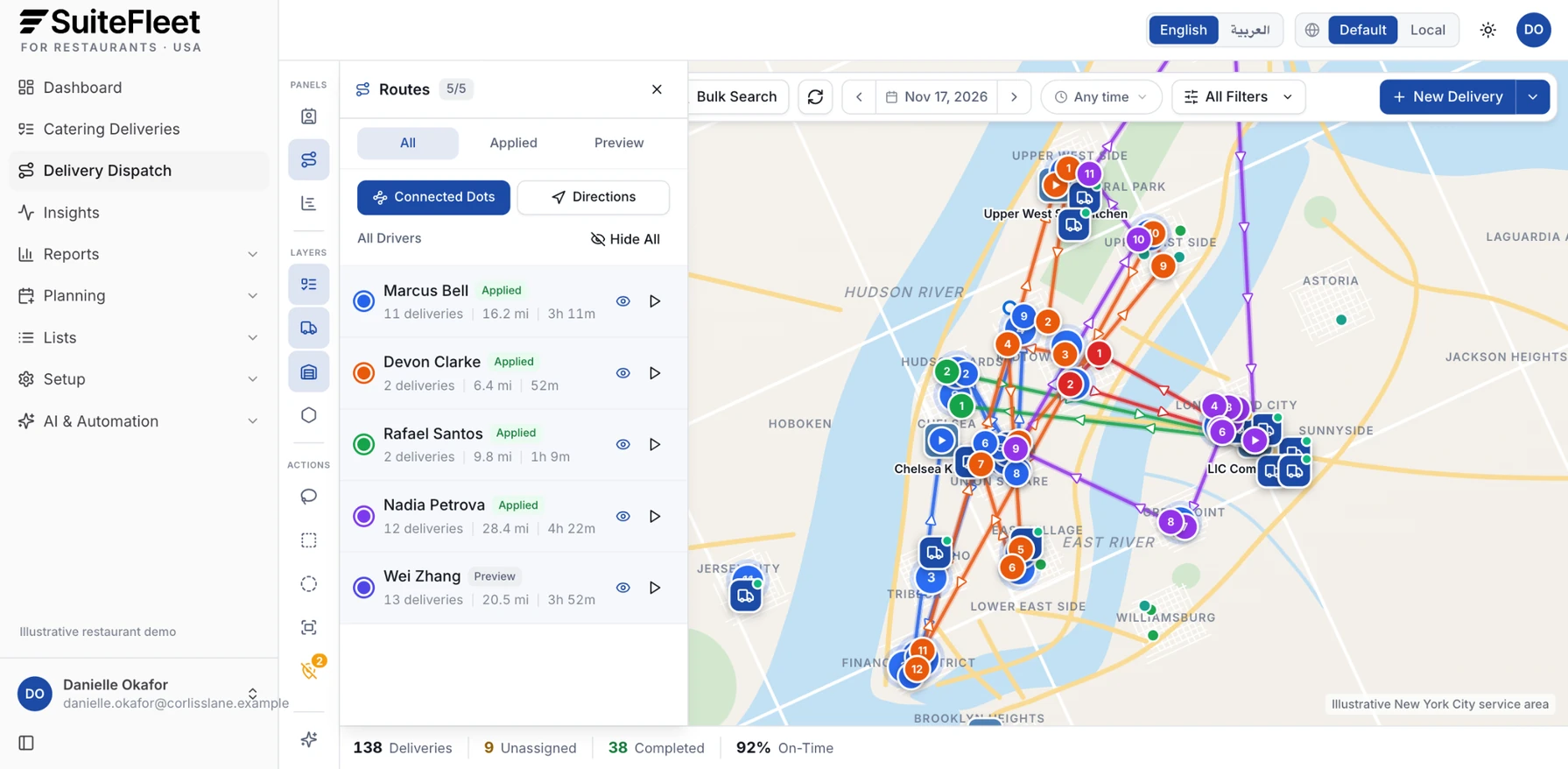
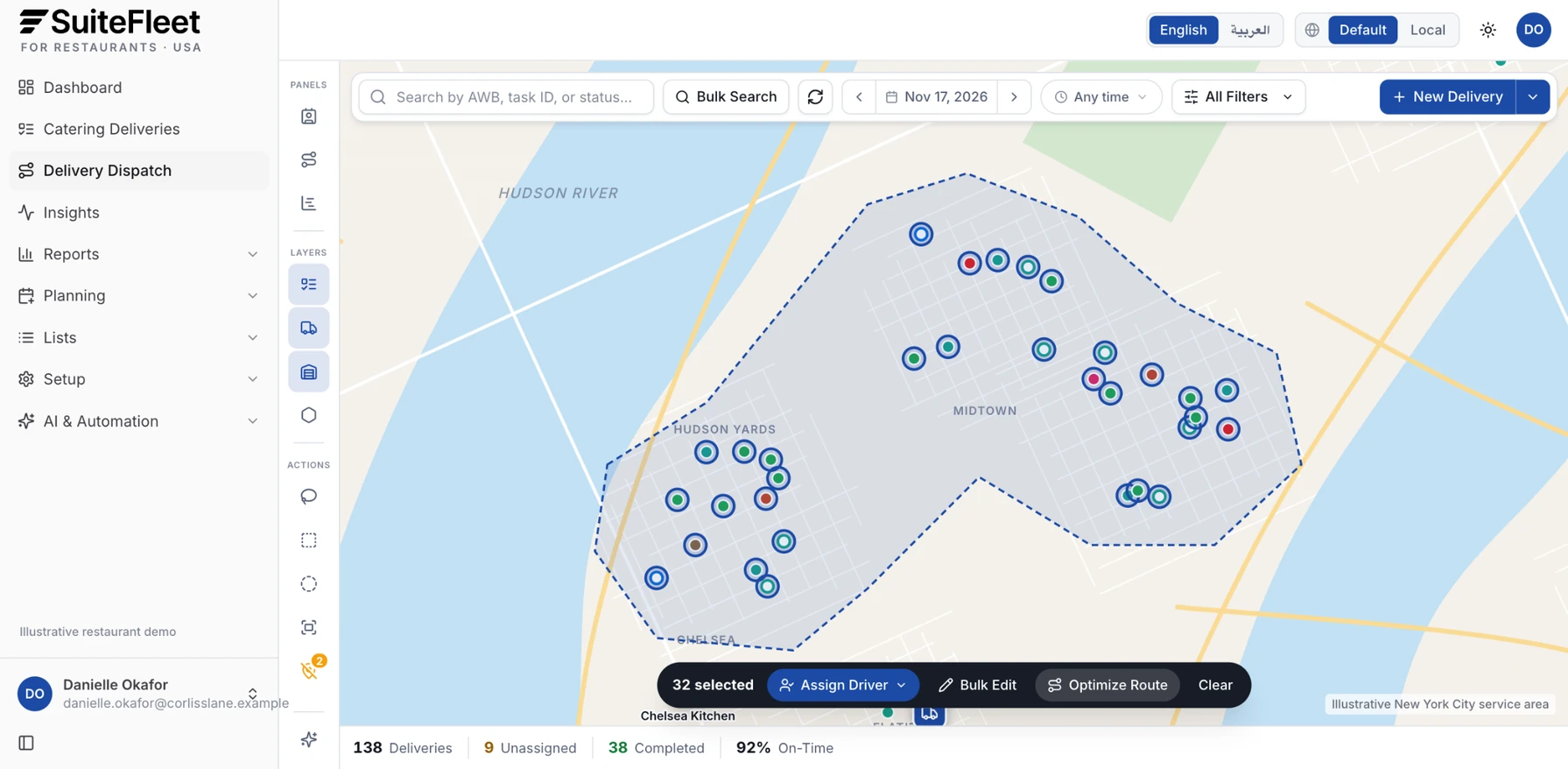
The lunch wave covers three parts of Midtown Manhattan: Midtown East, Midtown West, and Hudson Yards. The operations manager uses the lasso tool to select those deliveries, including the Third Avenue lunch. The selection bar then offers to assign a driver, edit in bulk, or optimize the route.
Get every buffet set up before the meeting starts
Of the 32 deliveries selected, 15 can still be planned: 13 in the kitchen and 2 confirmed. The optimizer leaves out the 17 breakfast deliveries that are already delivered, failed, returned, or canceled. The operations manager enables the three lunch vans that start at the commissary at 10:30 a.m. She leaves Reassign Assigned Deliveries switched off, so the six orders already on the vans stay where they are.
SuiteFleet's optimizer offers four goals: Fastest Completion, Shortest Distance, Fewest Vehicles, and Balanced Workload. The operations manager chooses Fastest Completion, which finishes all deliveries as early as possible. On a lunch wave, an early finish matters more than a few saved miles: a van that runs ten minutes late at 11:15 a.m. pushes every later office toward its noon start. She leaves Respect Time Windows switched on and sets the time per stop to 15 minutes instead of the default 10. That allows for the loading dock, the freight elevator, lighting the fuel, and walking the client through the setup.
The results preview shows three routes, 29.0 miles in total, the last van back at the commissary by 1:01 p.m., and no unassigned deliveries. Each van gets five stops and works through the windows in order: 11:00 first, then 11:30, then noon. The Midtown East van covers 9.2 miles and reaches the Third Avenue office at 11:30 a.m., so the buffet should be set up by 11:45, before the noon lunch. The Hudson Yards van covers 11.1 miles and the Midtown West van 8.7 miles.
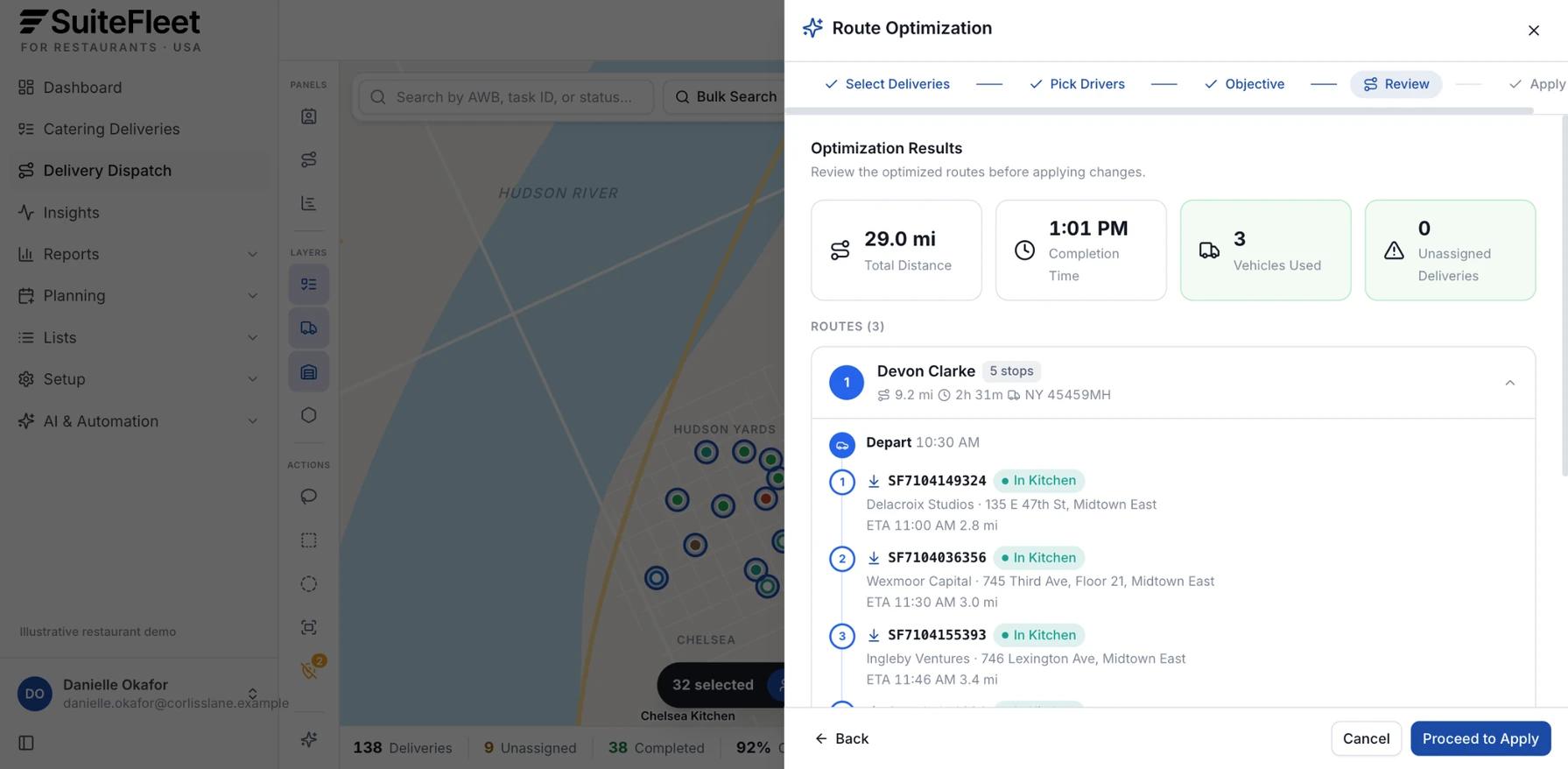
In this example, the optimizer plans stops and windows without counting insulated carriers, so the operations manager checks each load by eye before applying the plan. The wave feeds 437 people, and 13 of its 15 orders are hot buffets. Counting one carrier per hot or cold tray, one per coffee box, and one per ten boxed meals, the Midtown East van carries about 60 carriers, the Hudson Yards van 36, and the Midtown West van 33. In the example, Corliss Lane loads each van to about 70 carriers, so all three loads fit.
Once the plan is applied, the route order becomes the loading order: the last stop goes in the van first, and the first stop's carriers go by the doors. To see whether the waves work, track:
- Deliveries set up before the event start.
- Late and failed deliveries by reason.
- Credits issued.
- Stops per van per wave.
The screens show the workflow; your own operating data will show the improvement.
Handle the deliveries that do not get in
A failed catering delivery usually starts at the building, not the van. In the example, 8 deliveries failed:
- 3 with the reason "Building security refused entry."
- 2 with "Wrong floor or suite."
- 2 with "Order refused at door."
- 1 with "Client contact unreachable."
Five more orders are being returned to the kitchen or are already back.
"Building security refused entry" is the reason to watch, because it is the easiest one to prevent. Many office buildings ask vendors for a certificate of insurance, deliveries at the loading dock, and a name on the visitor list. The failure reason tells the catering team which buildings to call the day before. The fix belongs on the client profile, so the next order carries the dock hours, the insurance requirement, and the contact's mobile number. A lunch that cannot get into the building cannot be saved by a better route.
Prove the delivery, the setup, and the signature
Clients and office managers ask after the fact: "Was it set up by 11:45?" or "Who signed for breakfast?" The answer should take seconds, not a call to a driver on another route.
SuiteFleet records proof of pickup and proof of delivery for each stop. In the example, the record for a breakfast of pastries, fruit, yogurt parfaits, and coffee for 25 near Union Square shows the following:
- The driver picked up the order at the Long Island City commissary at 6:57 a.m.
- The office manager received it at 7:48 a.m., inside the 7:30 to 8:00 a.m. window.
- The record includes photos of the platters as set out, a signature, and a GPS check within 60 feet of the address.
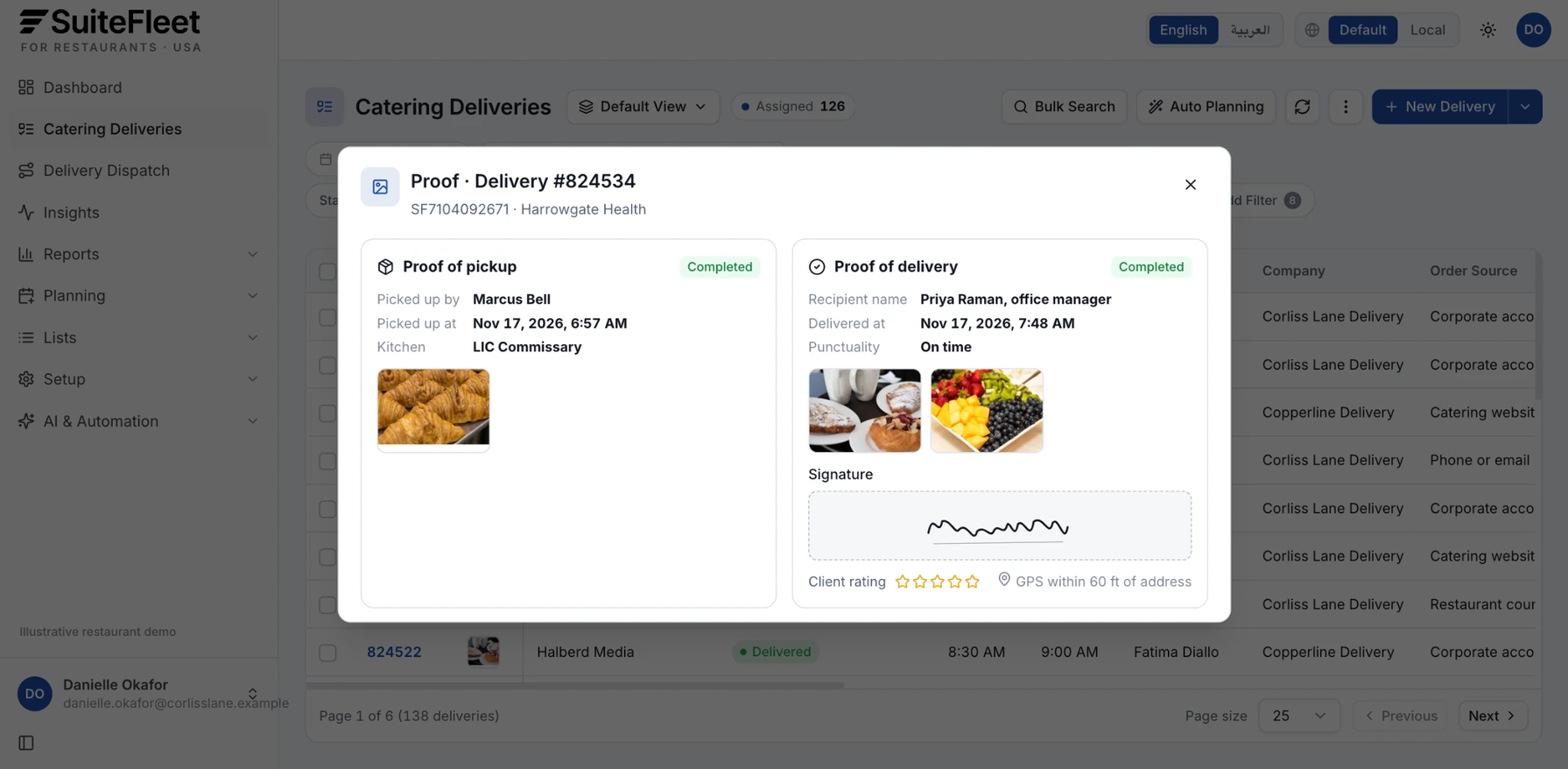
The proof record is not the invoice or the catering order. Those live in your POS, catering software, or accounting system, so decide during setup how the signed delivery and the SuiteFleet record link, and which photos the driver must take. For a hot buffet, a photo of the chafers lit and the labels in place settles most questions about what arrived and when.
Connect delivery with your POS, catering, and accounting systems
Your POS or catering system should stay the record for orders, menus, and billing, and your accounting system the record for invoices. Delivery software needs only what the driver needs: the client, address, loading dock or entrance, window, handling type, menu, setup instructions, and contact, plus the result to send back. NetSuite has a published SuiteFleet connector, and SuiteFleet says it plans to publish a QuickBooks Online connector. Restaurant POS, catering marketplace, and catering management systems would need a custom integration through SuiteFleet's API, subject to the access each vendor supports.
SuiteFleet's API supports custom integration work. During setup, decide which system owns the event time and the building instructions. Then a change the client calls in at 9:00 a.m. reaches the driver's phone instead of a note taped to the hot box.
Compare SuiteFleet with five restaurant delivery options
The comparison below places SuiteFleet alongside two general delivery platforms with restaurant setups and three options built for restaurants: the catering tools of a restaurant POS, a catering marketplace with a delivery network, and a delivery network for restaurants' own ordering channels.
When is your POS's delivery tool enough?
Most restaurant POS and catering platforms now include a way to dispatch couriers, and delivery networks cover most of the country, so why add a delivery platform? Often you should not. If you run one location and send a few drop-off orders a day, the dispatch button in your POS or a delivery network may be all you need. Toast's catering FAQ is clear about the limit, though: white glove setup, breakdown, and buffets that need warming are not part of its delivery service for catering.
A separate delivery platform earns its place when the hard part is coordination and setup rather than the single drop. That usually means:
- You run your own vans for hot buffets that need setup, alongside courier partners for boxed meals and cold platters.
- More than one kitchen serves overlapping parts of the city, and you want one plan and one proof record for all of them.
- Lunch waves are planned in the morning from orders that keep changing, including head-count changes, moved start times, and same-day orders.
- Orders come from more than one system, such as a POS, a catering marketplace, your catering website, and corporate accounts.
The Tuesday in this article is that kind of day. A lunch wave of 15 orders is planned at 9:40 a.m. for three vans working through three windows. One 40-person buffet has a loading dock, a freight elevator, and a noon start, and courier partners work next to Corliss Lane's own drivers. If the lunch wave is a daily scramble, compare the options on the same busy day's order list and see how much work still lands on the operations manager.
Keep hot food at 140°F in New York City
A good route is only part of a safe catering delivery. In New York City, restaurants and caterers follow Article 81 of the New York City Health Code, which defines a caterer as a permitted food service establishment that prepares food and may transport and serve it at another location. Four of its rules shape the example:
- Section 81.09 requires potentially hazardous food, also called time and temperature control for safety food, to be held at or below 41°F or at or above 140°F. The hot line is higher than the 135°F in the FDA's model Food Code, so a hot box set for another city's rules may not be enough in New York.
- Section 81.17(f) requires vehicles used to transport food to be clean, sanitary, and free of pests, with enough working equipment to keep food at the required temperatures.
- Section 81.10 lets an establishment use time instead of temperature. Hot food taken out of hot holding may be held for up to four hours if each container is labeled with the date, time, and temperature when it left hot holding and the time four hours later when it must be served or discarded.
- The same section does not allow time alone for food served at self-service salad bars or buffets.
That last rule decides how an office buffet is run. In the example, the hot trays leave the commissary's hot holding labeled with the time and temperature, ride in insulated hot boxes, and go straight into chafers. Once a buffet is set out for people to serve themselves, the chafers have to keep the food at 140°F or above. Boxed meals for individual people can carry time labels instead.
That is why every hot buffet in the example carries fuel and chafers on its item list, why the note mentions the tray labels, and why the 15-minute stop time includes lighting the fuel. Software can carry those instructions to the right van and keep a timestamped record of every handoff, but it does not make a delivery compliant on its own. Working hot boxes, thermometers, trained drivers, and the restaurant's own food safety plan still do that work; confirm how the rules apply to your operation with the Health Department or a qualified food safety professional.
Plan your next lunch wave
SuiteFleet gives restaurant groups one place to manage event times, catering windows, handling types, building instructions, routes, courier partners, failed deliveries, and proof for every stop. Test it against your busiest day. Bring your kitchen locations, van and driver shifts, courier partners, and a sample order list with a weekday's breakfasts, hot buffets, boxed lunches, and pickups. Then ask to see how the 9:40 a.m. plan changes when a client adds 20 people to a noon lunch.
Book a free SuiteFleet demonstration to see how dispatch planning and route optimization can fit your restaurant delivery operation.