In a health system, one courier van can carry a blood cooler, a locked pharmacy tote, a bag of specimens, and a case of IV start kits, and each one belongs to a different department with its own deadline.
It is 2:20 on a Friday afternoon. Folsom Hospital's blood bank called at 2:08 p.m.: its emergency department needs four units of O-negative red cells from the blood bank at Midtown Medical Center, the flagship hospital about 20 miles away. The central pharmacy at Midtown has its afternoon totes ready for the other hospitals, including a locked controlled-substance tote for Roseville that a pharmacist has to sign for. The core lab wants send-out specimens back from the hospital labs, and supply chain has replenishment cases waiting for the same vans.
Someone has to decide which courier takes each run, in what order, and how every handoff will be proven.
That is the job of delivery management for health systems. SuiteFleet brings scheduled loops, STAT runs, dispatch planning, route optimization, and proof of pickup and delivery into one shared workflow, so a health system's logistics team can run one courier network for every department instead of a separate van for each.
Let's follow Teresa, the logistics manager at a five-hospital health system in the Sacramento region with a consolidated service center and about 50 clinics and outpatient sites, through a worked example. The screens are health system demo illustrations; names, addresses, maps, and figures are examples.
Start with each department's deadline, not the van schedule
Every department on a health system's courier network runs on its own clock. The blood bank's clock starts when a STAT call comes in. The pharmacy's totes need to reach each hospital in time for the evening medication pass. The core lab wants send-out specimens before its evening run, sterile processing needs trays before the next surgical day, and supply chain restocks receiving docks before the night shift.
More of that work now starts in one place. St. Luke's Health System in Idaho opened a 330,000-square-foot Consolidated Service Center in 2025. It prepares and distributes supplies and medications daily for most of St. Luke's eight medical centers and more than 370 clinics, and it centralizes IV medication compounding for all of its hospitals. When stock is centralized like that, the courier network becomes the link between the center and every hospital and clinic.
The courier side of the case is just as strong. Tecsys, a healthcare supply chain software vendor, estimates in its healthcare transportation brochure that about 80% of healthcare logistics volume is clinical service items such as specimens, records, mail, lab supplies, and linen. It argues that one courier plan, where one driver performs many services at a single stop, is far more efficient than many couriers each performing one service.
The logistics manager starts with the day as a whole. The dashboard shows 184 courier stops across six departments: 98 completed, 14 still without a courier, and 70 still due across four hubs.
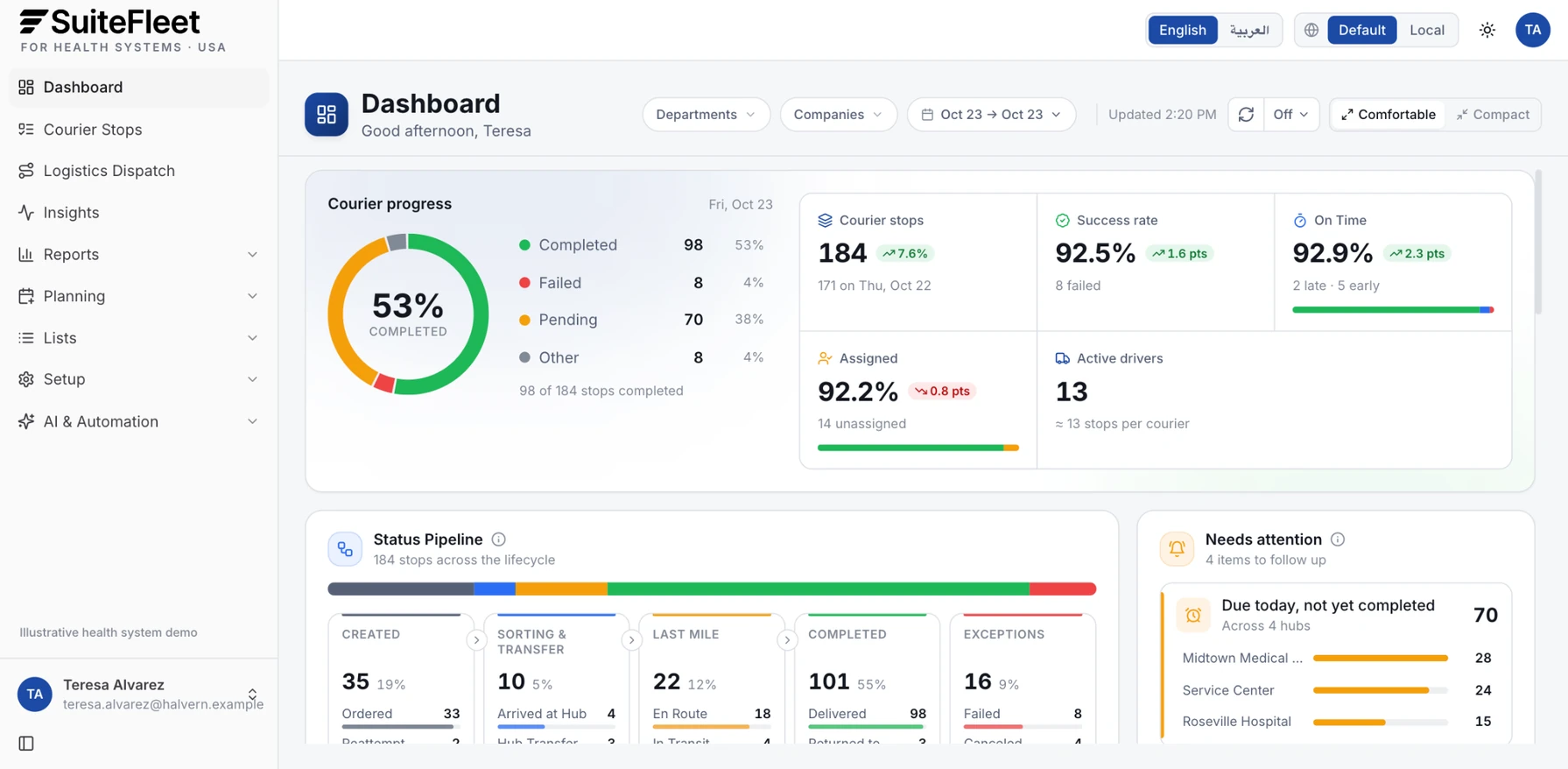
Good runs start when the request is entered. "Blood for Folsom" is far less useful than "STAT blood for the Folsom ED: 4 units O-negative red cells in a validated cooler, 1 to 10°C. Go direct; hand to the blood bank tech and sign the transfer form."
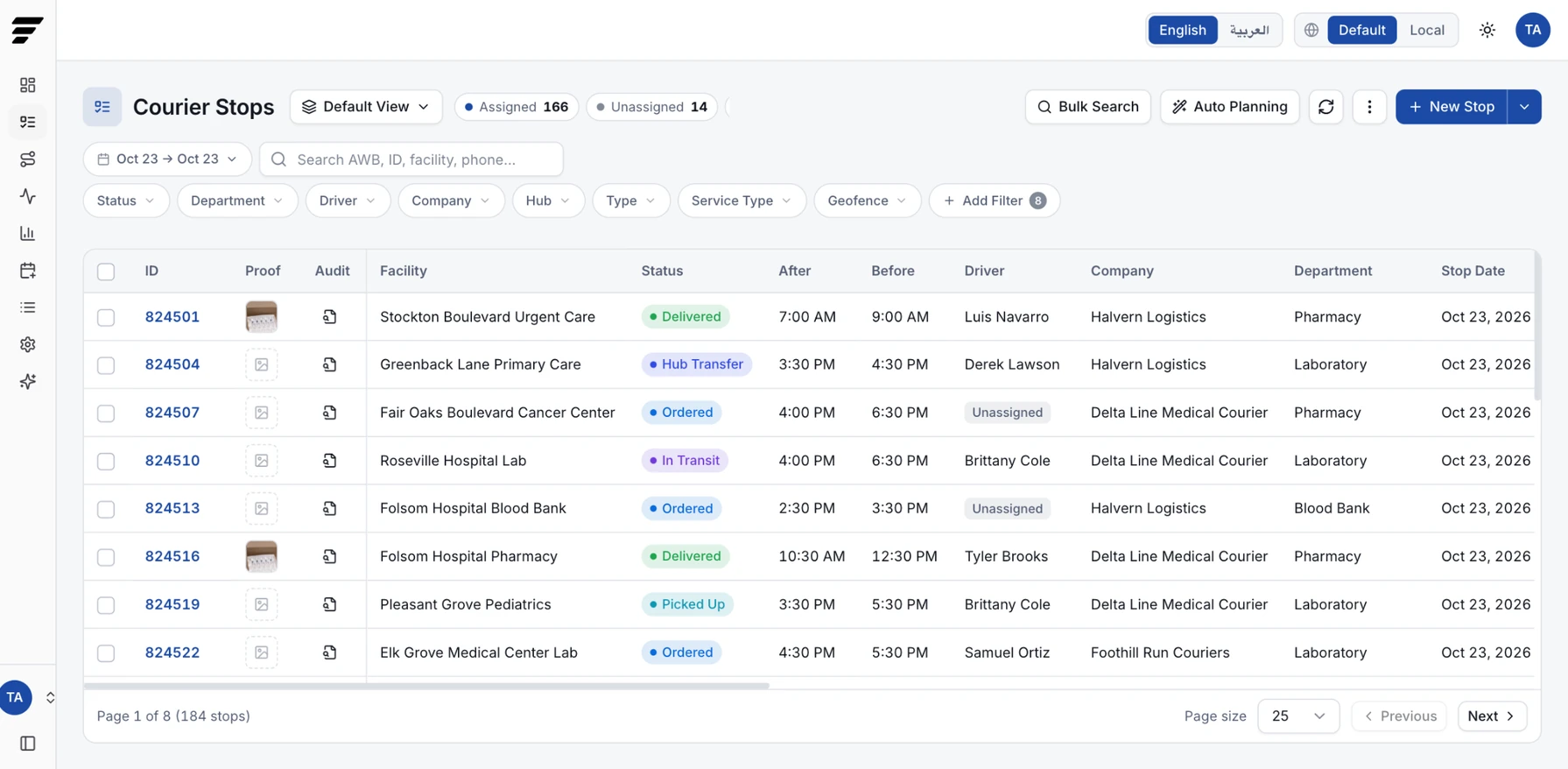
SuiteFleet's stop list keeps the facility, status, time window, courier, company, and department in the same view. The department column shows whose run each stop is, and the company column shows which couriers work for the health system and which come from courier partners.
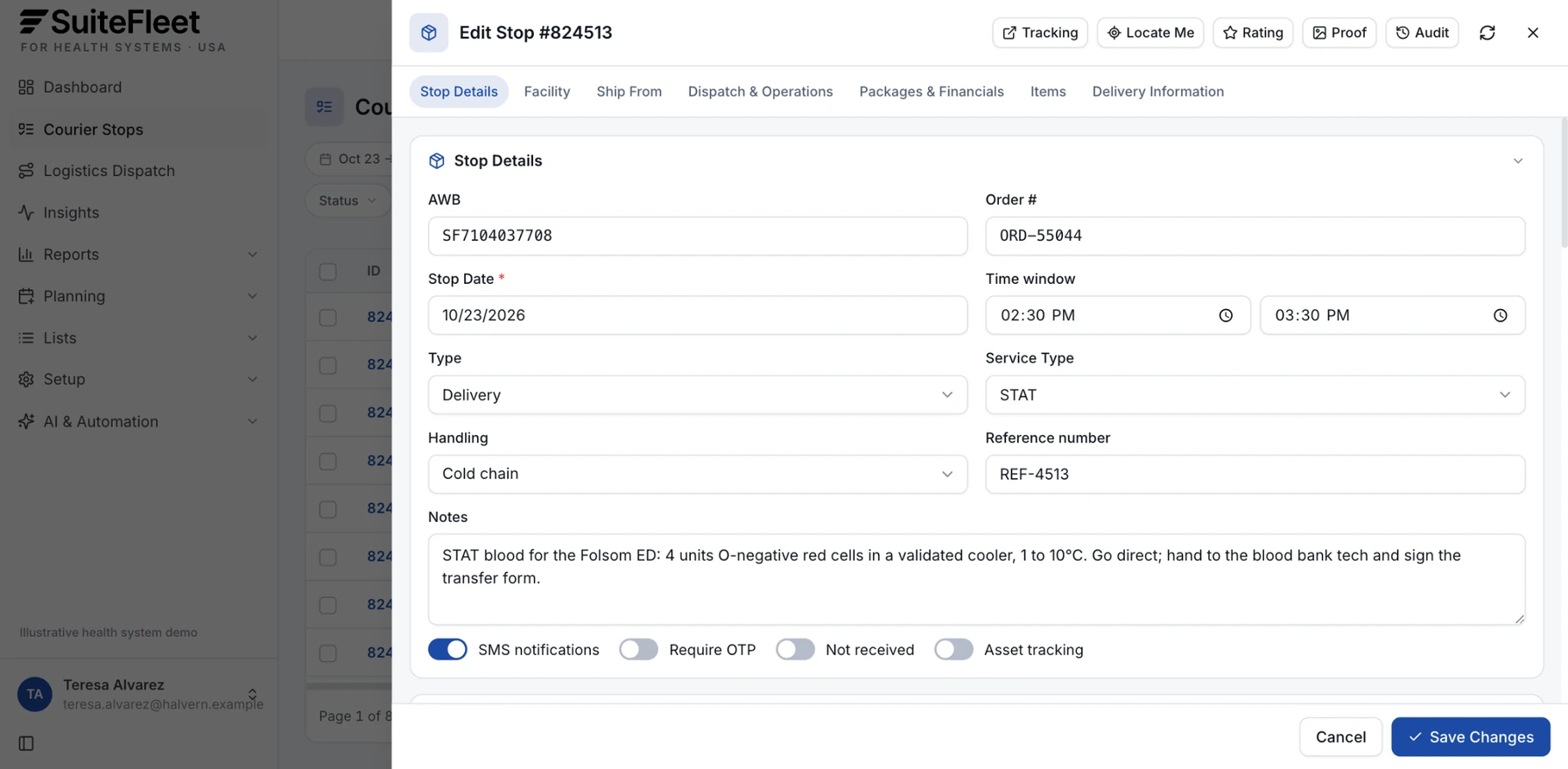
For the STAT run, the logistics manager opens the details screen. The type is Delivery, the service type is STAT, the window runs from 2:30 to 3:30 p.m., the handling is cold chain, and the note says how many units travel, at what temperature, and who signs. The note carries units and handling, not patient details.
Give a locked tote different rules from a case of gloves
A health system courier carries several kinds of cargo, and each one ends with a different handoff. A supply case can be signed for at the receiving dock. Sterile instrument trays go to the sterile core in a closed cart. Specimens go to the lab. Blood goes direct, in a validated cooler, to a blood bank tech. A locked controlled-substance tote goes hand to hand to a pharmacist.
In the example, every stop carries its handling type (standard, cold chain, secure tote, or specimens), its items, and its handoff note. The Roseville Hospital pharmacy stop lists three sealed unit dose totes and one locked controlled-substance tote, with "match the seal numbers, signature required." A courier who reads that note knows the tote cannot be left at the loading dock.
SuiteFleet does not lock a tote or cool a cooler; the pharmacy's totes and the blood bank's coolers do that. What it does is make the handling rule part of each stop, so the right instruction reaches the right courier. SuiteFleet's pharmaceutical delivery page also describes hospital replenishment and urgent medical deliveries that need controlled handling, defined handling requirements, and temperature threshold tracking with exception alerts.
Plan scheduled loops and STAT runs in one network
Most of a health system's courier work runs as scheduled loops: the same circuit between the flagship, the service center, the other hospitals, and the clinics, on a timetable. STAT runs break into that timetable. When loops and STAT runs live in separate tools or separate fleets, a STAT courier often drives out alone and comes back empty. In one plan, the STAT run can go first and the same trip can pick up loop stops at the hospital it was going to anyway.
Counting stops per courier hides the real workload. In SuiteFleet's dispatch workbench, each courier's route appears with its stop count, distance, and duration. In the example, one courier has 24 stops over 145.3 miles, and another has 21 stops over 28.0 miles. Those are very different days.
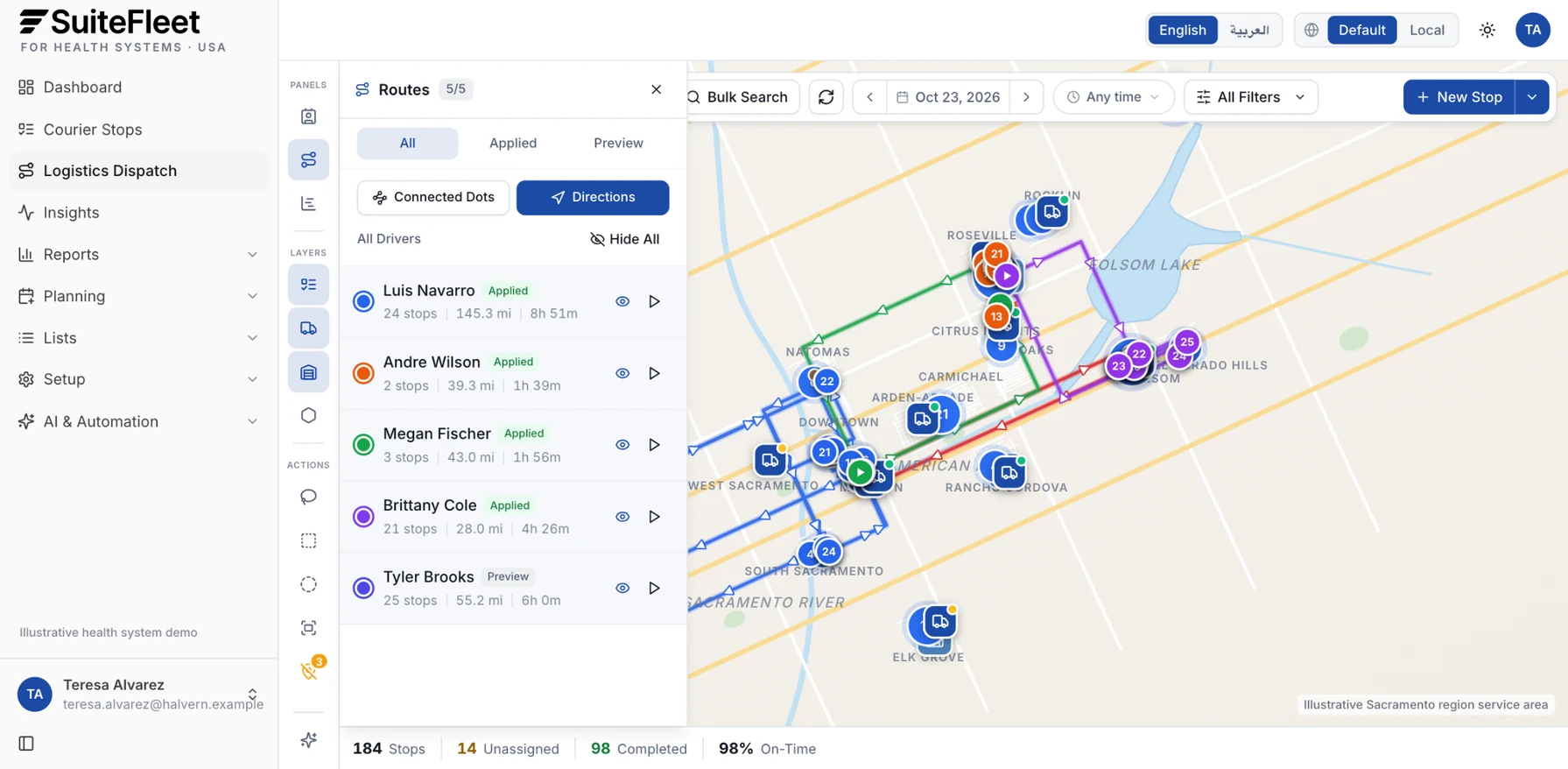
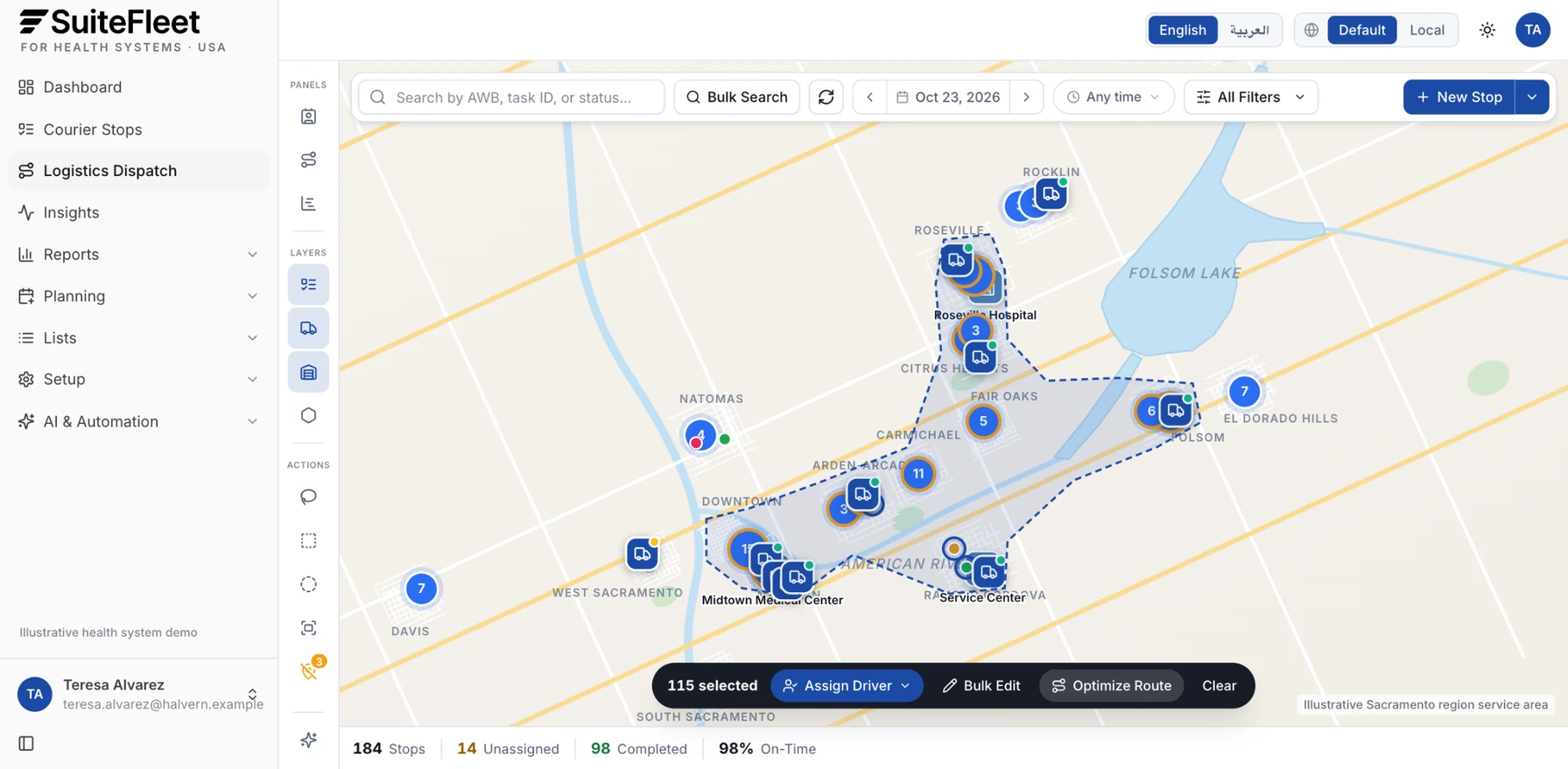
The afternoon work runs east from Midtown along the American River to Folsom and north to Roseville. The logistics manager uses the lasso tool to select those stops, including the STAT blood run and the Roseville pharmacy totes. The selection bar then offers to assign a courier, edit in bulk, or optimize the route.
Put the STAT run first and keep the pharmacy loop on time
Of the 115 stops selected, 42 are still open. The optimizer leaves out the 73 that are already delivered, failed, canceled, or being returned. The logistics manager enables the three couriers on the 2:30 to 11:00 p.m. shift who start at Midtown Medical Center: one from the health system's own courier team and one each from two courier partners. She leaves Reassign Assigned Stops switched off, so the 25 open stops already on day-shift couriers' routes stay with those couriers. The plan covers the other 17 stops, a mix of pharmacy, lab, blood bank, supply, sterile processing, and mail stops.
SuiteFleet's optimizer offers four goals: Fastest Completion, Shortest Distance, Fewest Vehicles, and Balanced Workload. The logistics manager keeps Fastest Completion, because the blood and the pharmacy totes are both on a clock. She leaves Respect Time Windows switched on and keeps the default 10 minutes per stop.
The results preview shows three routes, 129.2 miles in total, every courier back at Midtown by 5:22 p.m., and no unassigned stops. The STAT blood run is the first stop on the in-house courier's route, with an estimated arrival of 3:09 p.m., inside its 2:30 to 3:30 p.m. window. The same courier then picks up send-out specimens at the Folsom Hospital lab, drops pharmacy totes at the Folsom Hospital pharmacy, and delivers supplies to its receiving dock, the last of them at 3:40 p.m. The locked tote run to the Roseville Hospital pharmacy is the third stop on a courier partner's route, at 3:43 p.m., inside its 3:30 to 4:30 p.m. window.
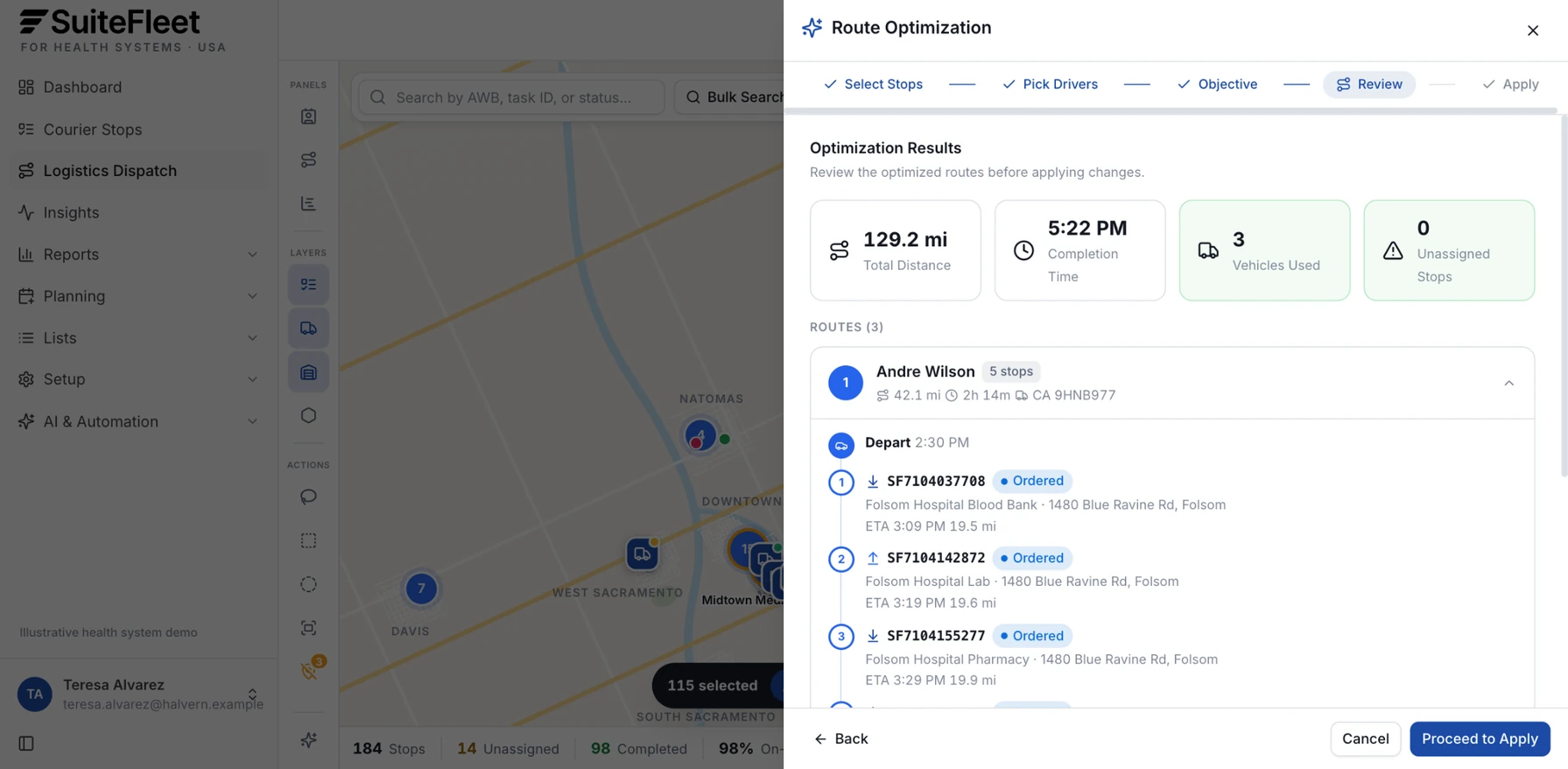
This is the practical value of health system route planning: one trip to Folsom Hospital serves four departments, and the decision is made while there is still time to change it. To see whether it is working, track the time from a STAT call to the handoff, scheduled loop stops on time, handoffs signed by the right role, and the miles each department's runs add to the network. The screens show the workflow; your own operating data will show the improvement.
Prove every handoff, including the partner courier's
Departments ask questions after the fact. "Did the controlled-substance tote reach Auburn?" "Who signed for it, and when?" The answer should take seconds, not a call to the courier.
SuiteFleet records proof of pickup and proof of delivery for each stop. In the example, the record shows the courier who picked up the pharmacy totes at Midtown Medical Center at 10:05 a.m., the pharmacist who received them at Auburn Hospital at 10:57 a.m., whether the stop was on time, photos, a signature, and a GPS location check. This courier works for a courier partner, and the record has the same fields an in-house courier's would.

Connect delivery with your EHR, supply chain, and central pharmacy
Your EHR should stay the system of record for patients, orders, and medications, and your supply chain system should stay the record for inventory. Delivery software should receive only what the courier needs: the facility, the window, the handling type, the items, and the handoff note. NetSuite has a published SuiteFleet connector. EHR, supply chain, and pharmacy automation systems would need a custom integration through SuiteFleet's API, subject to the access each vendor supports.
SuiteFleet's API supports custom integration work. During setup, map only the fields the courier needs: facility, department, window, service type, handling type, items, handoff note, and status updates. Keep patient details in the EHR.
Compare SuiteFleet with five health system options
Health systems can choose a dedicated delivery platform, a general routing platform, delivery tools inside their supply chain software, courier software built for medical couriers, or an outsourced logistics partner. The comparison below places SuiteFleet alongside two general platforms and three health-system-specific options.
When is your supply chain suite or logistics partner enough?
Some supply chain suites already include delivery tools, and some health systems hand the whole network to a logistics partner, so the fair question is why you would add a delivery platform. Often you should not. If your loops are fixed and one department drives most of the volume, keep courier work in the system that tracks the stock. If an outsourced network meets your windows and shows you chain of custody, that may be enough too.
A separate delivery platform earns its place when the hard part is coordination rather than the single run. That usually means:
- Several departments share couriers, and each needs its own handoff rules.
- STAT runs and on-demand requests arrive all day, and the loops have to be rebuilt around them.
- In-house couriers and courier partners serve the same hospitals, and you want one plan and one proof record for both.
- New hospitals and clinics join the network, and the loops need to change faster than a contract does.
The afternoon in this article is that kind of day: five hospitals, a service center, six departments on the same vans, a STAT call at 2:08 p.m., and an in-house courier working next to two partner drivers. A simple test: if your loops rarely change after the morning, the tool you have may be enough. If rebuilding the afternoon loops is a daily job, a separate platform is worth evaluating.
Either way, compare the options using the same busy day's stop list, with scheduled loops, STAT runs, locked pharmacy totes, blood, specimens, and supply drops, and see how much work still lands on the logistics manager.
Follow pharmacy, blood, and California's central packaging rules
A good route is only part of a safe interfacility run. Federal hospital rules set the baseline for medications. Under the Medicare Condition of Participation for pharmaceutical services, 42 CFR 482.25(b)(2), drugs and biologicals must be kept in a secure area and locked when appropriate, drugs in Schedules II through V must be kept locked within a secure area, and only authorized personnel may have access to locked areas. A courier record that shows a locked tote going from one pharmacy to a named pharmacist at another fits that picture.
Because the example health system is in California, its central pharmacy can work under the state's centralized hospital packaging pharmacy license. Business and Professions Code section 4128 lets such a pharmacy prepare unit dose medications for inpatients of its own general acute care hospital and of one or more other general acute care hospitals, if the hospitals are under common ownership and located within a 75-mile radius of each other. Among the related requirements:
- Each unit dose must be barcoded so it can be read at the inpatient's bedside with barcode medication administration software (section 4128.4).
- Each label must show, among other items, special storage or handling requirements and the lot or control number assigned by the central pharmacy (section 4128.5).
The 75-mile radius shapes the courier network itself: every hospital the central pharmacy supplies has to sit inside it. In the example, all five hospitals do.
Two federal rules apply to the other cargo. Under the Drug Supply Chain Security Act, the distribution of a product among hospitals or other health care entities under common control is not a "transaction" (21 U.S.C. 360eee(24)(B)(ii)), so the health system's own transfer records are what show where that stock went. For blood, FDA's rule on temperatures during shipment, 21 CFR 600.15, lists 1 to 10°C for liquid red blood cells, and as close as possible to 20 to 24°C for platelets labeled for room-temperature storage. The STAT stop in the example records the range; the blood bank's validated cooler holds it.
Courier records feed those logs. In the example, each stop carries a department, a handling type, and items, and the proof record gives each handoff a time, a courier, and the person who signed. Health systems outside California should check their own state's pharmacy rules, because central pharmacy and transfer rules differ by state.
Software can carry handling rules, schedule runs, and keep a signed, timestamped record, but it does not make a health system compliant on its own. Pharmacy policies, locked totes, validated coolers, trained couriers, and the hospital's own quality programs still do that work.
Plan your next interfacility loop
SuiteFleet gives health systems one place to manage scheduled loops, STAT runs, on-demand requests, courier assignments, routes, and proof for every department. Test it against your busiest afternoon. Bring your hospital and clinic list, department cutoffs, courier shifts, courier partners, and a sample stop list, and ask to see the plan, the exceptions, and how a 2 p.m. STAT call changes the afternoon.
Book a free SuiteFleet demonstration to see how dispatch planning and route optimization can fit your health system's courier network.