In surgical device distribution, the deadline is not the first incision. It is the sterile processing cutoff, and every set that goes into a hospital has to come back out.
It is 1:30 on a Wednesday afternoon. A hip fracture was just added to tomorrow's 7:30 a.m. schedule at a hospital in the Medical Center, and the trauma set has to reach sterile processing by 5:00 p.m. so the team can clean, inspect, and sterilize it overnight. A few blocks away, a spine set used yesterday is waiting in a holding area for pickup. Dozens of other sets are due at hospitals and surgery centers for Friday and Monday cases, and each one travels with an inventory sheet that someone will count against.
Someone has to decide which driver takes each set, in what order, and whether every hospital's cutoff still holds.
That is the job of delivery management for medical devices. SuiteFleet brings case orders, dispatch planning, route optimization, and proof of delivery into one shared workflow, so a distributor can run drop-offs and pickups from a plan instead of a group text.
Let's follow Elena, the logistics coordinator at an orthopedic and spine device distributor serving hospitals and surgery centers across Greater Houston from four depots, through a worked example. The screens are medical device demo illustrations; names, addresses, maps, and figures are examples.
Start with the cutoff at each sterile processing department
A loaner set does not go to the operating room. It goes to the hospital's sterile processing department (SPD), where staff check it in, count it against the inventory sheet, and then clean, inspect, and sterilize it before the case. Hospitals set lead times for that work. The University of Texas Medical Branch policy, for example, asks for loaner trays at least 48 hours before a scheduled case, and three business days for a set the hospital has not processed before.
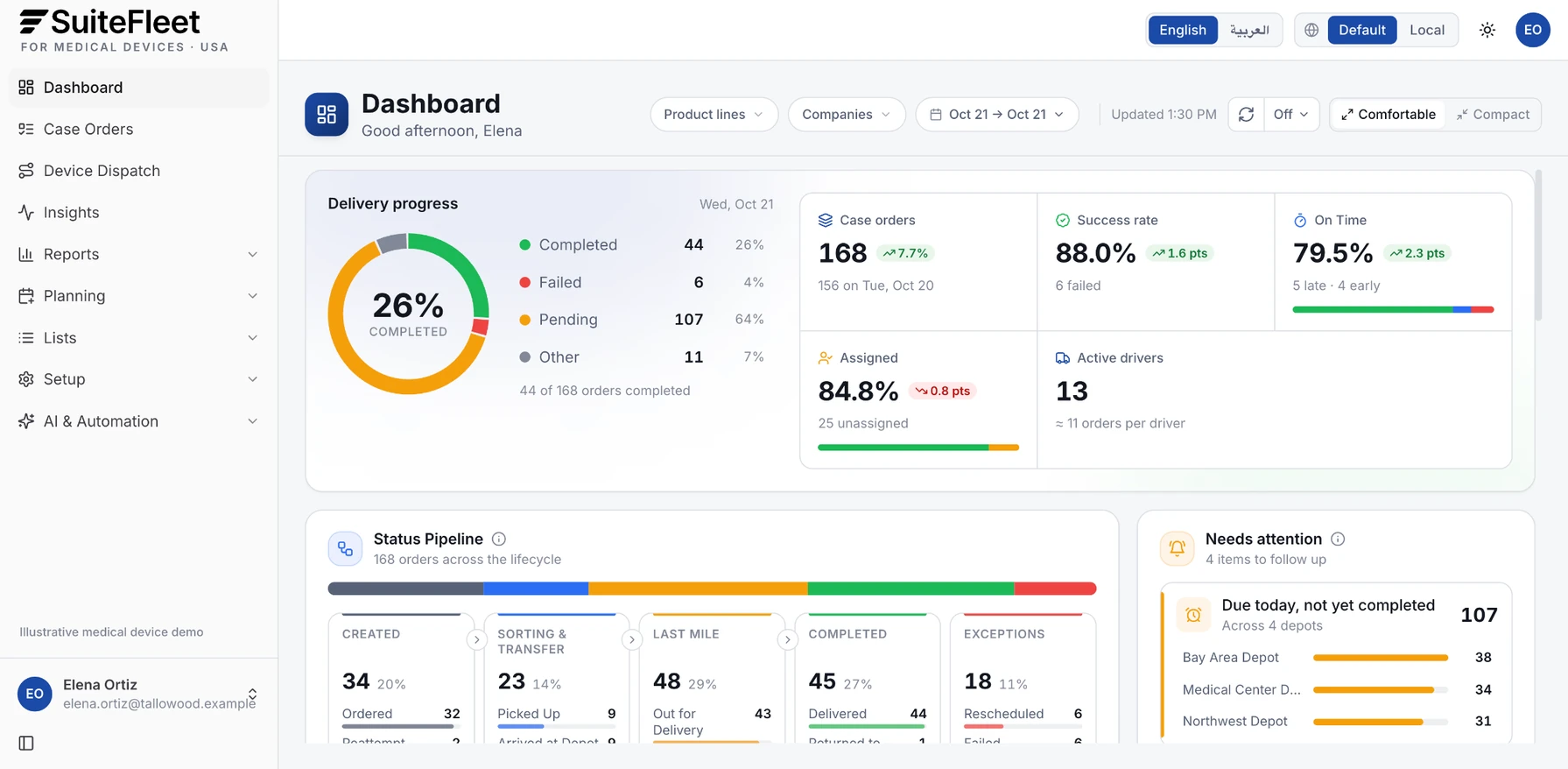
The coordinator starts with the day as a whole. The dashboard shows 168 case orders, 44 completed, 25 still without a driver, and 107 still due across four depots. Most of the open work belongs to the afternoon run.
Good delivery starts when the order is entered. "Deliver to Brayfield" is far less useful than "Sterile Processing, Level B1. STAT add-on: hip fracture case tomorrow at 7:30 AM. SPD will process tonight if the set arrives by 5 PM."
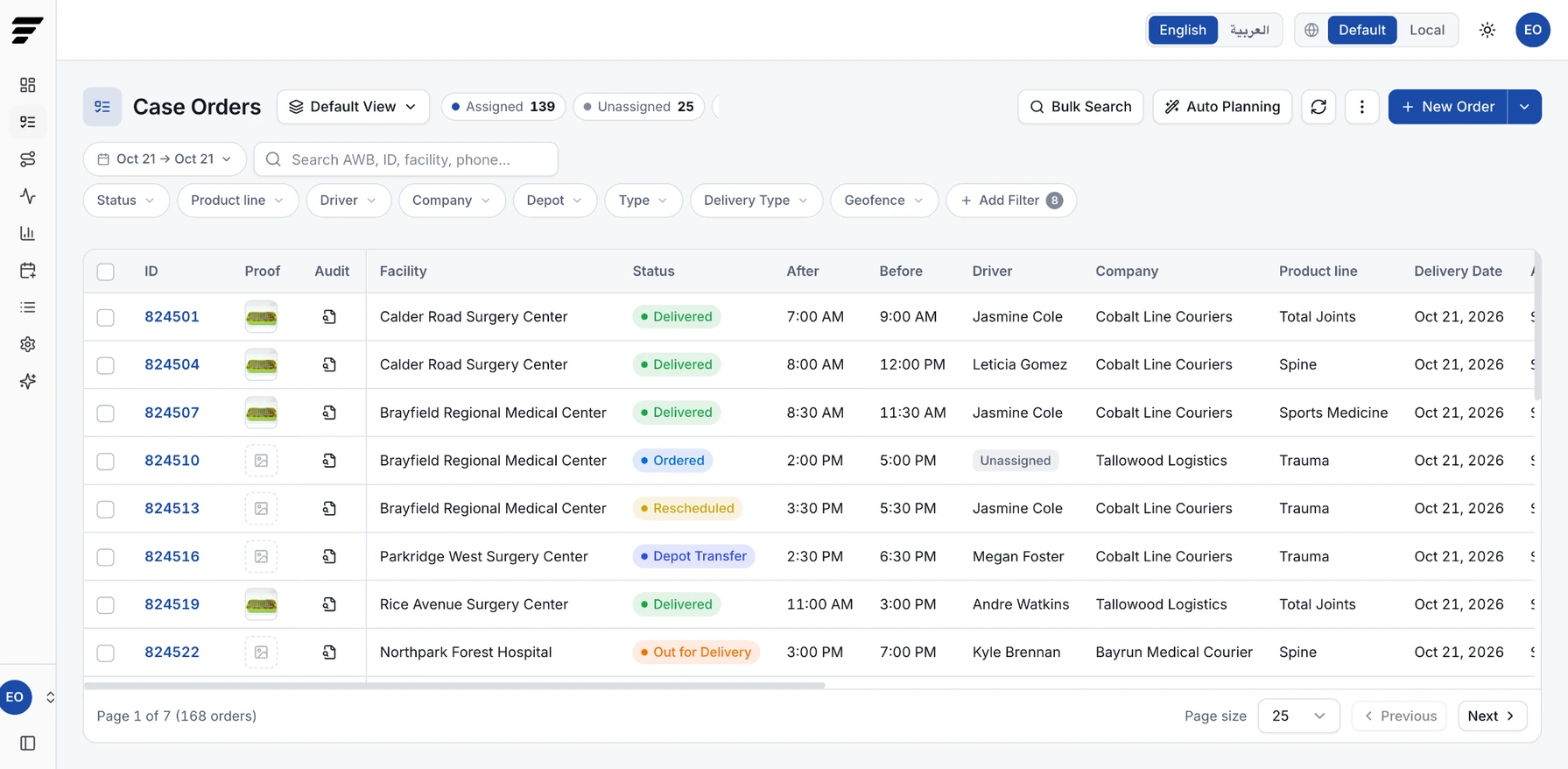
SuiteFleet's order list keeps the facility, status, delivery window, driver, company, and product line in the same view, so the coordinator can see which hospitals are covered and which orders still need a driver. The company column also shows which drivers work for the distributor and which come from courier partners.
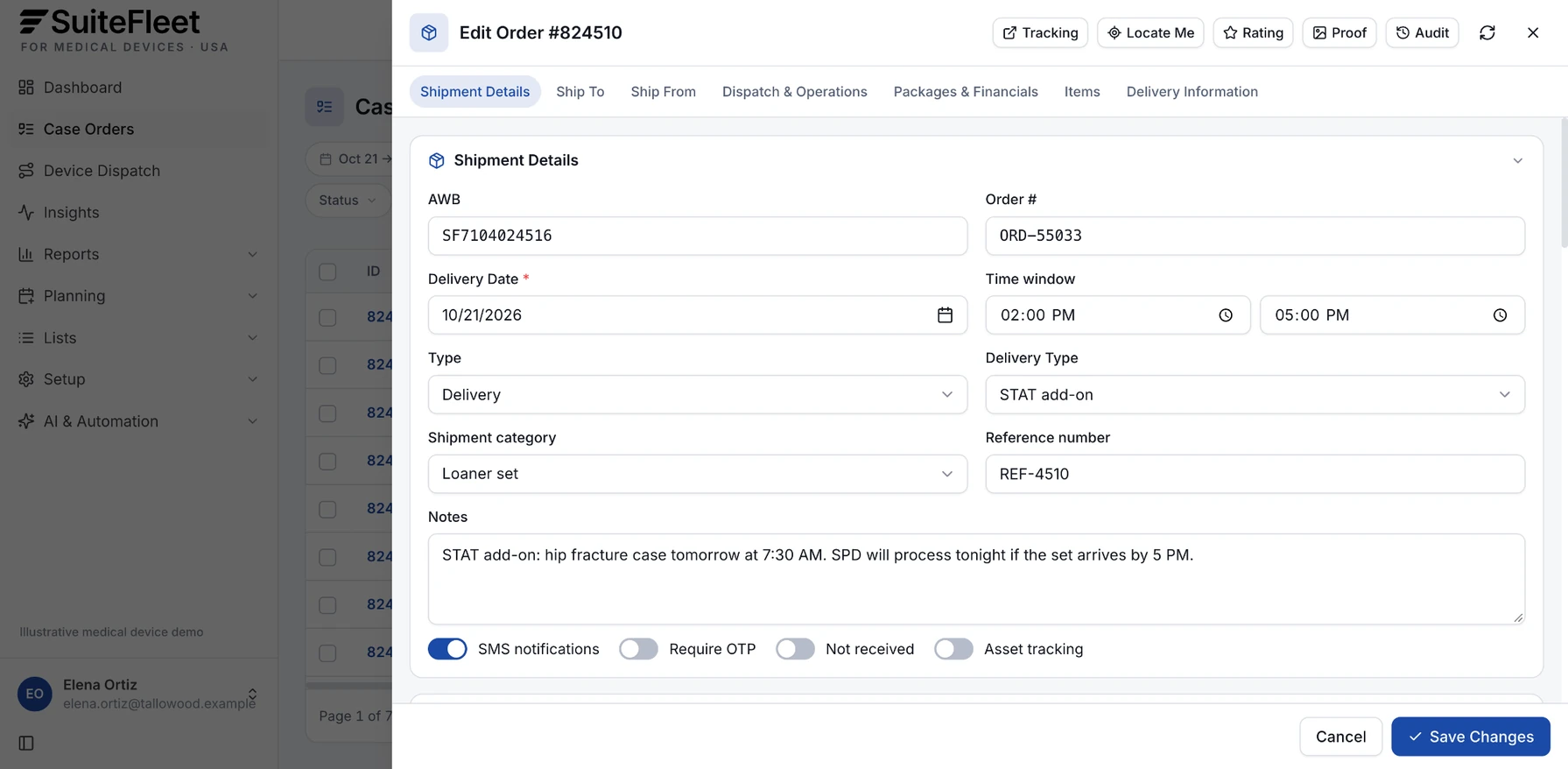
For the STAT add-on, the coordinator opens the details screen. The delivery type is STAT add-on, the window runs from 2:00 to 5:00 p.m., the shipment category is loaner set, and the note says when sterile processing needs it. Notice what the note leaves out: the driver needs the drop-off point and the deadline, not the patient's name.
Plan drop-offs and pickups as one workload
Used sets wait in a holding area until someone collects them, and the clock keeps running. Under the UTMB policy, vendors collect trays within two business days after use, or the hospital ships them back at the company's expense. A pickup deserves the same window, driver, and record as a delivery.
Counting stops per driver also hides the real workload. Fifteen orders over 203 miles is a very different day from four orders over 28 miles. A sterile processing handoff takes time as well: the driver checks in, the trays are weighed and counted against the inventory sheet, and a technician signs.
In SuiteFleet's dispatch workbench, each driver's route appears with its order count, distance, and duration, next to the map. The coordinator can compare workloads before adding anything new.
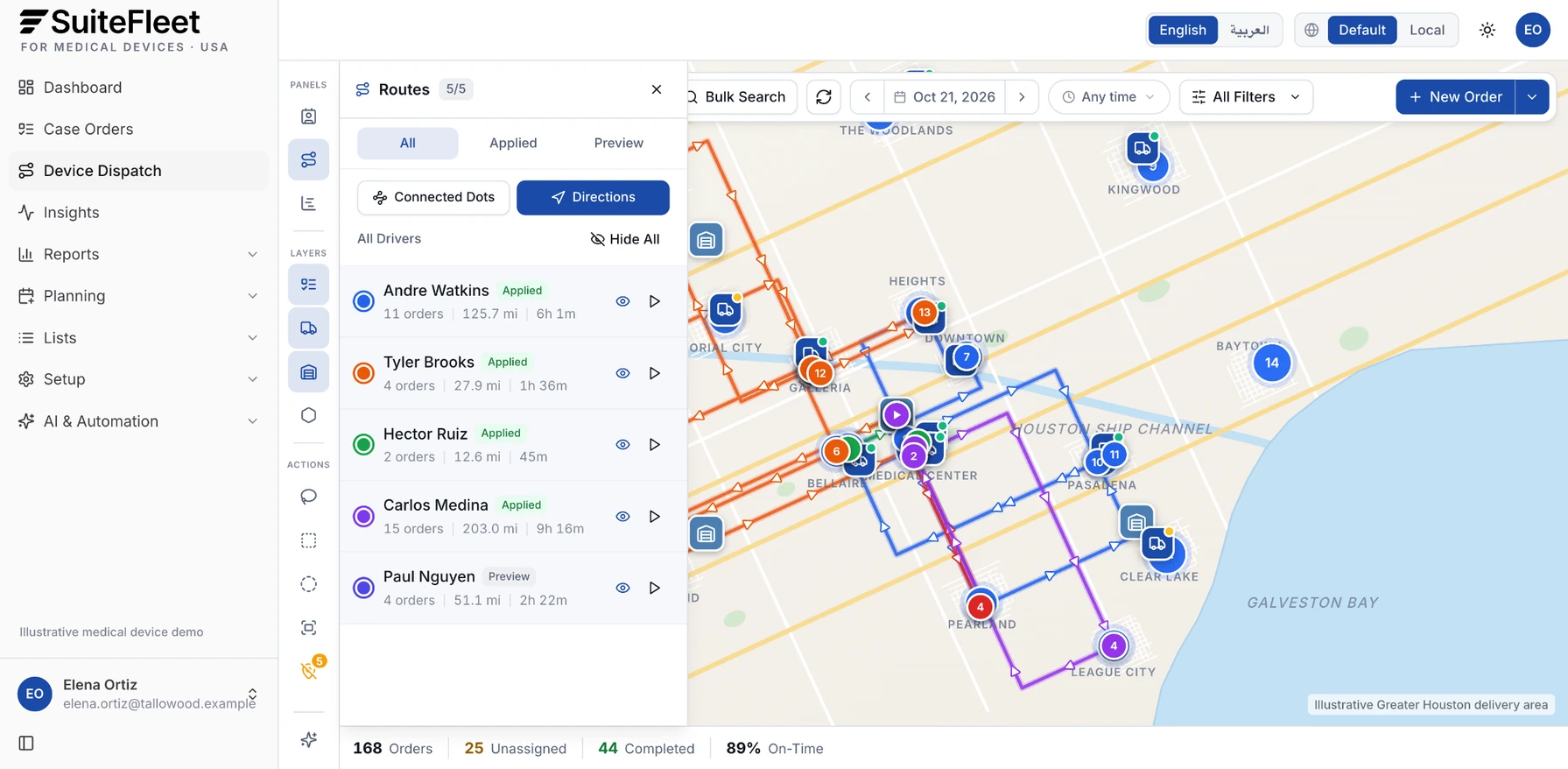
The open afternoon work clusters around the Medical Center depot. The coordinator uses the lasso tool to select orders across the Medical Center, Bellaire, the Galleria, Downtown, and the Heights, including the STAT add-on and the used-set pickup. The selection bar then offers to assign a driver, edit in bulk, or optimize the route.
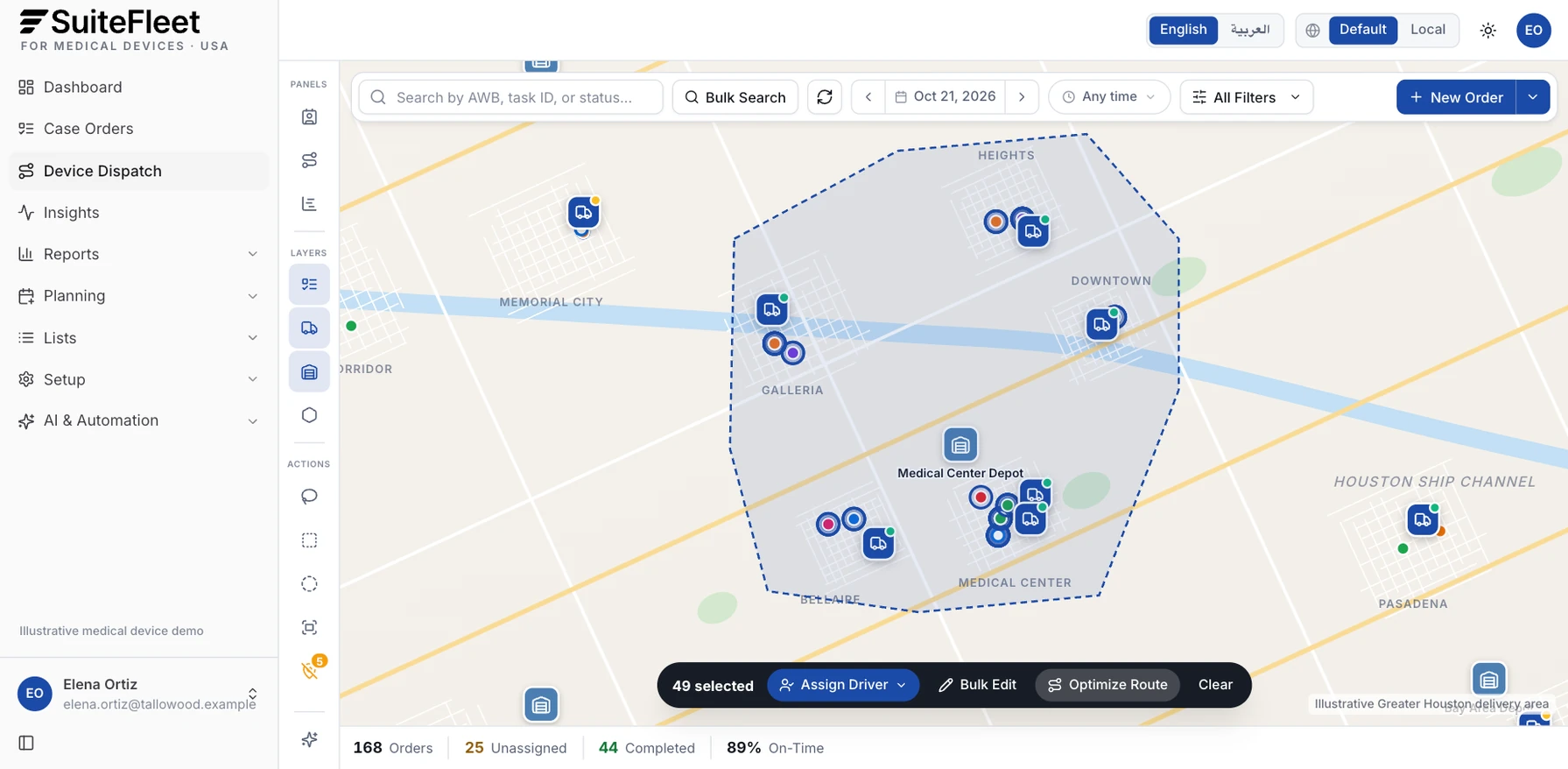
Fit STAT add-ons and pickups into the afternoon run
Of the 49 orders selected, 32 are still open. The optimizer leaves out the ones already delivered, failed, or being processed for return. The coordinator enables the three drivers on the 2:00 to 10:00 p.m. shift from the Medical Center depot: one company driver and two drivers from a courier partner. She leaves Reassign Assigned Orders switched off, so orders already on other drivers' routes stay where they are. The plan covers the 14 orders that are unassigned or already with the three afternoon drivers.
SuiteFleet's optimizer offers four goals: Fastest Completion, Shortest Distance, Fewest Vehicles, and Balanced Workload. The coordinator keeps Fastest Completion, leaves Respect Time Windows switched on, and raises the time per stop from the default 10 minutes to 20, because a sterile processing check-in includes weighing and counting trays.
The results preview shows three routes, 57.3 miles in total, the last stop finished by 5:53 p.m., and no unassigned orders. The STAT set becomes the first stop on a courier driver's route, with an estimated arrival of 2:05 p.m., almost three hours before the 5:00 p.m. cutoff. The used spine set is the first stop on the other courier driver's route, at 2:30 p.m., the moment its pickup window opens.
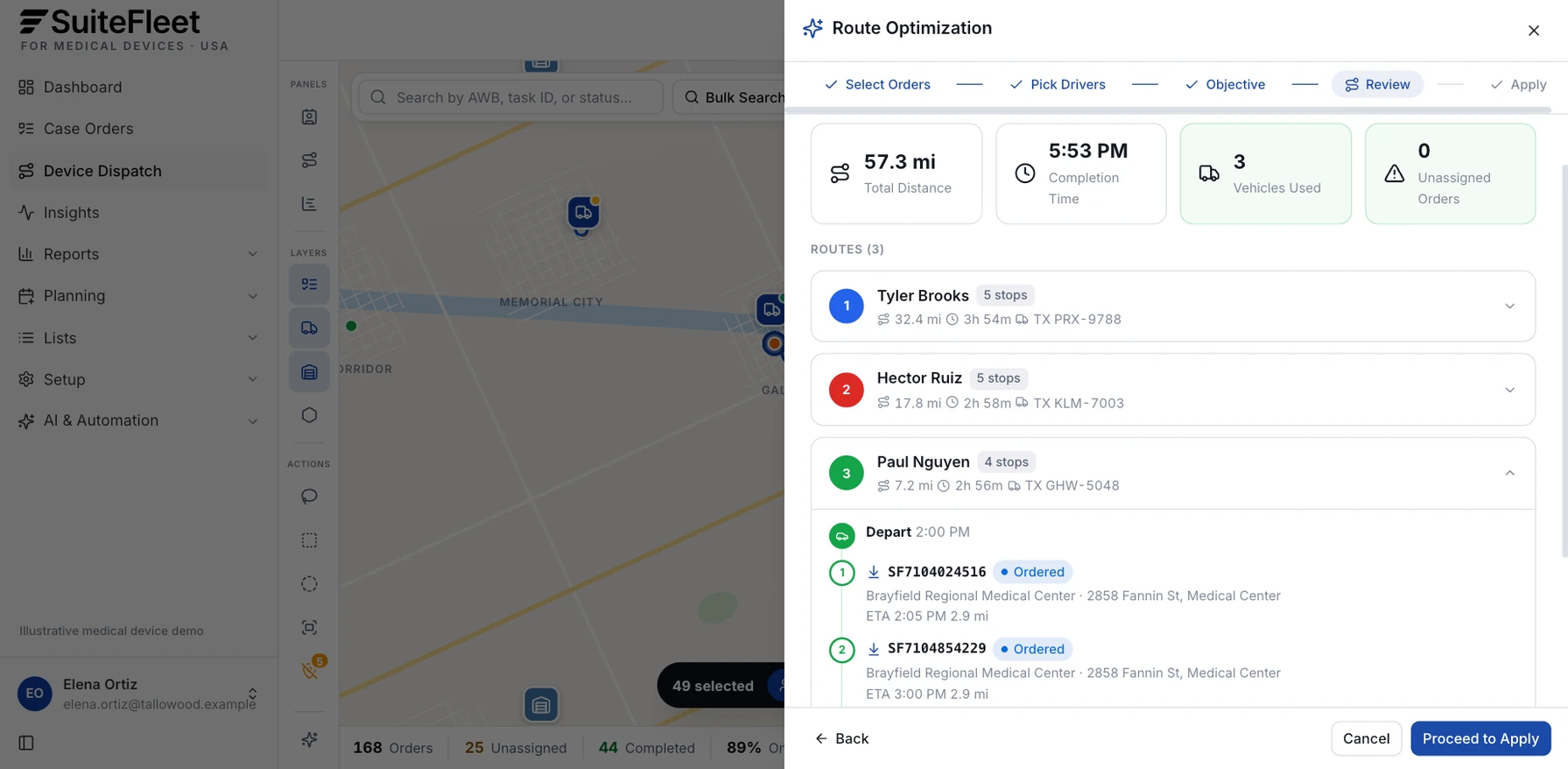
This is the practical value of route planning for surgical sets: a workable decision while there is still time to change it. To see whether it is working, track sets checked in before each hospital's cutoff, time from add-on call to SPD check-in, used sets waiting longer than the hospital allows, and trays reported missing at check-in. The screens show the workflow; your own operating data will show the improvement.
Close the loop with chain-of-custody proof
Hospitals and manufacturers both ask questions after the fact. "Did all four trays arrive?" "Who checked the set in?" The answer should take seconds, not a call to the rep.
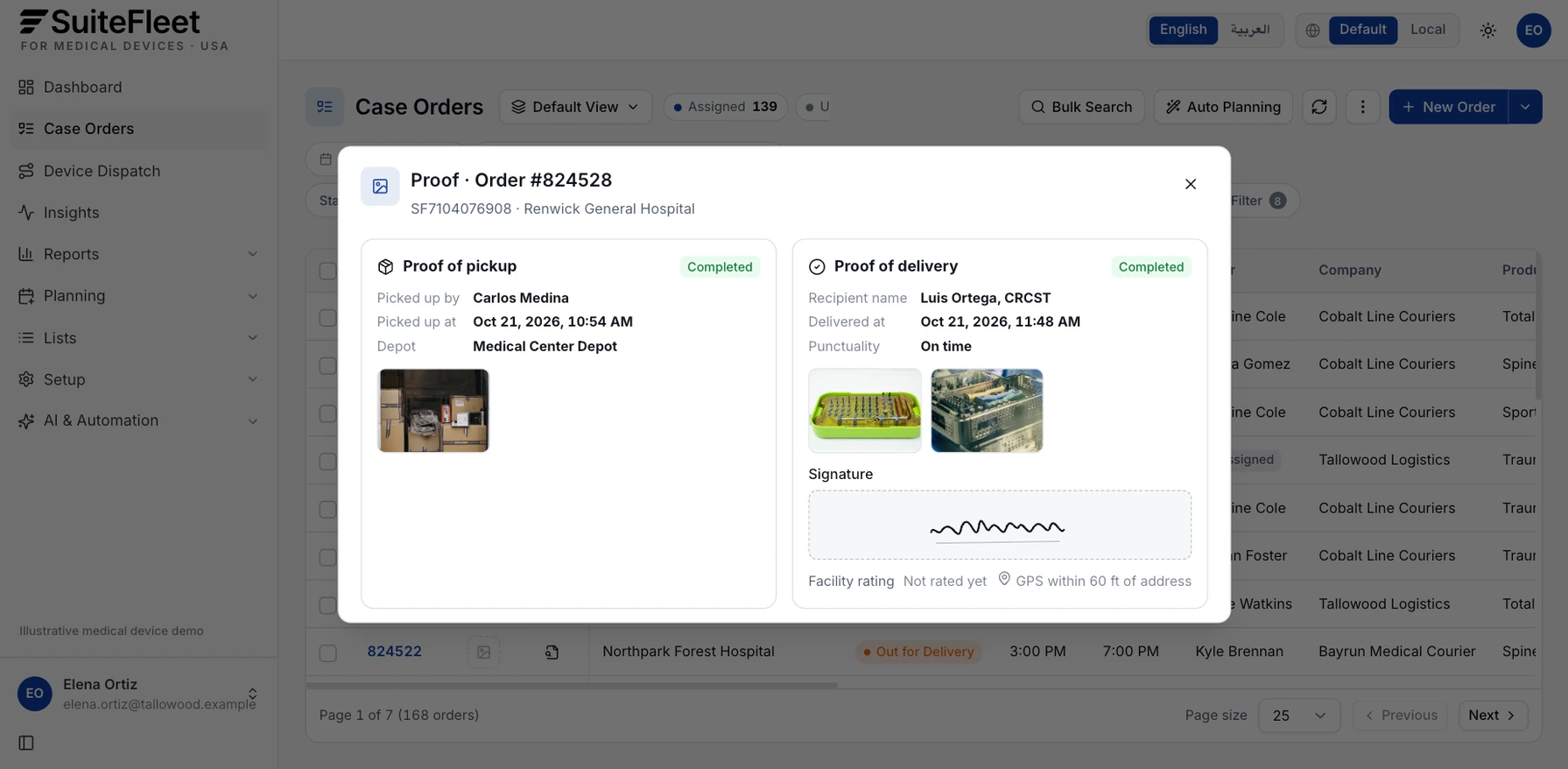
SuiteFleet records proof of pickup and proof of delivery for each order. In the example, the record shows the driver who loaded the set at the Medical Center depot, the sterile processing technician who received it, when it arrived, whether it was on time, delivery photos, a signature, and a GPS check against the hospital address. This driver works for the courier partner, and the record has the same fields a company driver's would.
Connect delivery with your ERP, CRM, and case systems
Your ERP or inventory system should stay the system of record for sets, implants, lot numbers, and billing, and hospitals keep their own case schedules and sterile processing systems. Delivery software should receive only what the delivery needs, without staff typing it twice. NetSuite has a published SuiteFleet connector. Field inventory, supplier network, and hospital systems would need a custom integration through SuiteFleet's API, subject to the access each vendor supports.
SuiteFleet's API supports custom integration work. During setup, map only the fields delivery needs: facility, SPD drop-off point, cutoff, STAT flag, set name, tray count, handling notes, pickup windows, and status updates.
Compare SuiteFleet with five medical device delivery options
Medical device companies can choose a dedicated delivery platform, a logistics platform built for device companies, or the logistics features inside tray tracking and field inventory software. The comparison below places SuiteFleet alongside two general delivery platforms and three device-specific options.
When is your inventory system's logistics enough?
Field inventory and tray tracking platforms already schedule cases and coordinate shipping, so the fair question is why you would add a delivery platform. Often you should not. If most sets ship overnight by parcel carrier or reps carry them to the hospital themselves, and the carrier's tracking and your inventory records satisfy your hospitals, keep shipping inside the system that knows the inventory.
A separate delivery platform earns its place when you run local routes every day. That usually means:
- Company drivers and courier partners cover the same metro, and you want one plan and one proof record for both.
- Add-on cases arrive all afternoon and routes need to be rebuilt around them.
- Pickups of used sets matter as much as drop-offs and need their own windows.
- Several depots or stock rooms share drivers, or one coordinator plans for all of them.
The afternoon in this article is that kind of day: four depots, an add-on trauma case, a used set to collect, and a company driver working next to two courier drivers. SuiteFleet's pharmaceutical delivery page lists medical devices among the items it supports and describes owned, 3PL, and hybrid fleets. A simple test: if your sets travel overnight by parcel carrier, your inventory system may be enough. If rebuilding the afternoon run around add-ons is a daily job, a separate platform is worth evaluating.
Either way, compare the options using the same busy order file, with add-on cases, first-time sets, implant restocks, and used-set pickups, and see how much work still lands on the coordinator.
Keep sets, records, and Texas rules in order
A good route is only part of safe surgical supply. Hospital loaner policies, which reference the AAMI ST79 sterilization standard, decide when sets must arrive and how they are checked in. Besides the lead times and pickup limit above, the UTMB policy asks vendors for a written inventory of every item on the trays, which an SPD technician verifies at receipt, and it weighs trays on delivery against a 25-pound limit.
Because the example distributor is in Texas, its own business also follows the Texas Department of State Health Services rules for device distributors:
- A license for each place of business that distributes devices in Texas, unless an exemption applies.
- Records showing each device's movement in commerce, its holding after movement, and its quantity, shipper, and consignee, kept for at least two years after the device is disposed of.
Federal rules add another layer. Devices carry a unique device identifier that includes production details such as the lot or serial number. For devices that FDA orders tracked, such as certain long-term implants, manufacturers must be able to locate them in distribution quickly, and final distributors pass patient information back to them.
Those records and pickups are delivery work. In the example, the used set becomes a pickup with its own window, the order carries the tray count and handling notes, and the proof record shows who received each set and when. Distributors outside Texas should check their own state's rules, because licensing differs by state.
Software can carry instructions, schedule pickups, and keep a signed, timestamped record, but it does not make a distributor or hospital compliant on its own. Your quality system, inventory records, trained couriers, and the hospital's sterile processing team still do that work.
Plan your next case day
SuiteFleet gives medical device distributors one place to manage case orders, STAT add-ons, driver assignments, routes, pickups, and proof. Test it against your busiest case day. Bring your hospital list and SPD cutoffs, driver shifts, courier partners, and a sample order file, and ask to see the plan, the exceptions, and how a late add-on changes the afternoon.
Book a free SuiteFleet demonstration to see how dispatch planning and route optimization can fit your medical device delivery operation.