A prepared meal company makes a promise that ends at a door: ten chilled meals in a sealed bag, inside a two-hour window, still cold when the customer opens it.
It is 1:20 on a Sunday afternoon in Atlanta. The kitchen's morning wave is finished, with 95 deliveries completed and 8 attempts failed. One of those failures was Olivia Bennett's ten high-protein meals. The gate code at her townhome community had changed, the driver could not get in, and the meals went back to the walk-in cooler. She will be home from 1:30 to 2:30 p.m. In Sandy Springs, 26 member orders need to be in a partner gym's cooler before members start picking up at 4:00 p.m. Three afternoon drivers clock in at 1:30.
Someone has to decide which driver takes each bag, in what order, and how the company will know each meal stayed cold to the door.
That is the job of delivery management for prepared meals. SuiteFleet brings delivery waves, time windows, dispatch planning, route optimization, and proof of pickup and delivery into one workflow, so a meal company can plan each wave around its customers' windows and its kitchen's timetable instead of around whichever driver happens to be free.
Let's follow Renee, the operations manager at a fictional prepared meal company in metro Atlanta with two kitchens, two depots, and a network of gym pickup points, through a worked example. The screens are prepared meal demo illustrations; names, addresses, maps, and figures are examples.
Start with the weekly cutoff, then plan the waves
In prepared meals, the delivery plan starts days before a van leaves. Orders close at a cutoff, the kitchen cooks to the order count, and the meals go out on set delivery days. GoPrep's guide to meal prep software describes the same rhythm: orders are closed at a deadline and then delivered or picked up on scheduled dates. A subscription business repeats that cycle every week with mostly the same customers and windows, plus the skips, pauses, and one-time orders that change each week.
In the example, orders close on Thursday at midnight, the kitchens cook on Friday and Saturday, and Sunday runs in two waves: a morning wave from 8:00 a.m. to noon and an afternoon wave from 2:00 to 6:00 p.m. Each customer picks a window. A two-hour window is a promise about temperature as much as time, because every extra hour a bag rides in a van is an hour the ice packs have to cover.
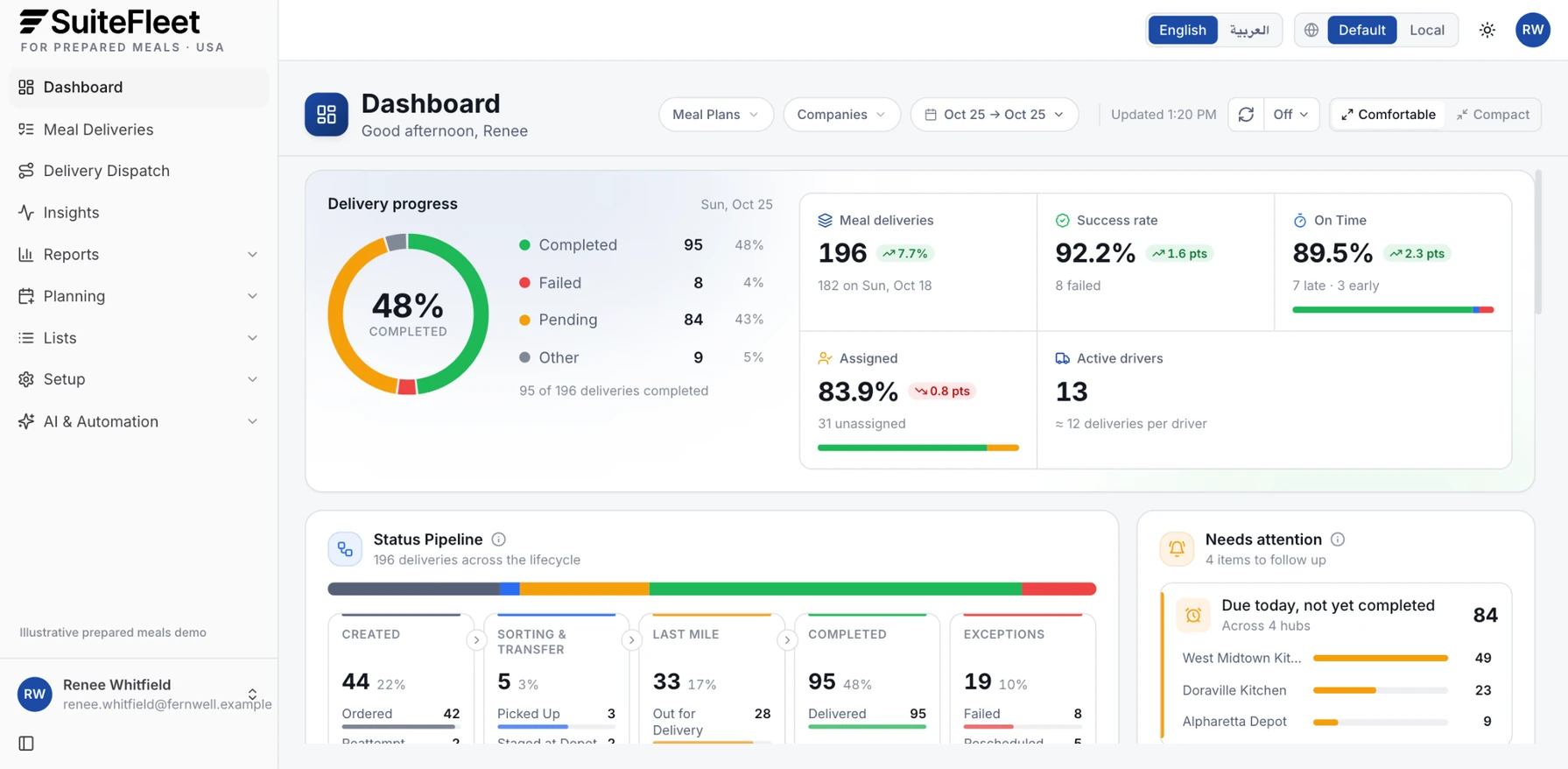
The operations manager starts with the day as a whole. The dashboard shows 196 meal deliveries: 95 completed, 8 failed, and 84 still due across two kitchens and two depots. Because meal volume follows the weekly cycle, the comparison line shows last Sunday rather than yesterday.
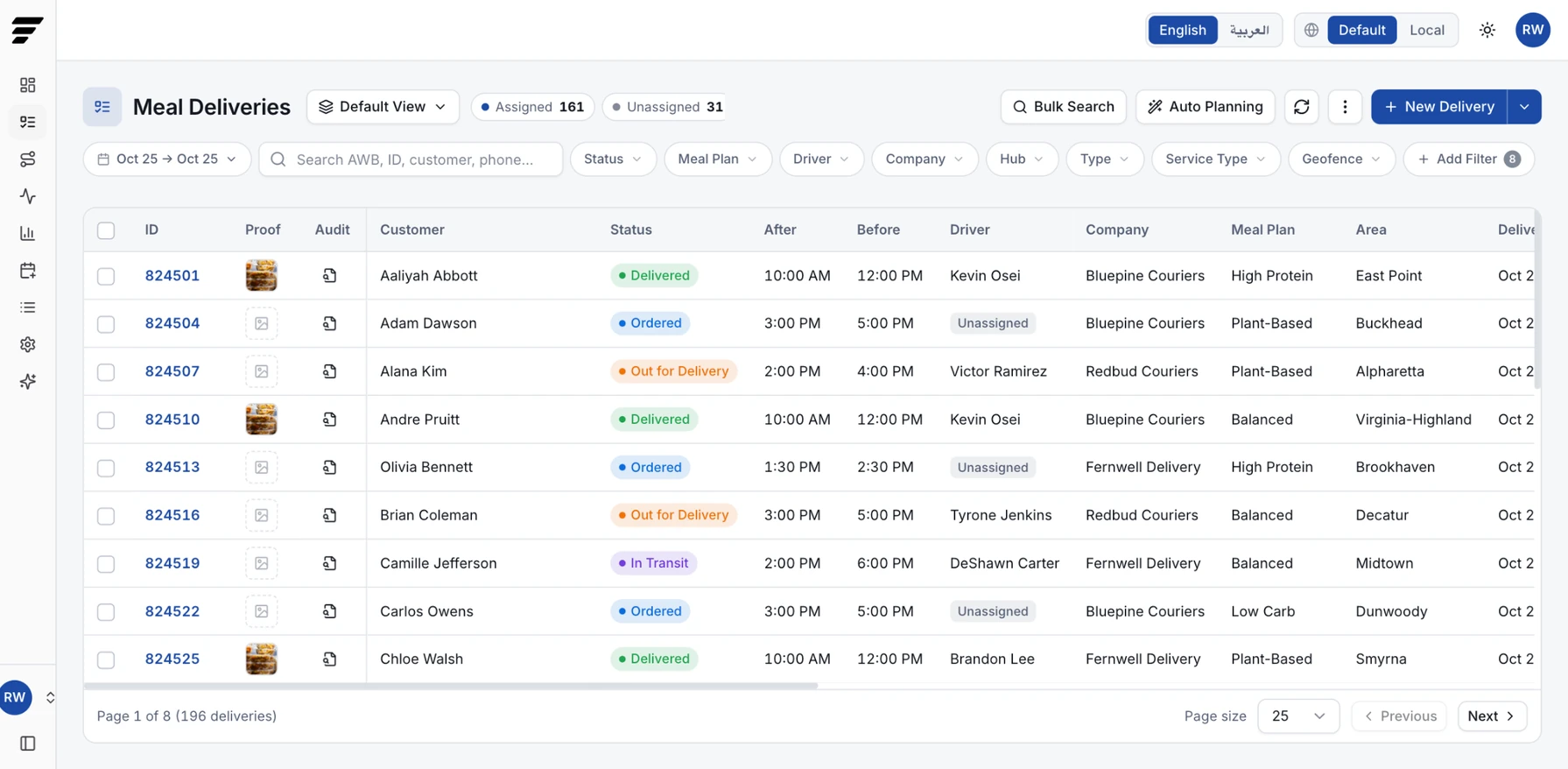
SuiteFleet's delivery list keeps the customer, status, window, driver, courier company, meal plan, and area in the same view. The company column shows which drivers belong to the company's own team and which come from two courier partners. Olivia's redelivery sits near the top, still unassigned, alongside the rest of the afternoon wave that has not been planned yet.
Write the cold chain into every delivery
The details that keep a meal safe are in the handling: chilled or frozen, which bag, how many ice packs, where to leave it, and what to do if no one answers.
For the redelivery, the operations manager opens the details screen. The service type is Redelivery, the window runs from 1:30 to 2:30 p.m., the handling is Chilled, and the note says what happened: the 9:40 a.m. attempt failed at the gate, the meals were back in the walk-in by 10:35 a.m., a probe check read 37°F, and the bag was repacked with fresh ice packs. The new gate code is in the customer profile.
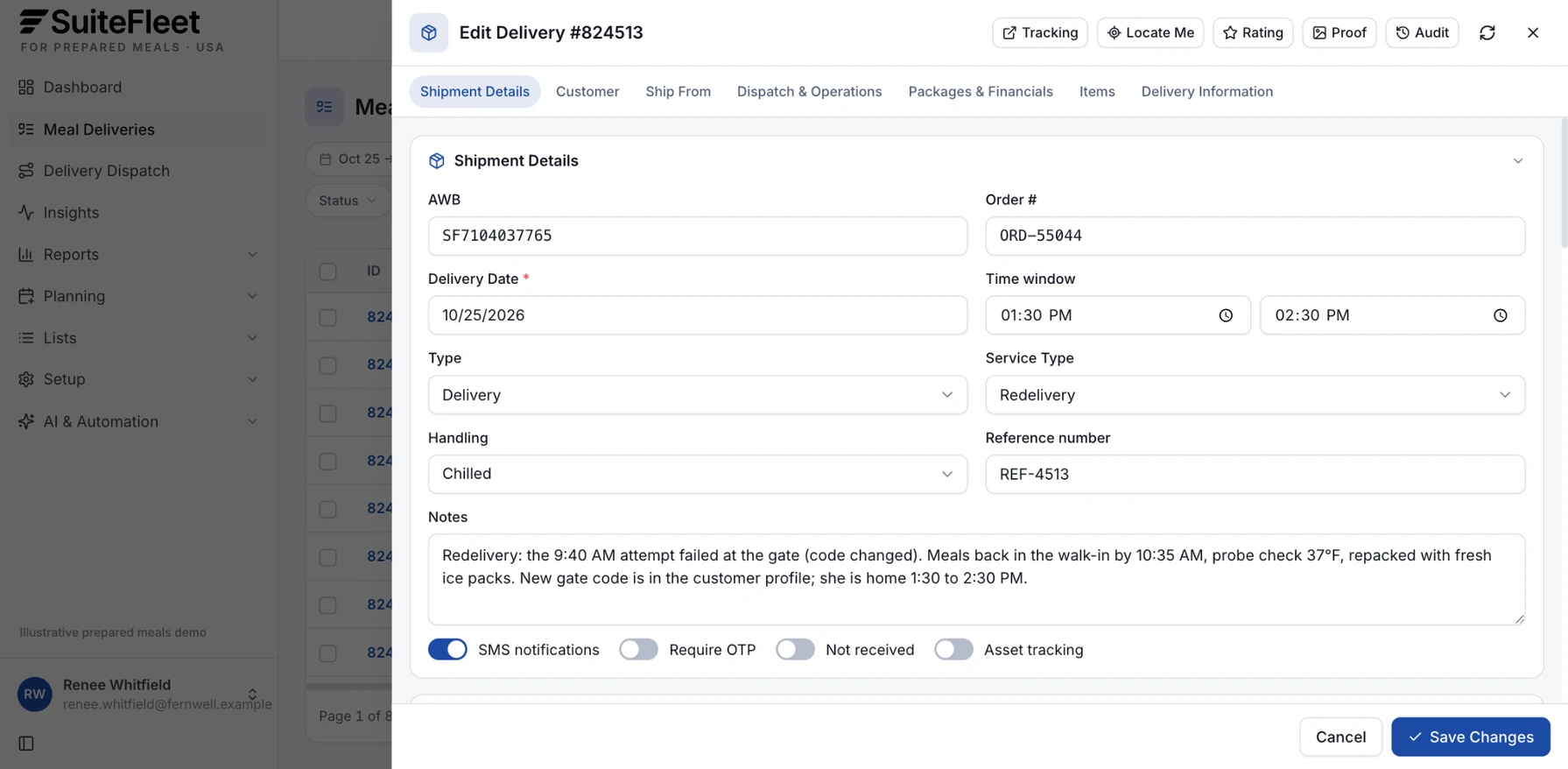
That note reflects a rule the company set before Sunday. In the example, meals from a failed attempt can go out again the same day only if they were back in the walk-in within an hour and probe at 41°F or below; anything else is discarded and credited. Your rule may differ, but write it down, because a failed meal delivery is not just a second trip. It can be a week of meals for one customer.
Every delivery in the example carries a handling type (Chilled, Frozen, Chilled and keep level for family trays and soups, or Bag return for collecting empty insulated bags), its items, and a drop note such as "Leave at the front door, out of direct sun, and take the door photo." Nut-free orders flag the red allergen tag on the bag.
SuiteFleet does not keep food cold; insulated bags, ice packs, and walk-in coolers do that. What it does is put the handling rule on each delivery, so the right instruction reaches the right driver. SuiteFleet's meal planning delivery page also describes cold chain monitoring with temperature threshold alerts, time-in-transit tracking, and delivery exception reporting.
Plan the afternoon wave after the morning wave closes
A plan made at 6:00 a.m. is out of date by early afternoon. The morning tells you which meals came back, which customers moved their window, and which drivers are free, so the afternoon wave is better planned at 1:00 p.m.
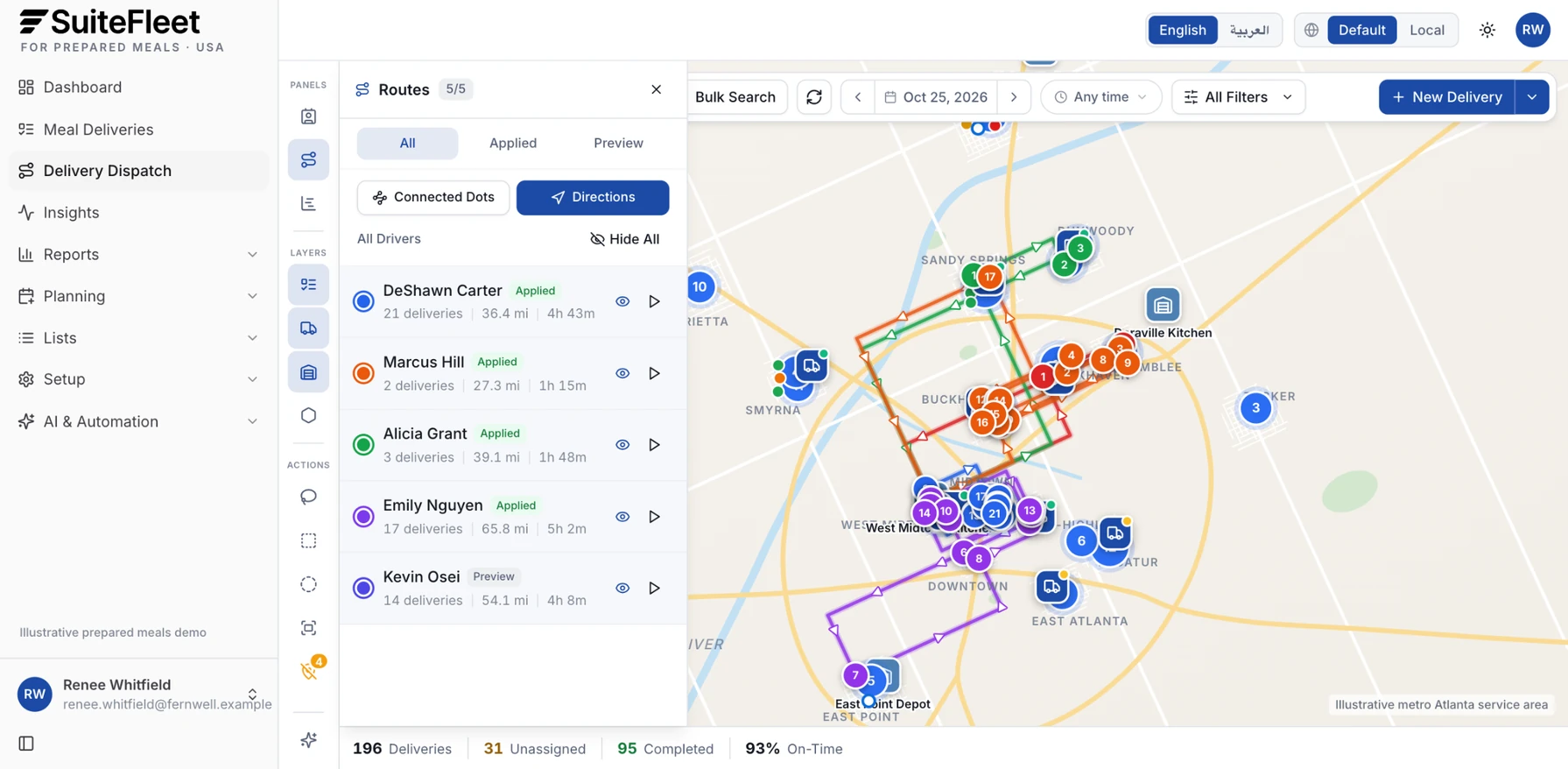
Counting deliveries per driver hides the real workload. In SuiteFleet's dispatch workbench, each driver's route appears with its delivery count, distance, and duration. In the example, one intown driver has 21 deliveries over 36.4 miles, and another has 17 deliveries over 65.8 miles. Those are very different days, and the difference is mostly miles between doors.
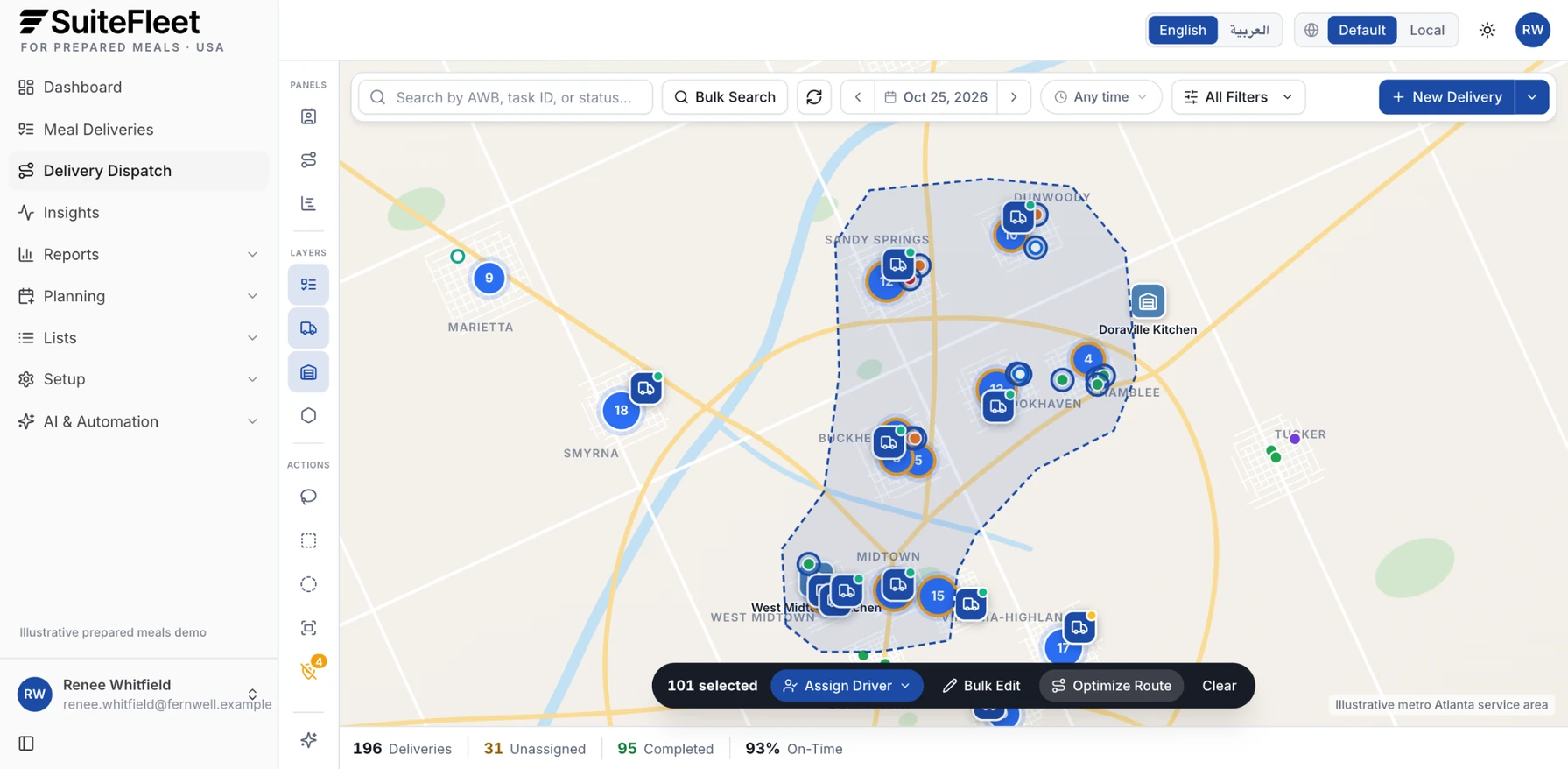
The afternoon wave north of Downtown runs from the West Midtown kitchen up through Midtown, Buckhead, Brookhaven, Chamblee, Sandy Springs, and Dunwoody. The operations manager uses the lasso tool to select those deliveries, including the Brookhaven redelivery and the Sandy Springs pickup point. The selection bar then offers to assign a driver, edit in bulk, or optimize the route.
Put the redelivery first and stock the pickup point early
Of the 101 deliveries selected, 46 can still be planned. The optimizer leaves out the 55 that are already delivered, failed, canceled, or being returned. The operations manager enables the three afternoon drivers who start at the West Midtown kitchen at 1:30 p.m.: one from the company's own delivery team and one each from two courier partners. She leaves Reassign Assigned Stops switched off, so the 15 deliveries already on day-shift drivers' routes stay with those drivers. The plan covers the other 31.
SuiteFleet's optimizer offers four goals: Fastest Completion, Shortest Distance, Fewest Vehicles, and Balanced Workload. The operations manager keeps Fastest Completion, because every bag is on an ice-pack clock. She leaves Respect Time Windows switched on and sets the time per stop to 5 minutes instead of the default 10, because a doorstep drop is quick.
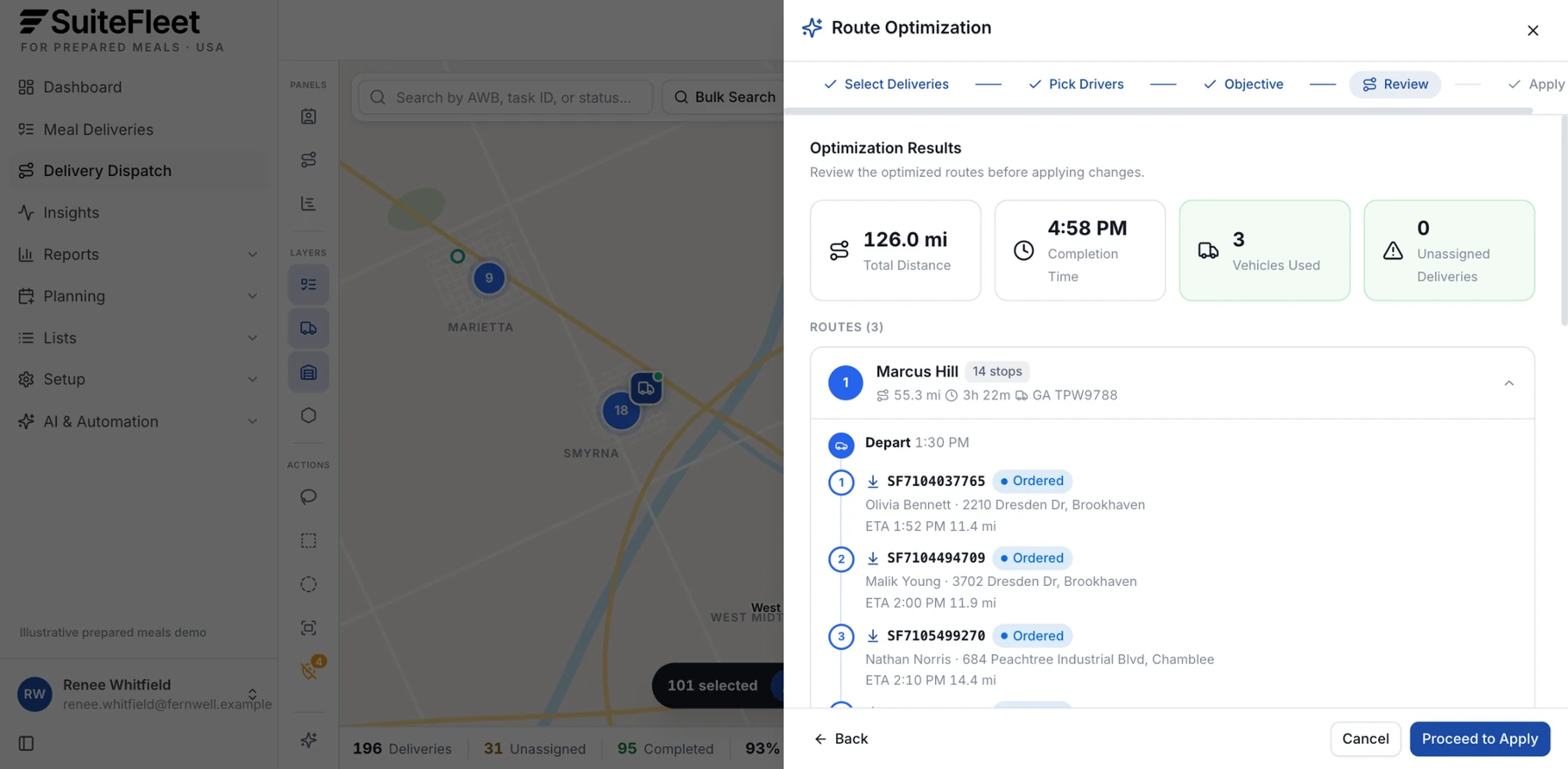
The results preview shows three routes, 126.0 miles in total, every driver back at the kitchen by 4:58 p.m., and no unassigned deliveries. The redelivery is the first stop on the in-house driver's route, with an estimated arrival of 1:52 p.m., inside Olivia's 1:30 to 2:30 p.m. window. Thirteen more Brookhaven, Chamblee, Buckhead, Sandy Springs, and Dunwoody deliveries follow on the same route. The Sandy Springs pickup point is the first stop on a courier partner's route at 2:00 p.m., two hours before members start collecting. The third driver stays intown with nine Midtown and West Midtown deliveries over 11.4 miles.
Once the plan is applied, the route order can become the packing order: stage bags by route and stop number, and load the last stop first. To see whether the waves are working, track deliveries inside the window, first-attempt success, redeliveries, and meals discarded or credited. The screens show the workflow; your own operating data will show the improvement.
Treat the doorstep as the last step of the cold chain
Many failed meal deliveries are not a routing problem. They happen in the last fifty feet: a changed gate code, a building with no access, a porch in full sun, or a customer who asked for a hand-off and is not home. In the example, failed attempts carry reasons such as "No gate or building access" and "No safe place to leave," so the operations manager can fix the customer profile before next Sunday.
Customers can help if they know when to expect the bag. SuiteFleet's meal planning page describes ETA notifications, real-time tracking, and delivery confirmation to help make sure customers are available to receive meals. Decide in advance what a driver does when no one is home. In the example, a subscription bag can be left at the customer's chosen drop spot, out of direct sun, with a door photo, while a hand-off order goes back to the kitchen.
Prove every drop, including the pickup point
Customers and partners ask questions after the fact: "My bag wasn't there," or "Was the gym's cooler cold when you loaded it?" The answer should take seconds, not a call to the driver.
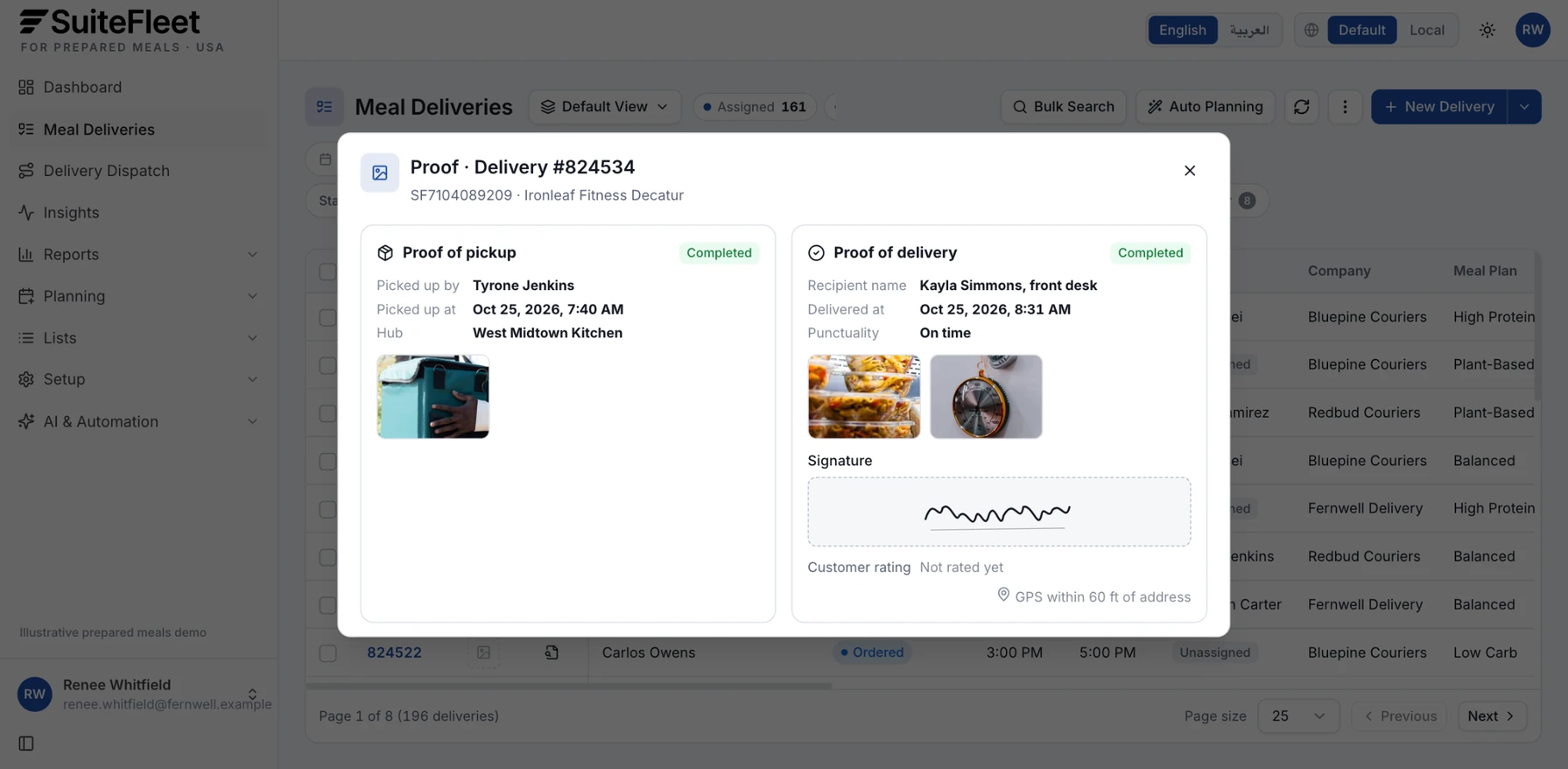
SuiteFleet records proof of pickup and proof of delivery for each stop. In the example, the record for the Decatur pickup point shows the driver who collected the orders at the West Midtown kitchen at 7:40 a.m., the front desk staff member who received them at 8:31 a.m., whether the drop was on time, photos of the loaded shelves and the cooler thermometer, a signature, and a GPS location check. This driver works for a courier partner, and the record has the same fields an in-house driver's would.
A photo of a thermometer records one moment; it is not a monitor. If a pickup point needs a continuous record, use a cooler that logs its own temperature.
Connect delivery with your storefront, subscriptions, and kitchen
Your storefront or subscription platform should stay the record for orders and billing, and your kitchen planning tool the record for production. Delivery software needs only what the driver needs: the customer, address, drop spot, window, handling type, items, and drop note. Shopify and NetSuite have published SuiteFleet connectors. Subscription, meal prep, and kitchen planning systems would need a custom integration through SuiteFleet's API, subject to the access each vendor supports.
SuiteFleet's API supports custom integration work. During setup, pick one source for the delivery day and window, because a subscription app, a delivery-date app, and a meal prep platform may each hold a version of them.
Compare SuiteFleet with five meal delivery options
Meal companies can choose a dedicated delivery platform, a general routing platform, the delivery tools inside their meal prep software, or a delivery service that supplies drivers. The comparison below places SuiteFleet alongside two general platforms and three options built for meal businesses.
When is your meal prep platform's delivery tool enough?
Many meal prep platforms already include a route report or route planner, and some meal companies hand delivery to a service that supplies drivers, so the fair question is why you would add a delivery platform. Often you should not. If you run one kitchen, one delivery day, and a few dozen stops on fixed routes, the route tool in your ordering system may be all you need. If a delivery service meets your windows and sends a photo of every drop, that may be enough too.
A separate delivery platform earns its place when the hard part is coordination rather than the single route. That usually means:
- You run more than one wave a day, and the afternoon has to be rebuilt around what happened in the morning.
- Your own drivers and courier partners deliver from the same kitchens, and you want one plan and one proof record for both.
- Pickup points, redeliveries, and bag returns share routes with doorstep subscriptions.
- You deliver from more than one kitchen or depot, and orders come from more than one storefront or subscription system.
The Sunday in this article is that kind of day: two kitchens, two depots, a morning failure that has to go out again by 2:30 p.m., a gym cooler to stock before 4:00 p.m., and an in-house driver working next to two partner drivers. If your afternoon routes look the same every week, the tool you have may be enough. If rebuilding the afternoon is a weekly scramble, a separate platform is worth evaluating. Either way, compare the options on the same busy Sunday's delivery list and see how much work still lands on the operations manager.
Keep meals at 41°F to the door, and follow Georgia's meal processor guidelines
A good route is only part of a safe meal delivery. The FDA's model Food Code, which state and local food codes are built on, requires time/temperature control for safety food that is held cold to be kept at 41°F (5°C) or less, in section 3-501.16(A)(2). The delivery guidance below uses the same line in its example: a company may require perishable refrigerated products to stay at or below 41°F throughout delivery.
For delivery, the clearest industry guidance comes from the Conference for Food Protection. In December 2022, the FDA, working with USDA and CDC, highlighted the food delivery best practices it released with the conference. The Guidance Document for Direct-to-Consumer and Third-Party Delivery Service Food Delivery asks companies to:
- Identify each product's time and temperature limits, validate the packaging and delivery times that keep food within them, and verify that those controls keep working.
- Use insulated bags or coolers with ice or gel packs when the vehicle does not control temperature, and tamper-evident packaging that drivers do not open.
- Keep customer names and addresses accurate, because delivery delays may affect food safety, and plan how to tell customers about delays.
- Decide what happens when a driver arrives on time but the customer is not there, including whether the food can still be delivered, returned, or discarded.
Because the example company is in Georgia, the state's rules for prepared, packaged meals apply. The Georgia Department of Agriculture's Retail Meal Processor Guidelines cover businesses that sell prepared, packaged meals to the end consumer. Such businesses are licensed and inspected as food sales establishments, and the guidelines say:
- Packaged meals may be sold on site, by delivery after a prior payment, or through a drop-off point for pickup after a prior payment.
- Products must be held at 41°F or below during storage, transport, and storage at the pickup location, and the license holder is responsible for their integrity, security, and temperature until the end consumer takes possession.
- Each meal needs a food-grade container with a secure lid or a sealed package, and meals may be inspected during transport and at pickup locations.
- Cooked and cooled meals must be stored at 41°F and consumed within 7 days.
The second point shapes the pickup point program. In the example, the gym's cooler is part of the company's cold chain, which is why drivers check its thermometer and photograph it on every drop. Meal companies outside Georgia should check their own state and local food codes, because the agency in charge and the delivery rules differ by state.
At the federal level, FDA's Sanitary Transportation rule waives its requirements for permitted food establishments that deliver food directly to consumers, themselves or through a third-party delivery service. For most local meal delivery, that leaves state and local food codes as the main rules.
Software can carry handling rules, plan each bag inside its window, and keep a signed, timestamped record of every drop, but it does not make a meal company compliant on its own. Validated packaging, working walk-ins and coolers, trained drivers, and the company's own food safety plan still do that work.
Plan your next delivery wave
SuiteFleet gives prepared meal companies one place to manage delivery waves, time windows, redeliveries, pickup points, driver assignments, routes, and proof for every drop. Test it against your busiest Sunday. Bring your kitchen and depot locations, order cutoff, delivery windows, driver shifts, courier partners, pickup points, and a sample delivery list, and ask to see the plan, the exceptions, and how a morning failure changes the afternoon wave.
Book a free SuiteFleet demonstration to see how dispatch planning and route optimization can fit your prepared meal delivery operation.